There have been many improvements to the password manager in Firefox and some of them may take a while to be noticed so I thought I would highlight some of the user-facing ones in version 67:
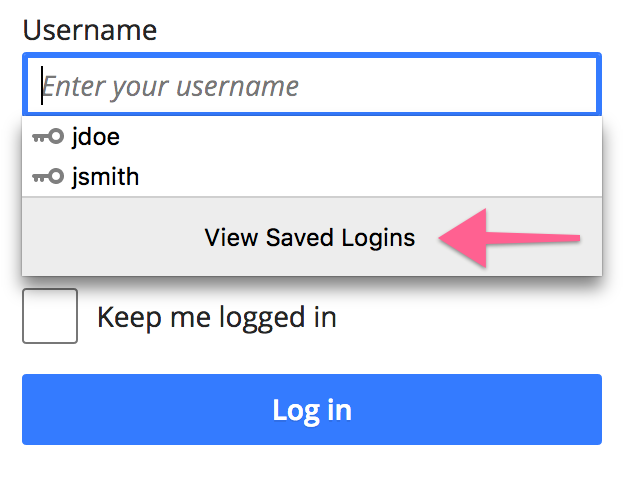
- The login field autocomplete popup has a "View Saved Logins" footer to provide easier access to logins not suggested in the popup itself.
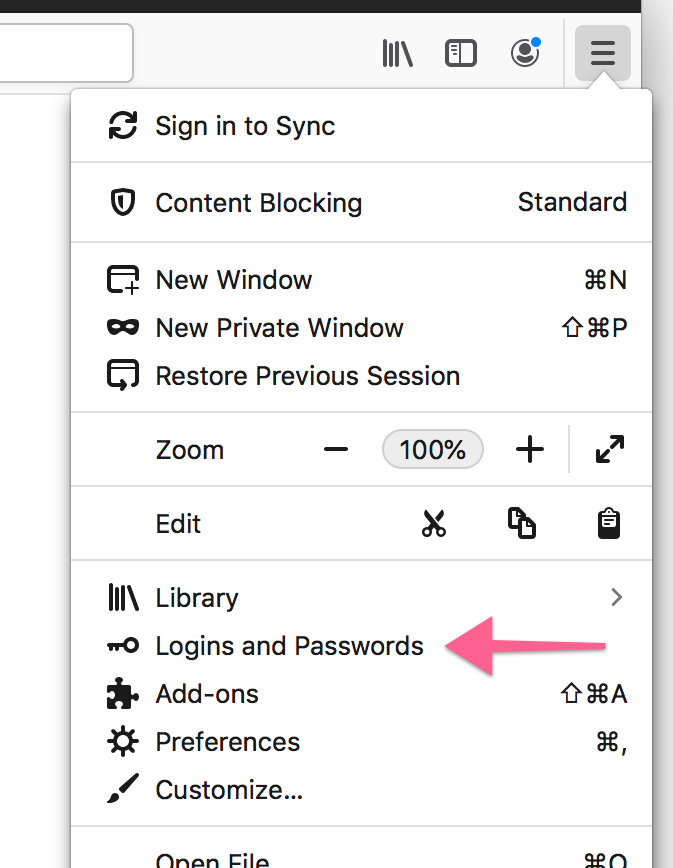
- The main menu has a new "Logins and Passwords" item to more easily access saved logins from any tab.
- Passwords can now be saved in private windows by clicking the key icon to access the save/update prompt after submitting a login form. The prompt won't automatically appear like it does in normal windows. This is handy for when a private window is used to start a new session on a site and the user isn't worried about their visit being recorded on their computer. This is similar to how bookmarking works in private windows.
- Visual feedback is provided when login fields are autofilled. This matches the behaviour for address autofill and it makes more clear when Firefox is the one doing the filling (rather than a cookie, in the case of username fields).
- A new checkbox lets users disable automatically filling saved logins into fields without their interaction. This was previously only accessible via
about:config. - Login autofill on background tabs is delayed until the tab is selected1. This provides some performance and privacy benefits.
- Autocomplete popups now work for first page loaded in a new tab.
- Duplicate prompts to save the same username and password combination for the same page are suppressed.
- Address fields using the
autocompleteattribute are no longer considered as potential username fields. - Password fields using
autocomplete="new-password"will no longer be autofilled with saved logins. They will still be accessible via autocomplete and the context menu though.
Credit for the fixes goes to Jared Wein, Sam Foster, Prathiksha Guruprasad, and myself. The full list of password manager improvements in Firefox 67 can be found on Bugzilla and there are many more to come in Firefox 68 so stay tuned…
- Due to interactions with the Master Password dialog, this change doesn't apply if a Master Password is enabled
https://matthew.noorenberghe.com/blog/2019/05/password-manager-improvements-firefox-67
What comes to your mind when you hear the term ‘online manipulation’? In the run-up to the EU parliamentary elections at the end of May, you probably think first and foremost of disinformation. But what about technical ways to manipulate voters on the internet? Although they are becoming more and more popular because they are so difficult to recognize and therefore particularly successful, they probably don’t come to mind first. Quite simply because they have not received much public attention so far. Firefox tackles this issue today: The ‘Firefox EU Election Toolkit’ not only provides important background knowledge and tips – designed to be easily understood by non-techies – but also tools to enable independent online research and decision-making.
Manipulation on the web: ‘fake news’ isn’t the main issue (anymore)
Few other topics have been so present in public perception in recent years, so comprehensively discussed in everyday life, news and science, and yet have been demystified as little as disinformation. Also commonly referred to as ‘fake news’, it’s defined as “deliberate disinformation or hoaxes spread via traditional print and broadcast news media or online social media.” Right now, so shortly before the next big elections at the end of May, the topic seems to be bubbling up once more: According to the European Commission’s Eurobarometer, 73 percent of Internet users in Europe are concerned about disinformation in the run-up to the EU parliamentary elections.
However, research also proves: The public debate about disinformation takes place in great detail, which significantly increases awareness of the ‘threat’. The fact that more and more initiatives against disinformation and fact-checking actors have been sprouting up for some time now – and that governments are getting involved, too – may be related to the zeitgeist or connected to individuals’ impression that they are constantly confronted with ‘fake news’ and cannot protect themselves on their own.
It’s important to take action against disinformation. Also, users who research the elections and potential candidates on the Internet, for example, should definitely stay critical and cautious. After all, clumsy disinformation campaigns are still taking place, revealing some of the downsides of a global, always available Internet; and they even come with a wide reach and rapid dissemination. Countless actors, including journalists, scientists and other experts now agree that the impact of disinformation is extremely limited and traditional news is still the primary and reliable source of information. This does not, however, mean that the risk of manipulation has gone away; in fact, we must make sure to stay alert and not close our eyes to new, equally problematic forms of manipulation, which have just been less present in the media and science so far. At Firefox we understand that this may require some support – and we’re happy to provide it today.
A toolkit for well-informed voters
Tracking has recently been a topic of discussion in the context of intrusive advertising, big data and GDPR. To refresh your memory: When browsing from site to site, users’ personal information may be collected through scripts or widgets on the websites. They’re called trackers. Many people don’t like that user information collected through trackers is used for advertising, often times without people’s knowledge (find more info here). But there’s another issue a lot less people are aware of and which hasn’t been widely discussed so far: User data can also be used for manipulation attempts, micro-targeted at specific groups or individuals. We believe that this needs to change – and in order to make that happen, more people need to hear about it.
Firefox is committed to an open and free Internet that provides access to independent information to everyone. That’s why we’ve created the ‘Firefox EU Elections Toolkit’: a website where users can find out how tracking and opaque online
Updates – Last Updated: 16:25 EDT May 5 2019
- A Firefox release has been pushed — version 66.0.4 on Desktop and Android, and version 60.6.2 for ESR. This release repairs the certificate chain to re-enable web extensions, themes, search engines, and language packs that had been disabled (Bug 1549061). There are remaining issues that we are actively working to resolve, but we wanted to get this fix out before Monday to lessen the impact of disabled add-ons before the start of the week. More information about the remaining issues can be found by clicking on the links to the release notes above. (May 5, 16:25 EDT)
- Some users are reporting that they do not have the “hotfix-update-xpi-signing-intermediate-bug-1548973” study active in “about:studies”. Rather than using work-arounds, which can lead to issues later on, we strongly recommend that you continue to wait. If it’s possible for you to receive the hotfix, you should get it by 6am EDT, 24 hours after it was first released. For everyone else, we are working to ship a more permanent solution. (May 5, 00:54 EDT)
- There are a number of work-arounds being discussed in the community. These are not recommended as they may conflict with fixes we are deploying. We’ll let you know when further updates are available that we recommend, and appreciate your patience. (May 4, 15:01 EDT)
- Temporarily disabled commenting on this post given volume and duplication. They’ll be re-enabled as more updates become available. (May 4, 13:02 EDT)
- Updated the post to clarify that deleting extensions can result in data loss, and should not be used to attempt a fix. (May 4, 12:58 EDT)
- Clarified that the study may appear in either the Active studies or Completed studies of “about:studies” (May 4, 12:10 EDT)
- We’re aware that some users are reporting that their extensions remain disabled with both studies active. We’re tracking this issue on Bugzilla in bug 1549078. (May 4, 12:03 EDT)
- Clarified that the Studies fix applies only to Desktop users of Firefox distributed by Mozilla. Firefox ESR, Firefox for Android, and some versions of Firefox included with Linux distributions will require separate updates. (May 4, 12:03 EDT)
Late on Friday May 3rd, we became aware of an issue with Firefox that prevented existing and new add-ons from running or being installed. We are very sorry for the inconvenience caused to people who use Firefox.
Our team identified and rolled-out a temporary fix for all Firefox Desktop users on Release, Beta and Nightly. The fix will be automatically applied in the background within 24 hours. No active steps need to be taken to make add-ons work again. In particular, please do not delete and/or re-install any add-ons as an attempt to fix the issue. Deleting an add-on removes any data associated with it, where disabling and re-enabling does not.
Please note: The fix does not apply to Firefox ESR or Firefox for Android. We’re working on releasing a fix for both, and will provide updates here and on social media.
To provide this fix on short notice, we are using the Studies system. This system is enabled by default, and no action is needed unless Studies have been disabled. Firefox users can check if they have Studies enabled by going to:
- Firefox Options/Preferences -> Privacy & Security -> Allow Firefox to install and run studies (scroll down to find the setting)

- Studies can be disabled again after the add-ons have been re-enabled
It may take up to six hours for the Study to be applied to Firefox. To check if the fix has been applied, you can enter “about:studies” in the location bar. If the fix is in the active, you’ll see “hotfix-update-xpi-signing-intermediate-bug-1548973” in either the Active
Tonight's Firefox add-on apocalypse, traced to a mistakenly expired intermediate signing certificate, is currently roiling Firefox users worldwide. It bit me on my Talos II, which really cheesed me off because it tanked all my carefully constructed site containers. (And that's an official Mozilla addon!)
This brief post is just to reassure you that TenFourFox is unaffected -- I disagreed with signature enforcement on add-ons from the beginning and explicitly disabled it.
http://tenfourfox.blogspot.com/2019/05/tenfourfox-not-affected-by-addon.html

“Open” in this context inextricably ties source control to individual agency. The checks and balances of openness in this context are about standards, data formats, and the ability to export or migrate your data away from sites or services that threaten to go bad or go dark. This view has very little to say about – and is often hostile to the idea of – granular access restrictions and the ability to impose them, those being the tools of this worldview’s bad actors.
The blind spots of this worldview are the products of a time where someone on the inside could comfortably pretend that all the other systems that had granted them the freedom to modify this software simply didn’t exist. Those access controls were handled, invisibly, elsewhere; university admission, corporate hiring practices or geography being just a few examples of the many, many barriers between the network and the average person.
And when we’re talking about blind spots and invisible social access controls, of course, what we’re really talking about is privilege.
How many people get to have this, I wonder: the sense that they can sit down in front of a computer and be empowered by it. The feeling of being able, the certainty that you are able to look at a hard problem, think about it, test and iterate; that easy rapid prototyping with familiar tools is right there in your hands, that a toolbox the size of the world is within reach. That this isn’t some child’s wind up toy I turn a crank on until the powerpoint clown pops up.
It’s not a universal or uniform experience, to be sure; they’re machines made of other people’s choices, and computers are gonna computer. But the only reason I get to have that feeling at all is that I got my start when the unix command line was the only decent option around, and I got to put the better part of a decade grooving in that muscle memory on machines and forums where it was safe – for me at least – to be there, fully present, make mistakes and learn from them.
(Big shoutout to everyone out there who found out how bash wildcards work by inadvertently typing mv * in a directory with only two files in it.)
That world doesn’t exist anymore; the internet that birthed it isn’t coming back. But I want everyone to have this feeling, that the machine is more than a glossy appliance. That it’s not a constraint. That with patience and tenacity it can work with you and for you, not just a tool for a task but an extension and expression of ourselves and our intent. That a computer can be a tool for expressing ourselves, for helping us be ourselves better.
Last week I laid out the broad strokes of Mozilla’s requirements for our next synchronous-text platform. They were pretty straightforward, but I want to thank a number of people from different projects who’ve gotten in touch on IRC or email to ask questions and offer their feedback.
Right now I’d like to lay out those requirements in more detail, and talk about some of the reasons behind them. Later I’m going to lay out the process and the options we’re looking at, and how we’re going to gather information, test those options and evaluate what we learn.
While the Rust community is making their own choices now about the best fit for their needs, the Rust community’s processes are going to strongly inform the steps for Mozilla. They’ve learned a lot the hard way about consensus-building and community decision-making, and it’s work that I have both a great deal of respect for and no intention of re-learning the hard way myself. I’ll have more about that shortly as well.
I mentioned our list of requirements last week but I want to drill into some of them here; in particular:
- It needs to be accessible to the greater Mozilla community.
This one implies a lot more than it states, and it would be pretty easy to lay out something trite like “we think holistically about accessibility” the way some organizations say “a diversity of ideas”, as though that means anything at all. But that’s just not good enough.
Diversity, accessibility and community are all tightly interwoven ideas we prize, and how we approach, evaluate and deploy the technologies that connect us speaks deeply to our intentions and values as an organization. Mozilla values
Whether you’re in school or working on a project, knowing how to research is an essential skill. However, understanding how to do something and doing it smarter are two different … Read more
The post How to research smarter, not harder with 10 tools on Firefox. appeared first on The Firefox Frontier.
As part of our ongoing work to make add-ons safer for Firefox users, we are updating our Add-on Policy to help us respond faster to reports of malicious extensions. The following is a summary of the changes, which will go into effect on June 10, 2019.
- We will no longer accept extensions that contain obfuscated code. We will continue to allow minified, concatenated, or otherwise machine-generated code as long as the source code is included. If your extension is using obfuscated code, it is essential to submit a new version by June 10th that removes it to avoid having it rejected or blocked.
We will also be clarifying our blocking process. Add-on or extension blocking (sometimes referred to as “blocklisting”), is a method for disabling extensions or other third-party software that has already been installed by Firefox users.
- We will be blocking extensions more proactively if they are found to be in violation of our policies. We will be casting a wider net, and will err on the side of user security when determining whether or not to block.
- We will continue to block extensions for intentionally violating our policies, critical security vulnerabilities, and will also act on extensions compromising user privacy or circumventing user consent or control.
You can preview the policy and blocking process documents and ensure your extensions abide by them to avoid any disruption. If you have questions about these updated policies or would like to provide feedback, please post to this forum thread.
May 4, 2019 9:09 AM PST update: A certificate expired yesterday and has caused add-ons to stop working or fail to install. This is unrelated to the policy changes. We will be providing updates about the certificate issue in other posts on this blog.
9:55 am PST: Because a lot of comments on this post are related to the certificate issue, we are temporarily turning off comments for this post.
The post Add-on Policy and Process Updates appeared first on Mozilla Add-ons Blog.
https://blog.mozilla.org/addons/2019/05/02/add-on-policy-and-process-updates/
Summary
Socorro is the crash ingestion pipeline for Mozilla's products like Firefox. When Firefox crashes, the crash reporter collects data about the crash, generates a crash report, and submits that report to Socorro. Socorro saves the crash report, processes it, and provides an interface for aggregating, searching, and looking at crash reports.
This blog post summarizes Socorro activities in April.
Read more… (6 min remaining to read)
https://bluesock.org/~willkg/blog/mozilla/socorro_2019_04.html
Introduction
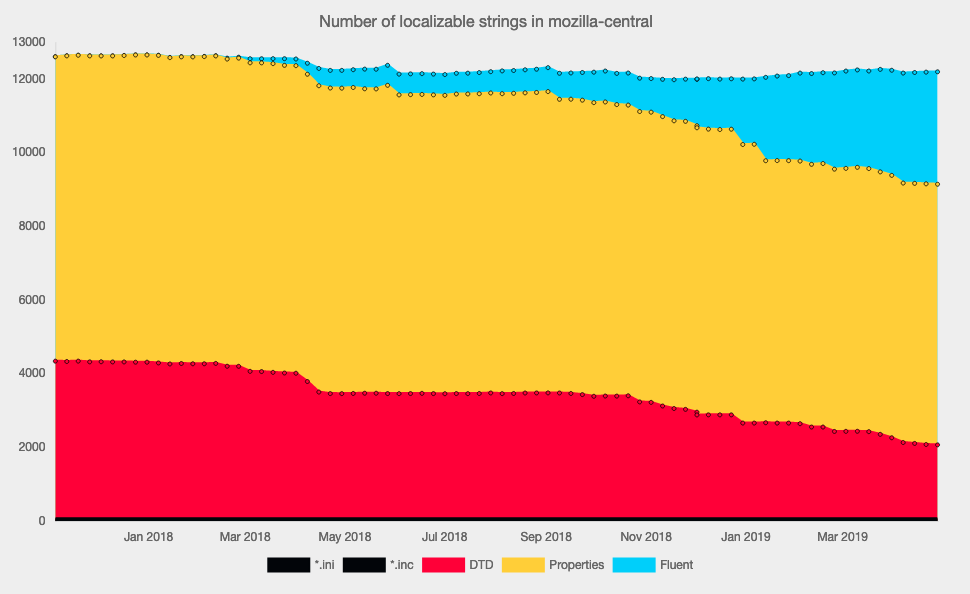
A couple of weeks ago the Localization Team at Mozilla released the Fluent Syntax specification. As mentioned in our announcement, we already have over 3000 Fluent strings in Firefox. You might wonder how we introduced Fluent to a running project. In this post I’ll detail on how the design of Fluent plays into that effort, and how we pulled it off.
Fluent’s Design for Simplicity
Fluent abstracts away the complexities of human languages from programmers. At the same time, Fluent makes easy things easy for localizers, while making complex things possible.
When you migrate a project to Fluent, you build on both of those design principles. You will simplify your code, and move the string choices from your program into the Fluent files. Only then you’ll expose Fluent to localizers to actually take advantage of the capabilities of Fluent, and to perfect the localizations of your project.
Fluent’s Layered Design
When building runtime implementations, we created several layers to tightly own particular tasks.
- Fluent source files are parsed into Resources.
- Multiple resources are aggregated in Bundles, which expose APIs to resolve single strings. Message and Term references resolve inside Bundles, but not necessarily inside Resources. A Bundle is associated with a single language, as well as fallback languages for i18n libraries.
- Language negotiation and language fallback happen in the Localization level. Here you’d implement that someone looking for Frisian would get a Frisian string. If that’s missing or has a runtime problem, you might want to try Dutch, and then English.
- Bindings use the Localization API, and integrate it into the development stack. They marshal data models from the programming language into Fluent data models like strings, numbers, and dates. Declarative bindings also apply the localizations to the rendered UI.
Invest in Bindings
Bindings integrate Fluent into your development workflow. For Firefox, we focused on bindings to generate localized DOM. We also have bindings for React. These bindings determine how fluent Fluent feels to developers, but also how much Fluent can help with handling the localized return values. To give an example, integrating Fluent into Android app development would probably focus on a LayoutInflator. In the bindings we use at Mozilla, we decided to localize as close to the actual display of the strings as possible.
If you have declarative UI generation, you want to look into a declarative binding for Fluent. If your UI is generated programmatically, you want a programmatic binding.
The Localization classes also integrate IO into your application runtime, and making the right choices here has strong impact on performance characteristics. Not just on speed, but also the question of showing untranslated strings shortly.
Migrate your Code
Migrating your code will often be a trivial change from one API to another. Most of your code will get a string and show it, after all. You might convert several different APIs into just one in Fluent, in particular dedicated plural APIs will go away.
You will also move platform-specific terminology into the localization side, removing conditional code. You should also be able to stop stitching several localized strings together in your application logic.
As we’ll go through the process here, I’ll show an example of a sentence with a link. The project wants to be really sure the link isn’t broken, so it’s not exposed to localizers at all. This is shortened from an actual example in Firefox, where we link to our privacy policy. We’ll convert to DOM overlays, to separate localizable and non-localizable aspects of the DOM in Fluent. Let’s just look at the HTML code snippet now, and look at the localizations later.
Before:
After:
Migrate your Localizations
Last but not least, we’ll want to migrate the localizations. While migrating code is work, losing

Pick of the Month: Google Translator for Firefox
by nobzol
Sleek translation tool. Just highlight text, hit the toolbar icon and your translation appears right there on the web page itself. You can translate selected text (up to 1100 characters) or the entire page.
Bonus feature: the context menu presents an option to search your highlighted word or phrase on Wikipedia.
“Sehr einfache Bedienung, korrekte "Ubersetzung aller Texte.”
Featured: Google Container
by Perflyst
Isolate your Google identity into a container. Make it difficult for Google to track your moves around the web.
(NOTE: Though similarly titled to Mozilla’s Facebook Container and Multi-Account Containers, this extension is not affiliated with Mozilla.)
“Thanks a lot for making this. Works great! I’m only sorry I did not find this extension sooner.”
The post May’s featured extensions appeared first on Mozilla Add-ons Blog.
https://blog.mozilla.org/addons/2019/05/01/mays-featured-extensions-2/
What does it mean to “own” an open-source project? With the browser-compat-data project (“BCD”), the MDN (Mozilla Developer Network) community and I recently had the opportunity to find out.
In 2017, the MDN Web Docs team invited me to work on what was described to me as a small, but growing project (previously on Hacks). The little project had a big goal: to provide detailed and reliable structured data about what Web platform features are supported by different browsers. It sounded ambitious, but my part was narrow: convert hand-written HTML compatibility tables on MDN into structured JSON data.
As a technical writer and consultant, it was an unusual project to get to work on. Ordinarily, I look at data and code and use them to write words for people. For BCD, I worked in the opposite direction: reading what people wrote and turning it into structured data for machines. But I think I was most excited at the prospect of working on an open source project with a lot of reach, something I’d never done before.
Plus the project appealed to my sense of order and tidiness. Back then, most of the compatibility tables looked something like this:

In their inconsistent state, they couldn’t be updated in bulk and couldn’t be redesigned without modifying thousands upon thousands of pages on MDN. Instead, we worked to liberate the data in the tables to a structured, validated JSON format that we could publish in an npm package. With this change, new tables could be generated and other projects could use the data too.

Since then, the project has grown considerably. If there was a single inflection point, it was the Hack on MDN event in Paris, where we met in early 2018 to migrate more tables, build new tools, and play with the data. In the last year and a half, we’ve accomplished so many things, including replacing the last of the legacy tables on MDN with shiny, new BCD-derived tables, and seeing our data used in Visual Studio Code.
Building a project to last
We couldn’t have built BCD into what it is now without the help of the hundreds of new contributors that have joined the project. But some challenges have come along with that growth. My duties shifted from copying data into the repository to reviewing others’ contributions, learning about the design of the schema, and hacking on supporting tools. I had to learn so much about being a thoughtful, helpful guide for new and established contributors alike. But the increased size of the project also put new demands on the project as a whole.
Florian Scholz, the project leader, took on answering a question key to the long-term sustainability of the project: how do we make sure that contributors can be more than mere inputs, and can really be part of the project? To answer that question, Florian wrote and helped us adopt a governance document that defines how any contributor—not just MDN staff—can become an owner of the project.
Inspired by the JS Foundation’s Technical Advisory Committee, the
Mozilla uses a lot of Python. Most of our build system, CI configuration, test harnesses, command line tooling and countless other scripts, tools or Github projects are all handled by Python. In mozilla-central there are over 3500 Python files (excluding third party files), comprising roughly 230k lines of code. Additionally there are 462 repositories labelled with Python in the Mozilla org on Github (though many of these are not active). That’s a lot of Python, and most of it is Python 2.
With Python 2’s exaugural year well underway, it is a good time to take stock of the situation and ask some questions. How far along has Mozilla come in the Python 3 migration? Which large work items lie on the critical path? And do we have a plan to get to a good state in time for Python 2’s EOL on January 1st, 2020?

We are excited to announce that we’re working with Valve to bring the immersive web to SteamVR!
This January, we announced that we were bringing the Firefox Reality experience to desktop devices and the Vive stores. Since then, collaborating closely with Valve, we have been working to also bring Firefox Reality to the SteamVR immersive experience. In the coming months, users will be offered a way to install Firefox Reality via a new web dashboard button, and then launch a browser window over any OpenVR experience.
With a few simple clicks, users will be able to access web content such as tips or guides or stream a Twitch comment channel without having to exit their immersive experiences. In addition, users will be able to log into their Firefox account once, and access synced bookmarks and cookies across both Firefox and Firefox Reality — no need to log in twice!
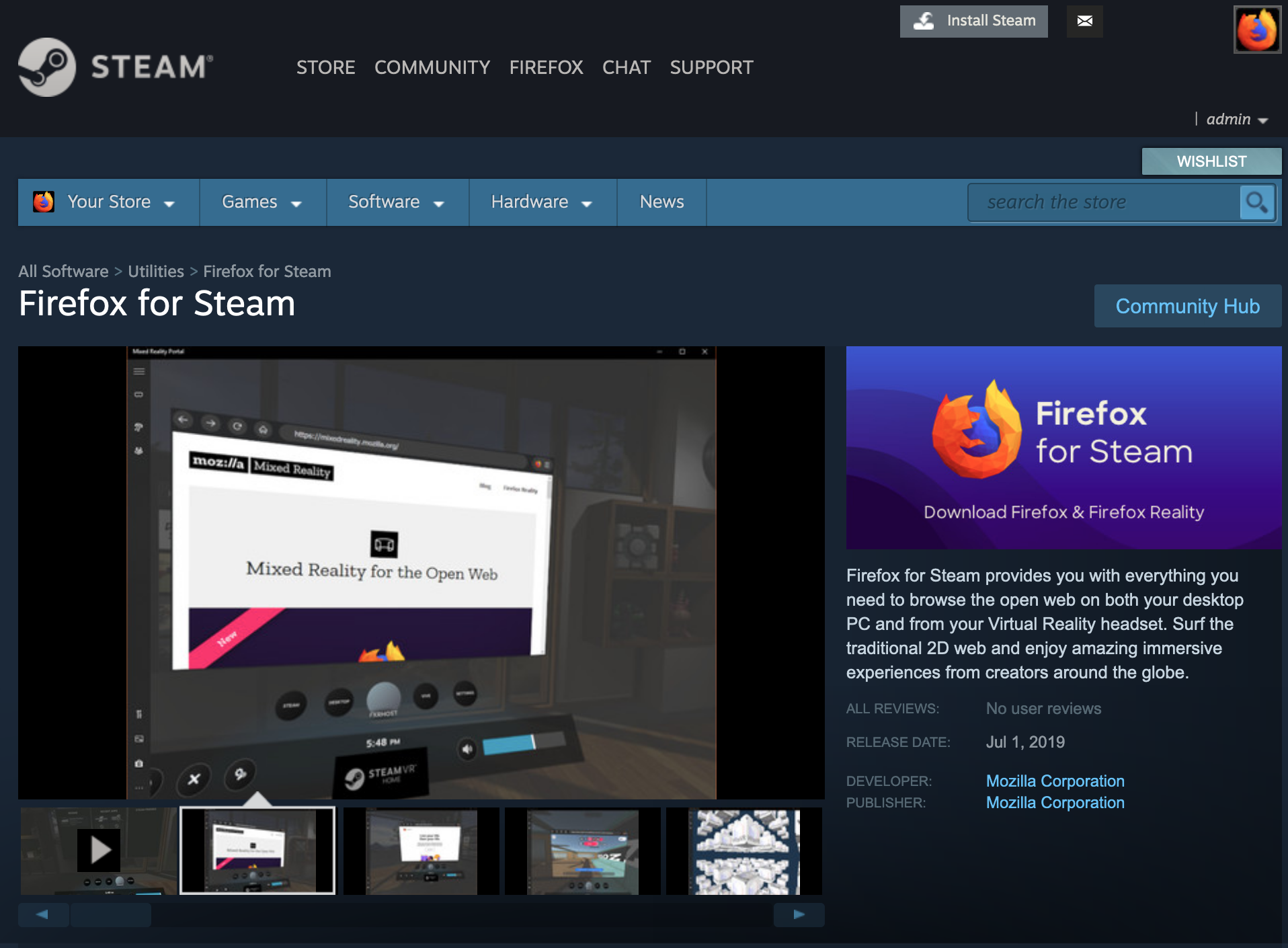
We are excited to collaborate with Valve and release Firefox for SteamVR this summer.
WebRender is a GPU based 2D rendering engine for web written in Rust, currently powering Mozilla’s research web browser servo and on its way to becoming Firefox‘s rendering engine.
WebRender on Linux in Firefox Nightly
Right after the previous newsletter was published, Andrew and Jeff enabled WebRender for Linux users on Intel integrated GPUs with Mesa 18.2 or newer on Nightly if their screen resolution is 3440x1440 or less.
We decided to start with Mesa is thanks to the quality of the drivers. Users with 4k screens will have to wait a little longer though (or enable WebRender manually) as there are a number of specific optimizations we want to do before we are comfortable getting WebRender used on these very high resolution screens. While most recent discreet GPUs can stomach about anything we throw at them, integrated GPUs operate on a much tighter budget and compete with the CPU for memory bandwidth. 4k screens are real little memory bandwidth eating monsters.
WebRender roadmap
Jessie put together a roadmap of the WebRender project and other graphics endeavors from the items discussed in the week in Toronto.
It gives a good idea of the topics that we are focusing on for the coming months.
A week in Toronto – Part deux
In the previous newsletter I went over a number of the topics that we discussed during the graphics team’s last get-together in Toronto. Let’s continue here.
WebRender on Android
We went over a number of the items in WebRender’s Android TODO-list. Getting WebRender to work at all on Android is one thing. A lot of platform-specific low level glue code which Sotaro has been steadily improving lately.
On top of that come mores questions:
- Which portion of the Android user population support the OpenGL features that WebRender relies on?
- Which OpenGL features we could stop relying on to cover more users
- What do we do about the remaining users which have such a small OpenGL feature set available that we don’t plan to get WebRender in the foreseeable future.
Among the features that WebRender currently heavily relies on but are (surprisingly) not universally supported in this day and age:
- texture arrays,
- float 32 textures,
- texture fetches in vertex shaders,
- instancing,
We discussed various workarounds. Some of them will be easy to implement, some harder, some will come at a cost, some we are not sure will provide an acceptable user experience. As it turns out, building a modern rendering engine while also targetting devices that are everything but modern is quite a challenge, who would have thought!
Frame scheduling
Rendering a frame, from a change of layout triggered by some JavaScript to photons flying out of the screen, goes through a long pipeline. Sometimes some steps in that pipeline take longer than we would want but other parts of the pipeline sort of absorb and hide the issue and all is mostly fine. Sometimes, though, slowdowns in particular places with the wrong timing can cause a chain of bad interactions which results a back and forth between a rapid burst of a few frames followed by a couple of missed frames as parts the system oscillate between throttle themselves on and off.
I am describing this in the abstract because the technical description of how and why this can happen in Gecko is complicated. It’s a big topic that impacts the design of a lot of pieces in Firefox’s rendering engine. We talked about this and came up with some short and long term potential improvements.
Intel 4K performance
I mentioned this towards the beginning of this post. Integrated GPUs tend to be more limited in, well in most things, but most importantly in memory bandwidth, which is exacerbated by sharing RAM with the CPU. When high resolution screens don’t fit in the integrated GPU’s dedicated caches, Jeff and Markus made the observation that it can be significantly faster to split the screen into a few large regions and render them one by one. This is at the cost of batch breaks and an increased amount of draw calls, however the restricting rendering to smaller portions of the screen gives the GPU a more cache-friendly workload than rendering the entire screen in a single pass.
This approach is interestingly similar to the way tiled GPUs common on mobile devices work.
On top of that there are some optimizations that we want to
Omidyar Network, Mozilla, Schmidt Futures, and Craig Newmark Philanthropies are announcing the Stage I winners of our Responsible Computer Science Challenge
Today, we are announcing the first winners of the Responsible Computer Science Challenge. We’re awarding $2.4 million to 17 initiatives that integrate ethics into undergraduate computer science courses.
The winners’ proposed curricula are novel: They include in-class role-playing games to explore the impact of technology on society. They embed philosophy experts and social scientists in computer science classes. They feature “red teams” that probe students’ projects for possible negative societal impacts. And they have computer science students partner with local nonprofits and government agencies.
The winners will receive awards of up to $150,000, and they span the following categories: public university, private university, liberal arts college, community college, and Jesuit university. Stage 1 winners are located across 13 states, with computer science programs ranging in size from 87 students to 3,650 students.
The Responsible Computer Science Challenge is an ambitious initiative by Omidyar Network, Mozilla, Schmidt Futures, and Craig Newmark Philanthropies. It aims to integrate ethics and responsibility into undergraduate computer science curricula and pedagogy at U.S. colleges and universities.
Says Kathy Pham, computer scientist and Mozilla Fellow co-leading the Challenge: “Today’s computer scientists write code with the potential to affect billions of people’s privacy, security, equality, and well-being. Technology today can influence what journalism we read and what political discussions we engage with; whether or not we qualify for a mortgage or insurance policy; how results about us come up in an online search; whether we are released on bail or have to stay; and so much more.”
Pham continues: “These 17 winners recognize that power, and take crucial steps to integrate ethics and responsibility into core courses like algorithms, compilers, computer architecture, neural networks, and data structures. Furthermore, they will release their materials and methodology in the open, allowing other individuals and institutions to adapt and use them in their own environment, broadening the reach of the work. By deeply integrating ethics into computer science curricula and sharing the content openly, we can create more responsible technology from the start.”
Says Yoav Schlesinger, principal at Omidyar Network’s Tech and Society Lab co-leading the Challenge: “Revamping training for the next generation of technologists is critical to changing the way tech is built now and into the future. We are impressed with the quality of submissions and even more pleased to see such outstanding proposals awarded funding as part of Stage I of the Responsible Computer Science Challenge. With these financial resources, we are confident that winners will go on to develop exciting, innovative coursework that will not only be implemented at their home institutions, but also scaled to additional colleges and universities across the country.”
Challenge winners are announced in two stages: Stage I (today), for concepts that deeply integrate ethics into existing undergraduate computer science courses, either through syllabi changes or teaching methodology adjustments. Stage I winners receive up to $150,000 each to develop and pilot their ideas. Stage II (summer 2020) supports the spread and scale of the most promising approaches developed in Stage I. In total, the Challenge will award up to $3.5 million in prizes.
The winners announced today were selected by a panel of 19 independent judges from universities, community organizations, and the tech industry. Judges deliberated over the course of three weeks.
(School | Location | Principal Investigator)
Allegheny College | Meadville, PA | Oliver Bonham-Carter
While studying fields like artificial intelligence and data analytics, students will investigate potential ethical and societal challenges. For example: They might interrogate how medical data is analyzed, used, or secured. Lessons will include relevant readings, hands-on activities, and talks
With the release of Firefox 67, we are pleased to welcome the 75 developers who contributed their first code change to Firefox in this release, 66 of whom were brand new volunteers! Please join us in thanking each of these diligent and enthusiastic individuals, and take a look at their contributions:
- aiyemacbain: 1530778
- al.dick: 1528464
- alvaroserero: 1529504
- asfiyab95: 1166355, 1528940
- ialokkumarsingh0: 1492279
- kellykc72: 1530844
- l.khadka: 1515009
- mscs.kim: 1530799
- shruti10gandotra: 1531013
- violet.bugreport: 1072758, 1343357, 1346610, 1413319, 1504072, 1508028, 1528635
- Aaditya Arora: 1525821, 1530612
- Adrian Anderson: 1254242
- Alexandru Ionescu: 1529211, 1529212
- Andrew Erickson: 1519489, 1530546, 1530846, 1531313, 1532434, 1534737
- Andrew L: 1531437
- Anthony Xie: 1530423
- Avery Berninger: 1517510, 1517519
- Bastien Abadie: 1524585, 1527895
- Berkay Barlas: 1151732
- Bisola Omisore: 1463347, 1519313
- Brian Chen: 1517307
- Carolina Jimenez Gomez: 1483626, 1530183
- Chris Frey: 1517493
- Chris Hartjes: 1507235, 1531356
- Dhruvi Butti: 1164195
- Emily Thompson:
(This is a repost of the answer I posted on stackoverflow for this question. This answer immediately became my most ever upvoted answer on stackoverflow with 516 upvotes during the 48 hours it was up before a moderator deleted it for unspecified reasons. It had then already been marked “on hold” for being “primarily opinion- based” and then locked but kept: “exists because it has historical significance”. But apparently that wasn’t good enough. I’ve saved a screenshot of the deletion. Debated on meta.stackoverflow.com)
I’m Daniel Stenberg.
I made curl
I founded the curl project back in 1998, I wrote the initial curl version and I created libcurl. I’ve written more than half of all the 24,000 commits done in the source code repository up to this point in time. I’m still the lead developer of the project. To a large extent, curl is my baby.
I shipped the first version of curl as open source since I wanted to “give back” to the open source world that had given me so much code already. I had used so much open source and I wanted to be as cool as the other open source authors.
Thanks to it being open source, literally thousands of people have been able to help us out over the years and have improved the products, the documentation. the web site and just about every other detail around the project. curl and libcurl would never have become the products that they are today were they not open source. The list of contributors now surpass 1900 names and currently the list grows with a few hundred names per year.
Thanks to curl and libcurl being open source and liberally licensed, they were immediately adopted in numerous products and soon shipped by operating systems and Linux distributions everywhere thus getting a reach beyond imagination.
Thanks to them being “everywhere”, available and liberally licensed they got adopted and used everywhere and by everyone. It created a defacto transfer library standard.
At an estimated six billion installations world wide, we can safely say that curl is the most widely used internet transfer library in the world. It simply would not have gone there had it not been open source. curl runs in billions of mobile phones, a billion Windows 10 installations, in a half a billion games and several hundred million TVs – and more.
Should I have released it with proprietary license instead and charged users for it? It never occured to me, and it wouldn’t have worked because I would never had managed to create this kind of stellar project on my own. And projects and companies wouldn’t have used it.
Why do I still work on curl?
Now, why do I and my fellow curl developers still continue to develop curl and give it away for free to the world?
- I can’t speak for my fellow project team members. We all participate in this for our own reasons.
- I think it’s still the right thing to do. I’m proud of what we’ve accomplished and I truly want to make the world a better place and I think curl does its little part in this.
- There are still bugs to fix and features to add!
- curl is free but my time is not. I still have a job and someone still has to pay someone for me to get paid every month so that I can put food on the table for my family. I charge customers and companies to help them with curl. You too can get my help for a fee, which then indirectly helps making sure that curl continues to evolve, remain free and the kick-ass product it is.
- curl was my spare time project for twenty years before I started working with it full time. I’ve had great jobs and worked on awesome projects. I’ve been in a position of luxury where I could continue to work on curl on my spare time and keep shipping a quality product for free. My work on curl has given me friends, boosted my career and taken me to places I would not have been at otherwise.
- I would not do it differently if I could back and do it again.
Am I proud of what we’ve done?
Yes. So insanely much.
But I’m not satisfied with this and I’m not just leaning back, happy with what we’ve done. I keep working on curl every single day, to improve, to fix bugs, to add features and to make sure curl keeps being the number one file transfer
I've been connected to Mozilla IRC for about 20 years. When I first started hanging out on Mozilla IRC I was a grad student at CMU. It's how I got to know a lot of Mozilla people. I was never an IRC op or power user, but when #mozilla was getting overwhelmed with browser user chat I was the one who created #developers. RIP.
I'll be sad to see it go, but I understand the decision. Technologies have best-before dates. I hope that Mozilla chooses a replacement that sucks less. I hope they don't choose Slack. Slack deliberately treats non-Chrome browsers as second-class — in particular, Slack Calls don't work in Firefox. That's obviously a problem for Mozilla users, and it would send a bad message if Mozilla says that sort of attitude is fine with them.
I look forward to finding out what the new venue is. I hope it will be friendly to non-Mozilla-staff and the community can move over more or less intact.
http://robert.ocallahan.org/2019/04/goodbye-mozilla-irc.html