FPR16 was supposed to reach you in beta sometime tomorrow but I found a reproducible crash in the optimized build, probably due to one of my vain attempts to fix JavaScript bugs. I'm still investigating exactly which change(s) were responsible. We should still make the deadline (September 3) to be concurrent with the 60.9/68.1 ESRs, but there will not be much of a beta testing period and I don't anticipate it being available until probably at least Friday or Saturday. More later.
While you're waiting, read about today's big OpenPOWER announcement. Isn't it about time for a modern PowerPC under your desk?
Hi there! Time for another mozilla graphics newsletter. In the comments section of the previous newsletter, Michael asked about the relation between WebRender and WebGL, I’ll try give a short answer here.
Both WebRender and WebGL need access to the GPU to do their work. At the moment both of them use the OpenGL API, either directly or through ANGLE which emulates OpenGL on top of D3D11. They, however, each work with their own OpenGL context. Frames produced with WebGL are sent to WebRender as texture handles. WebRender, at the API level, has a single entry point for images, video frames, canvases, in short for every grid of pixels in some flavor of RGB format, be them CPU-side buffers or already in GPU memory as is normally the case for WebGL. In order to share textures between separate OpenGL contexts we rely on platform-specific APIs such as EGLImage and DXGI.
Beyond that there isn’t any fancy interaction between WebGL and WebRender. The latter sees the former as a image producer just like 2D canvases, video decoders and plain static images.
What’s new in gfx
Wayland and hidpi improvements on Linux
- Martin Stransky made a proof of concept implementation of DMABuf textures in Gecko’s IPC mechanism. This dmabuf EGL texture backend on Wayland is similar what we have on Android/Mac. Dmabuf buffers can be shared with main/compositor process, can be bound as a render target or texture and can be located at GPU memory. The same dma buf buffer can be also used as hardware overlay when it’s attached to wl_surface/wl_subsurface as wl_buffer.
- Jan Horak fixed a bug that prevented tabs from rendering after restoring a minimized window.
- Jan Horak fixed the window parenting hierarchy with Wayland.
- Jan Horak fixed a bug with hidpi that was causing select popups to render incorrectly after scrolling.
WebGL multiview rendering
WebGL’s multiview rendering extension has been approved by the working group and it’s implementation by Jeff Gilbert will be shipping in Firefox 70.
This extension allows more efficient rendering into multiple viewports, which is most commonly use by VR/AR for rendering both eyes at the same time.
Better high dynamic range support
Jean Yves landed the first part of his HDR work (a set of 14 patches). While we can’t yet output HDR content to HDR screen, this work greatly improved the correctness of the conversion from various HDR formats to low dynamic range sRGB.
You can follow progress on the color space meta bug.
What’s new in WebRender
WebRender is a GPU based 2D rendering engine for web written in Rust, currently powering Firefox‘s rendering engine as well as the research web browser servo.
If you are curious about the state of WebRender on a particular platform, up to date information is available at http://arewewebrenderyet.com
Speaking of which, darkspirit enabled webrender on Nightly for Nvidia+Nouveau drivers linux users in Firefox Nightly.
More filters in WebRender
When We run into a primitive that isn’t supported by WebRender, we make it go through software fallback implementation which can be slow for some things. SVG filters are a good example of primitives that perform much better if implemented on the GPU in WebRender.
Connor Brewster has been working on implementing a number of SVG filters in WebRender:
- Bug 1555483 – Introduce some infrastructure for SVG filters in WebRender and implement the feBlend filter.
- Bug 1178765 – Implement backdrop-filter from the Filter Effects Module Level 2
Roughly a decade ago I read an article that asked antivirus vendors to stop intercepting encrypted HTTPS connections, this practice actively hurting security and privacy. As you can certainly imagine, antivirus vendors agreed with the sensible argument and today no reasonable antivirus product would even consider intercepting HTTPS traffic. Just kidding… Of course they kept going, and so two years ago a study was published detailing the security issues introduced by interception of HTTPS connections. Google and Mozilla once again urged antivirus vendors to stop. Surely this time it worked?
Of course not. So when I decided to look into Kaspersky Internet Security in December last year, I found it breaking up HTTPS connections so that it would get between the server and your browser in order to “protect” you. Expecting some deeply technical details about HTTPS protocol misimplementations now? Don’t worry, I don’t know enough myself to inspect Kaspersky software on this level. The vulnerabilities I found were far more mundane.

I reported eight vulnerabilities to Kaspersky Lab between 2018-12-13 and 2018-12-21. This article will only describe three vulnerabilities which have been fixed in April this year. This includes two vulnerabilities that weren’t deemed a security risk by Kaspersky, it’s up to you to decide whether you agree with this assessment. The remaining five vulnerabilities have only been fixed in July, and I agreed to wait until November with the disclosure to give users enough time to upgrade.
Edit (2019-08-22): In order to disable this functionality you have to go into Settings, select “Additional” on the left side, then click “Network.” There you will see a section called “Encryption connection scanning” where you need to choose “Do not scan encrypted connections.”
{{toc}}
The underappreciated certificate warning pages
There is an important edge case with HTTPS connections: what if a connection is established but the other side uses an invalid certificate? Current browsers will generally show you a certificate warning page in this scenario. In Firefox it looks like this:

This page has seen a surprising amount of changes over the years. The browser vendors recognized that asking users to make a decision isn’t a good idea here. Most of the time, getting out is the best course of action, and ignoring the warning only a viable option for very technical users. So the text here is very clear, low on technical details, and the recommended solution is highlighted. The option to ignore the warning is well-hidden on the other hand, to prevent people from using it without understanding the implications. While the page looks different in other browsers, the main design considerations are the same.
But with Kaspersky Internet Security in the middle, the browser is no longer talking to the server, Kaspersky is. The way HTTPS is designed, it means that Kaspersky is responsible for validating the server’s certificate and producing a certificate warning page. And that’s what the certificate warning page looks like then:

There is a considerable amount of technical details here, supposedly to allow users to make an informed decision, but usually confusing them instead. Oh, and why does it list the URL as “www.example.org”? That’s not what I typed into the address bar, it’s actually what this site claims to be (the name has been extracted from the site’s invalid certificate). That’s a tiny security issue here, wasn’t worth reporting however as this only affects sites accessed by IP address which should never be the case with HTTPS.
The bigger issue: what is the user supposed to do here? There is “leave this website” in the text, but experience shows that people usually won’t read when hitting a roadblock like this. And the highlighted action here is “I understand the risks and wish to continue” which is what most users can be expected to hit.
Using clickjacking to override certificate warnings
Let’s say that we hijacked some user’s web traffic, e.g. by tricking them into connecting to our malicious WiFi hotspot. Now we want to do something evil with
What is it with these people? Why can't things that are working be allowed to still go on working? (Blah blah insecure blah blah unused blah blah maintenance blah blah web everything.)
This leaves an interesting situation where Google has, in its very own search index, HTML pages served by FTP its own browser won't be able to view:

At the top of the search results, even!
Obviously those FTP HTML pages load just fine in mainline Firefox, at least as of this writing, and of course TenFourFox. (UPDATE: This won't work in Firefox either after Fx70, though FTP in general will still be accessible. Note that it references Chrome's announcements; as usual, these kinds of distributed firing squads tend to be self-reinforcing.)
Is it a little ridiculous to serve pages that way? Okay, I'll buy that. But it works fine and wasn't bothering anyone, and they must have some relevance to be accessible because Google even indexed them.
Why is everything old suddenly so bad?
http://tenfourfox.blogspot.com/2019/08/chrome-murders-ftp-like-jeffrey-epstein.html
At the beginning of IndieWeb Summit 2019, I gave a brief talk on State of the IndieWeb and mentioned that:
We've scheduled lots of IndieWebCamps this year and are on track to schedule a record number of different cities as well.
I had conceived of a graphical representation of the growth of IndieWebCamps over the past nine years, both in number and across the world, but with everything else involved with setting up and running the Summit, ran out of time. However, the idea persisted, and finally this past week, with a little help from Aaron Parecki re-implementing Dopplr’s algorithm for turning city names into colors, was able to put togther something pretty close to what I’d envisioned:
| Istanbul | |||||||||
|---|---|---|---|---|---|---|---|---|---|
| Amsterdam | |||||||||
| Utrecht | |||||||||
| N"urnberg | |||||||||
| D"usseldorf | |||||||||
| Berlin | |||||||||
| Edinburgh | |||||||||
| Oxford | |||||||||
| Brighton | |||||||||
It has long been recognized by the security industry that complex systems are impossible to secure, and that pushing for simplicity helps increase trust by reducing assumptions and increasing our ability to audit. This is often captured under the acronym KISS, for "keep it stupid simple", a design principlepopularized by the US Navy back in the 60s. For a long time, we thought the enemy were application monoliths that burden our infrastructure with years of unpatched vulnerabilities.
So we split them up. We took them apart. We created micro-services where each function, each logical component, is its own individual service, designed, developed, operated and monitored in complete isolation from the rest of the infrastructure. And we composed them ad vitam aeternam. Want to send an email? Call the rest API of micro-service X. Want to run a batch job? Invoke lambda function Y. Want to update a database entry? Post it to A which sends an event to B consumed by C stored in D transformed by E and inserted by F. We all love micro-services architecture. It’s like watching dominoes fall down. When it works, it’s visceral. It’s when it doesn’t that things get interesting. After nearly a decade of operating them, let me share some downsides and caveats encountered in large-scale production environments.
High operational cost
The first problem is operational cost. Even in a devops cloud automated world, each micro-service, serverless or not, needs setup, maintenance and deployment. We never fully got to the holy grail of completely automated everything, so humans are still involved with these things. Perhaps someone sold you on the idea devs could do the ops work on their free time, but let’s face it, that’s a lie, and you need dedicated teams of specialists to run the stuff the right way. And those folks don’t come cheap.
The more services you have, the harder it is to keep up with them. First you’ll start noticing delays in getting new services deployed. A week. Two weeks. A month. What do you mean you need a three months notice to get a new service setup?
Then, it’s the deployments that start to take time. And as a result, services that don’t absolutely need to be deployed, well, aren’t. Soon they’ll become outdated, vulnerable, running on the old version of everything and deploying a new version means a week worth of work to get it back to the current standard.
Ever wonder if that leaky pipe you fixed is holding up? With a trip to the hardware store and a Mozilla WebThings Gateway you can set up a cheap leak sensor to keep an eye on the situation, whether you’re home or away. Although you can look up detector status easily on the web-based dashboard, it would be better to not need to pay attention unless a leak actually occurs. In the WebThings Gateway 0.9 release, a number of different notification mechanisms can be set up, including emails, apps, and text messages.
Leak Sensor Demo
In this post I’ll show you how to set up gateway notifications to warn you of changes in your home that you care about. You can set each notification to one of three levels of severity–low, normal, and high–so that you can identify which are informational changes and which alerts should be addressed immediately (fire! intruder! leak!). First, we’ll choose a device to worry about. Next, we’ll decide how we want our gateway to contact us. Finally, we’ll set up a rule to tell the gateway when it should contact us.
Choosing a device
First, make sure the device you want to monitor is connected to your gateway. If you haven’t added the device yet, visit the Gateway User Guide for information about getting started.
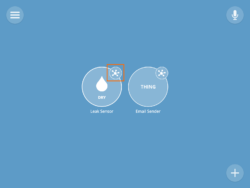
Now it’s time to figure out which things’ properties will lead to interesting notifications. For each thing you want to investigate, click on its splat icon to get a full view of all its properties.

You may also want to log properties of various analog devices over time to see what values are “normal”. For example, you can monitor the refrigerator temperature for a couple of days to help determine what qualifies as an abnormal temperature. In this graph, you can see the difference between baseline power draw (around 20 watts) and charging (up to 90 watts).

Charger Power Consumption Graph
In my case, I’ve selected a leak sensor so I won’t need to log data in advance. It’s pretty clear that I want to be notified when the leak property of my sensor becomes true (i.e., when a leak is detected). If instead you want to monitor a smart plug, you can look at voltage, power, or on/off state. Note that the notification rules you create will let you combine multiple inputs using “and” or “or” logic. For example, you might want to be alerted if indoor motion is detected “and” all of the family smartphone “presence” states are “inactive” (i.e., no one in your family is home, so what caused motion?). Whatever your choice, keep the logical states of your various sensors in mind while you set up your notifier.
Setting up your notifier
The 0.9 WebThings Gateway release added support for notifiers as a specific form of add-on. Thanks to the efforts of the community and a bit of our own work, your gateway can already send you notifications over email, SMS, Telegram, or specialized push notification apps with new add-ons released every week. You can find several notification add-on options by clicking “+” on the Settings > Add-ons page.
The Rust team is happy to announce a new version of Rust, 1.37.0. Rust is a programming language that is empowering everyone to build reliable and efficient software.
If you have a previous version of Rust installed via rustup, getting Rust 1.37.0 is as easy as:
rustup update stable
If you don't have it already, you can get rustup from the appropriate page on our website, and check out the detailed release notes for 1.37.0 on GitHub.
What's in 1.37.0 stable
The highlights of Rust 1.37.0 include referring to enum variants through type aliases, built-in cargo vendor, unnamed const items, profile-guided optimization, a default-run key in Cargo, and #[repr(align(N))] on enums. Read on for a few highlights, or see the detailed release notes for additional information.
Referring to enum variants through type aliases
With Rust 1.37.0, you can now refer to enum variants through type aliases. For example:
type ByteOption = Option;

fn increment_or_zero(x: ByteOption) -> u8 {
    match x {
        ByteOption::Some(y) => y + 1,
        ByteOption::None => 0,
    }
}
In implementations, Self acts like a type alias. So in Rust 1.37.0, you can also refer to enum variants with Self::Variant:
impl Coin {
    fn value_in_cents(&self) -> u8 {
        match self {
            Self::Penny => 1,
            Self::Nickel => 5,
            Self::Dime => 10,
            Self::Quarter => 25,
        }
    }
}
To be more exact, Rust now allows you to refer to enum variants through "type-relative resolution", >::Variant. More details are available in the stabilization report.
Built-in Cargo support for vendored dependencies
After being available as a separate crate for years, the cargo vendor command is now integrated directly into Cargo. The command fetches all your project's dependencies unpacking them into the vendor/ directory, and shows the configuration snippet required to use the vendored code during builds.
There are multiple cases where cargo vendor is already used in production: the Rust compiler rustc uses it to ship all its dependencies in release tarballs, and projects with monorepos use it to commit the dependencies' code in source control.
Using unnamed const items for macros
You can now create unnamed const items. Instead of giving your constant an explicit name, simply name it _ instead. For example, in the rustc compiler we find:
/// Type size assertion where the first parameter
/// is a type and the second is the expected size.
#[macro_export]
macro_rules! static_assert_size {
    ($ty:ty, $size:expr) => {
        const _: [(); $size] = [(); ::std::mem::size_of::<$ty>()];
        //    ^ Note the underscore here.
    }
}

static_assert_size!(Option>, 8); // 1.
static_assert_size!(usize, 8); // 2.
Notice the second static_assert_size!(..): thanks to the use of unnamed constants, you can define new items without naming conflicts. Previously you would have needed to write static_assert_size!(MY_DUMMY_IDENTIFIER, usize, 8);. Instead, with Rust 1.37.0, it now becomes easier to create ergonomic and reusable declarative and procedural macros for static analysis purposes.
Please note some of the information provided in this report may be subject to change as we are sometimes sharing information about projects that are still in early stages and are not final yet.
Welcome!
New localizers:
- Mohsin of Assanese (as) is committed to rebuild the community and has been contributing to several projects.
- Emil of Syriac (syc) joined us through the Common Voice project.
- Ratko and Isidora of Serbian (sr) have been prolific contributors to a wide range of products and projects since joining the community.
- Haile of Amheric (am) joined us through the Common Voice project, is busy localizing and recruiting more contributors so he can rebuild the community.
- Ahsun Mahmud of Bengali (bn) focuses his interest on Firefox.
Are you a locale leader and want us to include new members in our upcoming reports? Contact us!
New community/locales added
- Maltese (mt)
- Romansh Vallader (rm-vallery)
- Syriac (syc)
New content and projects
What’s new or coming up in Firefox desktop
We’re quickly approaching the deadline for Firefox 69. The last day to ship your changes in this version is August 20, less than a week away.
A lot of content targeting Firefox 70 already landed and it’s available in Pontoon for translation, with more to come in the following days. Here are a few of the areas where you should focus your testing on.
about:logins
This is the new password manager for Firefox. If you don’t plan to store the passwords in your browser, you should at least create a new profile to test the feature and its interactions (adding logins, editing, removing, etc.).
Enhanced Tracking Protection (ETP) and Protection Panels
 This is going to be the main focus for Firefox 70:
- New protection panel displayed when clicking the shield icon in the address bar.
- Updated preferences.
- New about:protections page. The content of this page will be exposed for localization in the coming days.
With ETP there will be several new terms to define for your language, like “Cross-Site Tracking Cookies” or “Social Media Trackers”. Make sure they’re translated consistently across the products and websites.
The deadline to ship localization for Firefox 70 will be October 8.
What’s new or coming up in mobile
It’s summer vacation time in mobile land, which means most projects are following the usual course of things.
Just like for Desktop, we’re quickly approaching the deadline for Firefox Android v69. The last day to ship your changes in this version is August 20.
Another thing to note is that we’ve exposed strings for Firefox iOS v19 (deadline TBD soon).
Other projects are following the usual continuous localization workflow. Stay tuned for the next report as there will be novelties then for sure!
What’s new or coming up in web projects
Firefox Accounts
A lot of strings landed earlier this month. If you need to prioritize what to localize first, look for string IDs containing `delete_account` or `sync-engines`. Expect more strings to land in the coming weeks.
Mozilla.org
The following files were added or updated since the last report.
- New: firefox/adblocker.lang and firefox/whatsnew_69.lang (due on 26 of August)
- Update: firefox/new/trailhead.lang
The navigation.lang file has been made available for localization for some time. This is a shared file, and the content is on production whether the file is fully localized or not. If this is not fully translated, make sure to give this file higher priority to complete soon.
What’s new or coming up in Foundation projects
More content from foundation.mozilla.org

Today starts the 8th edition of the annual js13kGames competition and we are sponsoring its WebXR category with a bunch of prizes including Oculus Quest headsets!
Like many other game development contests, the main goal of the js13kGames competition is to make a game based on a given theme under a specific amount of time. This year’s theme is "BACK" and the time you have to work on your game is a whole month, from today to September 13th.
There is, of course, another important rule you must follow: the zip containing your game should not weigh more than 13kb. (Please follow this link for the complete set of rules). Don’t let the size restriction discourage you. Previous competitors have done amazing things in 13kb.
This year, as in the previous editions, Mozilla is sponsoring the competition, with special emphasis on the WebXR category, where, among other prizes, the best three games will get an Oculus Quest headset!
Like many other game development contests, the main goal is to release a game based on a given theme under a specific amount of time. This year’s theme is "BACK" and the time you have to work on your game is a whole month, from today to 13th September.
There is, of course, another important rule you must follow: the zip containing your game should not weigh more than 13kb. (Please follow this link for the complete set of rules).
This year, as in the previous editions, Mozilla is again sponsoring the competition, with special emphasis on the WebXR category, where, among other prizes, the best three games will get an Oculus Quest headset!

Frameworks allowed
Last year you were allowed to use A-Frame and Babylon.js in your game. This year we have been working with the organization to include three.js on that list!
Because these frameworks weigh far more than 13kb, the requirements for this category have been softened. The size of the framework builds won’t count as part of the final 13kb limit. The allowed links for each framework to include in your game are the following:

The allowed links per framework to include on your game are the following:
- A-Frame 0.9.2:
- Three.js r107 (Include the WebVR helper accessible as
THREE.WEBVR) - Bablyon.js 4.0.3:
If you feel you can present a WebXR game without using any third-party framework and still keep the 13kb limit for the whole game, you are free to do so and I’m sure the judges will value that fact.
You may use any kind of input system: gamepad, gazer, 3dof or 6dof controllers and we will still be able to test your game in different VR devices. Please indicate in the description what the device/input requirements are for your game.
If you have a standalone headset, please make sure you try your game on Firefox Reality because we plan to feature the best games of the competition on the Firefox Reality homepage.
Resources
Here are some useful links if you need some help or want to share your progress!
- Js13kgames https://js13kgames.com/ make sure to check the previous years' entries (2018 and 2017)
- JS13kgames resources collection:

We are happy to introduce the first set of custom elements for the immersive web we have been working on: and
From the Mixed Reality team, we keep working on improving the content creator experience, building new frameworks, tools, APIs, performance tuning and so on.
Most of these projects are based on the assumption that the users have a basic knowledge of 3D graphics and want to go deep on fully customizing their WebXR experience, (eg: using A-Frame or three.js).
But there are still a lot of use cases where content creators just want very simple interactions and don’t have the knowledge or time to create and maintain a custom application built on top of a WebXR framework.
With this project we aim to address the problems these content creators have by providing custom elements with simple, yet polished features. One could be just a simple 360 image or video viewer, another one could be a tour allowing the user to jump from one image to another.

Custom elements provide a standard way to create HTML elements to provide simple functionality that matches expectations of content creators without knowledge of 3D, WebXR or even Javascript.
How does this work?
Just include the Javascript bundle on your page and you could start using both elements in your HTML: and . You just need to provide them with a 360 image or video and the custom elements will do the rest, including detecting WebVR support. Here is a simple example that adds a 360 image and video to a page. All of the interaction controls are generated automatically:
You can try a demo here and find detailed information on how to use them on Github.
Next steps
Today we are releasing just these two elements but we have many others in mind and would love your feedback. What new elements would you find useful? Please join us on GitHub to discuss them.
We are also excited to see other companies working hard on providing quality custom elements for the 3D and XR web as Google with their component and we hope others will follow.
https://blog.mozvr.com/custom-elements-for-the-immersive-web/
Here is the list of the OKRs (objective and Key Results) that the Reps Council has set for the second half of 2019
Objective 1: By the end of 2019, Reps are feeling informed and are more confident to contribute to Mozilla initiatives
- KR1: More activities related to MDM campaigns are reported on reps portal (30% more reporting)
- KR2: 10% of inactive Reps are getting reactivated via the campaigns
- KR3: 3 communities that haven’t participated before in campaigns are now joining campaigns regularly
- KR4: Reps report feeling more involved in the program (success increase of 20%)
- KR5: More than 80% of the reps are reporting that they know what MDM is about
- KR6: More than 70% reps are voting in autumn elections
- KR7: More than 50% of reps are sharing feedback on surveys about the program
Objective 2: By the end of 2019, Reps have skills that allow them to be local leaders
- KR1: Due to the skills that the Reps have obtained, they now contribute to a 20% increase on campaigns contributions
- KR2: 80% of mentors are reporting that are ready to lead their mentees due to the new mentor training they got ( 4/5 satisfaction rate)
- KR3: 90% of the new onboarded Reps are reporting that are ready to become local leaders in their community due to their onboarding training
Objective 3: By the end of 2019, MDMs recognize Reps as local community builders / helpers
- KR1: 10% more bugs reported for budget / swag (filing on behalf of the community)
- KR2: [on hold] when the MDM portal is ready, 80% of the leaders of the communities join Reps
Let us know what you think by leaving feedback on the comments.
https://blog.mozilla.org/mozillareps/2019/08/12/reps-okrs-for-second-half-of-2019/
If you want to use a password manager (as you probably should), there are literally hundreds of them to choose from. And there are lots of reviews, weighing in features, usability and all other relevant factors to help you make an informed decision. Actually, almost all of them, with one factor suspiciously absent: security. How do you know whether you can trust the application with data as sensitive as your passwords?
Unfortunately, it’s really hard to see security or lack thereof. In fact, even tech publications struggle with this. They will talk about two-factor authentication support, even when discussing a local password manager where it is of very limited use. Or worse yet, they will fire up a debugger to check whether they can see any passwords in memory, completely disregarding the fact that somebody with debug rights can also install a simple key logger (meaning: game over for any password manager).
Judging security of a password manager is a very complex task, something that only experts in the field are capable of. The trouble: these experts usually work for competing products and badmouthing competition would make a bad impression. Luckily, this still leaves me. Actually, I’m not quite an expert, I merely know more than most. And I also work on competition, a password manager called PfP: Pain-free Passwords which I develop as a hobby. But today we’ll just ignore this.
So I want to go with you through some basic flaws which you might encounter in a local password manager. That’s a password manager where all data is stored on your computer rather than being uploaded to some server, a rather convenient feature if you want to take a quick look. Some technical understanding is required, but hopefully you will be able to apply the tricks shown here, particularly if you plan to write about a password manager.
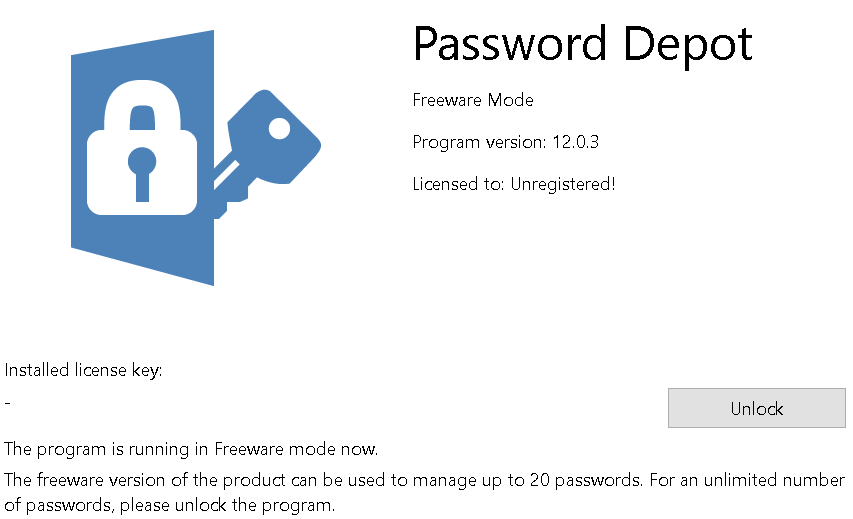
Our guinea pig is a password manager called Password Depot, produced by the German company AceBit GmbH. What’s so special about Password Depot? Absolutely nothing, except for the fact that one of their users asked me for a favor. So I spent 30 minutes looking into it and noticed that they’ve done pretty much everything wrong that they could.
Note: The flaws discussed here have been reported to the company in February this year. The company assured that they take these very seriously but, to my knowledge, didn’t manage to address any of them so far.
{{toc}}
Understanding data encryption
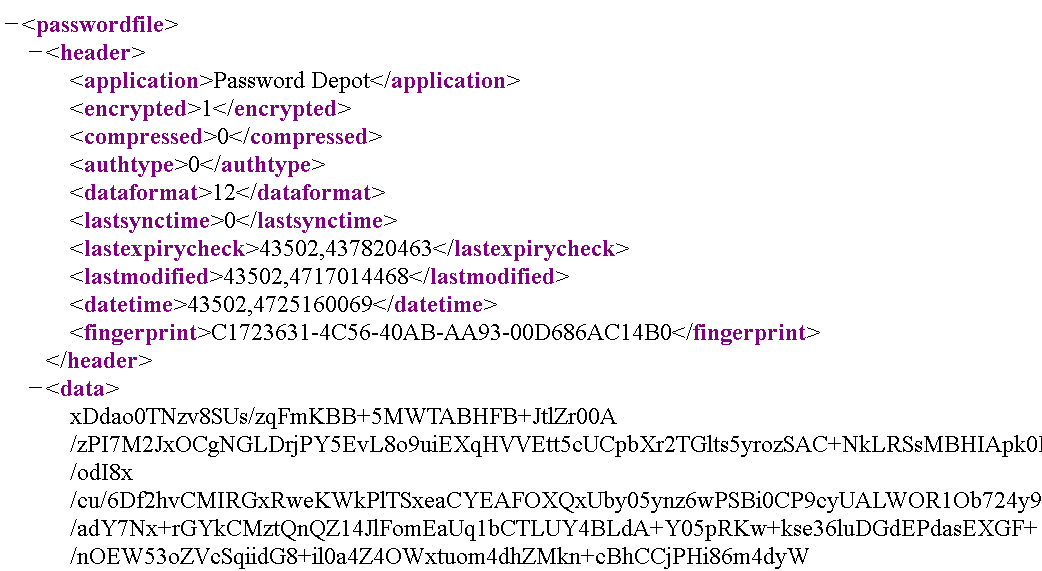
First let’s have a look at the data. Luckily for us, with a local password manager it shouldn’t be hard to find. Password Depot stores its in self-contained database files with the file extension .pswd or .pswe, the latter being merely a ZIP-compressed version of the former. XML format is being used here, meaning that the contents are easily readable:
The good news:
The actual data is more interesting. It’s a base64-encoded blob, when decoded it appears to be unstructured binary data. Size of the data is always a multiple of 16 bytes however. This matches the claim on the website that AES 256 is used for encryption, AES block size being 16 bytes (128 bits).
AES is considered secure, so all is good? Not quite, as there are various block cipher modes which could be used and not all of them are equally good. Which one is it here? I got a hint by saving the database as an outdated “mobile password database” file with the .pswx file extension:
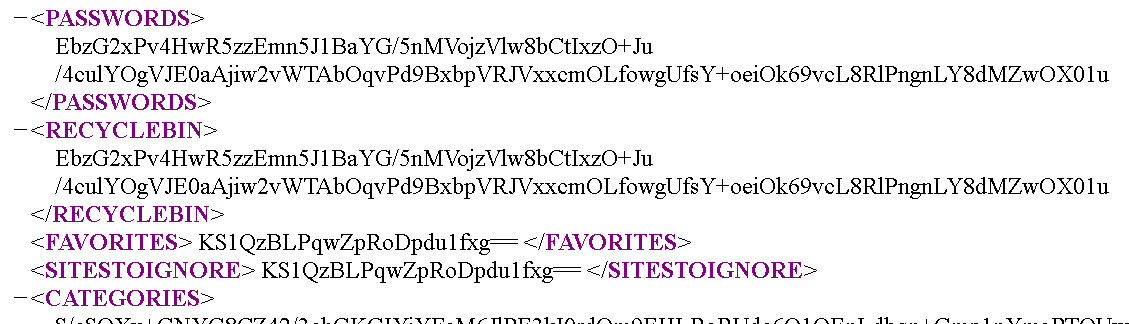
Unlike with the
‘5G’ is a new buzzword floating around every corner of the internet. But what exactly is this hyped-up cellular network, often referred to as the next technological evolution in mobile internet communications? Will it really be 100 times faster than what we have now? What will it make possible that has never been possible before? Who will reap the benefits? And, who will get left behind?
Mike Thelander at Signals Research Group imagines the wild ways 5G might change our lives in the near future. Rhiannon Williams hits the street and takes a new 5G network out for a test drive. Amy France lives in a very rural part of Kansas — she dreams of the day that true, fast internet could come to her farm (but isn’t holding her breath). Larry Irving explains why technology has never been provided equally to everyone, and why he fears 5G will leave too many people out. Shireen Santosham, though, is doing what she can to leverage 5G deployment in order to bridge the digital divide in her city of San Jose.
IRL is an original podcast from Firefox. For more on the series go to irlpodcast.org
Read more about Rhiannon Williams' 5G tests throughout London.
And, find out more about San Jose's smart city vision that hopes to bridge the digital divide.
UPDATE: Additional pictures are up at Talospace.

Vintage Computer Festival West 2019 has come and gone, and I'll be posting many of the pictures on Talospace hopefully tonight or tomorrow. However, since this blog's audience is both Mozilla-related (as syndicated on Planet Mozilla) and PowerPC-related, I've chosen to talk a little bit about old browsers for old machines (since, if you use TenFourFox, you're using a relatively recent browser on an old machine) since that was part of my exhibit this year as well as some of the Apple-related exhibits that were present.

This exhibit I christened "RISCy Business," a collection of various classic RISC-based portables and laptops. The machines I had running for festival attendees were a Tadpole-RDI UltraBook IIi (UltraSPARC IIi) running Solaris 10, an IBM ThinkPad 860 (166MHz PowerPC 603e, essentially a PowerBook 1400 in a better chassis) running AIX 4.1, an SAIC Galaxy 1100 (HP PA-7100LC) running NeXTSTEP 3.3, and an RDI PrecisionBook C160L (HP PA-7300LC) running HP/UX 11.00. I also brought my Sun Ultra-3 (Tadpole Viper with a 1.2GHz UltraSPARC IIIi), though because of its prodigious heat issues I didn't run it at the show. None of these machines retailed for less than ten grand, if they were sold commercially at all (the Galaxy wasn't).
Here they are, for posterity:


The UltraBook played a Solaris port of Quake II (software-rendered) and Firefox 2, the ThinkPad ran AIX's Ultimedia Video Monitor application (using the machine's built-in video capture hardware and an off-the-shelf composite NTSC camera) and Netscape

This summer I am very lucky to join the Hubs by Mozilla as a technical artist intern. Over the 12 weeks that I was at Mozilla, I worked on two different projects.
My first project is about particle systems, the thing that I always have great interest in. I was developing the particle system feature for Spoke, the 3D editor which you can easily create a 3D scene and publish to Hubs.
Particle systems are a technique that has been used in a wide range of game physics, motion graphics and computer graphics related fields. They are usually composed of a large number of small sprites or other objects to simulate some chaotic system or natural phenomena. Particles can make a huge impact on the visual result of an application and in virtual and augmented reality, it can deepen the immersive feeling greatly.
Particle systems can be incredibly complex, so for this version of the Particle System, we wanted to separate the particle system from having heavy behaviour controls like some particle systems from native game engines, only keeping the basic attributes that are needed. The Spoke particle system can be separated into two parts, particles and the emitter. Each particle, has a texture/sprite, lifetime, age, size, color, and velocity as it’s basic attributes. The emitter is more simple, as it only has properties for its width and height and information about the particle count (how many particles it can emit per life circle).
By changing the particle count and the emitter size, users can easily customize a particle system for different uses, like to create falling snow in a wintry scene or add a small water splash to a fountain.
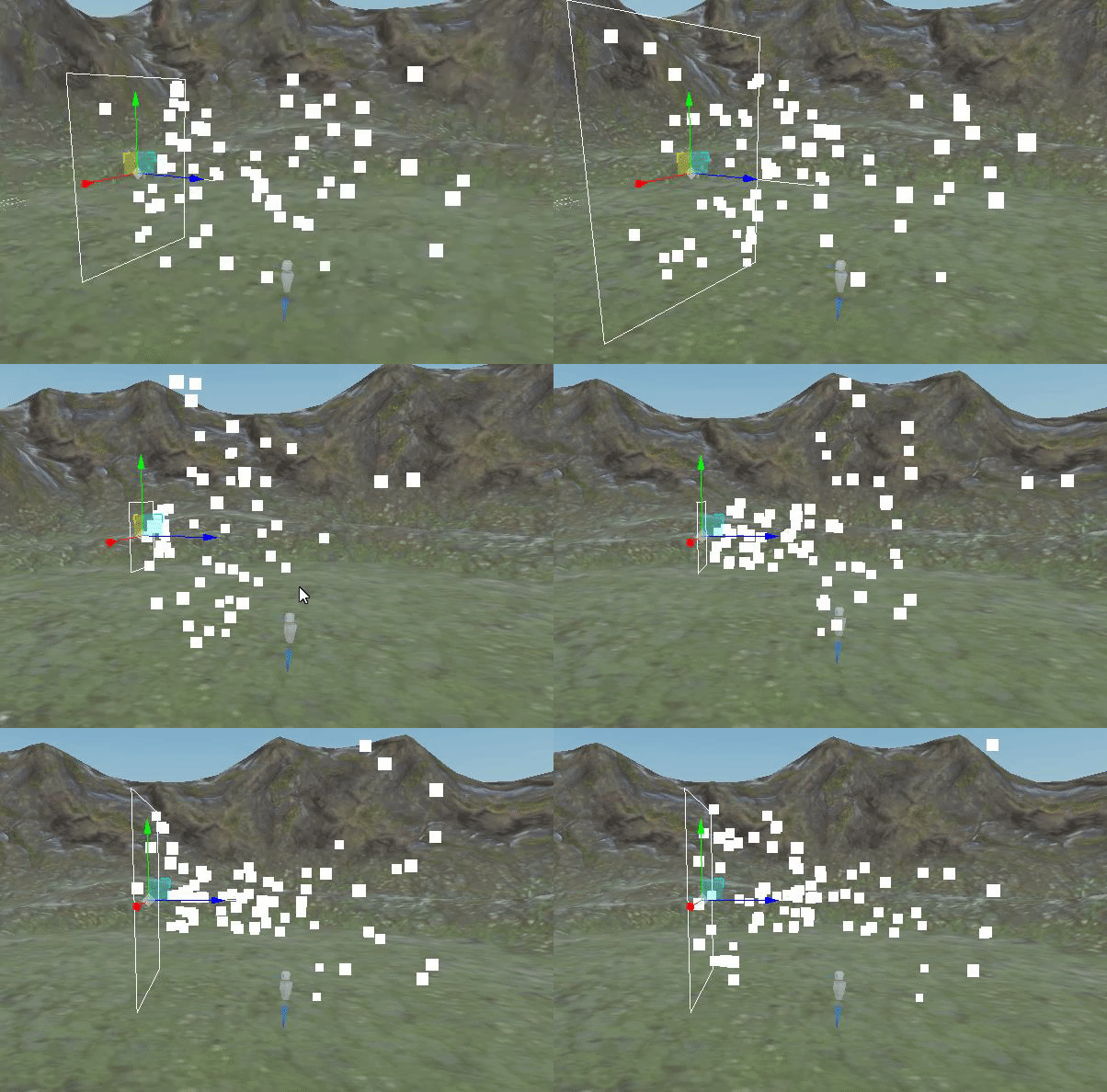
Changing the emitter size

Changing the number of particles from 100 to 200
You can also change the opacities and the colors of the particles. The actual color and opacity values are interpolated between start, middle and end colors/opacities.
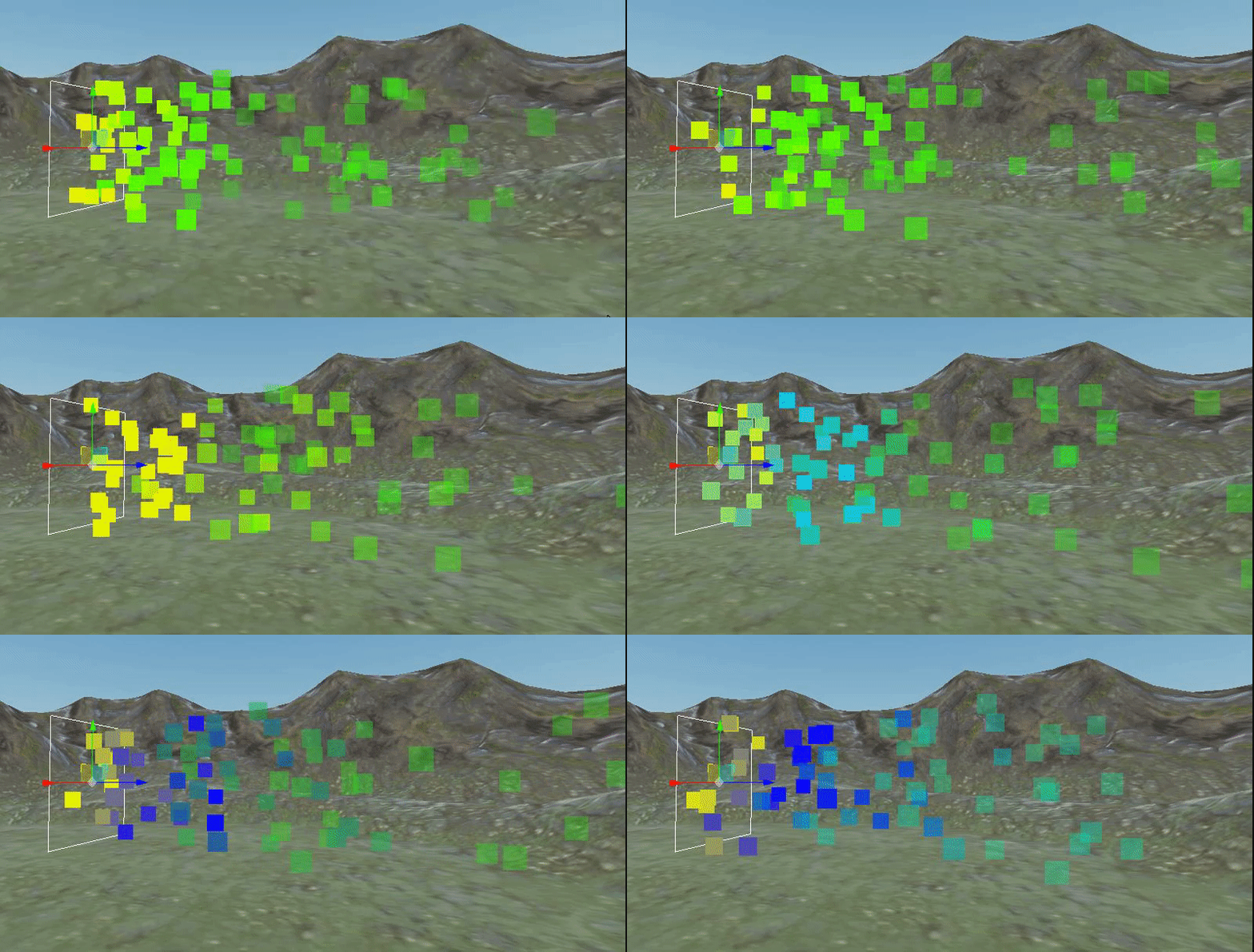
And for the main visuals, we can change the sprites to the image we want by using a URL to an image, or choosing from your local assets.

What does a particle’s life cycle look like? Let’s take a look at this chart:
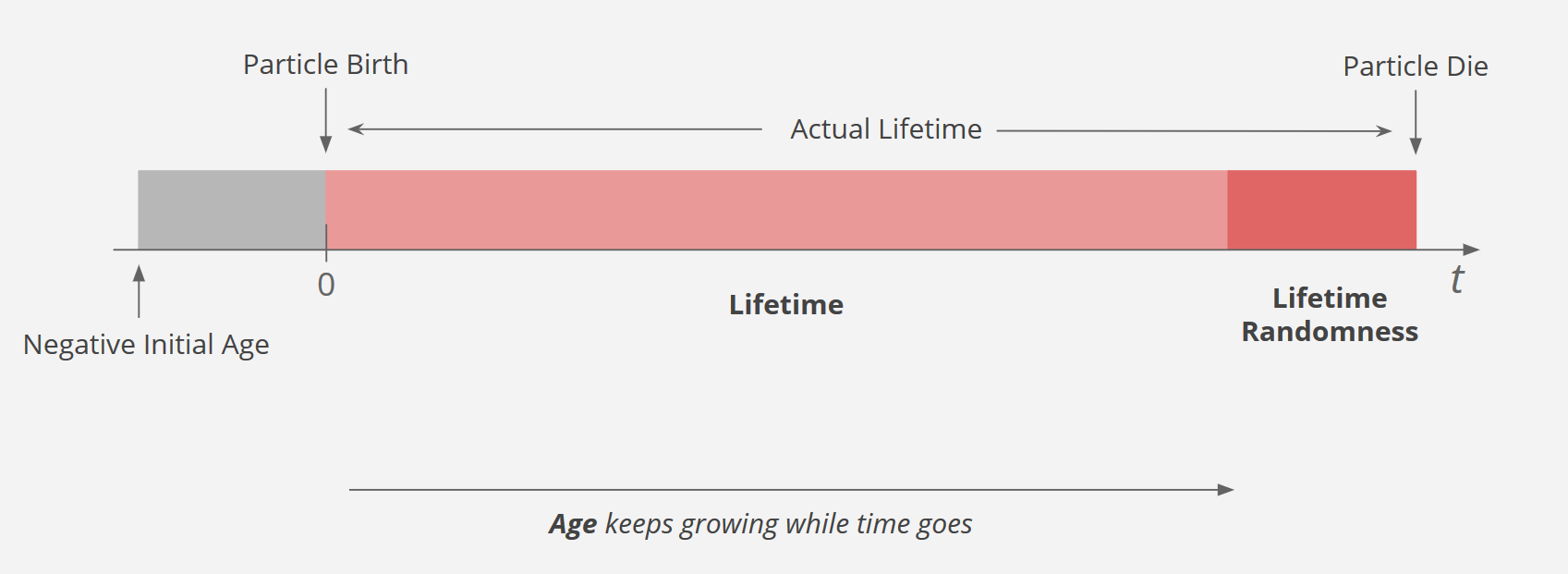
Every particle is born with a random negative initial age, which can be adjusted through the Age Randomness property after it’s born, its age will keep growing as time goes by. When its age is bigger than the total lifetime (formed by Lifetime and Lifetime Randomness), the particle will die immediately and be re-assigned a negative initial age, then start over again. The Lifetime here is not the actual lifetime that every particle will live, in order to not have all particles disappear at the same time, we have this Lifetime Randomness attribute to vary the actual lifetime of each particle. The higher the Lifetime Randomness, the larger the differentiation will be among the actual lifetimes of whole particle system. There is another attribute called Age Randomness, which is similar to Lifetime Randomness. The difference is that Age Randomness is used to vary the negative initial ages to have a variation on the birth of the particles, while Lifetime Randomness is to have the variation on the end of their lives.
Every particle also has velocity properties across the x, y and x axis. By adjusting the velocity in three dimensions, users can have a better control on particles’ behaviours. For example, simulation gravity or wind that kind of simple phenomena.
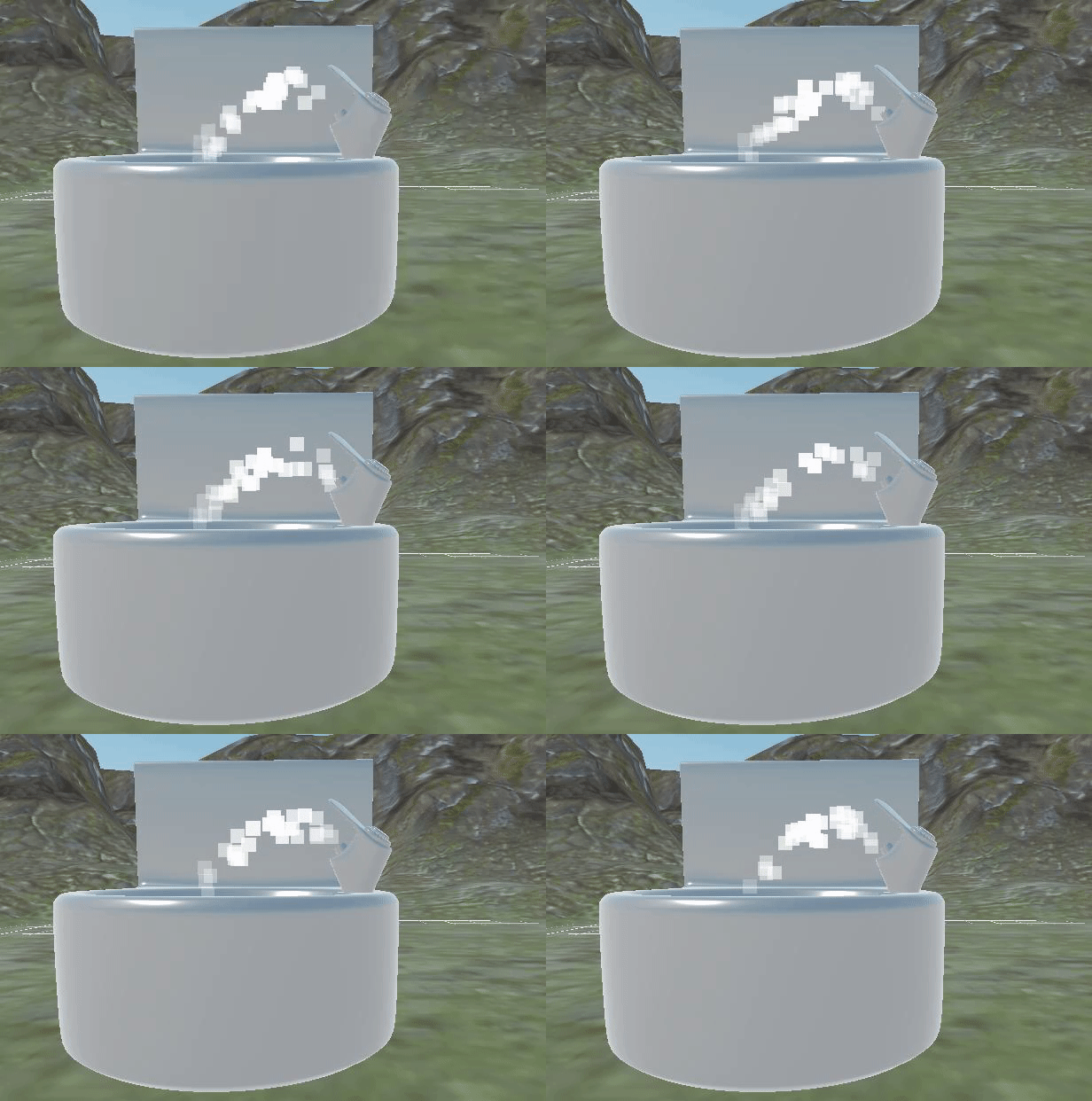
With angular velocity, you can also control on the rotation of the particle system to have a more natural and dynamic result.
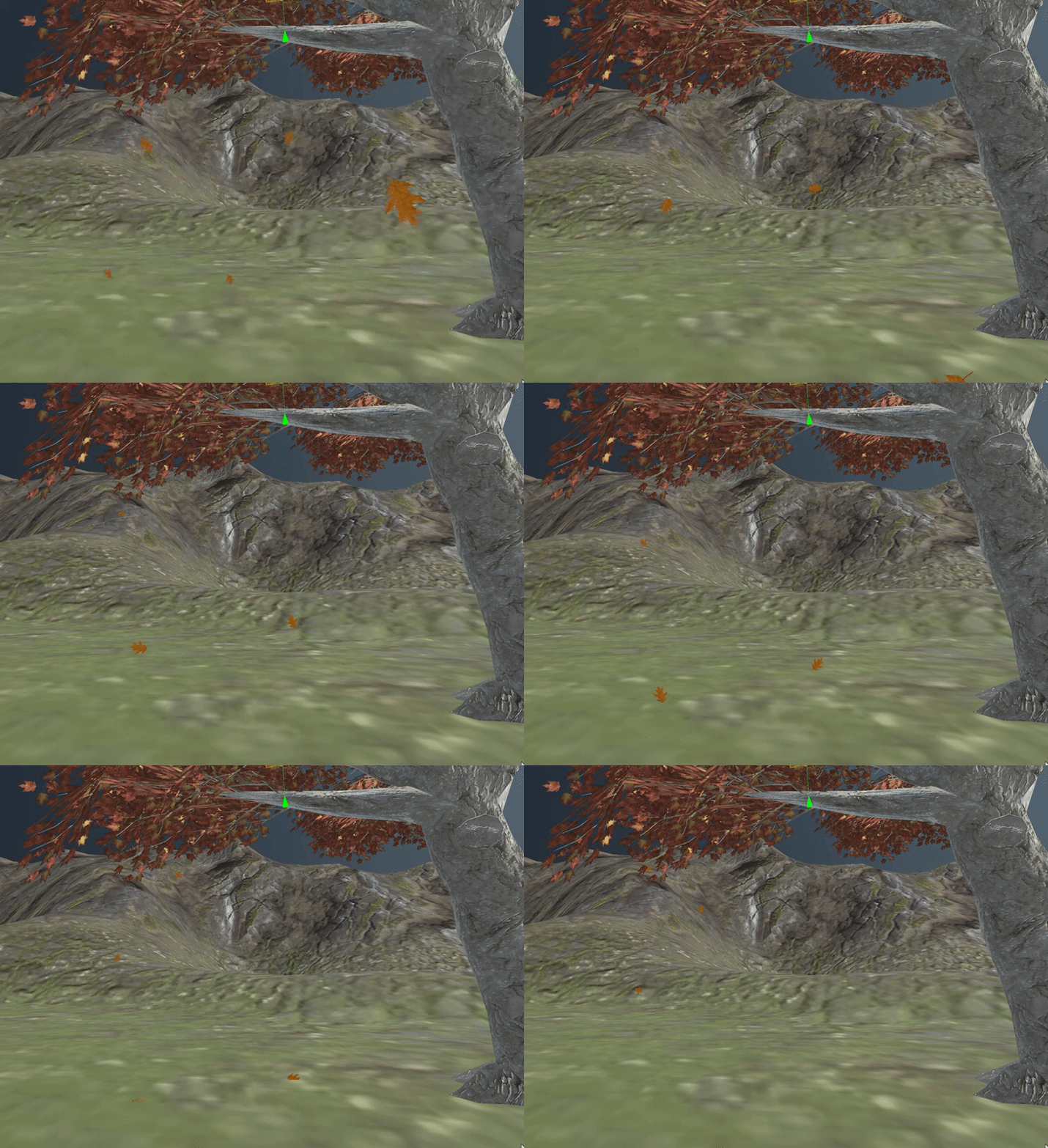
The velocity, color and size properties all have the option to use different interpolation functions between their start, middle and end stages.
Back in January I was privileged to speak at StarCon 2019 at the University of Waterloo about responsible data collection. It was a bitterly-cold weekend with beautiful sun dogs ringing the morning sun. I spent it inside talking about good ways to collect data and how Mozilla serves as a concrete example. It’s 15 minutes short and aimed at a general audience. I hope you like it.
I encourage you to also sample some of the other talks. Two I remember fondly are Aaron Levin’s “Conjure ye File System, transmorgifier” about video games that look like file systems and Cory Dominguez’s lovely analysis of Moby Dick editions in “or, the whale“. Since I missed a whole day, I now get to look forward to fondly discovering new ones from the full list.
:chutten

The Public Library of Science‘s Ten Simple Rules series can be fun reading; they’re introductory papers intended to provide novices or non-domain-experts with a set of quick, evidence-based guidelines for dealing with common problems in and around various fields, and it’s become a pretty popular, accessible format as far as scientific publication goes.
Topic-wise, they’re all over the place: protecting research integrity, creating a data-management plan and taking advantage of Github are right there next to developing good reading habits, organizing an unconference or drawing a scientific comic, and lots of them are kind of great.
I recently had the good fortune to be co-author on one of them that’s right in my wheelhouse and has recently been accepted for publication: Ten Simple Rules for Helping Newcomers Become Contributors to Open Projects. They are, as promised, simple:
- Be welcoming.
- Help potential contributors evaluate if the project is a good fit.
- Make governance explicit.
- Keep knowledge up to date and findable.
- Have and enforce a code of conduct.
- Develop forms of legitimate peripheral participation.
- Make it easy for newcomers to get started.
- Use opportunities for in-person interaction – with care.
- Acknowledge all contributions, and
- Follow up on both success and failure.
You should read the whole thing, of course; what we’re proposing are evidence-based practices, and the details matter, but the citations are all there. It’s been a privilege to have been a small part of it, and to have done the work that’s put me in the position to contribute.
http://exple.tive.org/blarg/2019/08/07/ten-more-simple-rules/