Password managers are the most recommended tool by security experts to protect your online credentials from hackers. But many people are still hesitant to use them. Here’s why password managers … Read more
The post Five myths about password managers appeared first on The Firefox Frontier.
https://blog.mozilla.org/firefox/myths-about-password-managers/
Welcome to a new series of blog post where I'll share at random, tips and tricks that I've gathered over the last 10 years as a remote worker. I have work for 1 company on different subject and in two countries , as I've moved from one to another while working remotely. I have managed to work being single, married without kids and married with kids. Advice that I'll be giving here are mostly from the employee's perspective, I'll also try to give a few hints about how to manage remotees. Disclaimer I have not read "Distributed Teams: The Art and Practice of Working Together While Physically Apart" from my ex-coworker.
So let's start by the obvious first tip : don't stay alone. When I started working remote I had a girlfriend so I was quite occupied, when I wasn't working and when I was. But I was working from home, so Id' miss chitchatting with colleagues over a coffee. But I was coming out of a startup that was using skype as it's main chat tool and there was/(still is) an alumni chat session. So when I had a question or when I wanted to rant or think about something else or just have a pause I would chat with my ex-colleagues. After a few month I broke up with the woman I was with. And was left with almost not physical interaction with humans. The only thing close to it was me going to a swimming pool once a week and seeing people - but hardly interacting with them.After a month or two of that regime I started looking for a new job - a non remote one. Thankfully the 1,5h train ride killed the idea, while I made local friends using the meetup service (I was a Frenchman living in The Nederlands - Met Other people like me , we ended up having a weekly get together - which ended up in me meeting my wife). I also had an ex-coworker not living far from me that was also working on his own venture. We ended up having weekly lunches at the same restaurant were we could both bitch at life work and food :-p.
When I moved back to my own country, it took my ISP two weeks to provide me with Internet access. In the meanwhile I needed access so I ended up going to the local co-working space. This was nice as I could interact with people in the same situation as mine (except that most of them were freelancers). They didn't have the same job nor background, so I had real nice tea chats. In the end I stop using the co-working facilities as I had plenty of meeting and I'm kind of a loud person - so I didn't fit much there and was more an annoyance than anything. But it was really a good solution to fight loneliness or the lack of human interaction (work related I mean). Finally I moved to a less populated area - were co-working didn't exist and was no option. Lunch with friend was not an option either. The only thing that kept me connected to work/ the rest of the world was IRC conversations with locals (a bit more locals , but I really mean French people here). The other thing that help was my involvement in local things like the kindergarten/ the library and so forth. This let me talk to people about work issue , even if they didn't understand everything venting helped a lot.
My XML5 idea is over twelve years old now. I still like it as web developers keep running into problems with text/html:
- Cannot arbitrarily nest elements. E.g., there is no way to create a custom element that takes the place of the
tdelement. There is also no way to create a custom element that contains certain HTML elements, such as thetrelement. (See webcomponents #113 for more.) - Cannot have custom elements start tags that are marked as self-closing. I.e., custom elements always require an explicit end tag. (See webcomponents #624 for more.)
- Cannot introduce a serialization of
ShadowRootnodes to enable server-side rendering. (See dom #510 for more.) - Any change made to the parser can and is likely to impact the parsing of existing documents as every byte stream is converted to a tree. This has severe compatibility and security implications that cannot be underestimated.
XML in browsers has much less of a compatibility footprint. Coupled with XML not always returning a tree for a given byte stream making backwards compatible (in the sense that old well-formed documents parse the same way) extensions to it is possible. There is a chance for it to ossify like text/html though, so perhaps XML5 ought to be amended somewhat to leave room for future changes.
(Another alternative is a new kind of format to express node trees, but then we have at least three problems.)
Today the Thunderbird project is happy to announce that for the future Thunderbird 78 release, planned for summer 2020, we will add built-in functionality for email encryption and digital signatures using the OpenPGP standard. This new functionality will replace the Enigmail add-on, which will continue to be supported until Thunderbird 68 end of life, in the Fall of 2020.
For some background on encrypted email in Thunderbird: Two popular technologies exist that add support for end-to-end encryption and digital signatures to email. Thunderbird has been offering built-in support for S/MIME for many years and will continue to do so.
The Enigmail Add-on has made it possible to use Thunderbird with external GnuPG software for OpenPGP messaging. Because the types of add-ons supported in Thunderbird will change with version 78, the current Thunderbird 68.x branch (maintained until Fall 2020) will be the last that can be used with Enigmail.
For users of Enigmail, Thunderbird 78 will offer assistance to migrate existing keys and settings. We are happy that Patrick Brunschwig, the long-time developer of Enigmail, has offered to work with the Thunderbird team on OpenPGP going forward. About this change, Patrick had this to say:
“It has always been my goal to have OpenPGP support included in the core Thunderbird product. Even though it will mark an end to a long story, after working on Enigmail for 17 years, I’m very happy with this outcome.”
Users who haven’t used Enigmail previously will need to opt in to use OpenPGP messaging, as encryption will not be enabled automatically. However, Thunderbird 78 will help users discover the new functionality.
To promote secure communication, Thunderbird 78 will encourage the user to perform ownership confirmation of keys used by correspondents, notify the user if the correspondent’s keys change unexpectedly, and, if there is an issue, offer assistance to resolve the situation.
It’s undecided whether Thunderbird 78 will support the indirect key ownership confirmations used in the Web of Trust (WoT) model, or to what extent. However, sharing of key ownership confirmations made by the user (key signatures), and interaction with OpenPGP key servers shall be possible.
If you have an interest in seeing more detailed plans on what is in store for OpenPGP in Thunderbird, check out our wiki page with more information.
https://blog.mozilla.org/thunderbird/2019/10/thunderbird-enigmail-and-openpgp/
Greetings! This issue of the newsletter is long overdue. Without further ado:
What’s new in gfx
Wayland dmabuf textures
Martin Stransky landed the dmabuf texture work which was at the prototype stage at the time of the previous newsletter. This is only used with the GL compositor at the moment which is not enabled by default (gfx.acceleration.force-enabled pref in about:config). Work to get dmabuf textures with WebRender is in progress.
CoreAnimation integration
Markus landed a number of infrastructure changes towards integrating with CoreAnimation and doing partial present optimizations on MacOS.
This short description doesn’t do justice to the amount of work that went into this. Stay tuned, you might read some more about this on this blog soon.
Direct Composition integration
Sotaro has been working on a number of bugs in support for Direct Composition integration, including some ground work and investigation such as bugs 1585893, 1585619 and 1585278, and bug fixes like an issue involving the tab bar, direct composition, the high contrast theme and WebRender.
RGB, RGBA, BGRA, BLARGH!
Andrew landed a number of image decoding performance improvements, using SIMD to speed up pixel format conversion.
Benchmarks targeting the improvements suggested a ceiling of 25-50% faster for pixel format conversions, initial telemetry data suggesting 5-10% real world average decoder performance improvement. Not bad!
What’s new in WebRender
WebRender is a GPU based 2D rendering engine for web written in Rust, currently powering Firefox‘s rendering engine as well as the research web browser servo.
To enable WebRender in Firefox, in the about:config, enable the pref gfx.webrender.all and restart the browser.
WebRender is available as a standalone crate on crates.io (documentation) for use in your own rust projects.
WebRender enabled in Firefox Preview Nightly on the Pixel 2
This is the first configuration on Android that Jamie enabled WebRender on by default. A pretty cool milestone to build upon!
Download it here: https://play.google.com/store/apps/details?id=org.mozilla.fenix.nightly
WebRender is only enabled by default for pixel 2 phones at the moment but on other configurations it can be enabled in about:config.
Pixel snapping
Andrew rewrote pixel snapping in WebRender. See the bug description and the six patches series that followed to get an idea of how much work went into this.
Blob image recoordination
If you have been following this newsletter you might remember reading hearing about “blob image recoordination” for a while now. That’s because work has been ongoing for quite a while. A lot of these patches that have been in the work for months landed recently. Blobs are now “recoordinated”.
In other words, Jeff and Nical landed a lot of infrastructure work went into handling the coordinate system of blob images, webrender’s fallback software rendering path.
This puts the fallback code on a saner foundation and allows reducing the invalidation of blob images in various scenarios such as scrolling large SVG elements, or when animations cause the bounds of a blob image to change. This translates to performance improvements on web pages that use SVG a lot.
Picture caching
Glenn landed some pretty big changes to picture caching:
This week, the U.S. Court of Appeals for the D.C. Circuit issued its ruling in Mozilla v. Federal Communications Commission (FCC), the court case to defend net neutrality protections for American consumers. The opinion opened a path for states to put net neutrality protections in place, even as the fight over FCC federal regulation is set to continue. While the decision is disappointing as it failed to restore net neutrality protections at the federal level, the fight for these essential consumer rights will continue in the states, in Congress, and in the courts.
The three-judge panel disagreed with the FCC’s argument that the FCC is able to preempt state net neutrality legislation across the board. States have already shown that they are ready to step in and enact net neutrality rules to protect consumers, with laws in California and Vermont among others. The Court is also requiring the FCC to consider the effect the repeal may have on public safety and subsidies for low-income consumer broadband internet access.
The Court did find that the FCC had discretion to treat broadband access like an information service and remove the previous rules. But as Judge Millett said (and Judge Wilkins concurred), that was with significant reservations: “I am deeply concerned that the result [of upholding much of the 2018 Order] is unhinged from the realities of modern broadband service.” Nevertheless, the judges stated that they felt their hands were tied by the existing legal precedent and invited the Supreme Court or Congress to step in.
The decision also underscores the frailty of the FCC’s approach. Questioning the FCC’s reclassification of broadband internet access from a “telecommunications service” to an “information service,” Judge Millett reprised an argument made by Mozilla and other petitioners: “[F]ollowing the Commission’s view to its logical conclusion, everything (including telephones) would be an information service. The only thing left within ‘telecommunications service’ would be the proverbial road to nowhere.”
We are exploring next steps to move the case forward for consumers, and we are grateful to be a part of a broad community pressing for net neutrality protections. We look forward to continuing this fight.
The post Breaking down this week’s net neutrality court decision appeared first on The Mozilla Blog.
https://blog.mozilla.org/blog/2019/10/04/breaking-down-this-weeks-net-neutrality-court-decision/
It’s Oktoberfest! You know, that German holiday about beer and lederhosen?
No. As many Germans will tell you it’s not a German thing as much as it is a Bavarian thing. It’s like saying kilts are a British thing (it’s a Scottish thing). Or that milk in bags is a Canadian thing (in Canada it’s an Eastern Canada thing).
In researching what the heck I was talking about when I was making this comparison at a recent team meeting, Alessio found a lovely study on the efficiency of milk bags as milk packaging in Ontario published by The Environment and Plastics Industry Council in 1997.
I highly recommend you skim it for its graphs and the study conclusions. The best parts for me are how it highlights that the consumption of milk (by volume) increased 22% from 1968 to 1995 while at the same time the amount (by mass) of solid waste produced by milk packaging decreased by almost 20%.
I also liked Table 8 which showed the recycling rates of the various packaging types that we’d need to reach in order to match the small amount (by mass) of solid waste generation of the (100% unrecycled) milk bags. (Interestingly, in my region you can recycle milk bags if you first rinse and dry them).
I guess what I’m trying to say about this is three-fold:
- Don’t assume regional characteristics are national in your distributed team. Berliners might not look forward to Oktoberfest the way M"unchner do, and it’s possible no one in the Vancouver office owns a milk jug or bag cutter.
- Milk Bags are kinda neat, and now I feel a little proud about living in a part of the world where they’re common. I’d be a little more confident about this if the data wasn’t presented by the plastics industry, but I’ll take what I can get (and I’ll start recycling my milk bags).
- Geez, my team can find data for _any topic_. What differences we have by being distributed around the world are eclipsed by how we’re universally a bunch of nerds.
:chutten
Note
This started as notes explaining the internals of how Celery’s AMQP backends operate. This isn’t meant to be a comparison or prove one is better or that one is broken. There just seemed to be a lack of documentation about the design and limitations of each backend …
https://patrick.cloke.us/posts/2019/10/04/celery-amqp-backends/
Imagine that you’ve been going from shop to shop looking for a cow-shaped butter dish. Later, you walk into a department store and a salesperson walks right up to you … Read more
The post Browse in peace on your phone with Firefox thanks to Enhanced Tracking Protection appeared first on The Firefox Frontier.
https://blog.mozilla.org/firefox/firefox-mobile-enhanced-tracking-protection/

Today we are introducing ECSY (Pronounced “eck-see”): a new -highly experimental- Entity Component System framework for Javascript.
After working on many interactive graphics projects for the web in the last few years we were trying to identify the common issues when developing something bigger than a simple example.
Based on our findings we discussed what an ideal framework would need:
- Component-based: Help to structure and reuse code across multiple projects.
- Predictable: Avoids random events or callbacks interrupting the main flow, which would make it hard to debug or trace what is going on in the application.
- Good performance: Most web graphics applications are CPU bound, so we should focus on performance much more.
- Simple API: The core API should be simple, making the framework easier to understand, optimize and contribute to; but also allow building more complex layers on top of it if needed.
- Graphics engine agnostic: It should not be tied to any specific graphics engine or framework.
These requirements are high-level features that are not usually provided by graphics engines like three.js or babylon.js. On the other hand, A-Frame provides a nice component-based architecture, which is really handy when developing bigger projects, but it lacks the rest of the previously mentioned features. For example:
- Performance: Dealing with the DOM implies overhead. Although we have been building
A-Frameapplications with good performance, this could be done by breaking the API contract, for example by accessing the values of the components directly instead of using setAttribute/getAttribute. This can lead to some unwanted side effects, such as incompatibility between components and a lack of reactive behavior. - Predictable: Dealing with asynchrony because of the DOM life cycle or the events’ callbacks when modifying attributes makes the code really hard to debug and to trace.
- Graphics engine agnostic: Currently
A-Frameand its components are so strongly tied to Three.js that it makes no sense to change it to any other engine.
After analyzing these points, gathering our experience with three.js and A-Frame, and looking at the state of the art on game engines like Unity, we decided to work on building this new framework using a pure Entity Component System architecture. The difference between a pure ECS like Unity DOTS, entt, or Entitas, and a more object oriented approach, such as Unity’s MonoBehaviour or A-Frame's Components, is that in the latter the components and systems both have logic and data, while with a pure ECS approach components just have data (without logic) and the logic resides in the systems.
Focusing on building a simple core for this new framework helps iterate faster when developing new applications and lets us implement new features on top of it as needed. It also allows us to use it with existing libraries as three.js, Babylon.js, Phaser, PixiJS, interacting directly with the DOM, Canvas or WebGL APIs, or prototype around new APIs as WebGPU, WebAssembly or WebWorkers.
Today we're happy to announce that we're starting a second blog, the Inside Rust blog. This blog will be used to post regular updates by the various Rust teams and working groups. If you're interested in following along with the "nitty gritty" of Rust development, then you should take a look!
Please meet our newest Friend of Add-ons, B.J. Herbison! B.J. is a longtime Mozillian and joined add-on content review team for addons.mozilla.org two years ago, where he helps quickly respond to spam submissions and ensures that public listings abide by Mozilla’s Acceptable Use Policy.
A software developer with a knack for finding bugs, B.J. is an avid user of ASan Nightly and is passionate about improving open source software. “The best experience is when I catch a bug in Nightly and it gets fixed before that code ships,” B.J. says. “It doesn’t happen every month, but it happens enough to feel good.”
Following his retirement in 2017, B.J. spends his time working on software and web development programs, volunteering at a local food pantry, and traveling the world with his wife. He also enjoys collecting and studying coins, and playing Dungeons and Dragons. “I’ve played D&D with some of the other players for over forty years, and some other players are under half my age,” B.J. says.
Thank you so much for your contributions to keeping our ecosystem safe and healthy, B.J.!
If you are interested in getting involved with the add-ons community, please take a look at our current contribution opportunities.
The post Friend of Add-ons: B.J. Herbison appeared first on Mozilla Add-ons Blog.
https://blog.mozilla.org/addons/2019/10/02/friend-of-add-ons-b-j-herbison/
Data breaches are one of many online threats. Using secure internet connections, updating your software, avoiding scam emails, and employing better password hygiene will all help you stay safer while … Read more
The post Steps you can take to protect your identity online appeared first on The Firefox Frontier.
https://blog.mozilla.org/firefox/protect-your-identity-online/
We’re excited to launch a new resource for people who build the web! It will include short videos, articles, demos, and tools that teach web technologies and standards, browser tools, compatibility, and more. No matter your experience level or job description, we’re all working together towards the future health of the web, and Mozilla is here to help.
Today we’re launching a new video channel, with a selection of shorts to kick things off. There are two in our “about:web” series on web technologies, and one in our “Firefox” series on browser tools for web professionals.
Get started with an intro to Dark Mode on the web, by Deja Hodge — and check out her dark mode demo.
Jen Simmons shows us how to access a handy third-panel in the Firefox Developer Tools, and toggle print preview mode.
If you’ve ever struggled to style lists with customized bullets and numbers, Miriam Suzanne has a video all about the ::marker pseudo-element and list counters. Watch the video, and go play with the demo on codepen.
To celebrate the launch, we’ll be releasing new videos every day this week! Check back to learn about several more Firefox tools like Screenshots and the CSS Track Changes panel, and a reflection on what makes CSS so weird. Over the next few months we’ll have new videos weekly (subscribe to the channel!), along with more articles, demos, and some exciting new open source tools.
The post Video Shorts from Mozilla Developer appeared first on Mozilla Hacks - the Web developer blog.
https://hacks.mozilla.org/2019/10/video-shorts-from-mozilla-developer/
One thing about me that most Mozillians don’t know is that, when I first applied to work at MoCo, I had applied to work on the mobile platform. When all was said and done, it was decided at the time that I would be a better fit for an opening on Taras Glek’s platform performance team.
My first day at Mozilla was October 15, 2012 – I will be celebrating my seventh anniversary at MoCo in just a couple short weeks! Some people with similar tenures have suggested to me that we are now “old guard,” but I’m not sure that I feel that way! Anyway, I digress.
The platform performance team eventually evolved into a desktop-focused performance team by late 2013. By the end of 2015 I had decided that it was time for a change, and by March 2016 I had moved over to work for Jim Mathies, focusing on Gecko integration with Windows. I ended up spending the next twenty or so months helping the accessibility team port their Windows implementation over to multiprocess.
Once Firefox Quantum 57 hit the streets, I scoped out and provided technical leadership for the InjectEject project, whose objective was to tackle some of the root problems with DLL injection that were causing us grief in Windows-land.
I am proud to say that, over the past three years on Jim’s team, I have done the best work of my career. I’d like to thank Brad Lassey (now at Google) for his willingness to bring me over to his group, as well as Jim, and David Bolter (a11y manager at the time) for their confidence in me. As somebody who had spent most of his adult life having no confidence in his work whatsoever, their willingness to entrust me with taking on those risks and responsibilities made an enormous difference in my self esteem and my professional life.
Over the course of H1 2019, I began to feel restless again. I knew it was time for another change. What I did not expect was that the agent of that change would be James Willcox, aka Snorp. In Whistler, Snorp planted the seed in my head that I might want to come over to work with him on GeckoView, within the mobile group which David was now managing.
The timing seemed perfect, so I made the decision to move to GeckoView. I had to finish tying up some loose ends with InjectEject, so all the various stakeholders agreed that I’d move over at the end of Q3 2019.
Which brings me to this week, when I officially join the GeckoView team, working for Emily Toop. I find it somewhat amusing that I am now joining the team that evolved from the team that I had originally applied for back in 2012. I have truly come full circle in my career at Mozilla!
So, what’s next?
I have a couple of InjectEject bugs that are pretty much finished, but just need some polish and code reviews before landing.
For the next month or two at least, I am going to continue to meet weekly with Jim to assist with the transition as he ramps up new staff on the project.
I still plan to be the module owner for the Firefox Launcher Process and the MSCOM library, however most day-to-day work will be done by others going forward;
I will continue to serve as the mozglue peer in charge of the DLL blocklist and DLL interceptor, with the same caveat.
Switching over to Android from Windows does not mean that I am leaving my Windows experience at the door; I would like to continue to be a resource on that front, so I would encourage people to continue to ask me for advice.
On the other hand, I am very much looking forward to stepping back into the mobile space. My first crack at mobile was as an intern back in 2003, when I was working with some code that had to run on PalmOS 3.0! I have not touched Android since I shipped a couple of utility apps back in 2011, so I am looking forward to learning more about what has changed. I am also looking forward to learning more about native development on Android, which is something that I never really had a chance to try.
As they used to say on Monty Python’s Flying Circus, “And now for something completely different!”
http://dblohm7.ca/blog/2019/09/30/coming-around-full-circle/
This is a keynote I gave to DevSecCon Seattle in September 2019. The recording of that keynote should be available soon.

Good morning everyone, and thank you for joining us on this second day of DevSecCon. My name is Julien Vehent. I run the Firefox Operations Security team at Mozilla, where I lead a team that secures the backend services and infrastructure of Firefox. I’m also the author of Securing DevOps.
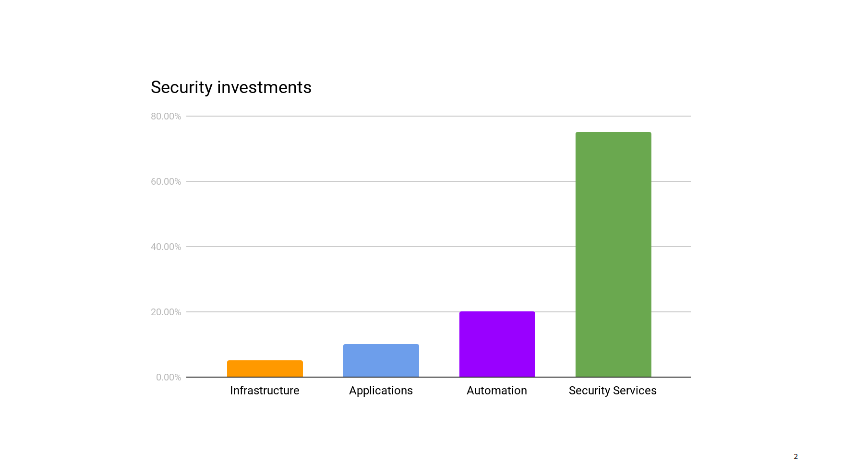
This story starts a few months ago, when I am sitting in our mid-year review with management. We’re reviewing past and future projects, looking at where the dozen or so people in my group spend their time, when my boss notes that my team is under invested in infrastructure security. It’s not a criticism. He just wonders if that’s ok. I have to take a moment to think through the state of our infrastructure. I mentally go through the projects the operations teams have going on, list the security audits and incidents of the past few months.
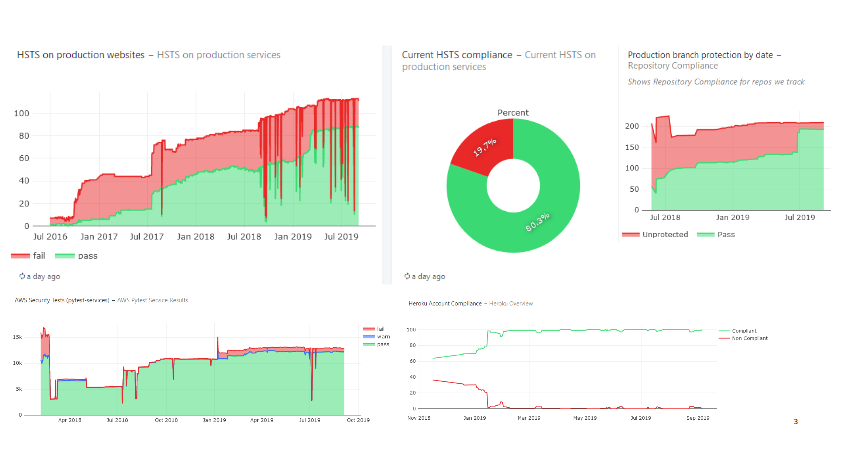
I pull up our security metrics and give the main dashboard a quick glance before answering that, yes, I think reducing our investment in infrastructure security makes sense right now. We can free up those resources to work on other areas that need help.
Infrastructure security is probably where security teams all over the industry spend the majority of their time. It’s certainly where, in the pre-cloud era, they use to spend most of their time.

Up until recently, this was true for my group as well. But after years of working closely with ops on hardening our AWS accounts, improving logging, integrating security testing in deployments, secrets managements, instances updates, and so on, we have reached the point where things are pretty darn good. Instead of implementing new infrastructure security controls, we spend most of our time making sure the controls that exist don’t regress.
It didn’t use to be this way
Please join us in congratulating Yamama Shakaa, our Rep of the Month for August 2019!
Yamama is from Nablus, Palestine. She is a teacher and has become a very active Mozillian, she joined the Reps program in November 2018 and is also part of the Mozilla Tech Speaker program. She keeps contributing deeply in the program as Reps Resources member.

She also contributes a lot to WebVR, A-frame, and Common Voice. Like many teachers around the world she inspires many people – especially school girls in her region by teaching them how to solve problems through lines of code.
Congratulations and keep rocking the open web! 
https://blog.mozilla.org/mozillareps/2019/09/30/rep-of-the-month-august-2019/
Creating experiences that look and work great across different browsers is one of the biggest challenges on the web. It also is the most rewarding part, as it gets your app to as many users as possible. On the other hand, cross-browser compatibility is also the web’s biggest frustration. Testing legacy browsers late in the development process can break a feature that you spent hours on, even requiring rewrites to fix.
What if the tools in your primary development browser could warn you sooner? Thanks to Webhint in Firefox DevTools, we can do exactly that, and more.
The Webhint engine
Webhint provides feedback about your site’s compatibility, performance, security, and accessibility to guide improvements. A key benefit is integration across the development cycle — while you author in VS Code, test in CI/CD automation, or benchmark sites in the online scanner. Having Webhint available in DevTools adds in-page context and inspection capabilities.

Firefox DevTools was happy to collaborate with the Webhint team, which just released version 1.0 of their extension. With the recommendations that the DevTools panel provides, developers on any browser (there is also a Chrome extension) can spend less time looking up cross-browser compatibility tables like caniuse or MDN. The cross-browser guidance for CSS and HTML, a core part of the 1.0 release, is also one of the first projects to apply MDN’s browser-compat-data on code to detect compatibility.
The foundation to build on
The hints are not rules written in stone. In fact, the hint engine is extensible by design so developers can capture their own expertise and best practices for their projects. We also have plans to tweak the heuristics behind recommendations, especially for new ground like compatibility, based on your feedback. We are also working to integrate recommendations further into DevTools. Everything should be at your fingertips when you need it.
Wrapping up
Install Webhint for Firefox, Chrome or Edge (Chromium) and run it against your old and new projects. Find out how you could further optimize compatibility, security, accessibility, and speed. We hope it will help you to make your site work for as many users as possible.
The post WebHint in Firefox DevTools: Improve Compatibility, Accessibility and more appeared first on Mozilla Hacks - the Web developer blog.
Just a note that I’ve decided to step back from metrics graphics maintenance for the time being, which means that the project is essentially unowned. This has sort of been the case for a while, but I figured I should probably make it official.
If you follow the link to the metrics graphics repository, you’ll note that the version has been bumped to “3.0-alpha3”. I was this close to making one last new release this afternoon but decided I didn’t want to potentially break existing users who were fine using the last “official” version (v3.0 bumps the version of d3 used to “5”, among other breaking changes). I’d encourage people who want to continue using the library to make a fork and publish a copy under their user or organization name on npm.