TenFourFox Feature Parity Release 18 beta 1 is now available (downloads, hashes, release notes). As promised, the biggest change in this release is to TenFourFox's Reader mode. Reader mode uses Mozilla Readability to display a stripped-down version of the page with (hopefully) the salient content, just the salient content, and no crap or cruft. This has obvious advantages for old systems like ours because Reader mode pages are smaller and substantially simpler, don't run JavaScript, and help to wallpaper over various DOM and layout deficiencies our older patched-up Firefox 45 underpinnings are starting to show a bit more.
In FPR18, Reader mode has two main changes: first, it is updated to the same release used in current versions of Firefox (I rewrote the glue module in TenFourFox so that current releases could be used unmodified, which helps maintainability), and second, Reader mode is now allowed on most web pages instead of only on ones Readability thinks it can render. By avoiding a page scan this makes the browser a teensy bit faster, but it also means that edge-case web pages that could still usefully display in Reader mode now can do so. When Reader mode can be enabled, a little "open book" icon appears in the address bar. Click that and it will turn orange and the page will switch to Reader mode. Click it again to return to the prior version of the page. Certain sites don't work well with this approach and are automatically filtered; we use the same list as Firefox. If you want the old method where the browser would scan the page first before offering reader mode, switch tenfourfox.reader.force-enable to false and reload the tab, and please mention what it was doing inappropriately so it can be investigated.
Reader mode isn't seamless, and in fairness wasn't designed to be. The most noticeable discontinuity is if you click a link within a Reader mode page, it renders that link in the regular browser (requiring you to re-enter Reader mode if you want to stay there), which kind of sucks for multipage documents. I'm considering a tweak to it such that you stay in Reader mode in a tab until you exit it but I don't know how well this would work and it would certainly alter the functionality of many pages. Post your thoughts in the comments. I might consider something like this for FPR19.
Besides the usual security updates, FPR18 also makes a minor compatibility fix to the browser and improves the comprehensiveness of removing browser data for privacy reasons. More work needs to be done on this because of currently missing APIs, but this first pass in FPR18 is a safe and easy improvement. As this is the first "fast four week" release, it will become live January 6.
I also wrote up another quickie script for those of you exploring TenFourFox's AppleScript support. Although Old Reddit appears to work just dandy with TenFourFox, the current React-based New Reddit is a basket case: it's slow, it uses newer JavaScript support that TenFourFox only allows incompletely, and its DOM is hard for extensions to navigate. If you're stuck on New Reddit and you can't read the comments because the "VIEW ENTIRE CONVERSATION" button doesn't work because React and if you work on React I hate you, you can now download Reddit Moar Comments. When the script is run, if a Reddit comments thread is in the current tab, it acts as if the View Entire Conversation button had been clicked and expands the thread. If you're like me, put the Scripts menu in the menu bar (using the AppleScript Utility), have a TenFourFox folder in your Scripts, and put this script in it so it's just a menu drop-down or two away. Don't forget to try the other possibly useful scripts in that folder, or see if you can write your own.
Merry Christmas to those of you who celebrate it, and a happy holiday to all.
http://tenfourfox.blogspot.com/2019/12/tenfourfox-fpr18b1-available.html
Reducing Treeherder’s time-to-deploy
Up until September we had been using code merges from the master branch to the production one to cause production deployments.
A merge to production would trigger few automatic steps:
- The code would get tested in the Travis CI (10 minutes or more)
- Upon success the code would be built by Heroku (few minutes)
- Upon success a Heroku release would happen (less than a minute)

If a regression was to be found on production we would either `git revert` a change out of all merged changes OR use Heroku’s rollback feature to the last known working state (without using Git).
Using `git revert` to get us back into a good state would be very slow since it would take 15–20 minutes to run through Travis, a Heroku build and a Heroku release.
On the other hand, Heroku’s rollback feature would be an immediate step as it would skip steps 1 and 2. Rolling back is possible because a previous build of a commit would still be available and only the release step would be needed .
The procedural change I proposed was to use Heroku’s promotion feature (similar to Heroku’s rollback feature). This would reuse a build from the staging app with the production app. The promotion process is a one-click button event that only executes the release step since steps 1 & 2 had already run on the staging app. Promotions would take less than a minute to be live.

This change made day to day deployments a less involved process since all deployments would take less that a minute. I’ve been quite satisfied with the change since a deployment requires less waiting around to validate a deployment.
Wishing all of my readers who celebrate it, a very happy Chanukka!
This year, Chanukka started at sundown on December 22 and runs through December 30. It coincides with Christmas. And as it so happens, the muslim mayor of London kicked off the Chanukka celebrations from a Christmas tree last night. In a world where there are so many separating thoughts and actions becoming more prominent again, endangering the free and open societies of some western countries, these connecting events are more important than ever.
Welcome to london…where the Muslim mayor of London kicks off the Jewish festival of Chanukah metre from a giant Christmas tree on one of the most famous sites in the world @JLC_uk @JewishLondon @ChabadUK @JewishNewsUK @sadiqkhan pic.twitter.com/5V8sUtaeE5
— Justin Cohen (@CohenJust) December 22, 2019
Let me close by sharing with you a musical wish for a happy Chanukka by one of my favorite bands, the Canadians Walk Off The Earth, featuring Scott Helman.
My recent frequent blogging about Gutenberg has led to some really productive changes.
One change is that my profile on WordPress.org now shows that I am also contributing to the accessibility effort. The accessibility team mostly consists of volunteers. And now, I am one of them as well.
I also started contributing more than issues to Gutenberg. I can also review and label issues and pull requests now. There are some exciting changes ahead that I helped test and review in the past few days, and I promise I’ll blog about them once they are in an official plugin release.
It is my hope that my contributions will help bring the accessibility forward in a good direction for all. I’d like to thank both the other members of the WordPress accessibility team as well as the maintainers of Gutenberg for welcoming me to the community.
https://marcozehe.de/2019/12/22/wordpress-accessibility-team-member-gutenberg-contributor/
I never got the pleasure to have met him in person, but virtually any desktop computer owes a debt to him. Not only the computers using the the 6502 microprocessor he designed, but because the 6502 was so inexpensive (especially compared against the Intel and Motorola chips it competed with) that it made the possibility of a computer in everybody's home actually feasible. Here just in the very room I'm typing this, there is a Commodore 128D, several Commodore SX-64s (with the 8502 and 6510 respectively, variants of the 6502 with on-chip I/O ports), a Commodore KIM-1, a blue-label PET 2001, an Apple IIgs (technically with a 65816, the later WDC 16-bit variant), an Atari 2600 (6507, with a reduced address bus), an Atari Lynx (with the CMOS WDC WD65SC02), and an NEC TurboExpress (Hudson HuC6280, another modified WDC 65C02, with a primitive MMU). The 6502 appeared in fact in the Nintendo Famicom/NES (Ricoh 2A03 variant) and Super Nintendo (65816) and the vast majority of Commodore home computers before the Amiga, plus the Atari 8-bit and Apple II lines. For that matter, the Commodore 1541s and 1571s separate and built-into the 128D and SX-64s have 6502 CPUs too. Most impactful was probably its appearance in the BBC Micro series which was one of the influences on the now-ubiquitous ARM architecture.
I will not recapitulate his life or biography except to say that when I saw him a number of years ago in a Skype appearance at Vintage Computer Festival East (in a big cowboy hat) he was a humble, knowledgeable and brilliant man. Computing has lost one of its most enduring pioneers, and I think it can be said without exaggeration that the personal computing era probably would not have happened without him.

http://tenfourfox.blogspot.com/2019/12/rip-chuck-peddle.html
Today, I am just quickly going to recommend you an old, but all-time reader favorite post of mine I published 4 years ago. And it is as current today as it was then, and most of it already was in the year 2000. Yes, I’m talking about the basics of web accessibility.
https://marcozehe.de/2019/12/21/recap-the-web-accessibility-basics/
2019 is special in my heart. 2019 was different than many other years to me in several ways. It was a great year! This is what 2019 was to me.
curl and wolfSSL

I quit Mozilla last year and in the beginning of the year I could announce that I joined wolfSSL. For the first time in my life I could actually work with curl on my day job. As the project turned 21 I had spent somewhere in the neighborhood of 15,000 unpaid spare time hours on it and now I could finally do it “for real”. It’s huge.
Still working from home of course. My commute is still decent.
HTTP/3

Just in November 2018 the name HTTP/3 was set and this year has been all about getting it ready. I was proud to land and promote HTTP/3 in curl just before the first browser (Chrome) announced their support. The standard is still in progress and we hope to see it ship not too long into next year.
curl
Focusing on curl full time allows a different kind of focus. I’ve landed more commits in curl during 2019 than any other year going back all the way to 2005. We also reached 25,000 commits and 3,000 forks on github.
We’ve added HTTP/3, alt-svc, parallel transfers in the curl tool, tiny-curl, fixed hundreds of bugs and much, much more. Ten days before the end of the year, I’ve authored 57% (over 700) of all the commits done in curl during 2019.
We ran our curl up conference in Prague and it was awesome.
We also (re)started our own curl Bug Bounty in 2019 together with Hackerone and paid over 1000 USD in rewards through-out the year. It was so successful we’re determined to raise the amounts significantly going into 2020.
Public speaking
I’ve done 28 talks in six countries. A crazy amount in front of a lot of people.
In media
Dagens Nyheter published this awesome article on me. I’m now shown on the internetmuseum. I was interviewed and highlighted in Bloomberg Businessweek’s “Open Source Code Will Survive the Apocalypse in an Arctic Cave” and Owen William’s Medium post The Internet Relies on People Working for Free.
When Github had their Github Universe event in November and talked about their new sponsors program on stage (which I am part of, you can sponsor me) this huge quote of mine was shown on the big screen.


VR was big this holiday season - the Oculus Go sales hit the Amazon #1 electronics device list on Black Friday, and the Oculus Quest continues to sell. But in the spirit of Mozilla's Privacy Not Included guidelines, you might be wondering: what personal information is Oculus collecting while you use your device?
Reading the Oculus privacy policy, they say that they process and collect information like
- information about your environment, physical movements, and dimensions
- location-related information
- information about people, games, content, apps, features, and experiences you interact with
- identifiers that may be unique to you
- and much much more!
That’s…a lot of data. Most of this data, like processing information about your physical movements is required for basic functionality of most MR experiences. For example, to track whether you avoid an obstacle in BeatSaber, your device needs to know the position of your head in space.
There’s a difference between processing and collecting. Like we mentioned, you can’t do much without processing certain data. Processing can either happen on the device itself, or on remote servers. Collecting data implies that it is stored remotely for a time period beyond what’s necessary for simply processing it.
Mozilla’s brand promise to our users is focused on security and privacy. So, while testing the Oculus Quest for Mozilla Mixed Reality products, we needed to know what kind of data was being sent to and from the device during a browsing session. The device has a developer mode that allows you to access advanced features by connecting it to your computer and using Android Debug Bridge (adb). From there, we used the developer mode and `adb` to install a custom trusted root certificate. This allows us to inspect the connections in depth.
So, what is Facebook transmitting from your device back to Facebook servers during a routine browsing session? From the data we saw, they’re reporting configuration and telemetry data, such as information about how long it took to fetch resources. For example, here’s a graph of the amount of data sent over time from the Oculus VR headset back to Facebook.
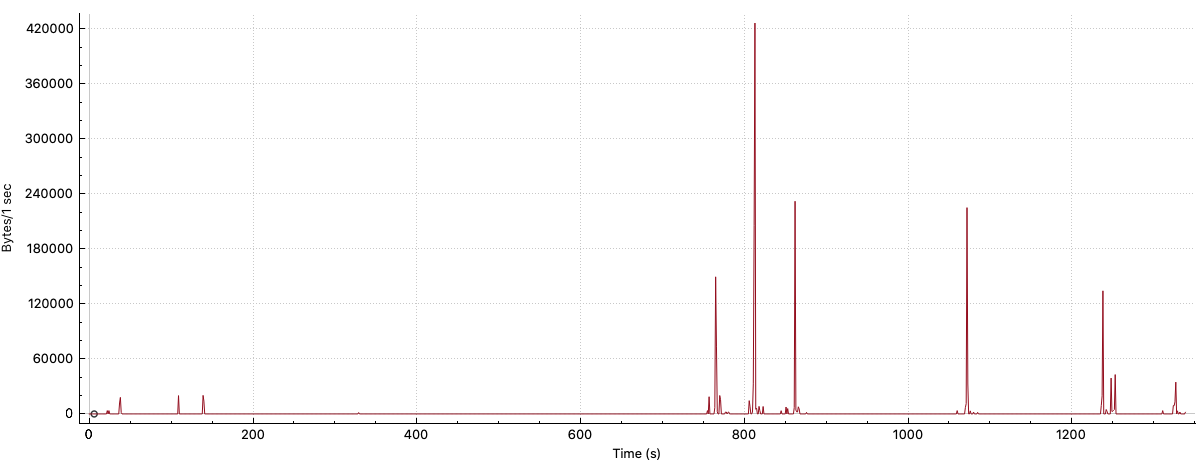
The data is identified by both an id, which is consistent across browsing sessions, and a session_id. The id appears to be linked to the device hardware, because linking a Facebook account didn’t change the identifier (or any other information as far as we detected).
In addition to general timing information, Facebook also receives reports on more granular, URL level timing information that uses a unique URL ID.
"time_to_fetch": "1",
"url_uid": "d8657582",
"firstbyte_time": "0",
Like computers, mixed reality (MR) devices can collect data on the sites you visit and applications you interact with. They also have the ability to collect and transmit large amounts of other data, including biometrically-derived data (BDD). BDD includes any information that may be inferred from biometrics, like gaze, gait, and other nonverbal communication methods. 6DOF devices like the Oculus Quest track both head and body movement. Other devices, like the MagicLeap One and HoloLens 2, also track gaze. This type of data can reveal intrinsic characteristics about users, such as their height. Information about where they look can reveal details about a user’s sexual preferences and powerful insights into their psychology. Innocuous data like facial movements during a task have been used in research to predict high or low performers.
Fortunately, even though its privacy policy would allow it to, today Facebook does not appear to

In 2019 I did more public speaking than I’ve ever than before in a single year: 28 public appearances. More than 4,500 persons have seen my presentations live at both huge events (like 1,200 in the audience at FOSDEM 2019) but also some very small and up-close occasions. Many thousands more have also seen video recordings of some of the talks – my most viewed youtube talk of 2019 has been seen over 58,000 times. Do I need to say that it was about HTTP/3, a topic that was my most common one to talk about through-out the year? I suspect the desire to listen and learn more about that protocol version is far from saturated out there…
Cities

During the year I’ve done presentations in
Barcelona, Brussels, Copenhagen, Gothenburg, Mainz, Prague, Stockholm and Umea.
I’ve did many in Stockholm, two in Copenhagen.
Countries

During the year I’ve done presentations in
Belgium, Czechia, Denmark, Germany, Spain and Sweden.
Most of my talks were held in Sweden. I did one streamed from my home office!
Topics

14 of these talks had a title that included “HTTP/3” (example)
9 talks had “curl” in the title (one of them also had HTTP/3 in it) (example)
4 talks involved DNS-over-HTTPS (example)
2 talks were about writing secure code (example)
Talks in 2020

There will be talks by me in 2020 as well as the planning . Probably just a little bit fewer of them!
Invite me?
Sure, please invite me and I will consider it. I’ve written down some suggestions on how to do this the best way.

(The top image is from Fullstackfest 2019)
Please note some of the information provided in this report may be subject to change as we are sometimes sharing information about projects that are still in early stages and are not final yet.
New community/locales added
- Kabardian
New content and projects
What’s new or coming up in Firefox desktop
Firefox 72 is currently in Beta. The deadline to ship localization changes in this version is approaching fast, and will be on December 24th. For the next version, the deadline will be on January 28th.
Most of the new strings are in the onboarding and Content Feature Recommendations (CFR). You can see them in the What’s New panel in the app menu.

What’s new or coming up in mobile
There is a lot going on with mobile these days, especially in regards to the transition of Firefox for Android browser (internal name Fennec) to a brand new browser (currently Firefox Preview, internal name Fenix).
Since the transition is expected to happen some time early 2020 (exact plans are still being discussed internally), we wanted to make a call to action to localizers to start now. We are still waiting for the in-app language switcher to be implemented, but since it is planned for very soon, we think it’s important that localizers get access to strings so they can complete and test their work in time for the actual release of Fenix (final name to be determined still).
The full details about all this can be found in this thread here. Please reach out directly to Delphine in order to activate Fenix in Pontoon for your locale (requests from managers only please), or if you have any questions.
Looking forwards to the best localized Android browser yet!
What’s new or coming up in web projects
Mozilla.org
We added a few more pages recently. Though some pages are quite long, they do contain a lot of useful information on the advantages of using Firefox over other browsers. They come in handy when you want to promote Firefox products in your language.
New:
- firefox/compare.lang
- firefox/windows-64-bit.lang
- firefox/welcome/page5.lang
Updates:
- firefox/campaign-trailhead.lang
- firefox/new/trailhead.lang
- firefox/products/developer-quantum.lang
WebThings Gateway
This is a brand new product. The Mozilla WebThings is an open platform for monitoring and controlling devices over the web. It is a software distribution for smart home gateways focused on privacy, security and interoperability.Essentially, it is a smart home platform for bridging new and existing Internet of Things (IoT) devices to the web in a private and secure way.
More information can be found on the website. Speaking of the website, there is a plan to make the site localizable early next year. Stay tuned!
The initial localized content was imported from GitHub, content localized by contributors. Once imported, the localized content is by default in “translated” state. Locale managers and translators, please review these strings soon as they go directly to production.
What’s new or coming up in SuMo
This past month has been really busy for the community and for our content manager, we got new and updated articles for Firefox 71 on desktop and the release of many products on mobile: Firefox Preview and Firefox Lite.
Following is a selection of interesting new articles that have been translated:
- For Firefox Lite
- For Firefox 71
More and more people are using smart speakers everyday. But how are they really using them? Tawfiq Ammari, a doctoral candidate at the University of Michigan, in conjunction with researchers at Mozilla and Yahoo, published a paper which sheds some light on the question. To do this, he gathered surveys and user logs from 170 Amazon Alexa and Google Home users, and interviewed another 19 users, to analyze their daily use of voice assistants.
Users of both Google Home and Alexa devices can access a log showing all the interactions they’ve had with their device. Our 170 users gave us a copy of this log after removing any personal information, which meant we could understand what people were really using their devices for, rather than just what they remembered using their devices for when asked later. Together, these logs contained around 259,164 commands.
We collected 193,665 commands on Amazon Alexa which were issued between May 2015 and August 2017, a period of 851 days. On average, the datasets for our 82 Amazon Alexa users span 210 days. On the days when they used their VA, Alexa users issued, on average,18.2 commands per day. We collected 65,499 commands on Google Home between September 2016 and July 2017, a period of 293 days. On average, the datasets for each of the 88 Google Home users spans 110 days. On days when they used their VA,Google Home users issued, on average, 23.2 commands per day with a median of 10.0 commands per day.
For both Amazon Alexa and Google Home, the top three command categories were listening to music, hands-free search, and controlling IoT devices. The most prevalent command for Amazon Alexa was listening to music, while Google Home was used most for hands-free search. We also found a lot of items in the logs reflecting that both devices didn’t often understand queries, or mis-heard other conversation as commands — that’s 17% in the case of Google Home and 11% in the case of Alexa, although those aren’t quite comparable because of the way that each device logs errors.
People used their smart speakers for all sorts of searches. For example, some of our respondents use VAs to convert measurement units while cooking. Others used their VAs to look up trivia with friends. Users also searched for an artist who sang a particular song, or looked for a music album under a specific genre (e.g., classical music).
The third largest category was controlling Internet of Things (IoT) devices, making up about 10% of the Google Home commands and about 17% of the Alexa commands. These were most frequently turning smart lights on and off, although also included controlling smart thermostats and changing light colors. Users told us in interviews that they were frustrated by some of the aspects of IoT control. For example, Brad told us that he was frustrated that when he asked the smart speaker in his kitchen to “turn the light off,” it wouldn’t work. He had to tell it to “turn the kitchen light off”.
We also found a long list of particular uses of smart speakers: asking for jokes, weather reports, and setting timers or alarms, for example. One thing we found interesting was that on both platforms there were nearly twice as many requests to turn the volume down than requests to turn the volume up, which suggests that default volume levels may be set too high for most homes.
Despite their use of voice assistants, our interviewees had some real concerns about their voice assistants. Both Amazon Alexa and Google Home provide user logs where users can view their voice commands. They both also provide a feature to “mute” their VAs. While most of our survey respondents were aware of the user history logs (~70%), more than a quarter of our respondents did not know that they could delete entries in their logs and only a small minority (~11%) had viewed or deleted entries in their logs.
Users also worried about whether their voice assistant was “listening all the time.” This was particularly contentious when family members and friends became “secondary users” of the voice assistant just by being in the same physical space. For example, Harriet told us that her “in-laws were mortified that someone could hack in and see what I’m doing, but what are they going to learn?”
Other users were worried about how their data was being processed on cloud services and shared with third party apps. John noted that he was concerned about how VAs “reach out to…third party services” when for example asking about the weather. He was concerned that he knew very little about what information is sent to third party services and how these data are stored.
While Mozilla has no plans to make a smart speaker, we do think it’s important to share our research as part of our mission to ensure that the Internet is a public resource, open and
Ah, the holiday season. It’s the time of year when we celebrate with family and friends, eat delicious meals, and repeat that magical phrase: did you try turning it on … Read more
The post Survive the holidays at home with our tech support guide appeared first on The Firefox Frontier.

[ This first appeared over on the Mozilla community discourse forums. ]
You can scroll down to the punchline if you like, but I want to start by thanking the Mozilla community, contributors, industry partners and colleagues alike, for the work everyone has put into this. Hundreds of invested people have weighed in on our hard requirements, nice-to-haves and long term goals, and tested our candidates with an eye not just to our immediate technical and community needs but to Mozilla’s mission, our tools as an expression of our values and a vision of a better future. Having so many people show up and give a damn has a rewarding, inspiring experience, and I’m grateful for the trust and patience everyone involved has shown us in helping us get this over the line.
We knew from the beginning that this was going to be a hard process; that it had to be not just transparent but open, not just legitimate but seen to be legitimate, that we had to meet our hard operational requirements while staying true to our values in the process. Today, after almost a year of research, consulting, gathering requirements, testing candidate stacks and distilling everything we’ve learned in the process down to the essentials, I think we’ve accomplished that.
I am delighted and honored to say that we have one candidate that unambiguously meets our institutional and operational needs: we have decided to replace IRC with Riot/Matrix, hosted by Modular.IM.
While all of the candidates proved to be excellent team collaboration and communication tools, Riot/Matrix has distinguished itself as an excellent open community collaboration tool, with robust support for accessibility and community safety that offers more agency and autonomy to the participants, teams and communities that make up Mozilla.
That Matrix gives individual community members effective tools for both reporting violations of Mozilla’s Community Participation Guidelines (“CPG”) and securing their own safety weighed heavily in our decision-making. While all of the candidates offered robust, mature APIs that would meet the needs of our developer, infrastructure and developer productivity teams, Riot/Matrix was the only candidate that included CPG reporting and enforcement tooling as a standard part of their offering, offering individual users the opportunity to raise their own shields on their own terms as well as supporting the general health and safety of the community.
Riot/Matrix was also the preferred choice of our accessibility team. Mozilla is committed to building a company, a community and a web without second class citizens, and from the beginning the accessibility team’s endorsement was a hard requirement for this process.
Speaking personally, it is an enormous relief that we weren’t forced to make “pick-two” sort of choice between community safety, developer support and accessibility, and it is a testament to the hard work the Matrix team has done that we can have all three.
Now that we’ve made our decision and formalized our relationship with the Modular.IM team, we’ll be standing up the new service in January. Soon after that we’ll start migrating tooling and forums over to the new system, and as previously mentioned no later than March of next year, we’ll shut down IRC.mozilla.org.
Thank you all for your help getting us here; I’m looking forward to seeing you on the new system.
– mhoye

We are currently seeing two changes in computing: improvements in network bandwidth and latency brought on by the deployment of 5G networks, and a large number of low-power mobile devices and headsets. This provides an opportunity for rich web experiences, driven by off-device computing and rendering, delivered over a network to a lightweight user agent.
As we’ve improved our Firefox Reality browser for VR headsets and the content available on the web kept getting better, we have learned that the biggest things limiting more usage are the battery life and compute capabilities of head-worn devices. These are designed to be as lightweight, cool, and comfortable as possible - which is directly at odds with hours of heavy content consumption. Whether it’s for VR headsets or AR headsets, offloading the computation to a separate high-end machine that renders and encodes the content suitable for viewing on a mobile device or headset can enable potentially massive scenes to be rendered and streamed even to low-end devices.

Mozilla’s Mixed Reality team has been working on embedding Servo, a modern web engine which can take advantage of modern CPU and GPU architectures, into GStreamer, a streaming media platform capable of producing video in a variety of formats using hardware-accelerated encoding pipelines. We have a proof-of-concept implementation that uses Servo as a back end, rendering web content to a GStreamer pipeline, from which it can be encoded and streamed across a network. The plugin is designed to make use of GPUs for hardware-accelerated graphics and video encoding, and will avoid unnecessary readback from the GPU to the CPU which can otherwise lead to high power consumption, low frame rates, and additional latency. Together with Mozilla’s Webrender, this means web content will be rendered from CSS through to streaming video without ever leaving the GPU.
Today, the GStreamer Servo plugin is available from our Github repo, and can be used to stream 2D non-interactive video content across a network. This is still a work in progress! We are hoping to add immersive, interactive experiences, which will make it possible to view richer content on a wide set of mobile devices and headsets. Contact mr@mozilla.com if you’re looking for specific support for your hardware or platform!
A couple of weeks ago, I posted a set of questions about the Internet Society’s plan to sell the non-profit Public Interest Registry (PIR) to Ethos capital here on the Mozilla blog.
As the EFF recently explained, the stakes of who runs PIR are high. PIR manages all of the dot org domain names in the world. It is the steward responsible for ensuring millions of public interest orgs have domain names with reliable uptime and freedom from censorship.
The importance of good dot org stewardship spurred not only Mozilla but also groups like EFF, Packet Clearing House and ICANN itself to raise serious questions about the sale.
As I noted in our original post, a private entity managing the dot org registry isn’t an inherently bad thing — but the bar for it being a good thing is pretty high. Strong rights protections, price controls and accountability mechanisms would need to be in place for a privately run PIR to be trusted by the dot org community. Aimed at the Internet Society, Ethos and ICANN, our questions focused on these topics, as well as the bidding process around the sale.
On Monday, Ethos CEO Erik Brooks published a blog post replying to Mozilla’s questions. The public response is appreciated — an open conversation means more oversight and more public engagement.
However, there are still critical questions about accountability and the bidding process that have yet to be answered before we can say whether this sale is good or bad for public interest organizations. These questions include:
1. For the Internet Society: what criteria, in addition to price, were used to review the bids for the purchase of PIR? Were the ICANN criteria originally applied to dot org bidders in 2002 considered? We realize that ISOC may not be able to disclose the specific bidders, but it’s well within reason to disclose the criteria that guided those bidders.
2. For Ethos: will accountability mechanisms such as the Stewardship Council and the incorporation of PIR as a public benefit corporation be in place before the sale closes? And, will outside parties be able to provide feedback on the charters for the B-corp before they are finalized? Both are essential if the mechanisms are going to be credible.
3. Finally, and possibly most importantly, for ICANN: will you put a new PIR contract in place as a condition of approving the deal? If so, will it provide robust oversight and accountability measures related to service quality and censorship issues?
We need much more information — and action — about this deal before it goes ahead. It is essential that Ethos and the Internet Society not close the PIR deal — and that ICANN does not approve the deal — until there are clear, strong provisions in place that protect service quality, prevent censorship and satisfy the dot org community.
As I wrote in my previous blog, Mozilla understands that a balance between commercial profit and public benefit is critical to a healthy internet. Much of the internet is and should be commercial. But significant parts of the internet — like the dot org ecosystem — must remain dedicated to the public interest.
The post More Questions About .org appeared first on The Mozilla Blog.
https://blog.mozilla.org/blog/2019/12/19/more-questions-about-org/