Previous command line options of the week.
--remote-time is a boolean flag using the -R short option. This option was added to curl 7.9 back in September 2001.
Downloading a file
One of the most basic curl use cases is “downloading a file”. When the URL identifies a specific remote resource and the command line transfers the data of that resource to the local file system:
curl https://example.com/file -O
This command line will then copy every single byte of that file and create a duplicated resource locally – with a time stamp using the current time. Having this time stamp as a default seems natural as it was created just now and it makes it work fine with other options such as --time-cond.
Use the remote file’s time stamp please
There are times when you rather want the download to get the exact same modification date and time as the remote file has. We made --remote-time do that.
By adding this command line option, curl will figure out the exact date and time of the remote file and set that same time stamp on the file it creates locally.
This option works with several protocols, including FTP, but there are and will be many situations in which curl cannot figure out the remote time – sometimes simply because the server won’t tell – and then curl will simply not be able to copy the time stamp and it will instead keep the current date and time.
Not be default
This option is not by default because.
- curl mimics known tools like cp which creates a new file stamp by default.
- For some protocols it requires an extra operation which then can be avoided if the time stamp isn’t actually used for anything.
Combine this with…
As mentioned briefly above, the --remote-time command line option can be really useful to combine with the --time-cond flag. An example of a practical use case for this is a command line that you can invoke repeatedly, but only downloads the new file in case it was updated remotely since the previous time it was downloaded! Like this:
curl --remote-name --time-cond cacert.pem https://curl.haxx.se/ca/cacert.pem
This particular example comes from the curl’s CA extract web page and downloads the latest Mozilla CA store as a PEM file.
https://daniel.haxx.se/blog/2020/06/29/curl-ootw-remote-time/
Thunderbird Conversations is an add-on for Thunderbird that provides a conversation view for messages. It groups message threads together, including those stored in different folders, and allows easier reading and control for a more efficient workflow.

Over the last couple of years, Conversations has been largely rewritten to adapt to changes in Thunderbird’s architecture for add-ons. Conversations 3.1 is the result of that effort so far.

The new version will work with Thunderbird 68, and Thunderbird 78 that will be released soon.

The one feature that is currently missing after the rewrite is inline quick reply. This has been of lower priority, as we have focussed on being able to keep the main part of the add-on running with the newer versions of Thunderbird. However, now that 3.1 is stable, I hope to be able to start work on a new version of quick reply soon.
More rewriting will also be continuing for the foreseeable future to further support Thunderbird’s new architecture. I’m planning a more technical blog post about this in future.
If you find an issue, or would like to help contribute to Conversations’ code, please head over to our GitHub repository.
The post Thunderbird Conversations 3.1 Released appeared first on Standard8's Blog.
https://www.thebanners.uk/standard8/2020/06/28/thunderbird-conversations-3-1-released/
TenFourFox Feature Parity Release 24 final is now available for testing (downloads, hashes, release notes). There are no additional changes other than outstanding security updates. Assuming all goes well, it will go live on Monday afternoon/evening Pacific time.
I don't have a clear direction for FPR25. As I said, a lot of the low hanging fruit is already picked, and some of the bigger projects are probably too big for a single developer trying to keep up with monthly releases (and do not lend themselves well to progressive implementation). I'll do some pondering in the meantime.
http://tenfourfox.blogspot.com/2020/06/tenfourfox-fpr24-available.html
 Yesterday Mozilla and Comcast announced that Comcast was the latest member of Mozilla’s Trusted Recursive Resolver program, joining current partners Cloudflare and NextDNS. Comcast is the first Internet Service Provider (ISP) to become a TRR and this represents a new phase in our DoH/TRR deployment.
What does this mean?
When Mozilla first started looking at how to deploy DoH we quickly realized that it wasn’t enough to just encrypt the data; we had to ensure that Firefox used a resolver which they could trust. To do this, we created the Trusted Recursive Resolver (TRR) program which allowed us to partner with specific resolvers committed to strong policies for protecting user data. We selected Cloudflare as our first TRR (and the current default) because they shared our commitment to user privacy and security because we knew that they were able to handle as much traffic as we could send them. This allowed us to provide secure DNS resolution to as many users as possible but also meant changing people’s resolver to Cloudflare. We know that there have been some concerns about this. In particular:
- It may result in less optimal traffic routing. Some ISP resolvers cooperate with CDNs and other big services to steer traffic to local servers. This is harder (though not impossible) for Cloudflare to do because they have less knowledge of the local network. Our measurements haven’t shown this to be a problem but it’s still a possible concern.
- If the ISP is providing value added services (e.g., malware blocking or parental controls) via DNS, then these stop working. Firefox tries to avoid enabling DoH in these cases because we don’t want to break services we know people have opted into, but we know those mechanisms are imperfect.
If we were able to verify that the ISP had strong privacy policies then we could use their resolver instead of a public resolver like Cloudflare. Verifying this would of course require that the ISP deploy DoH — which more and more ISPs are doing — and join our TRR program, which is exactly what Comcast has done. Over the next few months we’ll be experimenting with using Comcast’s DoH resolver when we detect that we are on a Comcast network.
How does it work?
Jason Livingood from Comcast and I have published an Internet-Draft describing how resolver selection works, but here’s the short version of what we’re going to be experimenting with. Note: this is all written in the present tense, but we haven’t rolled the experiment out just yet, so this isn’t what’s happening now. It’s also US only, because this is the only place where we have DoH on by default.
First, Comcast inserts a new DNS record on their own recursive resolver for a “special use” domain called doh.test with a value of doh-discovery.xfinity.com The meaning of this record is just “this network supports DoH and here is the name of the resolver.”
When Firefox joins a network, it uses the ordinary system resolver to look up doh.test. If there’s nothing there, then it just uses the default TRR (currently Cloudflare). However, if there is a record there, Firefox looks it up in an internal list of TRRs. If there is a match to Comcast (or a future ISP TRR) then we use that TRR instead. Otherwise, we fall back to the default.
What’s special about the “doh.test” name is that nobody owns “.test”; it’s specifically reserved for local use so it’s fine for Comcast to put its own data there. If another ISP were to want to do the same thing, they would populate doh.test with their own resolver name. This means that Firefox can do the same check on every network.
The end result is that if we’re on a network whose resolver is part of our TRR program then we use that resolver. Otherwise we use the default resolver.
What is the
A while ago I tweeted the good news that we’ve handed over our largest single monetary reward yet in the curl bug-bounty program: 700 USD. We announced this security problem in association with the curl 7.71.0 release the other day.
Someone responded to me and wanted this clarified: we award 700 USD to someone for reporting a curl bug that potentially affects users on virtually every computer system out there – while Apple just days earlier awarded a researcher 100,000 USD for an Apple-specific security flaw.
The difference in “amplitude” is notable.
A bug-bounty
I think first we should start with appreciating that we have a bug-bounty program at all! Most open source projects don’t, and we didn’t have any program like this for the first twenty or so years. Our program is just getting started and we’re getting up to speed.
Donations only
How can we in the curl project hand out any money at all? We get donations from companies and individuals. This is the only source of funds we have. We can only give away rewards if we have enough donations in our fund.
When we started the bug-bounty, we also rather recently had started to get donations (to our Open Collective fund) and we were careful to not promise higher amounts than we would be able to pay, as we couldn’t be sure how many problems people would report and exactly how it would take off.
The more donations the larger the rewards
Over time it has gradually become clear that we’re getting donations at a level and frequency that far surpasses what we’re handing out as bug-bounty rewards. As a direct result of that, we’ve agreed in the the curl security team to increase the amounts.
For all security reports we get now that end up in a confirmed security advisory, we will increase the handed out award amount – until we reach a level we feel we can be proud of and stand for. I think that level should be more than 1,000 USD even for the lowest graded issues – and maybe ten times that amount for an issue graded “high”. We will however never get even within a few magnitudes of what the giants can offer.

Are we improving security-wise?
The graph with number of reported CVEs per year shows that we started to get a serious number of reports in 2013 (5 reports) and it also seems to show that we’ve passed the peak. I’m not sure we have enough enough data and evidence to back this up, but I’m convinced we do a lot of things much better in the project now that should help to keep the amount of reports down going forward. In a few years when we look back we can see if I was right.
We’re at mid year 2020 now with only two reports so far, which if we keep this rate will make this the best CVE-year after 2012. This, while we offer more money than ever for reported issues and we have a larger amount of code than ever to find problems in.

The companies surf along
One company suggests that they will chip in and pay for an increased curl bug bounty if the problem affects their use case, but for some reason the problems just never seem to affect them and I’ve pretty much stopped bothering to even ask them.
curl is shipped with a large number of operating systems and in a large number of applications but yet not even the large volume users participate in the curl bug bounty program but leave it to us (and they rarely even donate). Perhaps you can report curl security issues to them and have a chance of a higher reward?
You would possibly imagine that these companies should be keen on helping us out to indirectly secure users of their operating systems and applications, but no. We’re an open source project. They can
Committing to Data Retention and Transparency Requirements That Protect Customer Privacy
Today, Mozilla, the maker of Firefox, and Comcast have announced Comcast as the first Internet Service Provider (ISP) to provide Firefox users with private and secure encrypted Domain Name System (DNS) services through Mozilla’s Trusted Recursive Resolver (TRR) Program. Comcast has taken major steps to protect customer privacy as it works to evolve DNS resolution.
“Comcast has moved quickly to adopt DNS encryption technology and we’re excited to have them join the TRR program,” said Eric Rescorla, Firefox CTO. “Bringing ISPs into the TRR program helps us protect user privacy online without disrupting existing user experiences. We hope this sets a precedent for further cooperation between browsers and ISPs.”
For more than 35 years, DNS has served as a key mechanism for accessing sites and services on the internet. Functioning as the internet’s address book, DNS translates website names, like Firefox.com and xfinity.com, into the internet addresses that a computer understands so that the browser can load the correct website.
Over the last few years, Mozilla, Comcast, and other industry stakeholders have been working to develop, standardize, and deploy a technology called (DoH). DoH helps to protect browsing activity from interception, manipulation, and collection in the middle of the network by encrypting the DNS data.
Encrypting DNS data with DoH is the first step. A necessary second step is to require that the companies handling this data have appropriate rules in place – like the ones outlined in Mozilla’s TRR Program. This program aims to standardize requirements in three areas: limiting data collection and retention from the resolver, ensuring transparency for any data retention that does occur, and limiting any potential use of the resolver to block access or modify content. By combining the technology, DoH, with strict operational requirements for those implementing it, participants take an important step toward improving user privacy.
Comcast launched public beta testing of DoH in October 2019. Since then, the company has continued to improve the service and has collaborated with others in the industry via the Internet Engineering Task Force, the Encrypted DNS Deployment Initiative, and other industry organizations around the world. This collaboration also helps to ensure that users’ security and parental control functions that depend on DNS are not disrupted in the upgrade to encryption whenever possible. Also in October, Comcast announced a series of key privacy commitments, including reaffirming its longstanding commitment not to track the websites that customers visit or the apps they use through their broadband connections. Comcast also introduced a new Xfinity Privacy Center to help customers manage and control their privacy settings and learn about its privacy policy in detail.
“We’re proud to be the first ISP to join with Mozilla to support this important evolution of DNS privacy. Engaging with the global technology community gives us better tools to protect our customers, and partnerships like this advance our mission to make our customers’ internet experience more private and secure,” said Jason Livingood, Vice President, Technology Policy and Standards at Comcast Cable.
Comcast is the latest resolver, and the first ISP, to join Firefox’s TRR Program, joining Cloudflare and NextDNS. Mozilla began the rollout of encrypted DNS over HTTPS (DoH) by default for US-based Firefox users in February 2020, but began testing the protocol in 2018.
Adding ISPs in the TRR Program paves the way for providing customers with the security of trusted DNS resolution, while also offering the benefits of a resolver provided by their ISP such as parental control services and better optimized, localized results. Mozilla and Comcast will be jointly running tests to inform how Firefox can assign the best available TRR to each user.
The post Comcast’s Xfinity Internet Service Joins Firefox’s Trusted
By its very design the internet has accelerated the sharing of ideas and information across borders, languages, cultures and time zones. Despite the awesome reach and power of what the web has enabled, there is still no substitute for the chemistry that happens when human beings of different backgrounds and experiences come together to live and work in the same community.
Immigration brings a wealth of diverse viewpoints, drives innovation and creative thinking, and is central to building the internet into a global public resource that is open and accessible to all.
This is why the current U.S. administration’s recent actions are so troubling. On June 22, 2020 President Donald Trump issued an Executive Order suspending entry of immigrants under the premise that they present a risk to the United States’ labor market recovery from the COVID-19 pandemic. This decision will likely have far-reaching and unintended consequences for industries like Mozilla’s and throughout the country.
Technology companies, including Mozilla, rely on brilliant minds from around the globe. This mix of people and ideas has generated significant technological advances that currently fuel our global economy and will undoubtedly be essential for future economic recovery and growth.
This is also why we’re eager to see lawmakers create a permanent solution for (DACA (Deferred Action for Childhood Arrivals). We hope that in light of the recent U.S. Supreme Court ruling, the White House does not continue to pursue plans to end the program that currently protects about 700,000 young immigrants known as Dreamers from deportation. These young people were brought to the U.S. as minors, and raised and educated here. We’ve made this point before, but it bears repeating: Breaking the promise made to these young people and preventing these future leaders from having a legal pathway to citizenship is short-sighted and morally wrong. We owe it to them and to the country to give them every opportunity to succeed here in the U.S.
Immigrants have been a core part of the United States’ strength since its inception. A global pandemic hasn’t changed that. At a time when the United States is grappling with how to make right so many of the wrongs of its past, the country can’t afford to double down on policies that shut out diverse voices and contributions of people from around the world. As they have throughout the country’s history, our immigrant family members, friends, neighbors and colleagues must be allowed to continue playing a vital role in moving the U.S. forward.
The post Immigrants Remain Core to the U.S.’ Strength appeared first on The Mozilla Blog.
https://blog.mozilla.org/blog/2020/06/24/immigrants-remain-core-to-the-u-s-strength/
As June comes to a close, we wanted to share some of our favorite LGBTQ browser themes, so you can celebrate Pride well into the summer and beyond. Gay Pride … Read more
The post Celebrate Pride with these colorful browser themes for Firefox appeared first on The Firefox Frontier.
https://blog.mozilla.org/firefox/pride-browser-themes-for-firefox/
Mozilla stands with the family of companies and civil society groups calling on Facebook to take strong action to limit hateful and divisive content on their platforms. Mozilla and Firefox have not advertised on Facebook and Instagram since March of 2018, when it became clear the company wasn’t acting to improve the lack of user privacy that emerged in the Cambridge Analytica scandal.
This is a crucial time for democracy, and internet platforms must play a constructive role. That means protecting people’s privacy and not becoming a willing vehicle for misinformation, hate, and lies. Now is the time for action, and we call upon Facebook to be on the right side of history.
The post We’re proud to join #StopHateForProfit appeared first on The Mozilla Blog.
https://blog.mozilla.org/blog/2020/06/24/were-proud-to-join-stophateforprofit/
A question I got repeatedly the last couple days was, now that AARM (Apple ARM) is a thing, is the ultimate ARM-Intel-PowerPC Universal Binary possible? You bet it is! In fact, Apple already documents that you could have a five-way binary, i.e., ARM64, 32-bit PowerPC, 64-bit PowerPC, i386 and x86_64. Just build them separately and lipo them together.
But it's actually more amazing than that because you can have multiple subtypes. Besides generic PPC or PPC64, you can have binaries that run specifically on the G3 (ppc750), G4 (ppc7400 or ppc7450) or G5 (ppc970). The G5 subtype in particular can be 32-bit or 64-bit. I know this is possible because LAMEVMX is already a three-headed binary that selects the non-SIMD G3, AltiVec G4 or special superduper AltiVec G5 version at runtime from a single file. The main reason I don't do this in TenFourFox is that the resulting executable would be ginormous (as in over 500MB in size).
But ARM has an even more dizzying array of subtypes, at least nine, and the Apple ARM in the new AARM Macs will probably be a special subtype of its own. This means that theoretically a Super Duper Universal Binary ("SDUB") could have all of the following:
- ppc750
- ppc7400
- ppc7450
- ppc970 (this would work for both 32-bit and 64-bit on the G5)
- i386
- x86_64
- x86_64h (i.e., Haswell, here's an example, thanks Markus Stange for pointing this out)
- armv4t
- armv5
- armv6
- armv6m
- armv7
- armv7em
- armv7k
- armv7m
- armv7s
- whatever AARM Macs turn out to be
http://tenfourfox.blogspot.com/2020/06/the-super-duper-universal-binary.html
In the future people will use their voice to access the internet as often as they use a screen. We’re already in the early stages of this trend: As of 2016 Google reported 20% of searches on mobile devices used voice, last year smart speakers sales topped 146 million units — a 70% jump from 2018, and I’m willing to bet your mom or dad have adopted voice to make a phone call or dictate a text message.
I’ve been exploring voice interactions as the design lead for Mozilla’s Emerging Technologies team for the past two years. In that time we’ve developed Pocket Listen (a Text-to-Speech platform, capable of converting any published web article into audio) and Firefox Voice (an experiment accessing the internet with voice in the browser). This blog post is an introduction to designing for voice, based on the lessons our team learned researching and developing these projects. Luckily, if you’re a designer transitioning to working with voice, and you already have a solid design process in place, you’ll find many of your skills transfer seamlessly. But, some things are very different, so let’s dive in.
The benefits of voice
As with any design it’s best to ground the work in the value it can bring people.
The accessibility benefits to a person with a physical impairment should be clear, but voice has the opportunity to aid an even larger population. Small screens are hard to read with aging eyes, typing on a virtual keyboard can be difficult, and understanding complex technology is always a challenge. Voice is emerging as a tool to overcome these limitations, turning cumbersome tasks into simple verbal interactions.
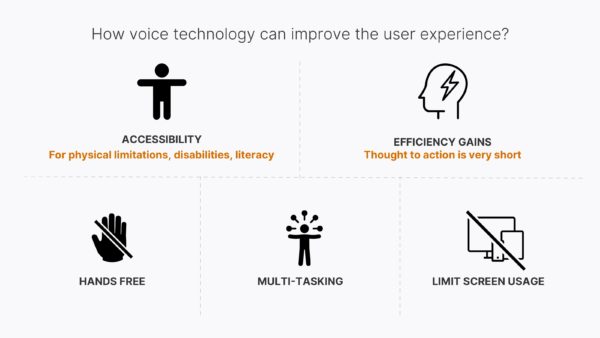
As designers, we’re often tasked with creating efficient and effortless interactions. Watch someone play music on a smart speaker and you’ll see how quickly thought turns to action when friction is removed. They don’t have to find and unlock their phone, launch an app, scroll through a list of songs and tap. Requesting a song happens in an instant with voice. A quote from one of our survey respondents summed it up perfectly:
“Being able to talk without thinking. It’s essentially effortless information ingestion.“
When is voice valuable?
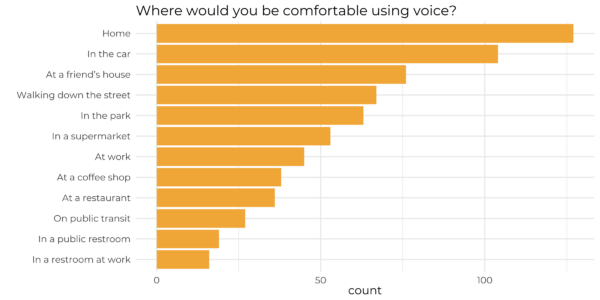
Talking out loud to a device isn’t always appropriate or socially acceptable. We see this over and over again in research and real world usage. People are generally uncomfortable talking to devices in public. The more private, the better.
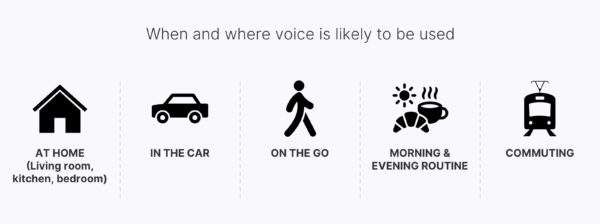
Hands-free and multi-tasking also drive voice usage — cooking, washing the dishes, or driving in a car. These situations present opportunities to use voice because our hands or eyes are otherwise occupied.
But, voice isn’t just used for giving commands. Text-to-Speech can generate content from anything written, including articles. It’s a technology we successfully used to build and deploy Pocket Listen, which allows you to listen to articles you’d saved for later.
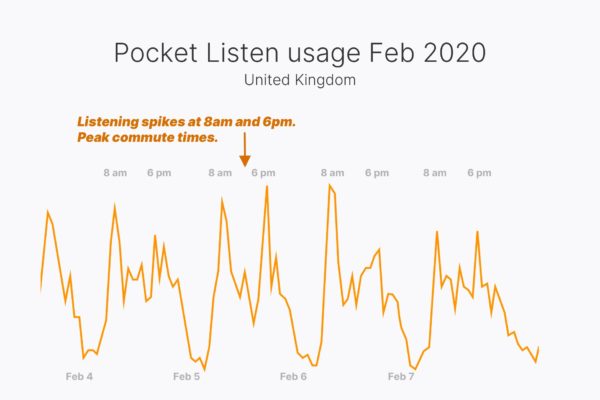
In the graph above you’ll see that people primarily use Pocket Listen while commuting. By creating a new format to deliver the content, we’ve expanded when and where the product provides value.
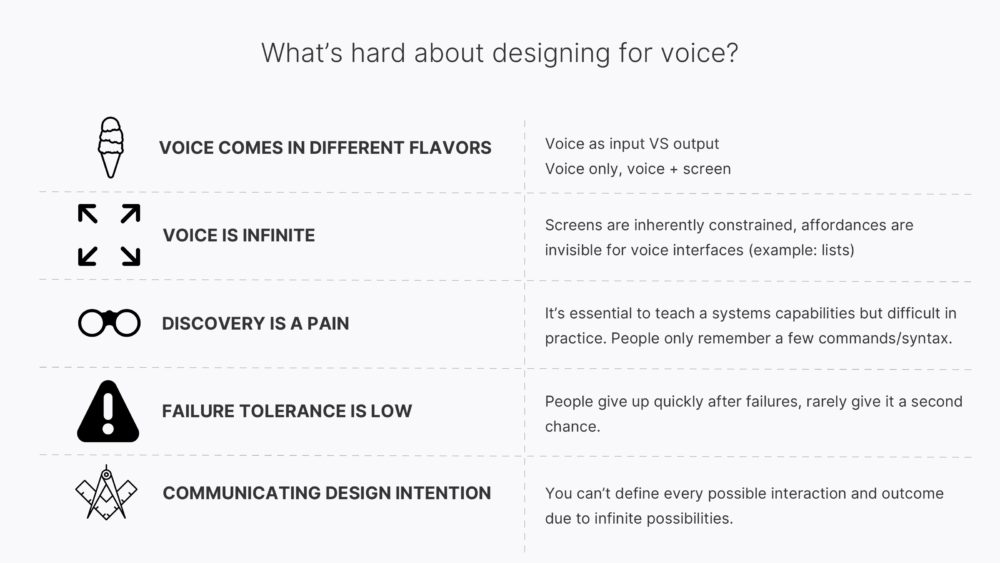
Why is designing for voice hard?
Now that you know ‘why’ and ‘when’ voice is valuable, let’s talk about what makes it hard. These are the pitfalls to watch for when building a voice product.
We’re excited about this week’s news from OKdo, highlighting a new kit built around Mozilla’s WebThings Gateway. OKdo is a UK-based global technology company focused on IoT offerings for hobbyists, educators, and entrepreneurs. Their idea is to make it easy to get a private and secure “web of things” environment up and running in either home or classroom. OKdo chose to build this kit around the Mozilla WebThings Gateway, and we’ve been delighted to work with them on it.
The WebThings Gateway is an open source software distribution focused on privacy, security, and interoperability. It provides a web-based user interface to monitor and control smart home devices, along with a rules engine to automate them. In addition, a data logging subsystem monitors device changes over time. Thanks to extensive contributions from our open source community, you’ll find an add-on system to extend the gateway with support for a wide range of existing smart home products.
With the WebThings Gateway, users always have complete control. You can directly monitor and control your home and devices over the web. In fact, you’ll never have to share data with a cloud service or vendor. This diagram of our architecture shows how it works:

Mozilla WebThings Gateway Kit details
The Mozilla WebThings Gateway Kit, available now from OKdo, includes:
- Raspberry Pi 4 and case
- MicroSD card pre-flashed with Mozilla WebThings Gateway software
- Power supply
- “Getting Started Guide” to help you easily get your project up and running

You can find out more about the OKdo kit and how to purchase it for either home or classroom from their website.
To learn more about WebThings, visit Mozilla’s IoT website or join in the discussion on Discourse. WebThings is completely open source. All of our code is freely available on GitHub. We would love to have you join the community by filing issues, fixing bugs, implementing new features, or adding support for new devices. Also, you can help spread the word about WebThings by giving talks at conferences or local maker groups.
The post Mozilla WebThings Gateway Kit by OKdo appeared first on Mozilla Hacks - the Web developer blog.
https://hacks.mozilla.org/2020/06/mozilla-webthings-gateway-kit-by-okdo/
Welcome to the “prose version” of the curl 7.71.0 change log. There’s just been eight short weeks since I last blogged abut a curl release but here we are again and there’s quite a lot to say about this new one.
Presentation
Numbers
the 192nd release
4 changes
56 days (total: 8,132)
136 bug fixes (total: 6,209)
244 commits (total: 25,911)
0 new public libcurl function (total: 82)
7 new curl_easy_setopt() option (total: 277)
1 new curl command line option (total: 232)
59 contributors, 33 new (total: 2,202)
33 authors, 17 new (total: 803)
2 security fixes (total: 94)
1,100 USD paid in Bug Bounties
Security
CVE-2020-8169 Partial password leak over DNS on HTTP redirect
This is a nasty bug in user credential handling when doing authentication and HTTP redirects, which can lead to a part pf the password being prepended to the host name when doing name resolving, thus leaking it over the network and to the DNS server.
This bug was reported and we fixed it in public – and then someone else pointed out the security angle of it! Just shows my lack of imagination. As a result, even though this was a bug already reported – and fixed – and therefor technically not subject for a bug bounty, we decide to still reward the reporter, just maybe not with the full amount this would otherwise had received. We awarded the reporter 400 USD.
CVE-2020-8177 curl overwrite local file with -J
When curl -J is used it doesn’t work together with -i and there’s a check that prevents it from getting used. The check was flawed and could be circumvented, which the effect that a server that provides a file name in a Content-Disposition: header could overwrite a local file, since the check for an existing local file was done in the code for receiving a body – as -i wasn’t supposed to work… We awarded the reporter 700 USD.
Changes
We’re counting four “changes” this release.
CURLSSLOPT_NATIVE_CA – this is a new (experimental) flag that allows libcurl on Windows, built to use OpenSSL to use the Windows native CA store when verifying server certificates. See CURLOPT_SSL_OPTIONS. This option is marked experimental as we didn’t decide in time exactly how this new ability should relate to the existing CA store path options, so if you have opinions on this you know we’re interested!
CURLOPT-BLOBs – a new series of certificate related options have been added to libcurl. They all take blobs as arguments, which are basically just a memory area with a given size. These new options add the ability to provide certificates to libcurl entirely in memory without using files. See for example CURLOPT_SSLCERT_BLOB.
CURLOPT_PROXY_ISSUERCERT – turns out we were missing the proxy version of CURLOPT_ISSUERCERT so this completed the set. The proxy version is used for HTTPS-proxy connections.
--retry-all-errors is the new blunt tool of retries. It tells curl to retry the transfer for all and any error that might occur. For the cases where just --retry isn’t enough and you know it should work and retrying can get it through.
Interesting bug-fixes
This is yet another release with over a hundred and thirty different bug-fixes. Of course all of them have their own little story to tell but I need to filter a bit to be able to do this blog post. Here are my collected favorites, in no particular order…
- Bug-fixed happy eyeballs– turns out the happy eyeballs algorithm for doing parallel dual-stack connections (also for QUIC) still had some glitches…
- Curl_addrinfo: use one malloc instead of three – another little optimize memory allocation step. When we allocate memory for DNS cache entries and more, we now allocate the full struct in a single larger allocation instead of the previous three
Firefox Relay is a smart, easy solution that can preserve the privacy of your email address, much like a post office box for your physical address. When a form requires … Read more
The post Firefox Relay protects your email address from hackers and spammers appeared first on The Firefox Frontier.
With the release of Firefox 78, we are pleased to welcome the 34 developers who contributed their first code change to Firefox in this release, 28 of whom were brand new volunteers! Please join us in thanking each of these diligent and enthusiastic individuals, and take a look at their contributions:
- adiabtaic28394: 1632345
- chris.cushman: 1629422
- keithamus: 1599415
- kel42: 1629424
- komalbharadiya: 1505500
- nikolaoutheod: 1622657
- shashvatshah9: 1629425
- Aaryan Dewan: 1621551
- Adam Vandolder: 1640188
- Aditi Dutta: 1636408
- Andra Esanu: 1631784
- Artem: 1609556
- Benjamin Beurdouche: 1615438, 1635047
- Benoit CHAUVET: 1626753
- Chanhee Cho: 1622656
- Daniel Lu: 1541511, 1637729
- David Burns: 1639230
- David Lawrence: 1637709
- Etienne Bruines: 1553849, 1635496, 1635806, 1637619, 1637621
- Harshil: 1628358
- Jan: 1633192
- Kushal Jain: 1633511
- Kyle Knaggs: 1636798
- Luka Zitnik: 1305344
- Luke Swiderski: 1576192
- Mikael Urankar: 1634852
- Nikita Kozhemiakin: 1523544
- Ria Agnes Jose: 1633696
- Roger: 1635932
- Tarik Eshaq: 1638440
- Tilden Windsor: 1334305, 1614477, 1629423, 1629604, 1640142
- Yue Zhang: 1630610
- carnould:
On June 30th, macOS 10.9, 10.10 and 10.11 users will automatically be moved to the Firefox Extended Support Release (ESR).
While Apple doesn’t have an official policy governing security updates for older macOS releases, their ongoing practice has been to support the most recent three releases (i.e. version N, N-1, and N-2). The last security update applicable to macOS 10.11 was made available nearly 2 years ago in July 2018 (https://support.apple.com/en-us/HT201222). Unsupported operating systems receive no security updates, have known exploits, and can be dangerous to use, which makes it difficult and less than optimal to maintain Firefox for those versions.
Users do not need to take additional action to receive those updates. On June 30th, these macOS users will automatically be moved to the ESR channel through application update.
In the meantime, we strongly encourage our users to upgrade to mac OS X 10.12 or higher to benefit from the security and privacy updates.
For more information please visit the Firefox support page.
The post Update on Firefox Support for macOS 10.9, 10.10 and 10.11 appeared first on Future Releases.
Browser extensions provide a convenient and powerful way for people to take control of how they experience the web. From blocking ads to organizing tabs, extensions let people solve everyday problems and add whimsy to their online lives.
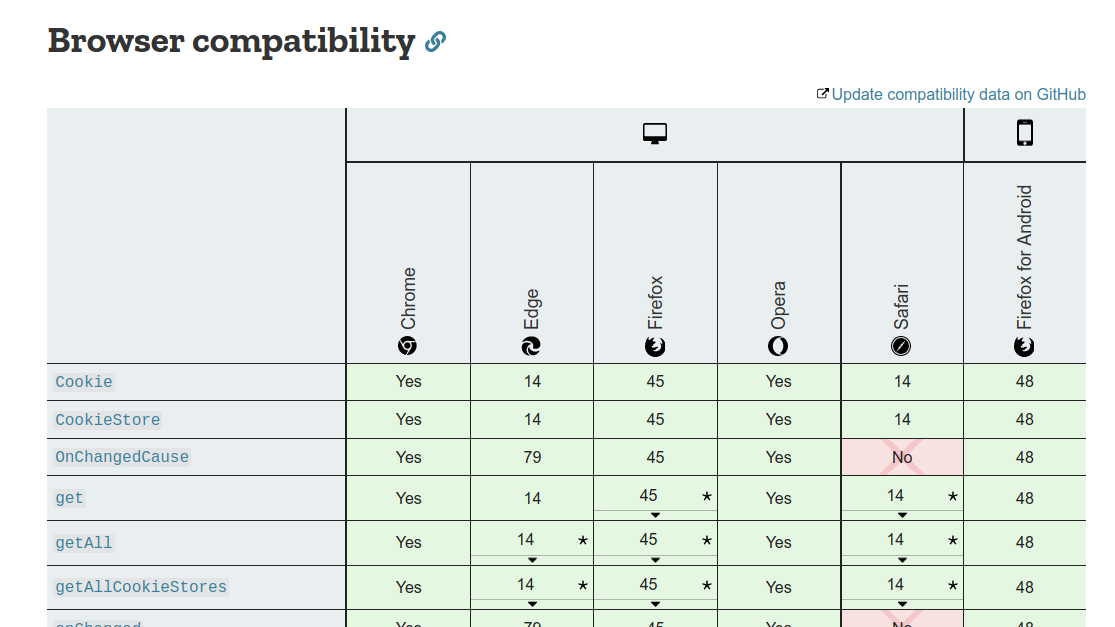
At yesterday’s WWDC event, Apple announced that Safari is adopting a web-based API for browser extensions similar to Firefox’s WebExtensions API. Built using familiar web technologies such as JavaScript, HTML, and CSS, the API makes it easy for developers to write one code base that will work in Firefox, Chrome, Opera, and Edge with minimal browser-specific changes. We’re excited to see expanded support for this common set of browser extension APIs.
What this means for you
Interested in porting your browser extension to Safari? Visit MDN to see which APIs are currently supported. Developers can start testing the new API in Safari 14 using the seed build for macOS Big Sur. The API will be available in Safari 14 on macOS Mojave and macOS Catalina in the future.
Or, maybe you’re new to browser extension development. Check out our guides and tutorials to learn more about the WebExtensions API. Then, visit Firefox Extension Workshop to find information about development tools, security best practices, and tips for creating a great user experience. Be sure to take a look at our guide for how to build a cross-browser extension.
Ready to share your extension with the world (or even just a few friends!)? Our documentation will guide you through the process of making your extension available for Firefox users.
Happy developing!
The post Welcoming Safari to the WebExtensions Community appeared first on Mozilla Hacks - the Web developer blog.
https://hacks.mozilla.org/2020/06/welcoming-safari-to-the-webextensions-community/
--connect-timeout [seconds] was added in curl 7.7 and has no short option version. The number of seconds for this option can (since 7.32.0) be specified using decimals, like 2.345.
How long to allow something to take?
curl shipped with support for the -m option already from the start. That limits the total time a user allows the entire curl operation to spend.
However, if you’re about to do a large file transfer and you don’t know how fast the network will be so how do you know how long time to allow the operation to take? In a lot of of situations, you then end up basically adding a huge margin. Like:
This operation usually takes 10 minutes, but what if everything is super overloaded at the time, let’s allow it 120 minutes to complete.
Nothing really wrong with that, but sometimes you end up noticing that something in the network or the remote server just dropped the packets and the connection wouldn’t even complete the TCP handshake within the given time allowance.
If you want your shell script to loop and try again on errors, spending 120 minutes for every lap makes it a very slow operation. Maybe there’s a better way?
Introducing the connect timeout
To help combat this problem, the --connect-timeout is a way to “stage” the timeout. This option sets the maximum time curl is allowed to spend on setting up the connection. That involves resolving the host name, connecting TCP and doing the TLS handshake. If curl hasn’t reached its “established connection” state before the connect timeout limit has been reached, the transfer will be aborted and an error is returned.
This way, you can for example allow the connect procedure to take no more than 21 seconds, but then allow the rest of the transfer to go on for a total of 120 minutes if the transfer just happens to be terribly slow.
Like this:
curl --connect-timeout 21 --max-time 7200 https://example.com
Sub-second
You can even set the connection timeout to be less than a second (with the exception of some special builds that aren’t very common) with the use of decimals.
Require the connection to be established within 650 milliseconds:
curl --connect-timeout 0.650 https://example.com
Just note that DNS, TCP and the local network conditions etc at the moment you run this command line may vary greatly, so maybe restricting the connection time a lot will have the effect that it sometimes aborts a connection a little too easily. Just beware.
A connection that stalls
If you prefer a way to detect and abort transfers that stall after a while (but maybe long before the maximum timeout is reached), you might want to look into using –limit-speed.
Also, if a connection goes down to zero bytes/second for a period of time, as in it doesn’t send any data at all, and you still want your connection and transfer to survive that, you might want to make sure that you have your –keepalive-time set correctly.
https://daniel.haxx.se/blog/2020/06/23/curl-ootw-connect-timeout/
Hello and welcome to another issue of This Week in Rust! Rust is a systems language pursuing the trifecta: safety, concurrency, and speed. This is a weekly summary of its progress and community. Want something mentioned? Tweet us at @ThisWeekInRust or send us a pull request. Want to get involved? We love contributions.
This Week in Rust is openly developed on GitHub. If you find any errors in this week's issue, please submit a PR.
Check out this week's This Week in Rust Podcast
Updates from Rust Community
News & Blog Posts
- Announcing Rust 1.44.1
- Writing Non-Trivial Macros in Rust
- Diving into Rust with a CLI
- Rust for Data-Intensive Computation
- 3K, 60fps, 130ms: achieving it with Rust
- Rust concurrency: the archetype of a message-passing bug.
- How to Design For Panic Resilience in Rust
- GitHub Action for binary crates installation
- Managing Rust bloat with Github Actions
- A multiplayer board game in Rust and WebAssembly
- Im bad at unsafe {}
- SIMD library plans
- Tips for Faster Rust Compile Times
- Rust Analyzer Changelog #30
- Building A Blockchain in Rust & Substrate: A Step-by-Step Guide for Developers
- Dart and Rust: the async story
- Decode a certificate
- Four Years of Rust At OneSignal
- How Rust Lets Us Monitor 30k API calls/min
- How to use C++ polymorphism in Rust
- Implementing a Type-safe printf in Rust
- Introduction to Rust for Node Developers
- The programming language that wants to rescue the world from dangerous code
- Property-based testing in Rust with Proptest
- Rust at CNCF
- Rust's Huge Compilation Units
- RustHorn: CHC-Based Verification for Rust Programs
Finally, Mac OS X goes to 11 with macOS Big Sur. In keeping with Apple's name selection from wildly inappropriate California landmarks, in just three versions you can go from a dusty, hostile desert to an expensive, cramped island and now steep cliffs with rugged beauty as your car goes off a substandard bridge into the Pacific Ocean.
But there's no doubt that Apple's upcoming move to ARM across all its platforms, or at least Apple's version of ARM (let's call it AARM), makes supreme business sense. And ARM being the most common RISC-descended architecture on the planet right now, it's a bittersweet moment for us Power Mac luddites (the other white meat) to see the Reality Distortion Field reject, embrace and then reject x86 once again.
Will AARM benefit Apple? You bet it will. Apple still lives in the shadow of Steve Jobs who always wanted the Mac to be an appliance, and now that Apple controls almost all of the hardware down to the silicon, there's no reason they won't do so. There's certainly benefit to the consumer: Big Sur is going to run really well on AARM because Apple can do whatever hardware tweaks, add whatever special instructions, you name it, to make the one OS the new AARM systems will run as fast and energy-efficient as possible (ironically done with talent from P. A. Semi, who was a Power ISA licensee before Apple bought them out). In fact, it may be the only OS they'll be allowed to run, because you can bet the T2 chip will be doing more and more essential tasks as application-specific hardware adds new functionality where Moore's law has failed. But the biggest win is for Apple themselves, who are no longer hobbled by Intel or IBM's respective roadmaps, and because their hardware will be sui generis will confound any of the attempts at direct (dare I say apples to apples) performance comparisons that doomed them in the past. AARM Macs will be the best machines in their class because nothing else will be in their class.
There's the darker side, too. With things like Gatekeeper, notarization and System Integrity Protection Apple has made it clear they don't want you screwing around with their computers. But the emergence of AARM platforms means Apple doesn't have to keep having the OS itself slap your hand: now the development tools and hardware can do it as well. The possibilities for low-level enforcement of system "security" policies are pretty much limitless if you even control the design of the CPU.
I might actually pick up a low-end one to play with, since I'm sort of a man without a portable platform now that my daily driver is a POWER9 (I have a MacBook Air which I tolerate because battery life, but Mojave Forever, and I'll bet runtime on these machines will be stupendous). However, the part that's the hardest to digest is that the AARM Mac, its hardware philosophy being completely unlike its immediate predecessors, is likely to be more Mac-like than any Mac that came before it save the Compact Macs. After all, remember that Jobs always wanted the Mac to be an appliance. Now, Tim Cook's going to sell you one.
http://tenfourfox.blogspot.com/2020/06/macos-big-unsure.html