Introduction
Mozilla’s history is steeped in openness and transparency – it’s simply core to what we do and how we see ourselves in the world. We are always looking for ways to bring our mission to life in ways that help create a healthy internet and support the Mozilla Manifesto. One of our commitments says “We are committed to an internet that elevates critical thinking, reasoned argument, shared knowledge, and verifiable facts”.
To this end, we have spent a good amount of time considering how we can publicly share our Mozilla telemetry data sets – it is one of the most simple and effective ways we can enable collaboration and share knowledge. But, only if it can be done safely and in a privacy protecting, principled way. We believe we’ve designed a way to do this and we are excited to outline our approach here.
Making data public not only allows us to be transparent about our data practices, but directly demonstrates how our work contributes to our mission. Having a publicly available methodology for vetting and sharing our data demonstrates our values as a company. It will also enable other research opportunities with trusted scientists, analysts, journalists, and policymakers in a way that furthers our efforts to shape an internet that benefits everyone.
Dataset Publishing Process
We want our data publishing review process, as well as our review decisions to be public and understandable, similar to our Mozilla Data Collection program. To that end, our full dataset publishing policy and details about what considerations we look at before determining what is safe to publish can be found on our wiki here. Below is a summary of the critical pieces of that process.
The goal of our data publishing process is to:
- Reduce friction for data publishing requests with low privacy risk to users;
- Have a review system of checks and balances that considers both data aggregations and data level sensitivities to determine privacy risk prior to publishing, and;
- Create a public record of these reviews, including making data and the queries that generate it publicly available and putting a link to the dataset + metadata on a public-facing Mozilla property.
Having a dataset published requires filling out a publicly available
(“This Week in Glean” is a series of blog posts that the Glean Team at Mozilla is using to try to communicate better about our work. They could be release notes, documentation, hopes, dreams, or whatever: so long as it is inspired by Glean.)
All “This Week in Glean” blog posts are listed in the TWiG index.
In the past week Alessio, Mike, Hamilton and I got together for the Glean.js workweek. Our purpose was to build a proof-of-concept of a Glean SDK that works on Javascript environments. You can expect a TWiG in the next few weeks about the outcome of that. Today I am going to talk about something that I tried out in preparation for that week: attempting to compile glean-core to Wasm.
A quick primer
glean-core
The glean-core is the heart of the Glean SDK where most of the logic and functionality of Glean lives. It is written in Rust and communicates with the language bindings in C#, Java, Swift or Python through an FFI layer. For a comprehensive overview of the Glean SDKs architecture, please refer to Jan-Erik’s great blog post and talk on the subject.
wasm
From the WebAssembly website:
“WebAssembly (abbreviated Wasm) is a binary instruction format for a stack-based virtual machine. Wasm is designed as a portable compilation target for programming languages, enabling deployment on the web for client and server applications.”
Or, from Lin Clark’s “A cartoon intro to WebAssembly”:
“WebAssembly is a way of taking code written in programming languages other than JavaScript and running that code in the browser.”
Why did I decide to do this?
On the Glean team we make an effort to move as much of the logic as possible to glean-core, so that we don’t have too much code duplication on the language bindings and guarantee standardized behaviour throughout all platforms.
Since that is the case, it was counterintuitive for me, that when we set out to build a version of Glean for the web, we wouldn’t rely on the same glean-core as all our other language bindings. The hypothesis was: let’s make JavaScript just another language binding, by making our Rust core compile to a target that runs on the browser.
Rust is notorious for making an effort to have a great Rust to Wasm experience, and the Rust and Webassembly working group has built awesome tools that make boilerplate for such projects much leaner.
First try: compile glean-core “as is” to Wasm
Since this was my first try in doing anything Wasm, I started by following MDN’s guide “Compiling from Rust to WebAssembly”, but instead of using their example “Hello, World!” Rust project, I used glean-core.
From that guide I learned about wasm-pack, a tool that deals with the complexities of compiling a Rust crate to Wasm and wasm-bindgen a tool that exposes, among many other things, the #[wasm_bindgen] attribute which, when added to a function, will make that function accessible from Javascript.
The first thing that was obvious, was that it would be much harder to try and compile glean-core directly to Wasm. Passing complex types to it has many limitations and I was not able to add the #[wasm_bindgen] attribute to trait objects or structs that contain trait objects or lifetime annotations. I needed a simpler API surface to make the connection between Rust and Javascript. Fortunately, I had that in hand: glean-ffi.
Our FFI crate exposes functions that rely on a global Glean singleton and have relatively simple signatures. These functions are the ones accessed by our language bindings through a C FFI. Most of the
Summary of a talk delivered at Apache Beam Digital Summit on August 24, 2020.

In this session, you won’t learn about joins or windows or timers or any other advanced features of Beam. Instead, we will focus on the real-world complexity that comes from simply moving data from one system to another safely. How do we model data as it passes from one transform to another? How do we handle errors? How do we test the system? How do we organize the code to make the pipeline configurable for different source and destination systems?
We will explore how each of these questions are addressed in Mozilla’s open source codebase for ingesting telemetry data from Firefox clients. By the end of the session, you’ll be equipped to explore the codebase and documentation on your own to see how these concepts are composed together.
Links
- Recording of the talk on YouTube
- Session page on beamsummit.org
- Slides from the session in Google Docs
https://jeff.klukas.net/writing/2020-09-25-the-nitty-gritty-of-moving-data-with-apache-beam/
Mozilla Webcompat Team New Management
So the Mozilla Webcompat team is entering a new era. Mike Taylor (by the time this will be published) was the manager of the webcompat team at Mozilla since August 2015. He decided to leave. Monday, September 21 was his last day. We had to file an issue about this.
The new interim manager is… well… myself.
So last week and this week will be a lot about:
- have a better understanding of the tasks and meetings that Mike was attending.
- trying to readjust schedules and understanding how to get a bit of sleep with a distributed organization which has most of its meeting toward friendly European and American time zones. Basically, all meetings are outside the reasonable working timeframe (8:00 to 17:00 Japan Time).
- trying to figure out how to switch from peer to manager with the other persons in the webcompat team. I want to remove any sources of stress.
Hence these notes restarting. I will try to keep a track of what I do and what I learn both for the public, but mostly for my team mates.
Currently the Mozilla webcompat team is composed of these wonderful people:
Regular Contributors:
- Guillaume Demesy (France)
- Kate Manning (Italy) (Hire her)
Softvision Contractors:
- Ciprian Ciocan (Romania)
- Oana Arbuzov (Romania)
Mozilla Employees:
- Dennis Schubert (Germany)
- James Graham (United Kingdom)
- Ksenia Berezina (Ontario, Canada)
- Thomas Wisniewski (Ontatio, Canada)
A lot of reading, a lot of thinking around management (probably more about that later).
I always said to Mike (and previous managers) in the past, that I was not interested in management position. But I deeply care about the webcompat project, and I want it to thrive as much as possible. I never associated management with a sense of promotion or career growth. I'm very careful about the issues that positions of power create both ways: from the manager toward the people being managed and from the people toward their manager. Power is a often tool of corruption and abuse and makes some people abandon their sense of autonomy and responsibility. The interim word in the title here is quite important. If someone more qualified wants to jump into the job, please reach out to Lonnen or Andrew Overholt. If anyone from the webcompat team is not satisfied, I will happily step down.
Last but not least, Thanks to Mike to have done this job for the last couple of years. Mike has a talent for being human and in touch with people. I wish a bright journey on his new endeavors.
Firefox Cross-Functional meeting
- Goal: Coordinate what is ready to be shipped in Firefox and keep track of the projects status
- When: Wednesday 09:00-10:00 (PDT) - Thursday 01:00-02:00 (JST) (will be 02:00-03:00 winter time)
- Frequency: Every 3 weeks
- Owner: Thomas Elin
- Notes: The meeting is using trello to track the shipping of Firefox features. The Webcompat relevant cards (Members only) need to be updated every 2 weeks (Tuesday morning Japan Time aka Monday evening for the rest of the world). I didn't attend. They have a slides deck which is not accessible to public unfortunately.
ETP workarounds for site breakage
Rachel Tublitz asked to give an update about ETP workarounds for site breakage for the What's New with Firefox 82 for the
Welcome!
New localizers
- Victor and Orif are teaming up to re-build the Tajik community.
- Th'eo of Corsican (co).
- Jonathan of Luganda (lg).
- Davud of Central Kurdish (ckb).
Are you a locale leader and want us to include new members in our upcoming reports? Contact us!
New community/locales added
New content and projects
Infrastructure and l10n.mozilla.org
As part of the effort to streamline and rationalize the localization infrastructure, following the recent lay-offs, we have decided to decommission Elmo. Elmo is the project name of what has been the backbone of our localization infrastructure for over 10 years, and its public facing part was hosted on l10n.mozilla.org (el as in “el-10-en (l10n)”, m(ozilla), o(rg) = elmo).
The practical consequences of this change are:
- There are no more sign-offs for Firefox. Beta builds are going to use the latest content available in the l10n repositories at the time of the build.
- The deadline for localization moves to the Monday before Release Candidate week. That’s 8 days before release day, and 5 full more days available for localization compared to the previous schedule. For reference, the deadline will be set to the day before in Pontoon (Sunday), since the actual merge happens in the middle of the day on Monday.
- https://10n.mozilla.org will be redirected to https://pontoon.mozilla.org/ (the 400 – Bad Gateway error currently displayed is a known problem).
What’s new or coming up in Firefox desktop
Upcoming deadlines:
- Firefox 82 is currently in beta and will be released on October 20th. The deadline to update localization is on October 11 (see above to understand why it moved closer to the release date).
As you might have noticed, the number of new strings in Firefox has significantly decreased, with DevTools becoming less actively developed. Now more than ever it’s a good time to:
- Test your builds.
- Review pending suggestions in Pontoon for your locale, in Firefox but also other projects. Firefox alone has currently over 12 thousand suggestions pending across teams, with several locales well over 500 unreviewed suggestions.
What’s new or coming up in mobile
This last month, as announced – and as you have probably noticed – we have been reducing the number, and priority, of mobile products to localize. We are now focusing much more on Firefox for Android and Firefox for iOS – our original flagship products for mobile. Please thus refer to the “star” metric on Pontoon to prioritize your work for mobile.
The Firefox for Android schedule from now on should give two weeks out of four for localization work – as it did for Focus. This means strings will be landing during two weeks in Pontoon – and then you will have two weeks to work on those strings so they can make it into the next version. Check the deadline section in Pontoon to know when the l10n deadline for the next release is.
Concerning iOS: with iOS 14 we can now set Firefox as default! Thanks to everyone who has helped localize the new strings that will enable globally this functionality.
What’s new or coming up in web projects
Common Voice
The support will continue with reduced staff. Though there won’t be new features introduced in the next six months, the team is still committed to fixing high priority bugs, adding newly requested languages, and releasing updated dataset. It will take longer to implement than before. Please follow the project’s latest update on

The latest version of Firefox Reality for standalone VR headsets brings a host of long-awaited features we're excited to reveal, as well as improved stability and performance.
Add-on support
Firefox Reality is the first and only browser to bring add-on support to the immersive web. Now you can download powerful extensions that help you take control of your VR browsing experience. We started with favorites like uBlock, Dark Reader, and Privacy Badger.
Autofill
Ever get tired of typing your passwords in the browser? This can be tedious, especially using VR headset controllers. Now, your browser can do the work of remembering and entering your passwords and other frequent form text with our autofill feature.
Redesigned library and updated status bar
We’ve completely redesigned and streamlined our library and simplified our status bar. You can also find additional information on the status bar, including indicators for the battery levels of controllers and the headset, as well as time/date info.
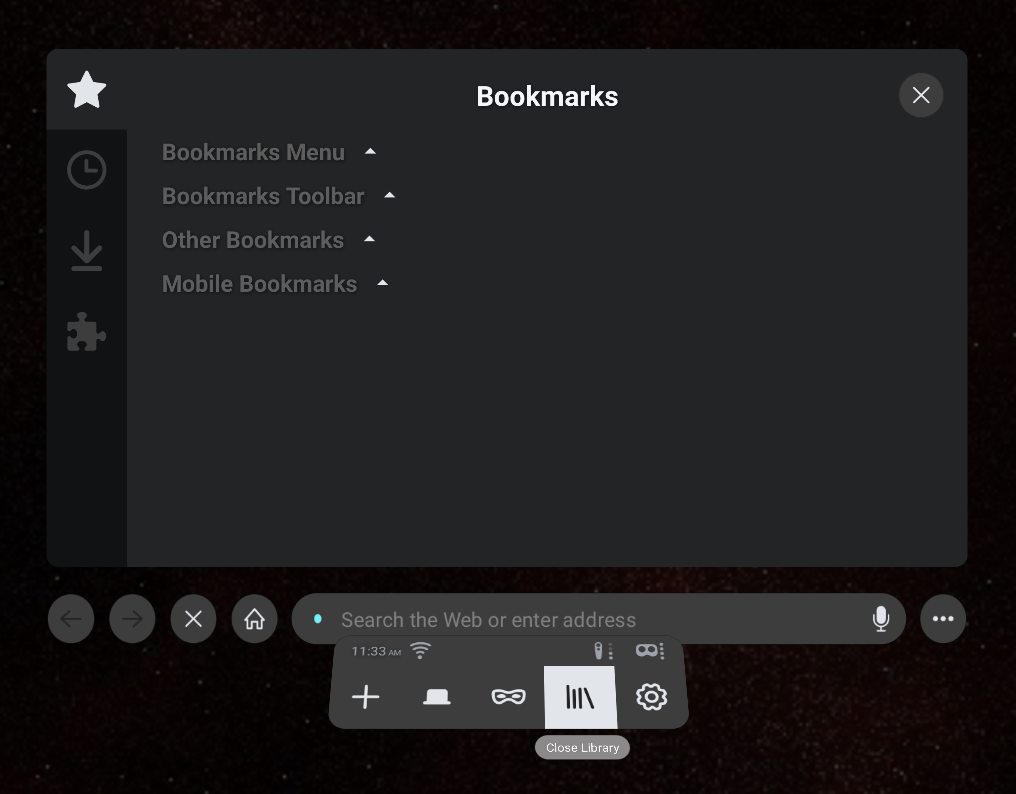
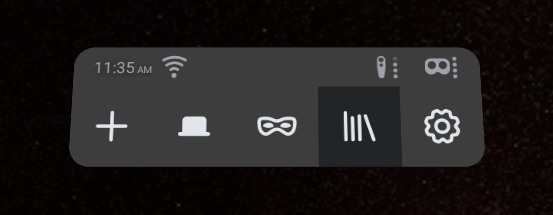
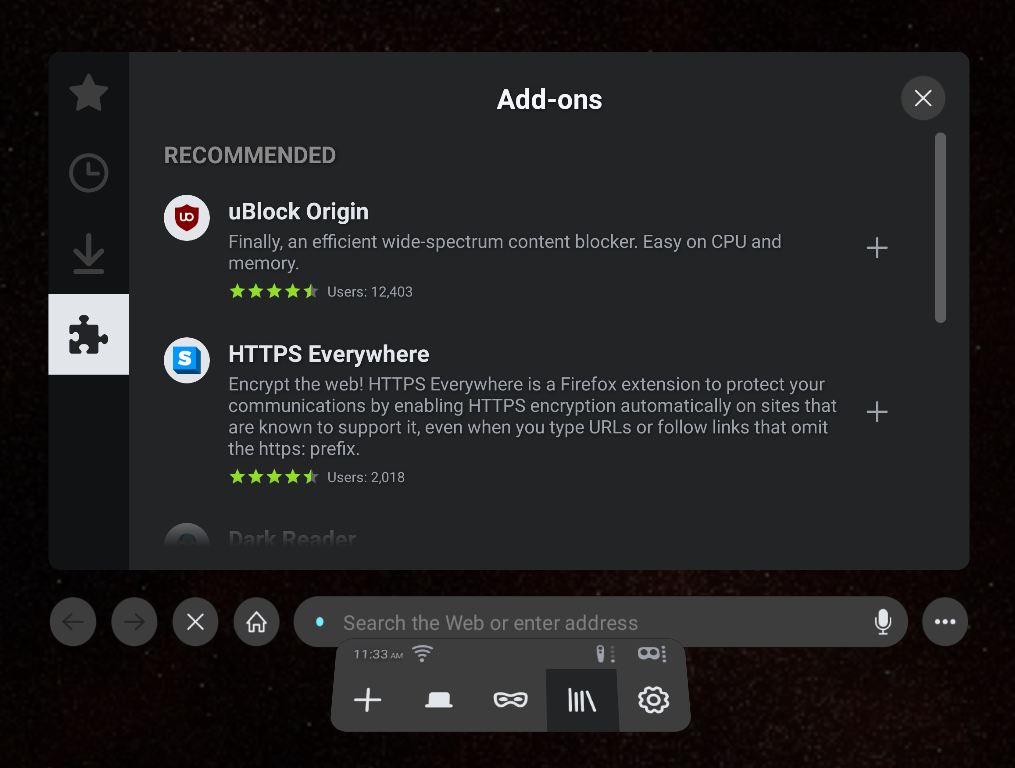
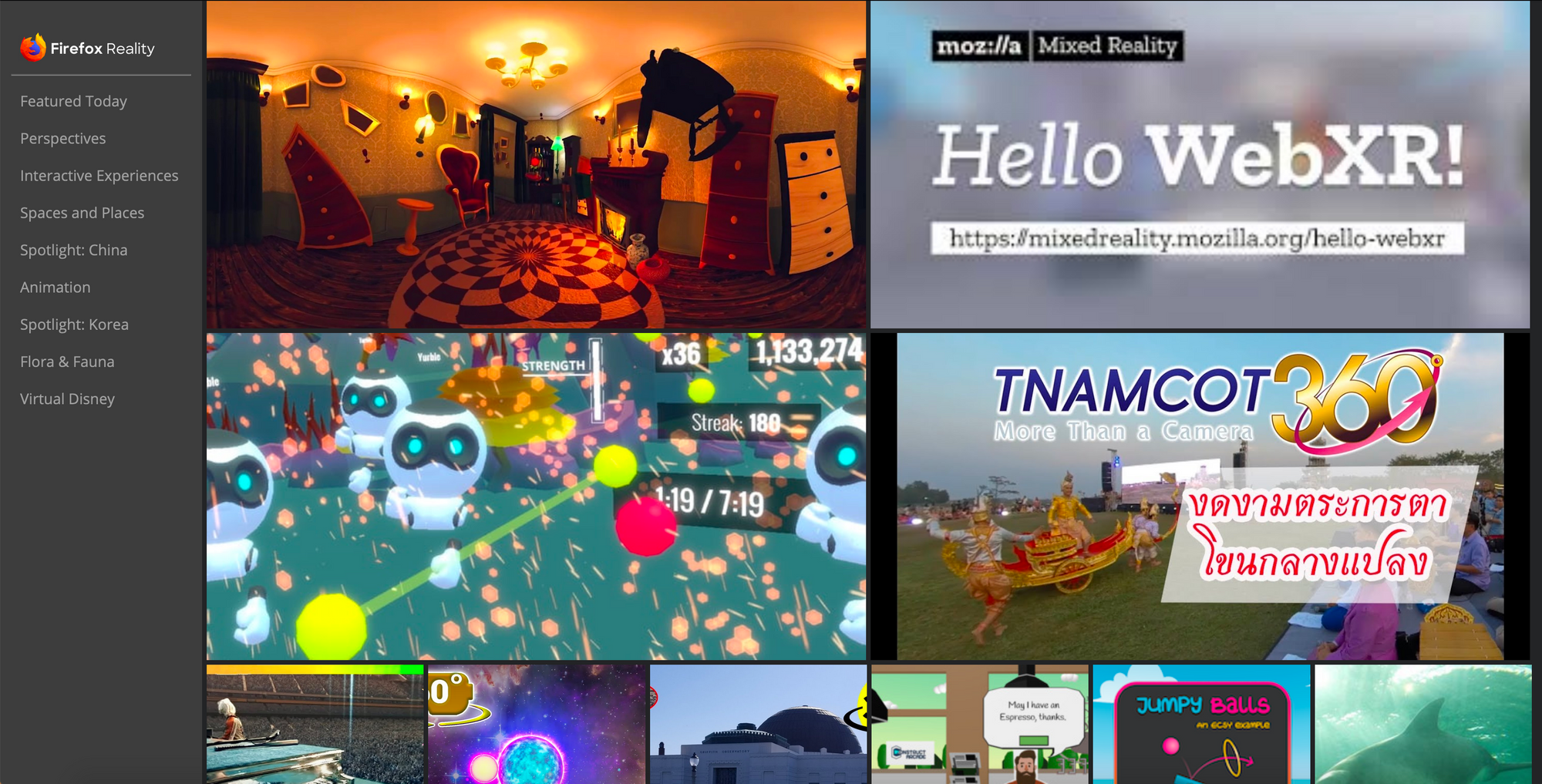
Redesigned Content Feed
We’ve also redesigned our content feed for ease of navigation and discovery of related content organized by the categories in the left menu. Stay tuned for this change rolling out to your platform of choice soon.
The future of Firefox Reality
Look for Firefox Reality 12 available now in the HTC, Pico and Oculus stores. This feature-packed release of Firefox Reality will be the last major feature release for a while as we gear up for a deeper investment in Hubs. But not to worry! Firefox Reality will still be well supported and maintained on your favorite standalone VR platform.
Contribute to Firefox Reality!
Firefox Reality is an open source project. We love hearing from and collaborating with our developer community. Check out Firefox Reality on GitHub and help build the open immersive web
The first content to the book Everything curl was committed on September 24, 2015 but I didn’t blog about it until several months later in December 2015: Everything curl – work in progress.

At the time of that blog post, the book was already at 13,000 words and 115 written subsections. I still had that naive hope that I would have it nearly “complete” by the summer of 2016. Always the optimist.
Today, the book is at over 72,000 words with content in 600 subsections – with just 21 subtitles noted “TBD” to signal that there’s still content to add there. The PDF version of it now clocks in at over 400 pages.
I’ve come to realize and accept that it will never be “complete” and that we will just keep on working on it indefinitely since curl itself keeps changing and we keep improving and expanding texts in the book.
Right now, we have 21 sections marked as not done, but then we’ve also added features through these five years that we haven’t described in the book yet. And there are probably other areas still missing too that would benefit the book to add. There’s no hurry, we’ll just add more content when we get around to it.
Everything curl is quite clearly the most complete book and resource about curl, libcurl, the project and how all of it works. We have merged contributions from 39 different authors and we’re always interested in getting more help!
Printed version
We’ve printed two editions of the book. The 2017 and the 2018 versions. As of 2020, the latest edition is out of print. If you really want one, email Dan Fandrich as mention on the web page this link takes you to. Maybe we can make another edition reality again.
The book was always meant to remain open and free, we only sell the printed version because it costs actual money to produce it.
For a long time we also offered e-book versions of everything curl, but sadly gitbooks removed those options in a site upgrade a while ago so now unfortunately we only offer a web version and a PDF version.
Other books?
There are many books that mention curl and that have sections or parts devoted to various aspects of curl but there are not many books about just curl. curl programming (by Dan Gookin) is one of those rare ones.
https://daniel.haxx.se/blog/2020/09/24/everything-curl-five-years/
Everyone needs something fun to do in their spare time. And digging deep into curl internals is mighty fun!
One of the things I do in curl every now and then is to run a few typical command lines and count how much memory is allocated and how many memory allocation calls that are made. This is good project hygiene and is a basic check that we didn’t accidentally slip in a malloc/free sequence in the transfer path or something.
We have extensive memory checks for leaks etc in the test suite so I’m not worried about that. Those things we detect and fix immediately, even when the leaks occur in error paths – thanks to our fancy “torture tests” that do error injections.
The amount of memory needed or number of mallocs used is more of a boiling frog problem. We add one now, then another months later and a third the following year. Each added malloc call is motivated within the scope of that particular change. But taken all together, does the pattern of memory use make sense? Can we make it better?
How?
Now this is easy because when we build curl debug enabled, we have a fancy logging system (we call it memdebug) that logs all calls to “fallible” system functions so after the test is completed we can just easily grep for them and count. It also logs the exact source code and line number.
cd tests
./runtests -n [number]
egrep -c 'alloc|strdup' log/memdump
Let’s start
Let me start out with a look at the history and how many allocations (calloc, malloc, realloc or strdup) we do to complete test 103. The reason I picked 103 is somewhat random, but I wanted to look at FTP and this test happens to do an “active” transfer of content and makes a total of 10 FTP commands in the process.
The reason I decided to take a closer look at FTP this time is because I fixed an issue in the main ftp source code file the other day and that made me remember the Curl_pp_send() function we have. It is the function that sends FTP commands (and IMAP, SMTP and POP3 commands too, the family of protocols we refer to as the “ping pong protocols” internally because of their command-response nature and that’s why it has “pp” in the name).
When I reviewed the function now with my malloc police hat on, I noticed how it made two calls to aprintf(). Our printf version that returns a freshly malloced area – which can even cause several reallocs in the worst case. But this meant at least two mallocs per issued command. That’s a bit unnecessary, isn’t it?
What about a few older versions
I picked a few random older versions, checked them out from git, built them and counted the number of allocs they did for test 103:
7.52.1: 141
7.68.0: 134
7.70.0: 137
7.72.0: 123
It’s been up but it has gone down too. Nothing alarming, Is that a good amount or a bad amount? We shall see…
Cleanup step one
The function gets printf style arguments and sends them to the server. The sent command also needs to append CRLF to the data. It was easy to make sure the CRLF appending wouldn’t need an extra malloc. That was just sloppy of us to have there in the first place. Instead of mallocing the new printf format string with CRLF appended, it could use one in a stack based buffer. I landed that as a first commit.
This trimmed off 10 mallocs for test 103.
Step two, bump it up a notch
The remaining malloc allocated the memory block for protocol content to send. It can be up to several kilobytes but is usually just a few bytes. It gets allocated in case it needs to be held on to if the entire thing cannot be sent off over the wire immediately. Remember, curl is non-blocking internally so it cannot just sit waiting for the data to get transferred.
I switched the malloc’ed buffer to instead use a ‘dynbuf’. That’s our internal “dynamic buffer” system that was introduced earlier this year and that we’re gradually switching all internals over to use instead of doing “custom” buffer management in various places. The internal API for dynbuf is documented here.
The internal API Curl_dyn_addf() adds a printf()-style string at the end of a “dynbuf”, and it seemed perfectly suitable to use here. I only needed to provide a vprintf() alternative since the printf() format was already received by Curl_pp_sendf()… I created Curl_dyn_vaddf() for this.
This
Firefox 81 is released. In addition to new themes of dubious colour coordination, media controls now move to keyboards and supported headsets, the built-in JavaScript PDF viewer now supports forms (if we ever get a JIT going this will work a lot better), and there are relatively few developer-relevant changes.
This release heralds the first official change in our standard POWER9 .mozconfig since Fx67. Link-time optimization continues to work well (and in 81 the LTO-enhanced build I'm using now benches about 6% faster than standard -O3 -mcpu=power9), so I'm now making it a standard part of my regular builds with a minor tweak we have to make due to bug 1644409. Build time still about doubles on this dual-8 Talos II and it peaks out at almost 84% of its 64GB RAM during LTO, but the result is worth it.
Unfortunately PGO (profile-guided optimization) still doesn't work right, probably due to bug 1601903. The build system does appear to generate a profile properly, i.e., a controlled browser instance pops up, runs some JavaScript code, does some browser operations and so forth, and I see gcc created .gcda files with all the proper count information, but then the build system can't seem to find them to actually tune the executable. This needs a little more hacking which I might work on as I have free time™. I'd also like to eliminate ac_add_options --disable-release as I suspect it is no longer necessary but I need to do some more thorough testing first.
In any event, reliable LTO at least with the current Fedora 32 toolchain is still continuous progress. I've heard concerns that some distributions are not making functional builds of Firefox for ppc64le (let alone ppc64, which has its own problems), though Fedora is not one of them. Still, if you have issues with your distribution's build and you are not able to build it for yourself, if there is interest I may put up a repo or a download spot for the binaries I use since I consider them reliable. Without further ado, here are the current .mozconfigs that I attest as functional.
Optimized Configuration
Debug Configuration
export CC=/usr/bin/gcc
export CXX=/usr/bin/g++

mk_add_options MOZ_MAKE_FLAGS="-j24"
ac_add_options --enable-application=browser
ac_add_options --enable-optimize="-O3 -mcpu=power9"
ac_add_options --disable-release
ac_add_options --enable-linker=bfd
ac_add_options --enable-lto=full

#export GN=/uncomment/and/set/path/if/you/haz
export RUSTC_OPT_LEVEL=2
export CC=/usr/bin/gcc
export CXX=/usr/bin/g++

mk_add_options MOZ_MAKE_FLAGS="-j24"
ac_add_options --enable-application=browser
ac_add_options --enable-optimize="-Og -mcpu=power9"
ac_add_options --enable-debug
ac_add_options --disable-release
ac_add_options --enable-linker=bfd

#export GN=/uncomment/and/set/path/if/you/haz
export RUSTC_OPT_LEVEL=0
Errata: In our release notes for Firefox 80, we forgot to mention all the developers who contributed their first code change to Firefox in this release, 10 of whom were brand new volunteers! We’re grateful for their efforts, and apologize for not giving them the recognition they’re due on time. Please join us in thanking each of these diligent and enthusiastic individuals, and take a look at their contributions:
- sraturi: 1649272
- szabka: 1622692
- Ahmed Sobeh: 1644976
- Alexey Izbyshev: 1651764
- Angus Sawyer: 1266808, 1536674
- Anwesha: 1622734
- Bruno Bartolomasi: 1646087, 1649686
- DH Kim: 1643130
- Elaine Neoh: 1653431
- Kanishk: 1380676, 1637931, 1647260, 1650713
- Sarah Bird: 1647501
- Tiger Oakes: 1602126, 1605688
- akshay: 1622662
As well, with the release of Firefox 81 we are once again honoured to welcome the developers who contributed their first code change to Firefox with this release, 18 of whom were brand new volunteers. Again, please join us in thanking each of these diligent and enthusiastic individuals, and take a look at their contributions:
- luc4leone: 1590885
- mcccs: 1623302
- nazarcf: 1614019
- Alessandro Castellani: 1638233, 1642279, 1643343, 1655284, 1655374, 1656360, 1656391, 1657497
- Atila Butkovits: 1573892
- Barun: 1483269
- Cas Verploegen: 1647894
- Cody Welsh: 1654218
- Dev Singh: 1635835
- Dmitry Bezhetskov: 1657825, 1657917
- Duncan Dean: 1620162
- Evan Welsh: 1654696
- Florian Samm"uller:
Right now, we’re in the early stages of the next phase of computing: AI. First we had the desktop. Then the internet. And smartphones. Increasingly, we’re living in a world where computing is built around vast troves of data and the algorithms that parse them. They power everything from the social platforms and smart speakers we use everyday, to the digital machinery of our governments and economies.
In parallel, we’re entering a new phase of how we think about, deploy, and regulate technology. Will the AI era be defined by individual privacy and transparency into how these systems work? Or, will the worst parts of our current internet ecosystem — invasive data collection, monopoly, opaque systems — continue to be the norm?
A year ago, a group of funders came together at Mozilla’s Berlin office to talk about just this: how we, as a collective, could help shape the direction of AI in Europe. We agreed on the importance of a landscape where European public interest and civil society organisations — and not just big tech companies — have a real say in shaping policy and technology. The next phase of computing needs input from a diversity of actors that represent society as a whole.
Over the course of several months and with dozens of organizations around the table, we came up with the idea of a European AI Fund — a project we’re excited to launch this week.
The fund is supported by the Charles Stewart Mott Foundation, King Baudouin Foundation, Luminate, Mozilla, Oak Foundation, Open Society Foundations and Stiftung Mercator. We are a group of national, regional and international foundations in Europe that are dedicated to using our resources — financial and otherwise — to strengthen civil society. We seek to deepen the pool of experts across Europe who have the tools, capacity and know-how to catalogue and monitor the social and political impact of AI and data driven interventions — and hold them to account. The European AI Fund is hosted by the Network of European Foundations. I can’t imagine a better group to be around the table with.
Over the next five years, the European Commission and national governments across Europe will forge a plan for Europe’s digital transformation, including AI. But without a strong civil society taking part in the debate, Europe — and the world — risk missing critical opportunities and could face fundamental harms.
At Mozilla, we’ve seen first-hand the expertise that civil society can provide when it comes to the intersection of AI and consumer rights, racial justice, and economic justice. We’ve collaborated closely over the years with partners like European Digital Rights, Access Now Algorithm Watch and Digital Freedom Fund. Alternatively, we’ve seen what can go wrong when diverse voices like these aren’t part of important conversations: AI systems that discriminate, surveil, radicalize.
At Mozilla, we believe that philanthropy has a key role to play in Europe’s digital transformation and in keeping AI trustworthy, as we’ve laid out in our trustworthy AI theory of change. We’re honoured to be working alongside this group of funders in an effort to strengthen civil society’s capacity to contribute to these tech policy discussions.
In its first step, the fund will launch with a 1,000,000 € open call for funding, open until November 1. Our aim is to build the capacity of those who already work on AI and Automated Decision Making (ADM). At the same time, we want to bring in new civil society actors to the debate, especially those who haven’t worked on issues relating to AI yet, but whose domain of work is affected by AI.
To learn more about the European AI Fund visit http://europeanaifund.org/
The post Launching the European AI Fund appeared first on The Mozilla Blog.
https://blog.mozilla.org/blog/2020/09/23/launching-the-european-ai-fund/
Think you can spot fake news when you see it? You might be surprised even the most digitally savvy folks can (at times) be fooled into believing a headline or … Read more
The post How to spot (and do something) about real fake news appeared first on The Firefox Frontier.
https://blog.mozilla.org/firefox/how-to-spot-real-fake-news/
Earlier this year I was the recipient of a monetary Google patch grant with the expressed purpose of improving security in libcurl.
This was an upfront payout under this Google program describing itself as “an experimental program that rewards proactive security improvements to select open-source projects”.
I accepted this grant for the curl project and I intend to keep working fiercely on securing curl. I recognize the importance of curl security as curl remains one of the most widely used software components in the world, and even one that is doing network data transfers which typically is a risky business. curl is responsible for a measurable share of all Internet transfers done over the Internet an average day. My job is to make sure those transfers are done as safe and secure as possible. It isn’t my only responsibility of course, as I have other tasks to attend to as well, but still.
Do more
Security is already and always a top priority in the curl project and for myself personally. This grant will of course further my efforts to strengthen curl and by association, all the many users of it.
What I will not do
When security comes up in relation to curl, some people like to mention and propagate for other programming languages, But curl will not be rewritten in another language. Instead we will increase our efforts in writing good C and detecting problems in our code earlier and better.
Proactive counter-measures
Things we have done lately and working on to enforce everywhere:
String and buffer size limits – all string inputs and all buffers in libcurl that are allowed to grow now have a maximum allowed size, that makes sense. This stops malicious uses that could make things grow out of control and it helps detecting programming mistakes that would lead to the same problems. Also, by making sure strings and buffers are never ridiculously large, we avoid a whole class of integer overflow risks better.
Unified dynamic buffer functions – by reducing the number of different implementations that handle “growing buffers” we reduce the risk of a bug in one of them, even if it is used rarely or the spot is hard to reach with and “exercise” by the fuzzers. The “dynbuf” internal API first shipped in curl 7.71.0 (June 2020).
Realloc buffer growth unification – pretty much the same point as the previous, but we have earlier in our history had several issues when we had silly realloc() treatment that could lead to bad things. By limiting string sizes and unifying the buffer functions, we have reduced the number of places we use realloc and thus we reduce the number of places risking new realloc mistakes. The realloc mistakes were usually in combination with integer overflows.
Code style – we’ve gradually improved our code style checker (checksrc.pl) over time and we’ve also gradually made our code style more strict, leading to less variations in code, in white spacing and in naming. I’m a firm believer this makes the code look more coherent and therefore become more readable which leads to fewer bugs and easier to debug code. It also makes it easier to grep and search for code as you have fewer variations to scan for.
More code analyzers – we run every commit and PR through a large number of code analyzers to help us catch mistakes early, and we always remove detected problems. Analyzers used at the time of this writing: lgtm.com, Codacy, Deepcode AI, Monocle AI, clang tidy, scan-build, CodeQL, Muse and Coverity. That’s of course in addition to the regular run-time tools such as valgrind and sanitizer builds that run the entire test suite.
Memory-safe components – curl already supports getting built with a plethora of different libraries and “backends” to cater for users’ needs and desires. By properly supporting and offering users to build with components that are written in for example rust – or other languages that help developers avoid pitfalls – future curl and libcurl builds could potentially avoid a whole section of risks. (Stay tuned for more on this topic in a near future.)
Reactive measures
Recognizing that whatever we do and however tight ship we run, we will continue to slip every once in a while, is important and we should make sure we find and fix such slip-ups as good and early as possible.
Raising bounty rewards. While not directly fixing things, offering more money in
Back in the Golden Era of Computing (which is what the industry has collectively agreed to call the years 2016 and 2017) I was giving semi-regular updates at the Mozilla Weekly Meeting.
Now this was also back when Potch was the Weekly Project All Hands Meeting module owner. If that sounds like a scary amount of power to entrust to that guy, well, that’s because it was.
(This doesn’t have anything to do with the point of this post, I’m just trying to game SEO with these outbound links.)
So anyways, the point of these updates was to improve communication between Firefox and Platform teams which were more siloed than you would expect, and generally just let people know about interesting Platform work other teams were doing. I don’t even remember how that task fell upon me, I think it was just cause I just showed up to do it.
Rumor has it that Chris Beard wanted to switch to Blink back then but was moved by my artwork, and that’s why Gecko still exists to this day.
(Full disclosure: I just made up this rumor, but please quote me as “Anonymous Source” and link back to here if anyone wants to run with it.)




https://miketaylr.com/posts/2020/09/seven-platform-updates.html
At the end of 2019, if you were using Firefox to watch a video, you saw a new blue control with a simple label: “Picture-in-Picture.” Even after observing and carefully crafting the feature with feedback from in-progress versions of Firefox (Nightly and Beta), our Firefox team wasn’t really sure how people would react to it. So we were thrilled when we saw signals that the response was positive.
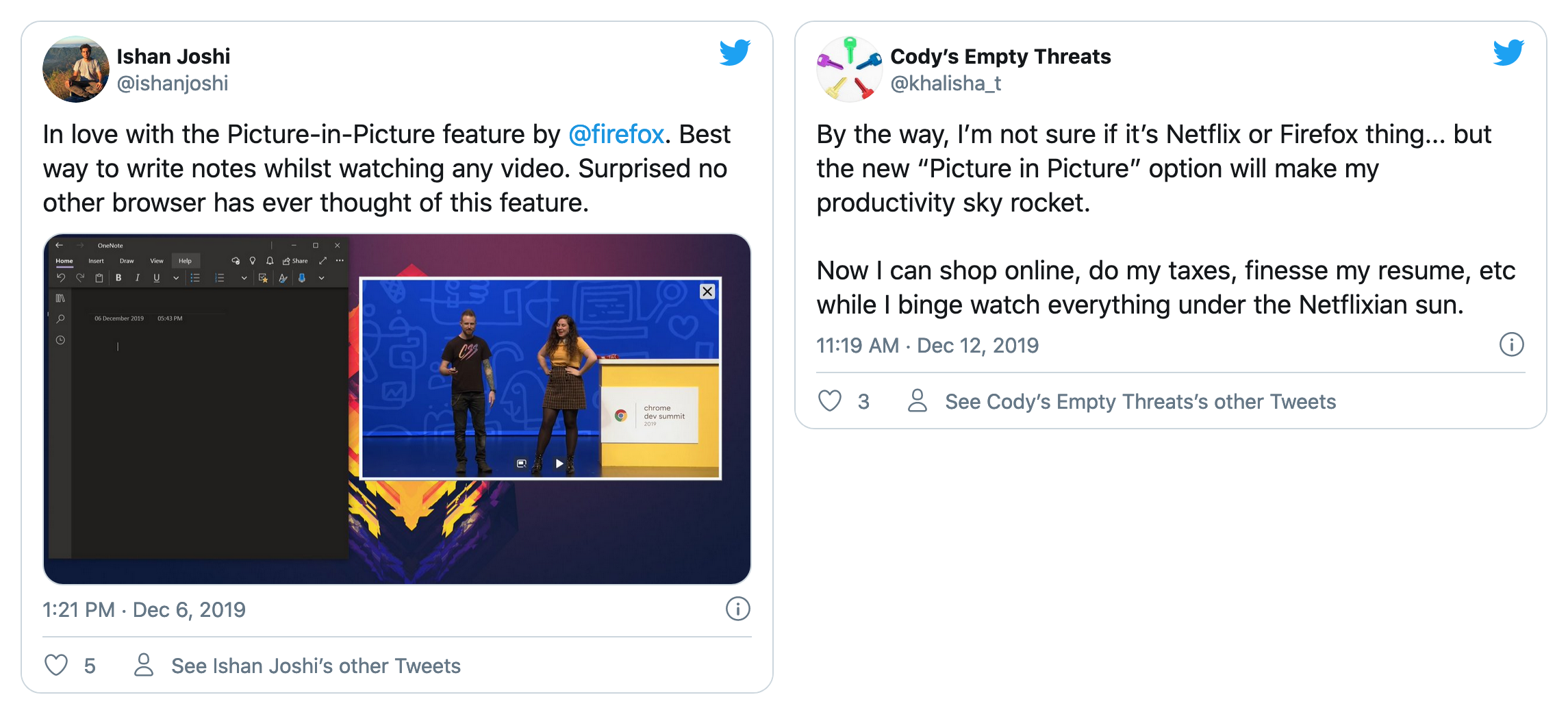
Firefox’s Picture-in-Picture allows you to watch videos in a floating window (always on top of other windows) so you can keep an eye on what you’re watching while interacting with other sites, or applications.
From a feature to a habit
About 6 months after PiP’s release, we started to see some trends from our data. We know from our internal data that people use Firefox to watch video. In fact, some people watch video over 60% of the time when they’re using Firefox. And, some of these people use PiP to do that. Further, our data shows that people who use Picture-in-Picture open more PiP windows over time. In short, we see that not everyone uses PiP, but those who do seem to be forming a habit with it.
A habit is a behaviour “done with little or no conscious thought.” So we asked ourselves:
- Why is PiP becoming a habit for some people?
- What are peoples’ motivations behind using PiP?
Fogg’s Behavior Model describes habits and how they form. We already knew two parts of this equation: Behavior and Ability. But we didn’t know Motivation and Trigger.

Fogg’s Behavior Model.
To get at these “why” questions, we conducted qualitative research with people who use PiP. We conducted interviews with 11 people to learn more about how they discovered PiP and how they use it in their everyday browsing. We were even able to observe these people using PiP in action. It’s always a privilege to speak directly to people who are using the product. Talking to and observing peoples’ actions is an indispensable part of making something people find useful.
Now we’ll talk about the Motivation part of the habit equation by sharing how the people we interviewed use PiP.
Helps with my tasks
When we started to look at PiP, we were worried that the feature would bring some unintended consequences in peoples’ lives. Could PiP diminish their productivity by increasing distractibility? Surprisingly, from what we observed in these interviews, PiP helped some participants do their task, as opposed to being needlessly distracting. People are using PiP as a study tool, to improve their focus, or to motivate them to complete certain tasks.
PiP for note-taking
One of our participants was a student. He used Picture-in-Picture to watch lecture videos and take notes while doing his homework. PiP helped him complete and enhance a task.

Taking notes in a native desktop application while watching a lecture video in picture-in-picture. (Recreation of what a participant did during an interview)
Breaks up the monotony of work
You might have this experience: listening to music or a podcast helps you “get in the zone” while you’re exercising or perhaps doing chores. It helps you lose yourself in the task, and make mundane tasks more bearable. Picture-in-Picture does the same for some people while they are at work, to avoid the surrounding silence.
“I just kind of like not having dead silence… I find it kind of motivating and I don’t know, it just makes the day seem less, less long.” — Executive Assistant to a Real Estate Developer
Calms me down
Multiple people told us they watch videos in PiP to calm themselves down. If they are reading a difficult article for work or study, or doing some art, watching ASMR or trance-like videos feels therapeutic. Not only does this calm people down, they said it can help them focus.

Mozilla and the Hubs team takes internet security seriously. We do our best to follow best practices for web security and securing data. This post will provide an overview of how we secure access to your rooms and your data.
Room Authentication
In the most basic scenario, only people who know the URL of your room can access your room. We use randomly generated strings in the URLs to obfuscate the URLs. If you need more security in your room, then you can limit your room to only allow users with Hubs accounts to join (usually, anyone can join regardless of account status). This is a server-wide setting, so you have to run your own Hubs Cloud instance to enable this setting.
You can also make rooms “invite only” which generates an additional key that needs to be used on the link to allow access. While the room ID can’t be changed, an “invite only” key can be revoked and regenerated, allowing you to revoke access to certain users.
Discord OAuth Integration
Alternatively, users can create a room via the Hubs Discord bot, and the room becomes bound to the security context of that Discord. In this scenario, a user’s identity is tied to their identity in Discord, and they only have access to rooms that are tied to channels they have access to. Users with “modify channel” permissions in Discord get corresponding “room owner” permissions in Hubs, which allows them to change room settings and kick users out of the room. For example, if I am a member of the private channel #standup, and there is a room tied to that channel, only members of that channel (including me) are allowed in the associated room. Anyone attempting to access the room will first need to authenticate via Discord.
How we secure your data
We collect minimal data on users. For any data that we do collect, all database data and backups are encrypted at rest. Additionally, we don’t store raw emails in our database--this means we can’t retrieve your email, we can only check to see if the email you enter for log in is in our database. All data is stored on a private subnet and is not accessible via the internet.
For example, let’s go through what happens when a user uploads a file inside a room. First, the user uploads a personal photo to the room to share with others. This generates a URL via a unique key, which is passed to all other users inside the room. Even if others find the URL of the file, they cannot decrypt the photo without this key (including the server operator!). The photo owner can choose to pin the photo to the room, which saves the encryption key in a database with the encrypted file. When you visit the room again, you can access the file, because the key is shared with room visitors. However, if the file owner leaves the room without pinning the photo, then the photo is considered ‘abandoned data’ and the key is erased. This means that no users can access the file anymore, and the data is erased within 72 hours.
All data is encrypted in transit via TLS. We do not currently support end-to-end encryption.
Hubs Cloud Security
When you deploy your own Hubs Cloud instance, you have full control over the instance and its data via AWS or DigitalOcean infrastructure--Mozilla simply provides the template and automatic updates. Therefore, you can integrate your own security measures and technology as you like. Everyone’s use case is different. Hubs cloud is an as-is product, and we’re unable to predict the performance as you make changes to the template.
Server access is limited by SSH and sometimes two-factor authentication. For additional security, you can set stack template rules to restrict which IP addresses can SSH into the server.
How do we maintain Hubs Cloud with the latest security updates
We automatically update packages for security updates, and update our version in a monthly cadence, but if there’s a security issue exposed (either in our software or third party software), we can immediately update all stacks. We inherit our network architecture from AWS, which includes load balancing and DDoS protection.
Your security on the web is non-negotiable. Between maintaining security updates, authenticating users, and encrypting data at rest and in transit, we prioritize our users security needs. For any additional questions, please reach out to us. To contribute to Hubs, visit https://github.com/mozilla/hubs.

At Mozilla, we believe that privacy is fundamental to a healthy internet. We especially believe that this is the case in social VR platforms, which process and transmit large amounts of personal information. What happens in Hubs should stay in Hubs.
Privacy expectations in a Hubs room
First, let’s discuss what your privacy expectations should be when you’re in a Hubs room. In general, anything transmitted in a room is available to everyone connected to that room. They can save anything that you send. This is why it’s so important to only give the Hubs link out to people you want to be in the room, or to use Discord authentication so only authorized users can access a room.
While some rooms may have audio falloff to declutter the audio in a room, users should still have the expectation that anyone in the room (or in the lobby) can hear what’s being said. Audio falloff is performed in the client, so anyone who modifies their client can hear you from anywhere in the room.
Other users in the room have the ability to create recordings. While recording, the camera tool will display a red icon, and your avatar will indicate to others with a red icon that you are filming and capturing audio. All users are notified when a photo or video has been taken. However, users should still be aware that others could use screen recorders to capture what happens in a Hubs room without their knowledge.
Minimizing the data we collect on you
The only data we need to create an account for you is your email address, which we store hashed in an encrypted database. We don’t collect any additional personal information like birthdate, real name, or telephone numbers. Accounts aren’t required to use Hubs, and many features are available to users without accounts.
Processing data instead of collecting data
There’s a certain amount of information that we have to process in order to provide you with the Hubs experience. For example, we receive and send to others the name and likeness of your avatar, its position in the room, and your interactions with objects in the room. If you create an account, you can store custom avatars and their names.
We receive data about the virtual objects and avatars in a room in order to share that data with others in the room, but we don’t monitor the individual objects that are posted in a room. Users have the ability to permanently pin objects to a room, which will store them in the room until they’re deleted. Unpinned files are deleted from Mozilla’s servers after 72 hours.
We do collect basic metrics about how many rooms are being created and how many users are in those rooms, but we don’t tie that data to specific rooms or users. What we don’t do is collect or store any data without the user's explicit consent.
Hubs versus Hubs Cloud
Hubs Cloud owners have the capability to implement additional server-side analytics. We provide Hubs Cloud instances with their own versions of Hubs, with minimal data collection and no user monitoring, which they can then modify to suit their needs. Unfortunately, this means that we can’t make any guarantees about what individual Hubs Cloud instances do, so you’ll need to consult with the instance owner if you have any privacy concerns.
Our promise to you
We will never perform user monitoring or deep tracking, particularly using VR data sources like gaze-tracking. We will continue to minimize the personal data we collect, and when we do need to collect data, we will invest in privacy preserving solutions like differential privacy. For full details, see our privacy policy. Hubs is an open source project–to contribute to Hubs, visit https://github.com/mozilla/hubs.
We will be closing the collection of blog posts on October 5th. As a reminder, we plan to close the survey on September 24th, later this week.
If you haven't written a post yet, read the initial announcement.
Looking forward, we are expecting the following:
- Roadmap RFC proposed by mid-November
- Roadmap RFC merged by mid-December
We look forward to reading your posts!
https://blog.rust-lang.org/2020/09/21/Scheduling-2021-Roadmap.html