Firefox 86 will be released on February 23, 2021. We’d like to call out two highlights and several bug fixes for the WebExtensions API that will ship with this release.
Highlights
- Extensions that have host permissions for tabs no longer need to request the broader “tabs” permission to have access to the tab URL, title, and favicon URL.
- As part of our work on Manifest V3, we have landed an experimental base content security policy (CSP) behind a preference in Firefox 86. The new CSP disallows remote code execution. This restriction only applies to extensions using
manifest_version, which is not currently supported in Firefox. If you would like to test the new CSP for extension pages and content scripts, you must change your extension’smanifest_versionto 3 and setextensions.manifestv3.enabledtotrueinabout:config. Because this is a highly experimental and evolving feature, we want developers to be aware that extensions that work with the new CSP may break tomorrow as more changes are implemented.
Bug fixes
- Redirected URIs can now be set to a loopback address in the
identity.launchWebAuthFlowAPI. This fix makes it possible for extensions to successfully integrate with OAuth authentication for some common web services like Google and Facebook. This will also be uplifted to Firefox Extended Support Release (ESR) 78. - Firefox 76 introduced a regression where webRequest.StreamFilter did not disconnect after an API, causing the loading icon on tabs to run persistently. We’ve also fixed a bug that caused crashes when using view-source requests.
- The zoom levels for the extensions options pages embedded in the Firefox Add-ons Manager (about:addons) tabs should work as expected.
- Now that the tabs hiding API is enabled by default, the
extensions.webextensions.tabhide.enabledpreference is no longer displayed and references to it have been removed.
As a quick note, going forward we’ll be publishing release updates in the Firefox developer release notes on MDN. We will still announce major changes to the WebExtensions API, like new APIs, significant enhancements, and deprecation notices, on this blog as they become available.
Thanks
Many thanks to community members Sonia Singla, Tilden Windsor, robbendebiene, and Brenda Natalia for their contributions to this release!
The post Extensions in Firefox 86 appeared first on Mozilla Add-ons Blog.
https://blog.mozilla.org/addons/2021/02/09/extensions-in-firefox-86/
Introduction
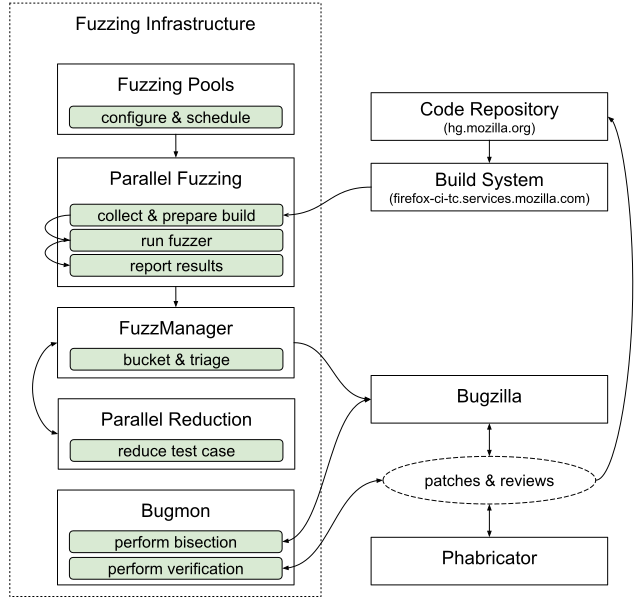
Mozilla has been fuzzing Firefox and its underlying components for a while. It has proven to be one of the most efficient ways to identify quality and security issues. In general, we apply fuzzing on different levels: there is fuzzing the browser as a whole, but a significant amount of time is also spent on fuzzing isolated code (e.g. with libFuzzer) or whole components such as the JS engine using separate shells. In this blog post, we will talk specifically about browser fuzzing only, and go into detail on the pipeline we’ve developed. This single pipeline is the result of years of work that the fuzzing team has put into aggregating our browser fuzzing efforts to provide consistently actionable issues to developers and to ease integration of internal and external fuzzing tools as they become available.
Build instrumentation
To be as effective as possible we make use of different methods of detecting errors. These include sanitizers such as AddressSanitizer (with LeakSanitizer), ThreadSanitizer, and UndefinedBehaviorSanitizer, as well as using debug builds that enable assertions and other runtime checks. We also make use of debuggers such as rr and Valgrind. Each of these tools provides a different lens to help uncover specific bug types, but many are incompatible with each other or require their own custom build to function or provide optimal results. Besides providing debugging and error detection, some tools cannot work without build instrumentation, such as code coverage and libFuzzer. Each operating system and architecture combination requires a unique build and may only support a subset of these tools.
Last, each variation has multiple active branches including Release, Beta, Nightly, and Extended Support Release (ESR). The Firefox CI Taskcluster instance builds each of these periodically.
Downloading builds
Taskcluster makes it easy to find and download the latest build to test. We discussed above the number of variants created by different instrumentation types, and we need to fuzz them in automation. Because of the large number of combinations of builds, artifacts, architectures, operating systems, and unpacking each, downloading is a non-trivial task.
To help reduce the complexity of build management, we developed a tool called fuzzfetch. Fuzzfetch makes it easy to specify the required build parameters and it will download and unpack the build. It also supports downloading specified revisions to make it useful with bisection tools.
How we generate the test cases
As the goal of this blog post is to explain the whole pipeline, we won’t spend much time explaining fuzzers. If you are interested, please read “Fuzzing Firefox with WebIDL” and the in-tree documentation. We use a combination of publicly available and custom-built fuzzers to generate test cases.
How we execute, report, and scale
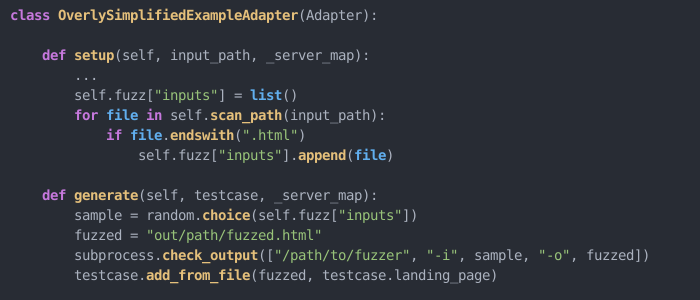
For fuzzers that target the browser, Grizzly manages and runs test cases and monitors for results. Creating an adapter allows us to easily run existing fuzzers in Grizzly.
To make full use of
This blog post is one of several guest blog posts, where we invite participants of our bug bounty program to write about bugs they’ve reported to us.
Continuing with Part 1, this article introduces some practices for finding security bugs in Fenix.
Fenix’s architecture is unique. Many of the browser features are not implemented in Fenix itself – they come from independent and reusable libraries such as GeckoView and Mozilla Android Components (known as Mozac). Fenix as a browser application combines these libraries as building parts for the internals, and the fenix project itself is primarily a User Interface. Mozac is noteworthy because it connects web contents rendered in GeckoView into the native Android world.
There are common pitfalls that lead to security bugs in the connection between web content and native apps. In this post, we’ll take a look at one of the pitfalls: private browsing mode bypasses. While looking for this class of bug, I discovered three separate but similar issues (Bugs 1657251, 1658231, and 1663261.)
Pitfalls in Private Browsing Mode
Take a look at the following two lines of HTML.

Although these two HTML tags look similar in that they both fetch and render PNG images from the server, their internal processing is very different. In the former tag identifies a favicon for the page, and code in Mozac fetches the image and renders it as a part of a view of Android. When I discovered these vulnerabilities in the fall of 2020, a HTTP request sent from showed the string “MozacFetch”.
Like other browsers, GeckoView has a separated context for normal mode and private browsing mode. So the cookies and local storage areas in private browsing mode are completely separated from the normal mode, and these values are not shared. On the other hand, the URL fetch class that Mozac has – written in Kotlin – has only a single cookie store. If a favicon request responded with a Set-Cookie header; it would be stored in that cookie store and a later fetch of the favicon in private browsing mode would respond with the same cookie and vice versa. (Bug 1657251).

This same type of bug appears not only in Favicon, but also in other features that have a similar mechanism. One example is the Web Notification API. Web Notifications is a feature that shows an OS-level notification through JavaScript. Similar to favicons, an icon image can appear in the notification dialog – and it had a bug that shared private browsing mode cookies with the normal mode in the exact same way (Bug 1658231).
These bugs do not only occur when loading icon images. Bug 1663261 points out that a similar bypass occurs when downloading linked files via . File downloads are also handled by Mozac’s Downloads feature, which satisfies the same conditions to cause a similar flaw.
As you can see, Mozac’s URL fetch is one of the places that creates inconsistencies with web content. Other than private browsing mode, there are various other security protection mechanisms in the web world, such as port blocks, HSTS, CSP, Mixed-Content Block, etc. These protections are sometimes overlooked when issuing HTTP requests from another component. By focusing on these common pitfalls, you’ll likely be able to find new security bugs continuously into the future.
Using the difference in User-Agent to distinguish the initiator of the request was a useful technique for finding these kinds of bugs, but it’s no longer available in today’s Fenix. If you can build Fenix yourself, you can still use this technique by
curl is an internet transfer engine. A rather modular one too. Parts of curl’s functionality is provided by selectable alternative implementations that we call backends. You select what backends to enable at build-time and in many cases the backends are enabled and powered by different 3rd party libraries.
Many backends
curl has a range of such alternative backends for various features:
- International Domain Names
- Name resolving
- TLS
- SSH
- HTTP/3
- HTTP content encoding
- HTTP
Stable API and ABI
Maintaining a stable API and ABI is key to libcurl. As long as those promises are kept, changing internals such as switching between backends is perfectly fine.
The API is the armored front door that we don’t change. The backends is the garden on the back of the house that we can dig up and replant every year if we want, without us having to change the front door.
TLS backends
Already back in 2005 we added support for using an alternative TLS library in curl when we added support for GnuTLS in addition to OpenSSL, and since then we’ve added many more. We do this by having an internal API through which we do all the TLS related things and for each third party library we support we have code that does the necessary logic to connect the internal API with the corresponding TLS library.
rustls
Today, we merged support for yet another TLS library: rustls. This is a TLS library written in rust and it has a C API provided in a separate project called crustls. Strictly speaking, curl is built to use crustls.
This is still early days for the rustls backend and it is not yet feature complete. There’s more work to do and polish to apply before we can think of it as a proper competitor to the already established and well-used TLS backends, but with this merge it makes it much easier for more people to help out and test it out. Feel free and encouraged to join in!
We count this addition as the 14th concurrently supported TLS library in curl. I’m not aware of any other project, anywhere, that supports more or even this many TLS libraries.

rustls again!
The TLS library named mesalink is actually already using rustls, but under an OpenSSL API disguise and we support that since a few years back…
Credits
The TLS backend code for rustls was written and contributed by Jacob Hoffman-Andrews.
https://daniel.haxx.se/blog/2021/02/09/curl-supports-rustls/
Today Mozilla is thrilled to join the Rust community in announcing the formation of the Rust Foundation. The Rust Foundation will be the home of the popular Rust programming language that began within Mozilla. Rust has long been bigger than just a Mozilla project and today’s announcement is the culmination of many years of community building and collaboration. Mozilla is pleased to be a founding Platinum Sponsor of the Rust Foundation and looks forward to working with it to help Rust continue to grow and prosper.
Rust is an open-source programming language focused on safety, speed and concurrency. It started life as a side project in Mozilla Research. Back in 2010, Graydon Hoare presented work on something he hoped would become a “slightly less annoying” programming language that could deliver better memory safety and more concurrency. Within a few years, Rust had grown into a project with an independent governance structure and contributions from inside and outside Mozilla. In 2015, the Rust project announced the first stable release, Rust 1.0.
Success quickly followed. Rust is so popular that it has been voted the most “most-loved” programming language in Stack Overflow’s developer survey for five years in a row. Adoption is increasing as companies big and small, scientists, and many others discover its power and usability. Mozilla used Rust to build Stylo, the CSS engine in Firefox (replacing approximately 160,000 lines of C++ with 85,000 lines of Rust).
It takes a lot for a new programming language to be successful. Rust’s growth is thanks to literally thousands of contributors and a strong culture of inclusion. The wide range of contributors and adopters has made Rust a better language for everyone.
Mozilla is proud of its role in Rust’s creation and we are happy to see it outgrow its origins and secure a dedicated organization to support its continued evolution. Given its reach and impact, Rust will benefit from an organization that is 100% focused on the project.
The new Rust Foundation will have board representation from a wide set of stakeholders to help set a path to its own future. Other entities will be able to provide direct financial resources to Rust beyond in-kind contributions. The Rust Foundation will not replace the existing community and technical governance for Rust. Rather, it will be the organization that hosts Rust infrastructure, supports the community, and stewards the language for the benefit of all users.
Mozilla joins all Rustaceans in welcoming the new Rust Foundation.
The post Mozilla Welcomes the Rust Foundation appeared first on The Mozilla Blog.
https://blog.mozilla.org/blog/2021/02/08/mozilla-welcomes-the-rust-foundation/
What is it?
Markus is a Python library for generating metrics.
Markus makes it easier to generate metrics in your program by:
providing multiple backends (Datadog statsd, statsd, logging, logging roll-up, and so on) for sending metrics data to different places
sending metrics to multiple backends at the same time
providing testing helpers for easy verification of metrics generation
providing a decoupled architecture making it easier to write code to generate metrics without having to worry about making sure creating and configuring a metrics client has been done--similar to the Python logging module in this way
We use it at Mozilla on many projects.
v3.0.0 released!
I released v3.0.0 just now. Changes:
Features
Added support for Python 3.9 (#79). Thank you, Brady!
Changed
assert_*helper methods onmarkus.testing.MetricsMockto print the records to stdout if the assertion fails. This can save some time debugging failing tests. (#74)
Backwards incompatible changes
Dropped support for Python 3.5 (#78). Thank you, Brady!
markus.testing.MetricsMock.get_recordsandmarkus.testing.MetricsMock.filter_recordsreturnmarkus.main.MetricsRecordinstances now.This might require you to rewrite/update tests that use the
MetricsMock.
Where to go for more
Changes for this release: https://markus.readthedocs.io/en/latest/history.html#february-5th-2021
Documentation and quickstart here: https://markus.readthedocs.io/en/latest/index.html
Source code and issue tracker here: https://github.com/willkg/markus/
Let me know how this helps you!
Highlights
- Starting from Firefox 86, WebExtensions will not need to request the broader “tabs” permission to have access to some of the more privileged part of the tabs API (in particular access to tab url, title and favicon url) on tabs they have host permissions for – Bug 1679688. Thanks to robbendebiene for contributing this enhancement!
- Over 1/4 of our Nightly population has Fission enabled, either by opting in, or via Normandy!
- You can go to about:support to see if Fission is enabled. You can opt in to using it on Nightly by visiting about:preferences#experimental
- Think you’ve found a Fission bug? Please file it here!
- With the export and now import of logins landed and looking likely to ship soon, we are starting to have a much better story for migrating from other browsers, password managers, other Firefox profiles, etc. We ingest a common subset of the many fields these kinds of software export. Please try it out and file bugs!
- Multiple Picture-in-Picture player support has been enabled to ride the trains in Firefox 86!
Friends of the Firefox team
Resolved bugs (excluding employees)
Fixed more than one bug (between Jan. 12th and Jan 26th)
- Hunter Jones
- Swapnik Katkoori
- Tim Nguyen :ntim
Project Updates
Add-ons / Web Extensions
Addon Manager & about:addons
- Starting from Firefox 86 about:addons will not (wrongly) show a pending update badge on all addons cards when a new extension is installed – Bug 1659283
- Thanks to Tilden Windsor for contributing this fix!
- In preparation for “addons.mozilla.org API v3 deprecation”, usage of the addons.mozilla.org (AMO) API in Firefox has been updated to point to the AMO API v4 –
On February 11th, 2021 18:00 UTC (10am Pacific time, 19:00 Central Europe) we invite you to participate in a webinar we call “curl, Hyper and Rust”. To join us at the live event, please register via the link below:
https://www.wolfssl.com/isrg-partner-webinar/
What is the project about, how will this improve curl and Hyper, how was it done, what lessons can be learned, what more can we expect in the future and how can newcomers join in and help?
Participating speakers in this webinar are:
Daniel Stenberg. Founder of and lead developer of curl.
Josh Aas, Executive Director at ISRG / Let’s Encrypt.
Sean McArthur, Lead developer of Hyper.
The event will be about 30 minutes long with a following Q&A session.
Recorded
The webinar will be recorded and made available after the fact. This post will get updated with a link once the video is ready.
Questions?
If you already have a question you want to ask, please let us know ahead of time. Either in a reply here on the blog, or as a reply on one of the many tweets that you will see about about this event from me and my fellow “webinarees”.
https://daniel.haxx.se/blog/2021/02/04/webinar-curl-hyper-and-rust/
This is going to be a rather technical dive into a recent improvement that went into WebRender.
Texture atlas allocation
In order to submit work to the GPU efficiently, WebRender groups as many drawing primitives as it can into what we call batches. A batch is submitted to the GPU as a single drawing command and has a few constraints. for example a batch can only reference a fixed set of resources (such as GPU buffers and textures). So in order to group as many drawing primitives as possible in a single batch we need to place as many drawing parameters as possible in few resources. When rendering text, WebRender pre-renders the glyphs before compositing them on the screen so this means packing as many pre-rendered glyphs as possible into a single texture, and the same applies for rendering images and various other things.
For a moment let’s simplify the case of images and text and assume that it is the same problem: input images (rectangles) of various rectangular sizes that we need to pack into a larger textures. This is the job of the texture atlas allocator. Another common name for this is rectangle bin packing.

Many in game and web development are used to packing many images into fewer assets. In most cases this can be achieved at build time Which means that the texture atlas allocator isn’t constrained by allocation performance and only needs to find a good layout for a fixed set of rectangles without supporting dynamic allocation/deallocation within the atlas at run time. I call this “static” atlas allocation as opposed to “dynamic” atlas allocation.
There’s a lot more literature out there about static than dynamic atlas allocation. I recommend reading A thousand ways to pack the bin which is a very good survey of various static packing algorithms. Dynamic atlas allocation is unfortunately more difficult to implement while keeping good run-time performance. WebRender needs to maintain texture atlases into which items are added and removed over time. In other words we don’t have a way around needing dynamic atlas allocation.
A while back
A while back, WebRender used a simple implementation of the guillotine algorithm (explained in A thousand ways to pack the bin). This algorithm strikes a good compromise between packing quality and implementation complexity.
The main idea behind it can be explained simply: “Maintain a list of free rectangles, find one that can hold your allocation, split the requested allocation size out of it, creating up to two additional rectangles that are added back to the free list.”. There is subtlety in which free rectangle to choose and how to split it, but the overall, the algorithm is built upon reassuringly understandable concepts.

Deallocation could simply consist of adding the deallocated rectangle back to the free list, but without some way to merge back neighbor free rectangles, the atlas would quickly get into a fragmented stated with a lot of small free rectangles and can’t allocate larger ones anymore.

To address that, WebRender’s implementation would regularly do a O(n^2) complexity search to find and merge neighbor free rectangles, which was very slow when dealing with thousands of items. Eventually we stopped using the guillotine allocator in systems that needed support for deallocation, replacing it with a very simple slab allocator which I’ll get back to further down this post.
Moving to a worse allocator because of the run-time defragmentation issue was rubbing me the wrong way, so as a side project I wrote a guillotine allocator that tracks rectangle splits in a tree in order to find and merge neighbor free rectangle in constant instead of quadratic time. I published it in the guillotiere crate. I wrote about how it works in details in the documentation
Soon after Big Sur came out, I received my new work laptop. I decided to upgrade to it. Unfortunately, I quickly discovered that the Python set up needed for Sentry required some changes. Since it took me a bit of time to figure it out I decided to document it for anyone trying to solve the same problem.
If you are curious about all that I went through and see references to upstream issues you can visit this issue. It’s a bit raw. Most important notes are in the first comment.
On Big Sur, if you try to install older versions of Python you will need to tell pyenv to patch the code. For instance, you can install Python 3.8.7 the typical way ( pyenv install 3.8.7 ), however, if you try to install 3.8.0, or earlier, you will have to patch the code before building Python.
pyenv install --patch 3.6.10 < \
  <(curl -sSL https://github.com/python/cpython/commit/8ea6353.patch\?full_index\=1)
If your pyenv version is lesser than 1.2.22 you will also need to specify LDFLAGS. You can read more about it here.
LDFLAGS="-L$(xcrun --show-sdk-path)/usr/lib ${LDFLAGS}" \
  pyenv install --patch 3.6.10 < \
  <(curl -sSL https://github.com/python/cpython/commit/8ea6353.patch\?full_index\=1)
It seems very simple, however, it took me a lot of work to figure it out. I hope I saved you some time!

I have decided to halt any plans to maintain the extension and focus on other spare time open source projects instead. I should have probably made this decision about seven months ago, when Twitch integration broke, however this extension means a lot to me. It was my first browser extension that still exists and went …
Continue reading "Sunsetting Stream Notifier"
The post Sunsetting Stream Notifier appeared first on Humanoids beLog.
New features and changes in Crash Stats
Crash Stats crash report view pages show Breadcrumbs information
In 2020q3, Roger and I worked out a new Breadcrumbs crash annotation for
crash reports generated by the android-components crash reporter. It's a
JSON-encoded field with a structure just like the one that the sentry-sdk
sends. Incoming crash reports that have this annotation will show the data on
the crash report view page to people who have protected data access.

Figure 1: Screenshot of Breadcrumbs data in Details tab of crash report view on Crash Stats.
I implemented it based on what we get in the structure and what's in the Sentry interface.
Breadcrumbs information is not searchable with Supersearch. Currently, it's
only shown in the crash report view in the Details tab.
Does this help your work? Are there ways to improve this? If so, let me know!
This work was done in [bug 1671276].
Crash Stats crash report view pages show Java exceptions
For the longest of long times, crash reports from a Java process included a
JavaStackTrace annotation which was a big unstructured string of problematic
parseability and I couldn't do much with it.
In 2020q4, Roger and I worked out a new JavaException crash annotation which
was a JSON-encoded structured string containing the exception information. Not
only does it have the final exception, but it also has cascading exceptions if
there are any! With a structured form of the exception, we can suddenly do a
lot of interesting things.
As a first step, I added display of the Java exception information to the crash report view page in the Display tab. It's in the same place that you would see the crashing thread stack if this were a C++/Rust crash.
Just like JavaStackTrace, the JavaException annotation has some data in
it that can have PII in it. Because of that, the Socorro processor generates
two versions of the data: one that's sanitized (no java exception message
values) and one that's raw. If you have protected data access, you can see the
raw one.
The interface is pretty wide and exceeds the screenshot. Sorry about that.

Figure 2: Screenshot of Java exception data in Details tab of crash report view in Crash Stats.
My next step is to use the structured exception information to improve Java crash report signatures. I'm doing that work in [bug 1541120] and hoping to land that in 2021q1. More on that later.
Does this help your work? Are there ways to improve this? If so, let me know!
This work was done in [bug 1675560].
Changes to crash report view
One of the things I don't like about the crash report view is that it's impossible to intuit where the data you're looking at is from. Further, some of the tabs were unclear about what bits of data were protected data and what bits weren't. I've been improving that over time.
The most recent step involved the following changes:
The "Metadata" tab was renamed to "Crash Annotations". This tab holds the crash annotation data from the raw crash before processing as well as a few fields that the collector adds when accepting a crash report from the client. Most of the fields are defined in the CrashAnnotations.yaml file in mozilla-central. The ones that aren't, yet, should get added. I have that on my list of things to get to.
The "Crash Annotations" tab is now split into public and protected data sections. I hope this makes it a little clearer which is which.
I removed some unneeded fields that the collector adds at ingestion.
Does this help your work? Are there ways to improve this? If so, let me know!
What's in the queue
In addition to the day-to-day stuff, I'm working on the following big projects in 2021q1.
Remove
There’s been another 56 day release cycle and here’s another curl release to chew on!
Release presentation
Numbers
the 197th release
6 changes
56 days (total: 8,357)
113 bug fixes (total: 6,682)
268 commits (total: 26,752)
0 new public libcurl function (total: 85)
1 new curl_easy_setopt() option (total: 285)
2 new curl command line option (total: 237)
58 contributors, 30 new (total: 2,322)
31 authors, 17 new (total: 860)
0 security fixes (total: 98)
0 USD paid in Bug Bounties (total: 4,400 USD)
Security
No new security advisories this time!
Changes
We added --create-file-mode to the command line tool. To be used for the protocols where curl needs to tell the remote server what “mode” to use for the file when created. libcurl already supported this, but now we expose the functionality to the tool users as well.
The --write-out option got five new “variables” to use. Detailed in this separate blog post.
The CURLOPT_RESOLVE option got an extended format that now allows entries to be inserted to get timed-out after the standard DNS cache expiry time-out.
gophers:// – the protocol GOPHER done over TLS – is now supported by curl.
As a new experimentally supported HTTP backend, you can now build curl to use Hyper. It is not quite up to 100% parity in features just yet.
AWS HTTP v4 Signature support. This is an authentication method for HTTP used by AWS and some other services. See CURLOPT_AWS_SIGV4 for libcurl and --aws-sigv4 for the curl tool.
Bug-fixes
Some of the notable things we’ve fixed this time around…
Reduced struct sizes
In my ongoing struggles to remove “dead weight” and ensure that curl can run on as small devices as possible, I’ve trimmed down the size of several key structs in curl. The memory foot-print of libcurl is now smaller than it has been for a very long time.
Reduced conn->data references
While itself not exactly a bug-fix, this is a step in a larger refactor of libcurl where we work on removing all references back from connections to the transfer. The grand idea is that transfers can point to connections, but since a connection can be owned and used by many transfers, we should remove all code that reference back to a transfer from the connection. To simplify internals. We’re not quite there yet.
Silly writeout time units bug
Many users found out that when asking the curl tool to output timing information with -w, I accidentally made it show microseconds instead of seconds in 7.74.0! This is fixed and we’re back to the way it always was now…
CURLOPT_REQUEST_TARGET works with HTTP proxy
The option that lets the user set the “request target” of a HTTP request to something custom (like for example “*” when you want to issue a request using the OPTIONS method) didn’t work over proxy!
CURLOPT_FAILONERROR fails after all headers
Often used with the tools --fail flag, this is feature that makes libcurl stop and return error if the HTTP response code is 400 or larger. Starting in this version, curl will still read and parse all the response headers before it stops and exists. This then allows curl to act on and store contents from the other headers that can be used for features in combination with --fail.
Proxy-Connection duplicated headers
In some circumstances, providing a custom “Proxy-Connection:” header for a HTTP request would still get curl’s own added header in the request as well, making the request get sent with a duplicate set!
CONNECT chunked encoding race condition
There was a bug in the code that handles proxy responses, when the body of the CONNECT responses was using chunked-encoding. curl could end up thinking the response had ended before it actually
Hello and welcome to another issue of This Week in Rust! Rust is a systems language pursuing the trifecta: safety, concurrency, and speed. This is a weekly summary of its progress and community. Want something mentioned? Tweet us at @ThisWeekInRust or send us a pull request. Want to get involved? We love contributions.
This Week in Rust is openly developed on GitHub. If you find any errors in this week's issue, please submit a PR.
Updates from Rust Community
No official blog posts this week.
Newsletters
Project/Tooling Updates
- rust-analyzer Changelog #62
- IntelliJ Rust Changelog #140
- Llama Rust SDK preview 0.1.3
- Gfx-rs Release of v0.7
- Open-sourcing Datanymizer: in-flight template-driven data anonymization
- Announcing Step/Dir - Universal Stepper Motor Interface
- Announcing RampMaker - Stepper Motor Acceleration Ramp Generator
- Krustlet v0.6.0
Observations/Thoughts
- Is Rust a Functional Programming Language?
- Rust Collections Case Study: BTreeMap
- Saving some allocations
- Bringing Stack Clash Protection to Clang/X86 - the Open Source Way
- Announcing Krator: Build Kubernetes Operators with state machines.
Rust Walkthroughs
- Returning Rust Iterators
- How to Read Rust Functions, Part 1
- Parsing PDF Documents in Rust
- Building and deploying Rust utilities
- Learning to Fly: Let's create a simulation in Rust! (pt 2)
- Rust made my open source project 1000x faster
- Introducing Drogue Device
- 3 Things to Try When You Can't Make A Trait Object
- Making concurrency fearless with Rust (for C++ developers)
- Exploring WebSocket with Rust and Tide
- Macros in Rust: A tutorial with examples
- [PL] CrabbyBird #5 Obsluga kolizji
Miscellaneous
Shortly after posting my usual update on Firefox on POWER, I started to notice odd occasional tab crashes in Fx85 that weren't happening in Firefox 84. Dan Hor'ak independently E-mailed me to report the same thing. After some digging, it turned out that our fix way back when for Firefox 70 was incomplete: although it renovated the glue that allows scripts to call native functions and fixed a lot of problems, it had an undiagnosed edge case where if we had a whole lot of float arguments we would spill parameters to the wrong place in the stack frame. Guess what type of function was now getting newly called?
This fix is now in the tree as bug 1690152; read that bug for the dirty details. You will need to apply it to Firefox 85 and rebuild, though I plan to ask to land this on beta 86 once it sticks and it will definitely be in Firefox 87. It should also be applied to ESR 78, though that older version doesn't exhibit the crashes to the frequency Fx85 does. This bug also only trips in optimized builds.
https://www.talospace.com/2021/02/followup-on-firefox-85-for-power-new.html
The addons.mozilla.org (AMO) external API can be used by users and developers to get information about add-ons available on AMO, and to submit new add-on versions for signing. It’s also used by Firefox for recommendations, among other things, by the web-ext tool, and internally within the addons.mozilla.org website.
We plan to shut down Version 3 (v3) of the AMO API on December 31, 2021. If you have any personal scripts that rely on v3 of the API, or if you interact with the API through other means, we recommend that you switch to the stable v4. You don’t need to take any action if you don’t use the AMO API directly. The AMO API v3 is entirely unconnected to manifest v3 for the WebExtensions API, which is the umbrella project for major changes to the extensions platform itself.
Roughly five years ago, we introduced v3 of the AMO API for add-on signing. Since then, we have continued developing additional versions of the API to fulfill new requirements, but have maintained v3 to preserve backwards compatibility. However, having to maintain multiple different versions has become a burden. This is why we’re planning to update dependent projects to use v4 of the API soon and shut down v3 at the end of the year.
You can find more information about v3 and v4 on our API documentation site. When updating your scripts, we suggest just making the change from “/v3/” to “/v4” and seeing if everything still works – in most cases it will.
Feel free to contact us if you have any difficulties.
The post addons.mozilla.org API v3 Deprecation appeared first on Mozilla Add-ons Blog.
https://blog.mozilla.org/addons/2021/02/01/addons-mozilla-org-api-v3-deprecation/
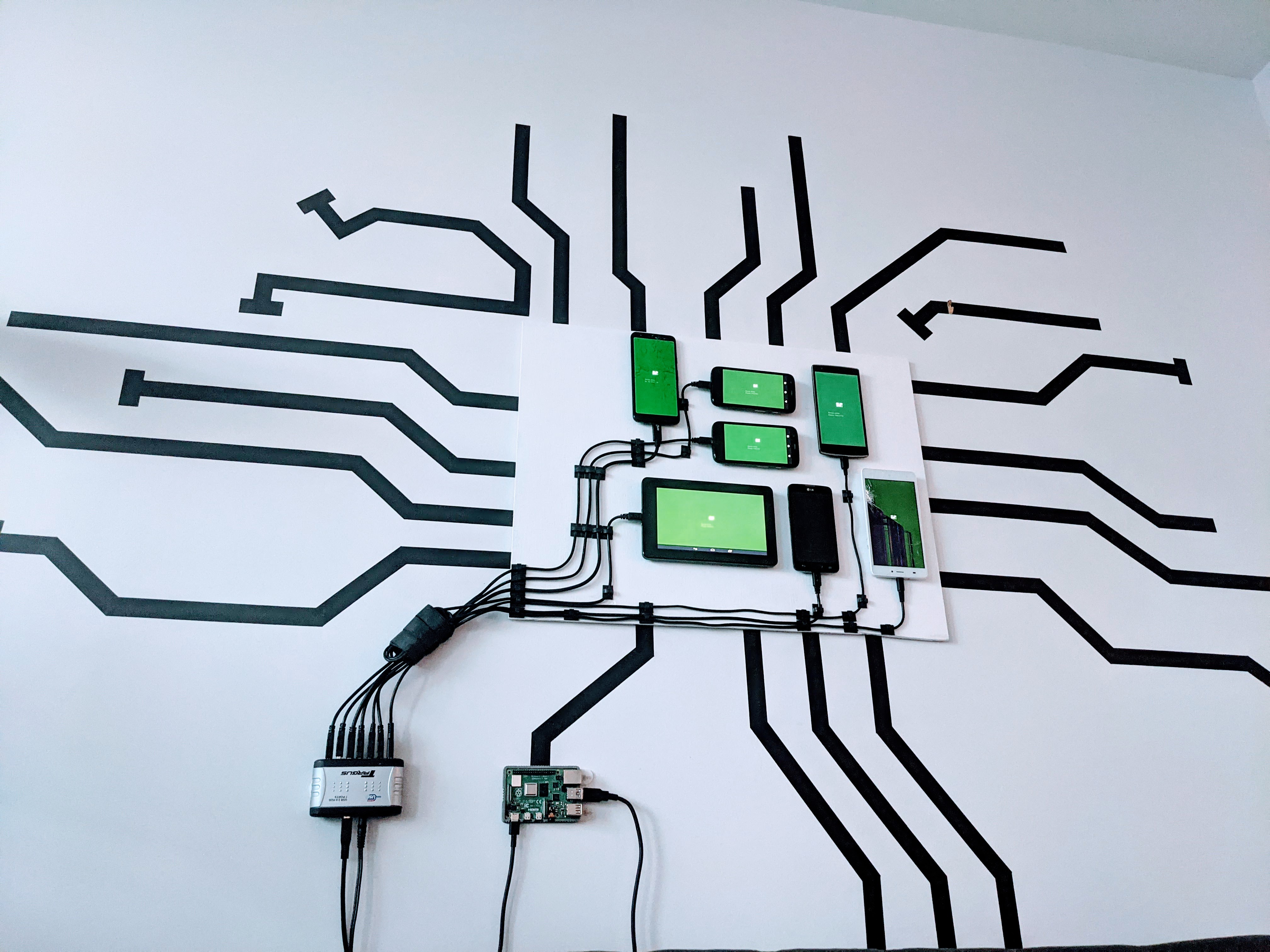
What do you do with your old phone when you get a new one? It probably goes to a pile in the back of the closest, or to the dump. I help my family with tech support and end up with any of their old devices, so my pile of junk phones got bigger and bigger.
I didn’t want to leave the phones lying around and collecting dust. One day I had the idea to stick them on the wall like digital photo frames. After some time with Velcro, paint, and programming, I had all the phones up and running.
What it does
These phones can do anything a normal phone does, but I’ve tweaked the use cases since they’re meant to be viewed and not touched.
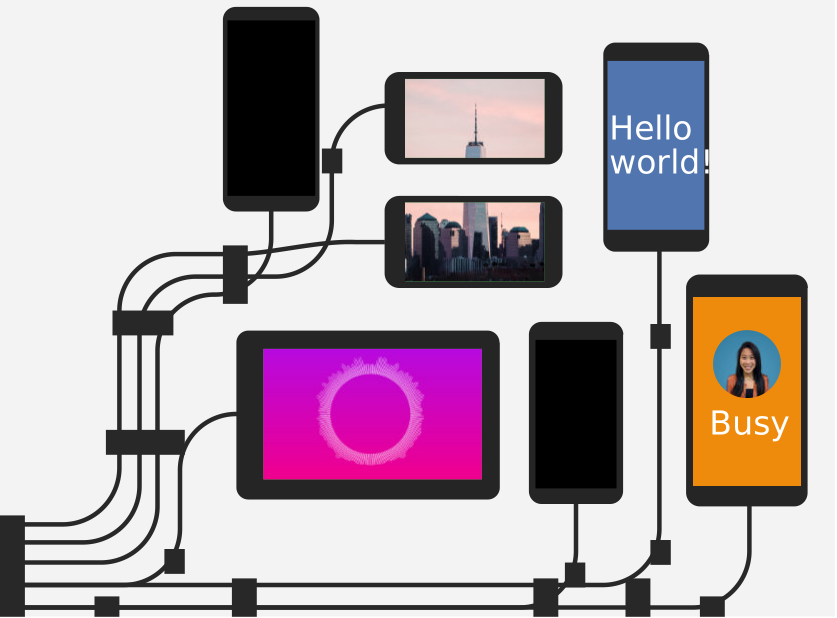
- Upload images to each individual cell phone or an image that spans multiple phones.
- Show a drink list or other text across all phones.
- Indicate at a glance if I or my partner is is in a meeting.
Parts and assembly
Each of these phones has a story of its own. Some have cracked screens, some can’t connect to the internet, and one I found in the woods. To build Cell Wall, I needed a physical board, software for the phones, and a way to mount the phones on the board. You might have some of this lying around already!
Wood plank base (the “Wall”)
- Plywood handy panel
- White acrylic paint
- Paint brush
- Sandpaper
- Tools to mount the plank onto your wall, such as:
- Command Strips for an apartment
- Wood screws for a house.
First off: there needs to be a panel for the phones to sit on top of. You could choose to stick phones directly on your wall, but I live in an apartment and I wanted to make something I could remove. I previously tried using a foam board but decided to “upgrade” to a wood panel with paint.
I started off arranging the phones on the floor and figuring out how much space was needed. I took some measurements and estimated that the board needed to be 2 feet by 1 1/2 feet to comfortably fit all the phones and wires.
Once I had some rough measurements, I took a trip to Home Depot. Home Depot sells precut 2 feet by 2 feet wood panels, so I found a sturdy light piece. You can get wood cut for free inside the store by an employee or at a DIY station, so I took out a saw and cut off the extra 6-inch piece.
The edges can be a little sharp afterwards. Use a block of sandpaper to smooth them out.
I wanted the wood board to blend in with my wall and not look like…wood. At a craft store, I picked up a small bottle of white paint and a paintbrush. At home, on top of some trash bags, I started painting a few coats of white.
Mounting and connecting the phones (the “Cell"s)
- Old cell phones and/or tablets running Android
- Raspberry Pi or another computer to use as the server
- Velcro strips
- USB cables
- Wire clips
- USB hub
To keep the phones from falling off, I use Velcro. It’s perfect for securely attaching the phones to the board while allowing them to be removed if needed.
Before sticking them on, I also double-checked that the phones turn on at all. Most do, and the ones that are busted make a nice extra decoration.