The TenFourFox 45.5.0 beta (yes, it says it's 45.4.0, I didn't want to rev the version number yet) is now available for testing (downloads, hashes). This blog post will serve as the current "release notes" since we have until November 8 for the next release and I haven't decided everything I'll put in it, so while I continue to do more work I figured I'd give you something to play with. Here's what's new so far, roughly in order of importance.
First, minimp3 has been converted to a platform decoder. Simply by doing that fixed a number of other bugs which were probably related to how we chunked frames, such as Google Translate voice clips getting truncated and problems with some types of MP3 live streams; now we use Mozilla's built-in frame parser instead and in this capacity minimp3 acts mostly as a disembodied codec. The new implementation works well with Google Translate, Soundcloud, Shoutcast and most of the other things I tried. (See, now there's a good use for that Mac mini G4 gathering dust on your shelf: install TenFourFox and set it up for remote screensharing access, and use it as a headless Internet radio -- I'm sitting here listening to National Public Radio over Shoutcast in a foxbox as I write this. Space-saving, environmentally responsible computer recycling! Yes, I know I'm full of great ideas. Yes. You're welcome.)
Interestingly, or perhaps frustratingly, although it somewhat improved Amazon Music (by making duration and startup more reliable) the issue with tracks not advancing still persisted for tracks under a certain critical length, which is dependent on machine speed. (The test case here was all the little five or six second Fingertips tracks from They Might Be Giants' Apollo 18, which also happens to be one of my favourite albums, and is kind of wrecked by this problem.) My best guess is that Amazon Music's JavaScript player interface ends up on a different, possibly asynchronous code path in 45 than 38 due to a different browser feature profile, and if the track runs out somehow it doesn't get the end-of-stream event in time. Since machine speed was a factor, I just amped up JavaScript to enter the Baseline JIT very quickly. That still doesn't fix it completely and Apollo 18 is still messed up, but it gets the critical track length down to around 10 or 15 seconds on this Quad G5 in Reduced mode and now most non-pathological playlists will work fine. I'll keep messing with it.
In addition, this release carries the first pass at AltiVec decoding for VP9. It has some of the inverse discrete cosine and one of the inverse Hadamard transforms vectorized, and I also wrote vector code for two of the convolutions but they malfunction on the iMac G4 and it seems faster without them because a lot of these routines work on unaligned data. Overall, our code really outshines the SSE2 versions I based them on if I do say so myself. We can collapse a number of shuffles and merges into a single vector permute, and the AltiVec multiply-sum instruction can take an additional constant for use as a bias, allowing us to skip an add step (the SSE2 version must do the multiply-sum and then add the bias rounding constant in separate operations; this code occurs quite a bit). Only some of the smaller transforms are converted so far because the big ones are really intimidating. I'm able to model most of these operations on my old Core 2 Duo Mac mini, so I can do a step-by-step conversion in a relatively straightforward fashion, but it's agonizingly slow going with these bigger ones. I'm also not going to attempt any of the encoding-specific routines, so if Google wants this code they'll have to import it themselves.
G3 owners, even though I don't support video on your systems, you get a little boost too because I've also cut out the loopfilter entirely. This improves everybody's performance and the mostly minor degradation in quality just isn't bad enough to be worth the CPU time required to clean it up. With this initial work the Quad is able to play many 360p streams at decent frame rates in Reduced mode and in Highest Performance mode even some 480p ones. The 1GHz iMac G4, which I don't technically support for video as it is below the 1.25GHz cutoff, reliably plays 144p and even some easy-to-decode (pillarboxed 4:3, mostly, since it has lots of "nothing" areas) 240p. This is at least as good as our AltiVec VP8 performance and as I grind through some of the really heavyweight transforms it should get even better.
Diversity and Inclusion is more than having people of different demographics in a group. It is also about having the resulting diversity of perspectives included in the decision-making and action of the group in a fundamental way.
I’ve had this experience lately, and it demonstrated to me both why it can be hard and why it’s so important. I’ve been working on a project where I’m the individual contributor doing the bulk of the work. This isn’t because there’s a big problem or conflict; instead it’s something I feel needs my personal touch. Once the project is complete, I’m happy to describe it with specifics. For now, I’ll describe it generally.
There’s a decision to be made. I connected with the person I most wanted to be comfortable with the idea to make sure it sounded good. I checked with our outside attorney just in case there was something I should know. I checked with the group of people who are most closely affected and would lead the decision and implementation if we proceed. I received lots of positive response.
Then one last person checked in with me from my first level of vetting and spoke up. He’s sorry for the delay, etc but has concerns. He wants us to explore a bunch of different options before deciding if we’ll go forward at all, and if so how.
At first I had that sinking feeling of “Oh bother, look at this. I am so sure we should do this and now there’s all this extra work and time and maybe change. Ugh!” I got up and walked around a bit and did a few thing that put me in a positive frame of mind. Then I realized — we had added this person to the group for two reasons. One, he’s awesome — both creative and effective. Second, he has a different perspective. We say we value that different perspective. We often seek out his opinion precisely because of that perspective.
This is the first time his perspective has pushed me to do more, or to do something differently, or perhaps even prevent me from something that I think I want to do. So this is the first time the different perspective is doing more than reinforcing what seemed right to me.
That lead me to think “OK, got to love those different perspectives” a little ruefully. But as I’ve been thinking about it I’ve come to internalize the value and to appreciate this perspective. I expect the end result will be more deeply thought out than I had planned. And it will take me longer to get there. But the end result will have investigated some key assumptions I started with. It will be better thought out, and better able to respond to challenges. It will be stronger.
I still can’t say I’m looking forward to the extra work. But I am looking forward to a decision that has a much stronger foundation. And I’m looking forward to the extra learning I’ll be doing, which I believe will bring ongoing value beyond this particular project.
I want to build Mozilla into an example of what a trustworthy organization looks like. I also want to build Mozilla so that it reflects experience from our global community and isn’t living in a geographic or demographic bubble. Having great people be part of a diverse Mozilla is part of that. Creating a welcoming environment that promotes the expression and positive reaction to different perspectives is also key. As we learn more and more about how to do this we will strengthen the ways we express our values in action and strengthen our overall effectiveness.
https://blog.lizardwrangler.com/2016/09/23/living-with-diverse-perspectives/
Once a month, web developers from across the Mozilla Project get together to talk about our side projects and drink, an occurrence we like to call “Beer and Tell”.
There’s a wiki page available with a list of the presenters, as well as links to their presentation materials. There’s also a recording available courtesy of Air Mozilla.
emceeaich: Gopher Tessel
First up was emceeaich, who shared Gopher Tessel, a project for running a Gopher server (an Internet protocol that was popular before the World Wide Web) on a Tessel. Tessel is small circuit board that runs Node.js projects; Gopher Tessel reads sensors (such as the temperature sensor) connected to the board, and exposes their values via Gopher. It also can control lights connected to the board.
groovecoder: Crypto: 500 BC – Present
Next was groovecoder, who shared a preview of a talk about cryptography throughout history. The talk is based on “The Code Book” by Simon Sign. Notable moments and techniques mentioned include:
- 499 BCE: Histiaeus of Miletus shaves the heads of messengers, tattoos messages on their scalps, and sends them after their hair has grown back to hide the message.
- ~100 AD: Milk of tithymalus plant is used as invisible ink, activated by heat.
- ~700 BCE: Scytale
- 49 BC: Caesar cipher
- 1553 AD: Vigen`ere cipher
bensternthal: Home Monitoring & Weather Tracking
bensternthal was up next, and he shared his work building a dashboard with weather and temperature information from his house. Ben built several Node.js-based applications that collect data from his home weather station, from his Nest thermostat, and from Weather Underground and send all the data to an InfluxDB store. The dashboard itself uses Grafana to plot the data, and all of these servers are run using Docker.
The repositories for the Node.js applications and the Docker configuration are available on GitHub:
craigcook: ByeHolly
Next was craigcook, who shared a virtual yearbook page that he made as a farewell tribute to former-teammate Holly Habstritt-Gaal, who recently took a job at another company. The page shows several photos that are clipped at the edges to look curved like an old television screen. This is done in CSS using clip-path with an SVG-based path for clipping. The SVG used is also defined using proportional units, which allows it to warp and distort correctly for different image sizes, as seen by the variety of images it is used on in the page.
peterbe: react-buggy
peterbe told us about react-buggy, a client for viewing Github issues implemented in React. It is a rewrite of buggy, a similar client peterbe wrote for Bugzilla bugs.
 Watch the Participation Team share the work from the last quarter in the Demos.
Setting a Freenode channel’s taxonomy info
Some recent flooding in a Freenode channel sent me on a quest to discover whether the network’s services were capable of setting a custom message rate limit for each channel. As far as I can tell, they are not.
However, the problem caused me to re-read the ChanServ help section:
/msg chanserv help
- ***** ChanServ Help *****
- ...
- Other commands: ACCESS, AKICK, CLEAR, COUNT, DEOP, DEVOICE,
-                 DROP, GETKEY, HELP, INFO, QUIET, STATUS,
-                 SYNC, TAXONOMY, TEMPLATE, TOPIC, TOPICAPPEND,
-                 TOPICPREPEND, TOPICSWAP, UNQUIET, VOICE,
-                 WHY
- ***** End of Help *****
Taxonomy is a cool word. Let’s see what taxonomy means in the context of IRC:
/msg chanserv help taxonomy
- ***** ChanServ Help *****
- Help for TAXONOMY:
-
- The taxonomy command lists metadata information associated
- with registered channels.
-
- Examples:
-     /msg ChanServ TAXONOMY #atheme
- ***** End of Help *****
Follow its example:
/msg chanserv taxonomy #atheme
- Taxonomy for #atheme:
- url                       : http://atheme.github.io/
- ОХЯЕБУ                    : лололол
- End of #atheme taxonomy.
That’s neat; we can elicit a URL and some field with a cryllic and apparently custom name. But how do we put metadata into a Freenode channel’s taxonomy section? Google has no useful hits (hence this blog post), but further digging into ChanServ’s manual does help:
/msg chanserv help set

- ***** ChanServ Help *****
- Help for SET:
-
- SET allows you to set various control flags
- for channels that change the way certain
- operations are performed on them.
-
- The following subcommands are available:
- EMAIL           Sets the channel e-mail address.
- ...
- PROPERTY        Manipulates channel metadata.
- ...
- URL             Sets the channel URL.
- ...
- For more
Hello, SUMO Nation!
How are you doing? Have you seen the First Inaugural Firefox Census already? Have you filled it out? Help us figure out what kind of people use Firefox! You can get to it right after you read through our latest & greatest news below.
Welcome, new contributors!
If you just joined us, don’t hesitate – come over and say “hi” in the forums!
Contributors of the week
- All the forum supporters who tirelessly helped users out for the last week.
- All the writers of all languages who worked tirelessly on the KB for the last week.
- All the Social Superheroes – thank you!
We salute you!
SUMO Community meetings
- LATEST ONE: 21st of September- you can read the notes here and see the video at AirMozilla.
- NEXT ONE: happening on the 28th of September!
- If you want to add a discussion topic to the upcoming meeting agenda:
- Start a thread in the Community Forums, so that everyone in the community can see what will be discussed and voice their opinion here before Wednesday (this will make it easier to have an efficient meeting).
- Please do so as soon as you can before the meeting, so that people have time to read, think, and reply (and also add it to the agenda).
- If you can, please attend the meeting in person (or via IRC), so we can follow up on your discussion topic during the meeting with your feedback.
Community
- We have sent out several nominations for the upcoming December Work Week conference – the Participation team will be reviewing the nominations and contacting some of you in the coming days.
- Reminder: MozFest is a bit more than a month away! Are you going to attend this year?
- Ongoing reminder #1: if you think you can benefit from getting a second-hand device to help you with contributing to SUMO, you know where to find us.
- Ongoing reminder #2: we are looking for more contributors to our blog. Do you write on the web about open source, communities, SUMO, Mozilla… and more? Do let us know!
- Ongoing reminder #3: want to know what’s going on with the Admins? Check
 Weekly project updates from the Mozilla Connected Devices team.
https://air.mozilla.org/connected-devices-weekly-program-update-20160922/
Once a month, web developers from across Mozilla get together to talk about the work that we’ve shipped, share the libraries we’re working on, meet new folks, and talk about whatever else is on our minds. It’s the Webdev Extravaganza! The meeting is open to the public; you should stop by!
You can check out the wiki page that we use to organize the meeting, or view a recording of the meeting in Air Mozilla. Or just read on for a summary!
Shipping Celebration
The shipping celebration is for anything we finished and deployed in the past month, whether it be a brand new site, an upgrade to an existing one, or even a release of a library.
Survey Gizmo Integration with Google Analytics
First up was shobson, who talked about a survey feature on MDN that prompts users to leave feedback about how MDN helped them complete a task. The survey is hosted by SurveyGizmo, and custom JavaScript included on the survey reports the user’s answers back to Google Analytics. This allows us to filter on the feedback from users to answer questions like, “What sections of the site are not helping users complete their tasks?”.
View Source Offline Mode
shobson also mentioned the View Source website, which is now offline-capable thanks to Service Workers. The pages are now cached if you’ve ever visited them, and the images on the site have offline fallbacks if you attempt to view them with no internet connection.
SHIELD Content Signing
Next up was mythmon, who shared the news that Normandy, the backend service for SHIELD, now signs the data that it sends to Firefox using the Autograph service. The signature is included with responses via the Content-Signature header. This signing will allow Firefox to only execute SHIELD recipes that have been approved by Mozilla.
Open-source Citizenship
Here we talk about libraries we’re maintaining and what, if anything, we need help with for them.
Neo
Eli was up next, and he shared Neo, a tool for setting up new React-based projects with zero configuration. It installs and configures many useful dependencies, including Webpack, Babel, Redux, ESLint, Bootstrap, and more! Neo is installed as a command used to initialize new projects or a dependency to be added to existing projects, and acts as a single dependency that pulls in all the different libraries you’ll need.
Roundtable
The Roundtable is the home for discussions that don’t fit anywhere else.
Standu.ps Reboot
Last up was pmac, who shared a note about how he and willkg are re-writing the standu.ps service using Django, and are switching the rewrite to use Github authentication instead of Persona. They have a staging server setup and expect to have news next month about the availability of the new service.
Standu.ps is a service used by several teams at Mozilla for posting status updates as they work, and includes an IRC bot for quick posting of updates.
If you’re interested in web development at Mozilla, or want to attend next month’s Extravaganza, subscribe to the
 This is a weekly call with some of the Reps to discuss all matters about/affecting Reps and invite Reps to share their work with everyone.
Every two weeks, engineering teams working on Firefox Desktop get together and update each other on things that they’re working on. These meetings are public. Details on how to join, as well as meeting notes, are available here.
We feel that the bleeding edge development state captured in those meeting notes might be interesting to our Nightly blog audience. To that end, we’re taking a page out of the Rust and Servo playbook, and offering you handpicked updates about what’s going on at the forefront of Firefox development!
Expect these every two weeks or so.
Thanks for using Nightly, and keep on rocking the free web!
Highlights
- In an effort to replace XUL themes with something better, jaws and mikedeboer sent out a survey to gather data on how people want to theme their browser.
- MattN announced that the Form Autofill project has been kicked off!
- Check out the excellent UX spec
- The current plan is to design and implement this as a System Add-on
- Development kick-off and mailing list coming soon!
- After analyzing performance and stability data, mconley and felipe report that we are green-lit to ship e10s to release users that have the add-ons on this whitelist installed, as well as WebExtensions. The plan is to do this in 49.
- To help with porting / transitioning, andym reports that the Add-ons Team is landing the ability for WebExtension APIs to be used from SDK and bootstrap.js extension. Stay tuned for official word from the team.
- A reminder that Firefox 49 release is scheduled for September 20th
Contributor(s) of the Week
- The team has nominated Adam (adamgj.wong), who has helped clean-up some of our Telemetry APIs. Great work, Adam!
Project Updates
Add-ons
- andym wants to remind everybody that the Add-ons team is still triaging and fixing SDK bugs (like this one, for example).
Electrolysis (e10s)
- mconley reports that a11y and touchscreen support landed in 51, but might not go out in that release, as there are still a few bad bugs with it.
- mconley also wants everybody to know that we’re currently on track to ship Firefox with two content processes by default in Firefox 52, so stay tuned for that.
Core Engineering
- ksteuber rewrote the Snappy Symbolication Server (mainly used for the Gecko Profiler for Windows builds) and this will be deployed soon.
- felipe is in the process of designing experiment mechanisms for testing different behaviours for Flash (allowing some, denying some, click-to-play some, based on heuristics)
Platform UI and other Platform Audibles
- mconley is refactoring the “unsubmitted crash report” notification, as well as allowing users to always submit backlogged crash reports
- jessica and scottwu are working hard on the Date / Time form field work, and reviews have been given for both the layout and picker
 Meeting OW2
 Want to learn more about EU Privacy? Join us for a lively panel discussion of EU Privacy, including GDPR, Privacy Shield, Brexit and more. After...

In 2015, The Mozilla Foundation launched the Mozilla Clubs program to bring people together locally to teach, protect and build the open web in an engaging and collaborative way. Within a year it grew to include 240+ Clubs in 100+ cities globally, and now is growing to reach new communities around the world.
Today we are excited to share a new focus for Mozilla Clubs taking place on a University or College Campus (Campus Clubs). Mozilla Campus Clubs blend the passion and student focus of the former Firefox Student Ambassador program and Take Back The Web Campaign with the existing structure of Mozilla Clubs to create a unified model for participation on campuses!
Mozilla Campus Clubs take advantage of the unique learning environments of Universities and Colleges to bring groups of students together to teach, build and protect the open web. It builds upon the Mozilla Club framework to provide targeted support to those on campus through its:
- Structure: Campus Clubs include an Executive Team in addition to the Club Captain position, who help develop programs and run activities specific to the 3 impact areas (teach, build, protect).
- Training & Support: Like all Mozilla Clubs, Regional Coordinators and Club Captains receive training and mentorship throughout their clubs journey. However the nature of the training and support for Campus Clubs is specific to helping students navigate the challenges of setting up and running a club in the campus context.
- Activities: Campus Club activities are structured around 3 impact areas (teach, build, protect). Club Captains in a University or College can find suggested activities (some specific to students) on the website here.
These clubs will be connected to the larger Mozilla Club network to share resources, curriculum, mentorship and support with others around the world. In 2017 you’ll see additional unification in terms of a joint application process for all Regional Coordinators and a unified web presence.
This is an exciting time for us to unite our network of passionate contributors and create new opportunities for collaboration, learning, and growth within our Mozillian communities. We also see the potential of this unification to allow for greater impact across Mozilla’s global programs, projects and initiatives.
If you’re currently involved in Mozilla Clubs and/or the FSA program, here are some important things to know:
- The Firefox Student Ambassador Program is now Mozilla Campus Clubs: After many months of hard work and careful planning the Firefox Ambassador Program (FSA) has officially transitioned to Mozilla Clubs as of Monday September 19th, 2016. For full details about the Firefox Student Ambassador transition check out this guide here.
- Firefox Club Captains will now be Mozilla Club Captains: Firefox Club Captains who already have a club, a structure, and a community set up on a university/college should register your club here to be partnered with a Regional Coordinator and have access to new resources and opportunities, more details are here.
- Current Mozilla Clubs will stay the same: Any Mozilla Club that already exists will stay the same. If they happen to be on a university or college campus Clubs may choose to register as a Campus Club, but are not required to do so.
- There is a new application for Regional Coordinators (RC’s): Anyone interested in taking on more responsibility within the Clubs program can apply here. Regional Coordinators mentor Club Captains that are geographically close to them. Regional Coordinators support all Club Captains in their region whether they are on campus or elsewhere.
- University or College students who want to start a Club at
 Meetup for 2016 MozFest Volunteers
 mconley livehacks on real Firefox bugs while thinking aloud.
 This is the sumo weekly call
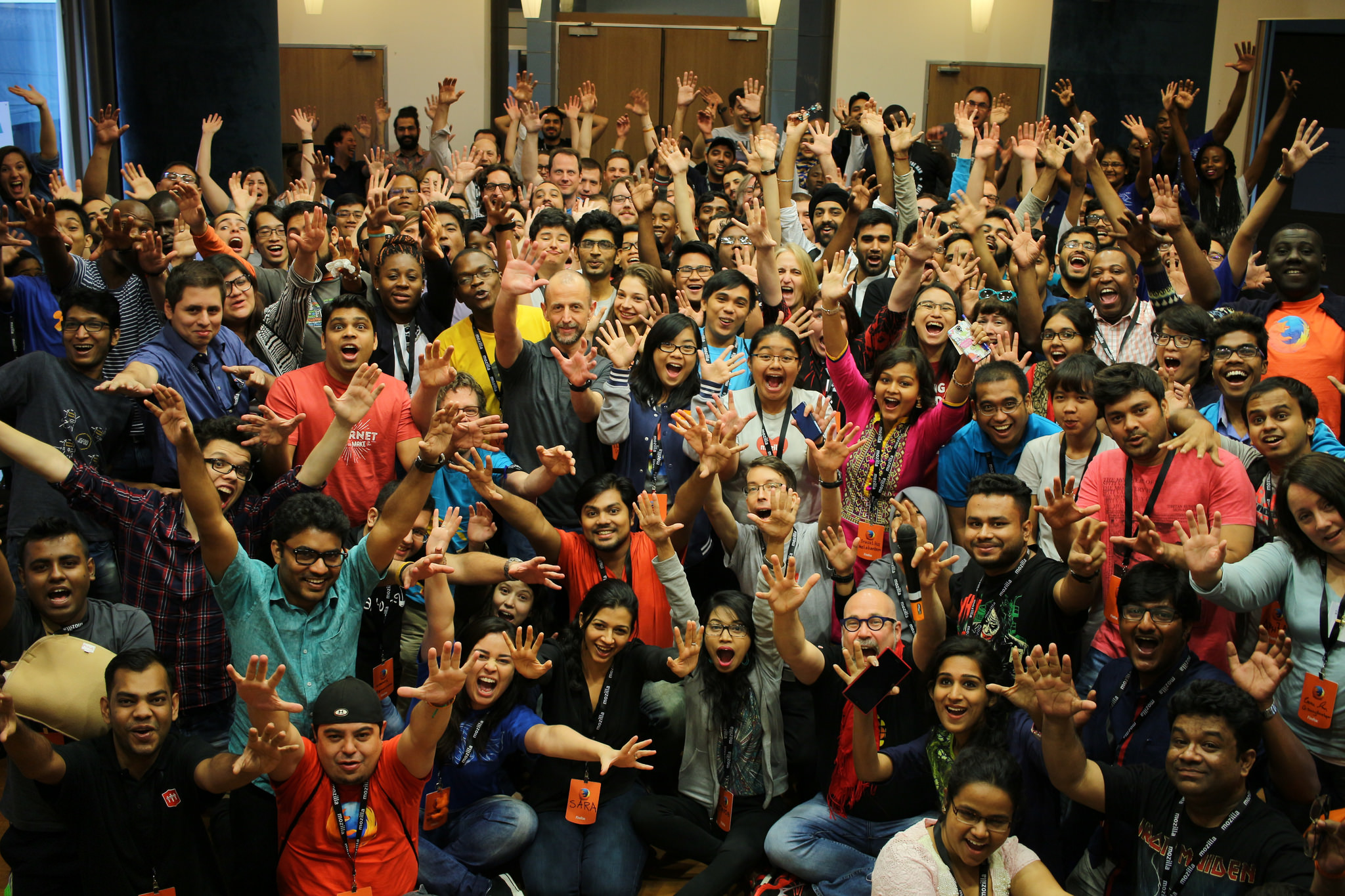
In 2015, The Mozilla Foundation launched the Mozilla Clubs program to bring people together locally to teach, protect and build the open web in an engaging and collaborative way. Within a year it grew to include 240+ Clubs in 100+ cities globally, and now is growing to reach new communities around the world.
Today we are excited to share a new focus for Mozilla Clubs taking place on a University or College Campus (Campus Clubs). Mozilla Campus Clubs blend the passion and student focus of the former Firefox Student Ambassador program and Take Back The Web Campaign with the existing structure of Mozilla Clubs to create a unified model for participation on campuses!
Mozilla Campus Clubs take advantage of the unique learning environments of Universities and Colleges to bring groups of students together to teach, build and protect the open web. It builds upon the Mozilla Club framework to provide targeted support to those on campus through its:
- Structure: Campus Clubs include an Executive Team in addition to the Club Captain position, who help develop programs and run activities specific to the 3 impact areas (teach, build, protect).
- Specific Training & Support: Like all Mozilla Clubs, Regional Coordinators and Club Captains receive training and mentorship throughout their clubs journey. However the nature of the training and support for Campus Clubs is specific to helping students navigate the challenges of setting up and running a club in the campus context.
- Activities: Campus Club activities are structured around 3 impact areas (teach, build, protect). Club Captains in a University or College can find suggested activities (some specific to students) on the website here.
These clubs will be connected to the larger Mozilla Club network to share resources, curriculum, mentorship and support with others around the world. In 2017 you’ll see additional unification in terms of a joint application process for all Club leaders and a unified web presence.
This is an exciting time for us to unite our network of passionate contributors and create new opportunities for collaboration, learning, and growth within our Mozillian communities. We also see the potential of this unification to allow for greater impact across Mozilla’s global programs, projects and initiatives.
If you’re currently involved in Mozilla Clubs and/or the FSA program, here are some important things to know:
- The Firefox Student Ambassador Program is now Mozilla Campus Clubs: After many months of hard work and careful planning the Firefox Ambassador Program (FSA) has officially transitioned to Mozilla Clubs as of Monday September 19th, 2016. For full details about the Firefox Student Ambassador transition check out this guide here.
- Firefox Club Captains will now be Mozilla Club Captains: Firefox Club Captains who already have a club, a structure, and a community set up on a university/college should register your club here to be partnered with a Regional Coordinator and have access to new resources and opportunities, more details are here.
- Current Mozilla Clubs will stay the same: Any Mozilla Club that already exists will stay the same. If they happen to be on a university or college campus Clubs may choose to register as a Campus Club, but are not required to do so.
- There is a new application for Regional Coordinators (RC’s): Anyone interested in taking on more responsibility within the Clubs program can apply
System add-ons are a new kind of add-on in Firefox, you might also know them as Go Faster add-ons.
These are interesting add-ons, they allow Firefox developers to ship code faster by writing the code in an add-on and then allow that to be developed and shipped independently of the main Firefox code.
Mostly these are not using WebExtensions and there is some questions if they should. I've been thinking about this one for a while and here are my thoughts at the moment - they aren't more than thoughts at this time.
System add-ons are really "internal" pieces of code that would otherwise be shipped in mozilla-central, blessed by the module owner and generally approved. They are maintained by someone who is active involved in their code (usually but not always a Mozilla employee). They have gone through security and privacy reviews. They are tested against Firefox code in the test infrastructure on each release. They sometimes do things that no other add-on should be allowed to do.
This is all in contrast to third party add-ons that you'll find on AMO. When you look through all the reasoning behind WebExtensions, you'll find that a lot of the reasons involve things like "hard to maintain", "security problems" and so on. Please see my earlier posts for more on this. I would say that these reasons don't apply to system add-ons.
So do system add-ons need to be WebExtensions? Maybe they don't. In fact I think if we try and push them into being system add-ons we'll create a scenario where WebExtensions become the blocker.
System add-ons will want to do things that don't exist, so APIs will need to be added to WebExtensions. Some of the things that system add-ons will want to do are things that third party add-ons should not be allowed to do. Then we need to add in another permissions layer to say some add-on developers can use those APIs and others can't.
Already there is a distinction between what can and cannot land in Firefox and that's made by the module owners and people who work on Firefox.
If a system add-on does something unusual, do you end up in a scenario where you write a WebExtension API that only one add-on uses? The maintenance burden of creating an API for one part of Firefox that only one add-on can use doesn't seem worth it. It also makes WebExtensions the blocker and slows system add-on development down.
It feels to me like there isn't a compelling reason to make system add-ons to be WebExtensions. Instead we should encourage them to be so if it makes sense and let them be regular bootstrapped add-ons otherwise.
We use shared memory (shmem) pretty extensively in the graphics stack in Gecko. Unfortunately, there isn’t a huge amount of documentation regarding how the shmem mechanisms in Gecko work and how they are managed, which I will attempt to address in this post.
Firstly, it’s important to understand how IPC in Gecko works. Gecko uses a language called IPDL to define IPC protocols. This is effectively a description language which formally defines the format of the messages that are passed between IPC actors. The IPDL code is then compiled into C++ code by our IPDL compiler, and we can then use the generated classes in Gecko’s C++ code to do IPC related things. IPDL class names start with a P to indicate that they are IPDL protocol definitions.
IPDL has a built-in shmem type, simply called mozilla::ipc::Shmem. This holds a weak reference to a SharedMemory object, and code in Gecko operates on this. SharedMemory is the underlying platform-specific implementation of shared memory and facilitates the shmem subsystem by implementing the platform-specific API calls to allocate and deallocate shared memory regions, and obtain their handles for use in the different processes. Of particular interest is that on OS X we use the Mach virtual memory system, which uses a Mach port as the handle for the allocated memory regions.
mozilla::ipc::Shmem objects are fully managed by IPDL, and there are two different types: normal Shmem objects, and unsafe Shmem objects. Normal Shmem objects are mostly intended to be used by IPC actors to send large data chunks between themselves as this is more efficient than saturating the IPC channel. They have strict ownership policies which are enforced by IPDL; when the Shmem object is sent across IPC, the sender relinquishes ownership and IPDL restricts the sender’s access rights so that it can neither read nor write to the memory, whilst the receiver gains these rights. These Shmem objects are created/destroyed in C++ by calling PFoo::AllocShmem() and PFoo::DeallocShmem(), where PFoo is the Foo IPDL interface being used. One major caveat of these “safe” shmem regions is that they are not thread safe, so be careful when using them on multiple threads in the same process!
Unsafe Shmem objects are basically a free-for-all in terms of access rights. Both sender and receiver can always read/write to the allocated memory and careful control must be taken to ensure that race conditions are avoided between the processes trying to access the shmem regions. In graphics, we use these unsafe shmem regions extensively, but use locking vigorously to ensure correct access patterns. Unsafe Shmem objects are created by calling PFoo::AllocUnsafeShmem(), but are still destroyed in the same manner as normal Shmem objects by simply calling PFoo::DeallocShmem().
With the work currently ongoing to move our compositor to a separate GPU process, there are some limitations with our current shmem situation. Notably, a SharedMemory object is effectively owned by an IPDL channel, and when the channel goes away, the SharedMemory object backing the Shmem object is deallocated. This poses a problem as we use shmem regions to back our textures, and when/if the GPU process dies, it’d be great to keep the existing textures and simply recreate the process and IPC channel, then continue on like normal. David Anderson is currently exploring a solution to this problem, which will likely be to hold a strong reference to the SharedMemory region in the Shmem object, thus ensuring that the SharedMemory object doesn’t get destroyed underneath us so long as we’re using it in Gecko.
http://www.hackermusings.com/2016/09/an-introduction-to-shmemipc-in-gecko/