 Nicholas van de Walle is a local web developer who loves shoving computers into everything from clothes to books to rocks. He has worked for...
https://air.mozilla.org/connected-devices-meetup-nicholas-van-de-walle/
6:30pm - Johannes Ernst; UBOS and the Indie IoT: Will the IoT inevitably make us all digital serfs to a few overlords in the cloud,...
https://air.mozilla.org/connected-devices-meetup-2016-09-27/
the following changes have been pushed to bugzilla.mozilla.org:
- [1305713] BMO: Persistent XSS via Git commit messages in comments
discuss these changes on mozilla.tools.bmo.
 [показать]
https://dlawrence.wordpress.com/2016/09/27/happy-bmo-push-day-2-2/
 The weekly B2G meeting on Tuesday 27th September will be attended by Mozilla senior staff members who would like to make some announcements to the...
 Reuni'on bi-semanal para hablar sobre el estado de Mozilla, la comunidad y sus proyectos. Bi-weekly meeting to talk (in Spanish) about Mozilla status, community and...
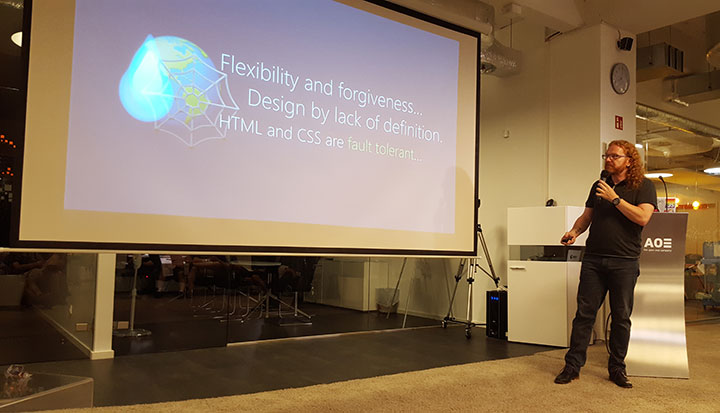
Das Video des Vortrags ist von AOE schon fertig editiert und auf YouTube zu finden:
Die (englischen) Slides sind auf Slideshare:
Eine Vorschau auf den ganzen Talk gab es von mir auch auf der SmashingConf Freiburg Jam Session, und der Screencast davon (schreiend, auf Englisch) ist auch auf YouTube:
Sowohl AOE als auch die UserGruppe haben ueber den Abend gebloggt.
Es war ein netter Abend, und obschon ich dachte es w"are das zehnj"ahrige Jubil"aum und nicht das zehnte Meetup hat sichs gelohnt, nach der SmashingConf und vor dem A-Tag in Wiesbaden vorbei zu kommen. Vor allem auch, weil Patricia Kuchen gebacken hat und nun ganz wild JavaScript lernt!
Six weeks ago, I posted “On Trial”, which explained that I was taking part in a medical trial in Manchester. In the trial, I was trying out some interesting new DNA repair pathway inhibitors which, it was hoped, might have a beneficial effect on my cancer. However, as of ten days ago, my participation has ended. The trial parameters say that participants can continue as long as their cancer shrinks or stays the same. Scans are done every six weeks to determine what change, if any, there has been. As mine had been stable for the five months before starting participation, I was surprised to discover that after six weeks of treatment my liver metastasis had grown by 7%. This level of growth was outside the trial parameters, so they concluded (probably correctly!) the treatment was not helping me and that was that.
The Lord has all of this in his hands, and I am confident of his good purposes for me :-)
http://feedproxy.google.com/~r/HackingForChrist/~3/nYtwef5d39c/
Rust’s Community Automation
Here’s the text version, with clickable links, of my Automacon lightning talk today.
Intro
I’m a DevOps engineer at Mozilla Research and a member of the Rust Community subteam, but the conclusions and suggestions in this talk are my own observations and opinions.
The slides are a result of trying to write my own CSS for sliderust... Sorry about the ugliness.
I have 10 minutes, so this is not the time to teach you any Rust. Check out rust-lang.org, the Rust Community Resources, or your city’s Rust meetup to get started with the language.
What we are going to cover is how Rust automates some community tasks, and what you can learn from our automation.
Community
I define “community”, in this context, as “the human interaction work necessary for a project’s success”. This work is done by a wide variety of people in many situations. Every interaction, from helping a new contributor to discussing a proposed code change to criticizing someone’s behavior, affects the overall climate of a project’s community.
Automation
To me, “automation” means “offloading peoples’ work onto a system”. This can be a computer system, but I think it can also mean changes to the social systems that guide peoples’ behavior.
So, community automation is a combination of:
- Building tools to do things the humans used to have to
- Tweaking the social systems to minimize the overhead they create
Scoping the Problem
While not all things can be automated and not all factors of the community are under the project leadership’s control, it’s not totally hopeless.
Choices made and automation deployed by project leaders can help control:
- Which contributors feel welcome or unwelcome in a project
- What code makes it into the project’s tree
- Robots!
Moderation
Our robots and social systems to improve workflow and contributor experience all rely on community members’ cooperation. To create a community of people who want to work constructively together and not be jerks to each other, Rust defines behavior expectations code of conduct. The important thing to note about the CoC is that half the document is a clear explanation of how the policies in it will be enforced. This would be impossible without the dedication of the amazing mod team.
The process of moderation cannot and should not be left to a computer, but we can use technology to make our mods’ work as easy as possible. We leave the human tasks to humans, but let our technologies do the rest.
In this case, while the mods need to step in when a human has a complaint about something, we can automate the process of telling peole that the rules exist. You can’t join the IRC channel, post on the Discourse forums, or even read the Rust subreddit without being made aware that you’re expected to follow the CoC’s guidelines in official Rust spaces.
Depending on the forums where your project communicates, try to automate the process of excluding obvious spammers and trolls. Not everybody has the skills or interest to be an excellent moderator, so when you find them, avoid wasting their time on things that a computer could do for them!
It didn’t fit in the talk, but this Slashdot post is one of my favorite examples of somebody being filtered out of participating in the Rust community due to their personal convictions about how project leadership should work. While we do miss out on that person’s potential technical contributions, we also save all of the time that might be spent hashing out our disagreements with them if we had a less clear set of community guideines.
Robots
This lightning talk highlighted 4 categories of robots:
- Maintaining code quality
- Engaging in social pleasantries
- Guiding new contributors
- Widening the contributor pipeline
Longer versions of this talk also touch on automatically testing compiler releases, but that’s more than 10 minutes of content on its own.
The EU’s proposed copyright reform keeps in place retrograde laws that make many normal online creative acts illegal. The same restrictive laws will stifle innovation and hurt technology businesses. Let’s fix it. Sign Mozilla’s petition, watch and share videos, and snap a rebellious selfie
—
Earlier this month, the EU Commission released their proposal for a reformed copyright framework. In response, we are asking everyone reading this post to take a rebellious selfie and send that doctored snapshot to EU Parliament. Seem ridiculous? So is an outdated law that bans taking and sharing selfies in front of the Eiffel Tower at night in Paris, or in front of the Little Mermaid in Copenhagen.
Of course, no one is actually going to jail for subversive selfies. But the technical illegality of such a basic online act underscores the grave shortcomings in the EU’s latest proposal on copyright reform. As Mozilla’s Denelle Dixon-Thayer noted in her last post on the proposed reform, it “thoroughly misses the goal to deliver a modern reform that would unlock creativity and innovation.” It doesn’t, for instance, include needed exceptions for panorama, parody, or remixing, nor does it include a clause that would allow noncommercial transformations of works (like remixes, or mashups) or a flexible user clause like an open norm, or fair dealing.
Translation? Making memes and gifs will remain an illicit act.
And that’s just the start. Exceptions for text and data mining are limited to public institutions. This could stifle startups looking to online data to build innovative businesses. Then there is the dangerous “neighbouring right,” similar to the ancillary copyright laws we’ve seen in Spain and Germany (which have been clear failures, respectively). This misguided part of the reform would allow online publishers to copyright “press publications” for up to 20 years, with retroactive effect. The vague wording makes it unclear exactly to whom and for whom this new exclusive right would apply.
Finally, another unclear provision would require any internet service that provides access to “large amounts” of works to users to broker agreements with rightsholders for the use of, and protection of, their works. This could include the use of “effective content recognition technologies” — which imply universal monitoring and strict filtering technologies that identify and/or remove copyrighted content.
These proposals, if adopted as they are, would deal a blow to EU startups, to independent coders, creators, and artists, and to the health of the internet as a driver for economic growth and innovation.
We’re not advocating plagiarism or piracy. Creators must be treated fairly, including proper remuneration, for their creations and works. Mozilla wants to improve copyright for everyone, so individuals are not discouraged from creating and innovating.
Mozilla isn’t alone in our objections: Over 50,000 individuals have signed our petition and demanded modern copyright laws that foster creativity, innovation, and opportunity online.
We have our work cut out for us. As the European Parliament revises the proposal this fall, we need a movement — a collection of passionate internet users who demand better, modern laws. Today, Mozilla is launching a public education campaign to support that movement.

Mozilla has created an app to highlight the absurdity of some of Europe’s outdated copyright laws. Try Post Crimes: Take a selfie in front of European landmarks that can be technically unlawful to photograph — like the Eiffel Tower’s night-time light display, or the Little Mermaid in Denmark — due to restrictive copyright laws.
Then, send your selfie as a postcard to your Member of the European Parliament (MEP). Show European policymakers how outdated copyright laws are, and encourage them to forge a more future-looking and innovation-friendly copyright reform.
We’ve also created three short videos that outline the need for reform. They’re educational, playful, and a little bit weird — just like the internet. But they explore a serious issue: The harmful effect outdated and restrictive copyright laws have on our creativity and the open internet. We hope you’ll watch them and share them with others.
We need your help standing up for better copyright laws.
Hello and welcome to another issue of This Week in Rust! Rust is a systems language pursuing the trifecta: safety, concurrency, and speed. This is a weekly summary of its progress and community. Want something mentioned? Tweet us at @ThisWeekInRust or send us a pull request. Want to get involved? We love contributions.
This Week in Rust is openly developed on GitHub. If you find any errors in this week's issue, please submit a PR.
Updates from Rust Community
News & Blog Posts
- Returning from Exceptions. How to return from exceptions correctly. Part of the series Writing an OS in Rust.
- ripgrep is faster than {grep, ag, git grep, ucg, pt, sift}. ripgrep is a command line search tool that combines the usability of The Silver Searcher (an ack clone) with the raw speed of GNU grep.
- Intersection Impls. A specialization example of adding a blanket impl that implements
Clonefor anyCopytype, its shortcomings, and one proposed fix using intersection impls (also called lattice impls). - My adventures in Rust web development.
- From tweet to Rust feature. Journey of an idea from being a tweet to becoming a Rust feature.
- How to count newlines really fast in Rust.
- Writing Cocoa apps in Rust.
- Experiment: compare ZODB file-storage iteration with Python and Rust.
- Implementing Huffman coding in Rust.
RustConf/RustFest Experiences
- My Thoughts on RustConf 2016 by Jeena Lee.
- RustConf and Strange Loop 2016 by Malisa.
- Habitat at RustConf by Salim Alam.
- RustFest was great! by Cyryl Plotnicki.
New Crates & Project Updates
- Rust Community Team announces the Rust programming language video channel on YouTube and Twitter.
- Servo maintains a fork of rust-bindgen which just got updated with a major rewrite that cleans up the codebase and paves the way for future improvements.
- slog version 1.0 released. slog is a structured, composable logging library for Rust.
- Cyano. An advanced Rust-to-JavaScript transpiler.
- gimli. A lazy, zero-copy parser for the DWARF debugging format.
- Sarkara. A Post-Quantum cryptography library written in Rust.
- Native Windows GUI. Native Window GUI (nwg for short) is a GUI library for Windows.
- dataplotlib. Plotting library that tries to make
So, a couple weeks ago I got to go to RustConf 2016, the first instance of an annual event! What was it about? The relatively new programming language Rust, from Mozilla!
Attending
I was only able to attend thanks to three factors: travel re-reimbursement allowance from Outreachy for my recent internship with them; a scholarship ticket from RustConf to cover attendance fees; and being able to stay at a friends place in Portland for a few days. Were it not for each of those, I would not have felt financially comfortable attending! I’m very grateful for all of the support.
The Morning
I went to RustConf with my now wife, Decky Coss (who also was able to attend under the same circumstances as me!). We decided that since the event is only a day long, and due to our track record for having a hard time getting the “full” experience out of conventions, that we would work extra hard on getting there on time. As such, we only missed 25 minutes of the first talk.
Of course, I’m not pleased that that happened, but we had the disadvantage of some rough flights the day before, as well as not staying on or near the location. Plus, we’re just not cut out for whatever it takes to attend conferences studiously. But we did our best that day and I think that was OK.
As I said, we missed the first half of the opening keynote, given by Aaron Turon and Niko Matsakis, but I really liked what I saw. It felt like a neat overview of Rust, especially concerning common issues newbies (like me!) run into with the language. It was gratifying hearing them point out the very same trip-ups I deal with, especially since they talked about how Rust developers are aware of these issues! They are looking into ways to help stop these trip-ups, such as better language syntax, and updating the Rust documentation.
Acting as a perfect follow-up to the keynote was “The Illustrated Adventure Survival Guide”, by Liz Baillie, which was easily the funnest talk. It was a drawn slideshow/comic making many metaphors and jokes representing how Rust works. I felt like it would be hard to enjoy if you didn’t have a decent understanding of Rust but then again, I suppose nobody would be there if they didn’t!
The last talk of the morning, “Integrating Rust and VLC”, by Geoffroy Couprie. It felt a bit hard to follow in that I didn’t know what it was leading to. All the same I greatly enjoyed seeing both a practical implementation of Rust (in this case, handling video streaming codecs), and how Rust can act as a friendlier alternative to C-like languages (something that has been heavily on my mind).
The Afternoon
Lunchtime! Lunch was set to be an hour and a half long, which, when I first saw the schedule, I thought would be excessively long. Somehow it went by very fast! Plus, following such a long morning, I was very grateful to get to unwind for a bit from listening to so much talking.
However, the dessert I had gave me a bad sugar rush and crash and I felt very out of it for the next few hours, so I don’t remember much about the talks during this time. None of them really did much for me, not that they were bad, but I just wasn’t able to pay much attention.
The Evening
Snack time! Again, I was glad to have a respite where I could chill out for a bit. Especially after having a hard time keeping focus for a few hours. This break was not nearly as long as lunch, but if it was any longer, I think the conference would have been too long.
The first talk of the evening was “A Modern Editor in Rust”, presented by Raph Levien. Raph talked about the text editor Xi. I was excited by some of the things offered in it, since it’s made to tackle unique issues, such as quickly loading and scrolling through massive (like, hundreds of megabytes big) files. I didn’t see much in it that I thought I needed personally, but I appreciate seeing programs for solving unique challenges like that.
The next talk I ended up writing so much about, I put it into another section.
The Second-Last Talk
Next was “RFC: In Order to Form a More Prefect union”, by Josh Triplett, which was easily the most impactful talk to me. It was a chronicle of a Request For Comments idea created by the speaker, which was recently committed into Rust! Josh described the RFC process in the Rust community as “welcoming, open, and inclusive”, all of which echoes my experience as a Rust newbie.
Josh talked about each step of their submission, including how far their proposal went (which was a bit of a surprise to them!). The best part to me was, despite it becoming one of the most discussed issues on Rust’s Github, Josh never found the proposal being taken from them by a
 The Monday Project Meeting

Way back in Episode 39 of Today In Digital Education, the podcast I record every week with Dai Barnes, we discussed the concept of ‘curriculum as algorithm’. If I remember correctly, it was Dai who introduced the idea.
The first couple of things that pop into my mind when considering curricula through an algorithmic lens are:
But let’s rewind and define our terms, including their etymology. First up, curriculum:
In education, a curriculum… is broadly defined as the totality of student experiences that occur in the educational process. The term often refers specifically to a planned sequence of instruction, or to a view of the student’s experiences in terms of the educator’s or school’s instructional goals.
[…]
The word “curriculum” began as a Latin word which means “a race” or “the course of a race” (which in turn derives from the verb currere meaning “to run/to proceed”). (Wikipedia)
…and algorithm:
In mathematics and computer science, an algorithm… is a self-contained step-by-step set of operations to be performed. Algorithms perform calculation, data processing, and/or automated reasoning tasks.
The English word 'algorithm’ comes from Medieval Latin word algorism and French-Greek word “arithmos”. The word 'algorism’ (and therefore, the derived word 'algorithm’) come from the name al-Khwarizmi. Al-Khwarizmi (Persian:
Last week I spent in Germany at an event sponsored by the government agency for unemployment covering the issue of digitalisation of the job market and the subsequential loss of jobs.
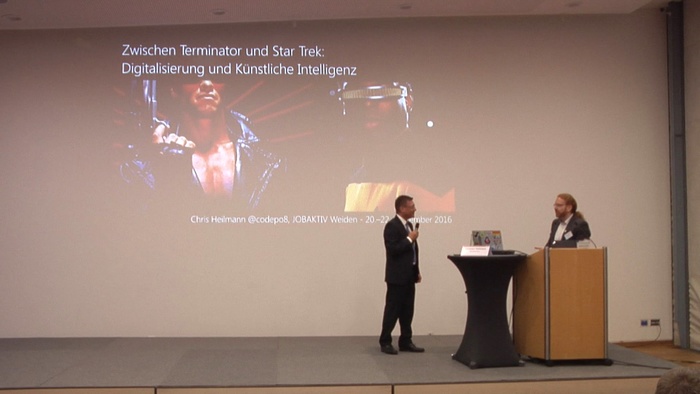
When the agency approached me to give a keynote on the upcoming “fourth industrial revolution” and what machine learning and artificial intelligence means for the job market I was – to put it mildly – bricking it. All the other presenters at the event had several doctor titles and were professors of this and that. And here I was, being asked to deliver the “future” to an audience of company owners, university professors and influential people who decide the employment fate of thousands of people.
I went into hermit mode and watched, read and translated dozens of videos and articles on AI and the work environment. In the end, I took a more detailed look at the conference schedule and realised that most of the subject matter data will be covered by the presenter before me.
Thus I delivered a talk covering the current situation of AI and what it means for us as job seekers and employers. The slides and screencast are in German, but I am looking forward to translating them and maybe deliver them in a European frame soon.
The slide deck is on Slideshare, and even without knowing German, you should get the gist:
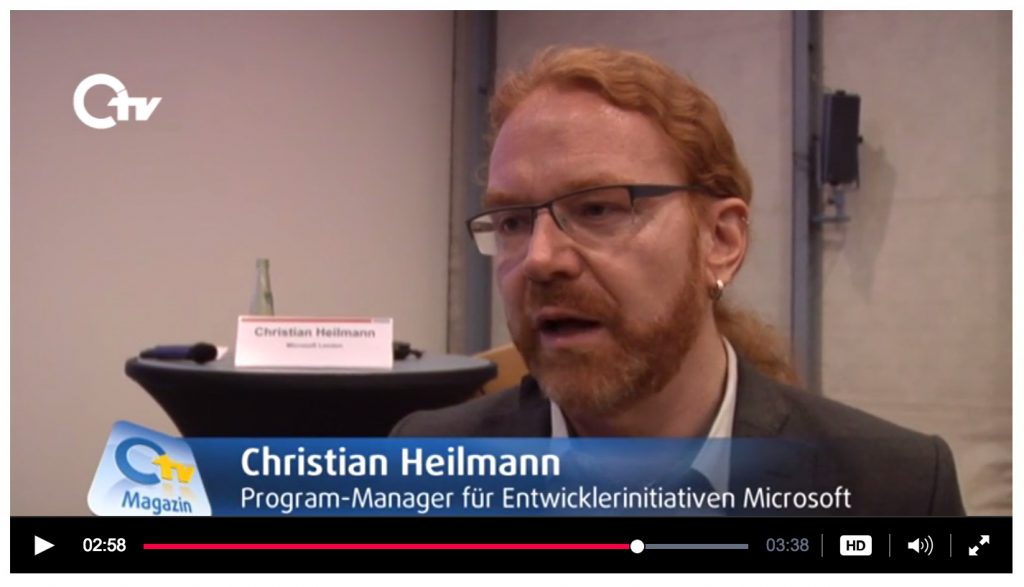
The feedback was overwhelming and humbling. I got interviewed by the local TV station where I mostly deflected all the negative and defeatist attitude towards artificial intelligence the media loves to portrait.
I also got a half page spread in the local newspaper where – to the amusement of my friends – I was touted a “fascinating prophet”.
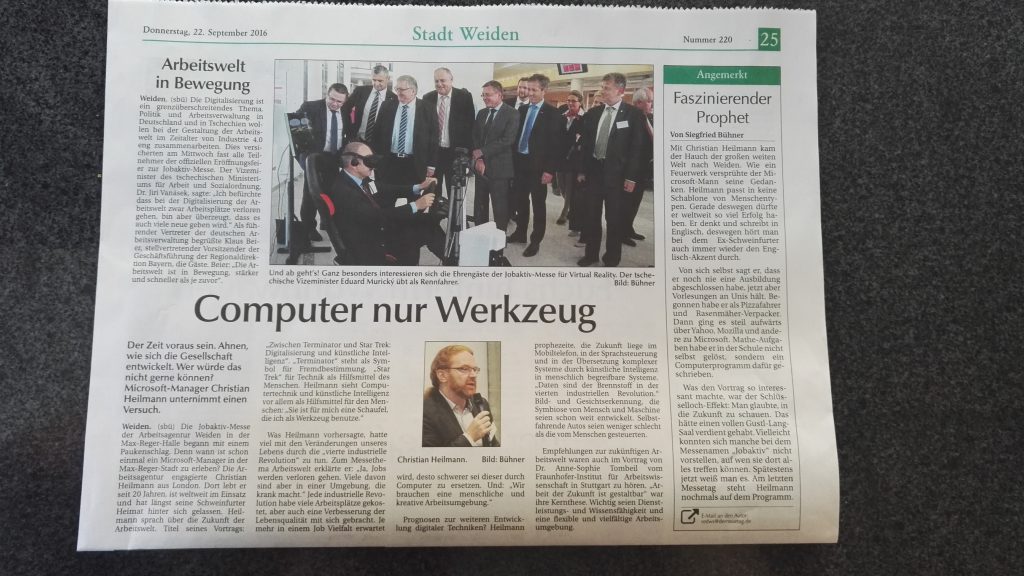
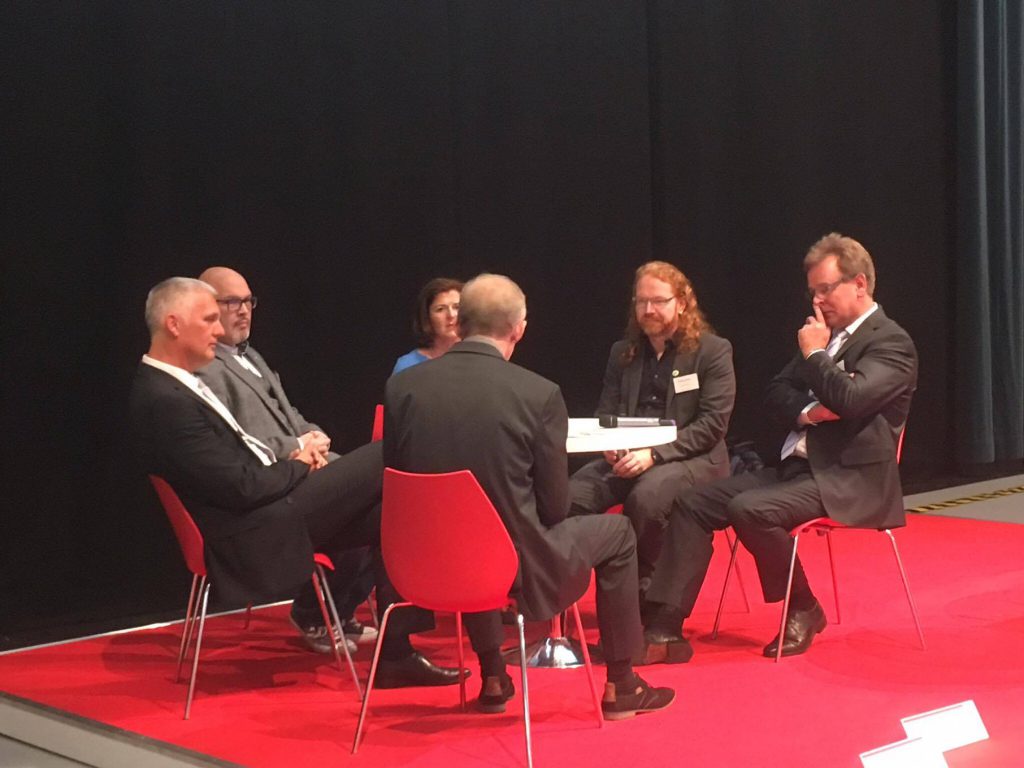
During the expert panel on digital security I had a few interesting encounters. Whilst in general it felt tough to see how inflexible and outdated some of the attitudes of companies towards computers were, there is a lot of innovation happening even in rural areas. I was especially impressed with the state of robots in warehouses and the investment of the European Union in Blockchain solutions and security research.
One thing I am looking forward to is working with a cybersecurity centre in the area giving workshops on social engineering and security of iOT.
A few things I learned and I’d like you to also consider:
- We are at the cusp – if not in the middle of – a new digital revolution
- Our job as people in the know is to reach out to those who are afraid of it and give out sensible information as a counter point to some of the fearmongering of the press
- It is incredibly rewarding to go out of our comfort zone and echo chamber and talk to people with real business and social change issues. It humbles you and makes you wonder just how you ended up knowing all that we do.
- The good social aspects of our jobs could be a blueprint for other companies to work and change to be resilient towards replacement by machines
- German is hard :)
So, be brave, offer to present at places not talking about the latest flavour of JavaScript or CSS preprocessing. The world outside our echo chamber needs us.
Or as the interrupters put it: What’s your plan for tomorrow?
CW: heavy open source license geekery ahead.
One unfortunate difficulty with open source licensing is that some lawyers, including the FSF, consider the Apache License 2.0 incompatible with the GPL 2.0, which is to say that you can’t combined Apache 2.0-licensed code with GPL 2.0-licensed code and distribute the result. This is annoying because when choosing a permissive licence, we want people to use the more modern Apache 2.0 over the older BSD or MIT licenses, because it provides some measure of patent protection. And this incompatibility discourages people from doing that.
This was a concern for Mozilla when determining the correct licensing for Rust, and this is why the standard Rust license is a dual license – the choice of Apache 2.0 or MIT. The idea was that Apache 2.0 would be the normal license, but people could choose MIT if they wanted to combine “Rust license” code with GPL 2.0 code.
However, the LLVM project has now had notable open source attorney Heather Meeker come up with an exception to be added to the Apache 2.0 license to enable GPL 2.0 compatibility. This exception meets a number of important criteria for a legal fix for this problem:
- It’s an additional permission, so is unlikely to affect the open source-ness of the license;
- It doesn’t require the organization using it to take a position on the question of whether the two licenses are actually compatible or not;
- It’s specific to the GPL 2.0, thereby constraining its effects to solving the problem.
Here it is:
—- Exceptions to the Apache 2.0 License: —-
In addition, if you combine or link compiled forms of this Software with software that is licensed under the GPLv2 (“Combined Software”) and if a court of competent jurisdiction determines that the patent provision (Section 3), the indemnity provision (Section 9) or other Section of the License conflicts with the conditions of the GPLv2, you may retroactively and prospectively choose to deem waived or otherwise exclude such Section(s) of the License, but only in their entirety and only with respect to the Combined Software.
—- end —-
It seems very well written to me; I wish it had been around when we were licensing Rust.
http://feedproxy.google.com/~r/HackingForChrist/~3/LwfflfNQj0E/
Google have just published the draft spec for a protocol called Roughtime, which allows clients to determine the time to within the nearest 10 seconds or so without the need for an authoritative trusted timeserver. One part of their ecosystem document caught my eye – it’s like a small “chaos monkey” for protocols, where their server intentionally sends out a small subset of responses with various forms of protocol error:
A healthy software ecosystem doesn‘t arise by specifying how software should behave and then assuming that implementations will do the right thing. Rather we plan on having Roughtime servers return invalid, bogus answers to a small fraction of requests. These bogus answers would contain the wrong time, but would also be invalid in another way. For example, one of the signatures might be incorrect, or the tags in the message might be in the wrong order. Client implementations that don’t implement all the necessary checks would find that they get nonsense answers and, hopefully, that will be sufficient to expose bugs before they turn into a Blackhat talk.
The fascinating thing about this is that it’s a complete reversal of the ancient Postel’s Law regarding internet protocols:
Be conservative in what you send, be liberal in what you accept.
This behaviour instead requires implementations to be conservative in what they accept, otherwise they will get garbage data. And it also involves being, if not liberal, then certainly occasionally non-conforming in what they send.
Postel’s law has long been criticised for leading to interoperability issues – see HTML for an example of how accepting anything can be a nightmare, with the WHAT-WG having to come along and spec things much more tightly later. However, but simply reversing the second half to be conservative in what you accept doesn’t work well either – see XHTML/XML and the yellow screen of death for an example of a failure to solve the HTML problem that way. This type of change wouldn’t work in many protocols, but the particular design of this one, where you have to ask a number of different servers for their opinion, makes it possible. It will be interesting to see whether reversing Postel will lead to more interoperable software. Let’s call it “Langley’s Law”:
Be occasionally evil in what you send, and conservative in what you accept.
http://feedproxy.google.com/~r/HackingForChrist/~3/tyuAOUDbG3c/
Hello Mozillians,
We are happy to announce that Friday, September 30th, we are organizing Firefox 50 Beta 3 Testday. We will be focusing our testing on Pointer Lock API and WebM EME support for Widevine features. Check out the detailed instructions via this etherpad.
No previous testing experience is required, so feel free to join us on #qa IRC channel where our moderators will offer you guidance and answer your questions.
Join us and help us make Firefox better! See you on Friday!
https://quality.mozilla.org/2016/09/firefox-50-beta-3-testday-september-30th/
Two Japanese national holidays during the week. And there goes the week. Tune of the Week: Anderson .Paak - Silicon Valley
Webcompat Life
Progress this week:
Today: 2016-09-26T09:24:48.064519
336 open issues
----------------------
needsinfo       13
needsdiagnosis  110
needscontact    9
contactready    27
sitewait        161
----------------------
You are welcome to participate
- Monday day off in Japan: Respect for the elders.
- Thursday day off in Japan: Autumn Equinox.
Firefox 49 has been released and an important piece of cake is delivered now to every users. You can get some context on why some (not all) -webkit- landed on Gecko and the impact on Web standards.
We have a team meeting soon in Taipei.
The W3C was meeting this week in Lisbon. Specifically about testing.
I did a bit of Prefetch links testing and how they appear in devtools.
Webcompat issues
(a selection of some of the bugs worked on this week).
- Little by little we are accumulating our issues list about CSS zoom. Firefox is the only one to not support the non-standard property. It's coming from (Trident) IE was imported in WebKit (Safari), then maintained alive in Blink (Chrome, Opera) to finally come into Edge. Sadness.
Webcompat.com development
- Working on code for improving our management of webhooks with GitHub.
- Suggestions for improving the design of comments box.
- Provide documentation for testing the branch of someone else
Reading List
- Thoughts about UI for an advanced search
- Firefox 49 fixes sites designed with WebKit in mind, and more
- Overview of web compatibility in Taiwan
Follow Your Nose
TODO
- Document how to write tests on webcompat.com using test fixtures.
- ToWrite: Amazon prefetching resources with
for Firefox only.
Otsukare!
How will you Lead? From a talk at MarsDD in Toronto April 2016
As some of you are probably aware, on the nightly Rust builds, we currently offer a feature called specialization, which was defined in RFC 1210. The idea of specialization is to improve Rust’s existing coherence rules to allow for overlap between impls, so long as one of the overlapping impls can be considered more specific. Specialization is hotly desired because it can enable powerful optimizations, but also because it is an important component for modeling object-oriented designs.
The current specialization design, while powerful, is also limited in a few ways. I am going to work on a series of articles that explore some of those limitations as well as possible solutions.
This particular posts serves two purposes: it describes the running
example I want to consder, and it describes one possible solution:
intersection impls (more commonly called lattice impls
). We’ll
see that intersection impls are a powerful feature, but they don’t
completely solve the problem I am aiming to solve and they also
intoduce other complications. My conclusion is that they may be a part
of the final solution, but are not sufficient on their own.
Running example: interconverting between Copy and Clone
I’m going to structure my posts around a detailed look at the Copy
and Clone traits, and in particular about how we could use
specialization to bridge between the two. These two traits are used in
Rust to define how values can be duplicated. The idea is roughly like
this:
- A type is
Copyif it can be copied from one place to another just by copying bytes (i.e., withmemcpy). This is basically types that consist purely of scalar values (e.g.,u32,[u32; 4], etc). - The
Clonetrait expands uponCopyto include all types that can be copied at all, even if requires executing custom code or allocating memory (for example, aStringorVec).
These two traits are clearly related. In fact, Clone is a
supertrait of Copy, which means that every type that is copyable
must also be cloneable.
For better or worse, supertraits in Rust work a bit differently than
superclasses from OO languages. In particular, the two traits are
still independent from one another. This means that if you want to
declare a type to be Copy, you must also supply a Clone impl.
Most of the time, we do that with a #[derive] annotation, which
auto-generates the impls for you:
1 2 3 4 5 | |
That derive annotation will expand out to two impls looking
roughly like this:
1 2 3 4 5 6 7 8 9 10 11 12 13 14 15 16 | |
The