While working on migrating support.mozilla.org away from Kitsune (which is a great community support platform that needs love, remember that internet) I needed to convert about 4M database rows of a custom, Markdown inspired, format to HTML.
The challenge of the task is that it needs to happen as fast as possible so we can dump the database, convert the data and load the database onto the new platform with the minimum possible time between the first and the last step.
I started a fresh MySQL container and started hacking:
Load the database dump
Kitsune's database weights about 35GiB so creating and loading the dump is a lengthy procedure. I used some tricks taken from different places with most notable ones:
-
Set
innodb_flush_log_at_trx_commit = 2for more speed. This should not be used in production as it may break ACID compliance but for my use case it's fine. -
Set
innodb_write_io_threads = 16 -
Set
innodb_buffer_pool_size=16Gandinnodb_log_file_size=4G. I read that theinnodb_log_file_sizeis recommended to be 1/4th ofinnodb_buffer_pool_sizeand I set the later based on my available memory.
Loading the database dump takes about 60 minutes. I'm pretty sure there's room for improvement there.
Extra tip: When dumping such huge databases from production websites make sure
to use a replica host and mysqldump's --single-transaction flag to avoid
locking the database.
Create a place to store the processed data
Kitsune being a Django project I created extra fields named content_html in the
Models with markdown content, generated the migrations and run them against the
db.
Process the data
An AWS m4.2xl gives 8 cores at my disposal and 32GiB of memory, of which 16 I allocated to MySQL earlier.
I started with a basic single core solution::
for question in Question.objects.all():
    question.content_html = parser.wiki_2_html(question.content)
    question.save()
which obviously does the job but it's super slow.
Transactions take a fair amount of time, what if we could bundle multiple saves into one transaction?
def chunks(count, nn=500):
    """Yield successive n-sized chunks from l."""
    offset = 0

    while True:
        yield (offset, min(offset+nn, count))
        offset += nn
        if offset > count:
            break

for low, high in chunks(Question.objects.count()):
    with transaction.atomic():
      for question in Question.objects.all().limit[low:high]:
          question.content_html = parser.wiki_2_html(question.content)
          question.save()
This is getting better. Increasing the chunk size to 20000 items in the cost of more RAM used produces faster results. Anything above this value seems to require about the same time to complete.
Tried pypy and I didn't get better
In December 1998, our comrade Bert Bos released a W3C Note: List of suggested extensions to CSS. I thought it could be interesting to see where we stand 18 years later...
| Id | Suggestion |
active WD | CR, PR or REC | Comment |
|---|---|---|---|---|
| 1 | Columns |
http://www.glazman.org/weblog/dotclear/index.php?post/2016/12/01/Eighteen-years-later
Last November, I wrote an iPhone app called Reenact that helps you reenact photos. It worked great on iOS 9, but when iOS 10 came out in July, Reenact would crash as soon as you tried to select a photo.

It turns out that in iOS 10, if you don’t describe exactly why your app needs access to the user’s photos, Apple will (intentionally) crash your app. For a casual developer who doesn’t follow every iOS changelog, this was shocking — Apple essentially broke every app that accesses photos (or 15 other restricted resources) if they weren’t updated specifically for iOS 10 with this previously optional feature… and they didn’t notify the developers! They have the contact information for the developer of every app, and they know what permissions every app has requested. When you make a breaking change that large, the onus is on you to proactively send some emails.
I added the required description, and when I tried to build the app, I ran into another surprise. The programming language I used when writing Reenact was version 2 of Apple’s Swift, which had just been released two months prior. Now, one year later, Swift 2 is apparently a “legacy language version,” and Reenact wouldn’t even build without adding a setting that says, “Yes, I understand that I’m using an ancient 1-year-old programming language, and I’m ok with that.”
After I got it to build, I spent another three evenings working through all of the new warnings and errors that the untouched and previously functional codebase had somehow started generating, but in the end, I didn’t do the right combination of head-patting and tummy-rubbing, so I gave up. I’m not going to pay $99/year for an Apple Developer Program membership just to spend days debugging issues in an app I’m giving away, all because Apple isn’t passionate about backwards-compatibility. So today, one year from the day I uploaded version 1.0 to the App Store (and serendipitously, on the same day that my Developer Program membership expires), I’m abandoning Reenact on iOS.

…but I’m not abandoning Reenact. Web browsers on both desktop and mobile provide all of the functionality needed to run Reenact as a Web app — no app store needed — so I spent a few evenings polishing the code from the original Firefox OS version of Reenact, adding all of the features I put in the iOS and Android versions. If your browser supports camera sharing, you can now use Reenact just by visiting app.reenact.me.
It runs great in Firefox, Chrome, Opera, and Amazon’s Silk browser. iOS users are still out of luck, because Safari supports precisely 0% of the necessary features. (Because if web pages can do everything apps can do, who will write apps?)
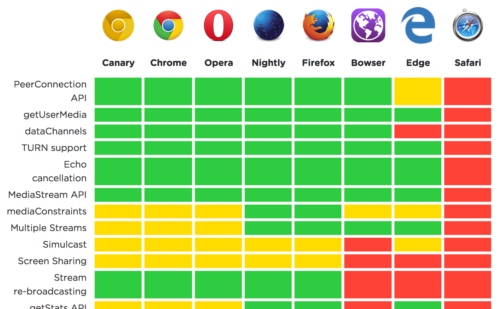
One of these things just doesn’t belong.
In summary: Reenact for iOS is dead. Reenact for the Web is alive. Both are open-source. Don’t trust anyone over
At roughly 1:30pm Pacific time on November 30th, Mozilla released an update to Firefox containing a fix for a vulnerability reported as being actively used to deanonymize Tor Browser users. Existing copies of Firefox should update automatically over the next 24 hours; users may also download the updated version manually.
Early on Tuesday, November 29th, Mozilla was provided with code for an exploit using a previously unknown vulnerability in Firefox. The exploit was later posted to a public Tor Project mailing list by another individual. The exploit took advantage of a bug in Firefox to allow the attacker to execute arbitrary code on the targeted system by having the victim load a web page containing malicious JavaScript and SVG code. It used this capability to collect the IP and MAC address of the targeted system and report them back to a central server. While the payload of the exploit would only work on Windows, the vulnerability exists on Mac OS and Linux as well. Further details about the vulnerability and our fix will be released according to our disclosure policy.
The exploit in this case works in essentially the same way as the “network investigative technique” used by FBI to deanonymize Tor users (as FBI described it in an affidavit). This similarity has led to speculation that this exploit was created by FBI or another law enforcement agency. As of now, we do not know whether this is the case. If this exploit was in fact developed and deployed by a government agency, the fact that it has been published and can now be used by anyone to attack Firefox users is a clear demonstration of how supposedly limited government hacking can become a threat to the broader Web.
https://blog.mozilla.org/security/2016/11/30/fixing-an-svg-animation-vulnerability/
While working on tracking down some tricky UI bugs in about:addons, I wondered what it would look like to rewrite it using web technologies. I've been meaning to learn React (which the Firefox devtools use), and it seems like a good choice for this kind of application:
- easy to create reusable components
XBL is used for this in the current about:addons, but this is a non-standard Mozilla-specific technology that we want to move away from, along with XUL.
- manage state transitions, undo, etc.
There is quite a bit of code in the current about:addons implementation to deal with undoing various actions. React makes it pretty easy to track this sort of thing through libraries like Redux.
To explore this a bit, I made a simple React version of about:addons. It's actually installable as a Firefox extension which overrides about:addons.
Note that it's just a proof-of-concept and almost certainly buggy - the way it's hooking into the existing sidebar in about:addons needs some work for instance. I'm also a React newb so pretty sure I'm doing it wrong. Also, I've only implemented #1 above so far, as of this writing.
I am finding React pretty easy to work with, and I suspect it'll take far less code to write something equivalent to the current implementation.
I think we can now safely say Opera, the browser maker, is no more. My opinions about the acquisition of the browser by a chinese trust were recently confirmed and people are let go or fleeing en masse. Rest in Peace Opera, you brought good, very good things to the Web and we'll miss you.
In fact, I'd love to see two things appear:
- Vivaldi is of course the new Opera, it was clear from day 1. Even the name was chosen for that. The transformation will be completed the day Vivaldi joins W3C and sends representatives to the Standardization tables.
- Vivaldi and Brave should join forces, in my humble opinion.
http://www.glazman.org/weblog/dotclear/index.php?post/2016/11/30/Rest-in-peace%2C-Opera...
The plan was to get you a test build of TenFourFox 45.6.0 this weekend, but instead you're going to get a chemspill for 45.5.1 to fix an urgent 0-day exploit in Firefox which is already in the wild. Interestingly, the attack method is very similar to the one the FBI infamously used to deanonymise Tor users in 2013, which is a reminder that any backdoor the "good guys" can sneak through, the "bad guys" can too.
TenFourFox is technically vulnerable to the flaw, but the current implementation is x86-based and tries to attack a Windows DLL, so as written it will merely crash our PowerPC systems. In fact, without giving anything away about the underlying problem, our hybrid-endian JavaScript engine actually reduces our exposure surface further because even a PowerPC-specific exploit would require substantial modification to compromise TenFourFox in the same way. That said, we will still implement the temporary safety fix as well. The bug is a very old one, going back to at least Firefox 4.
Meanwhile, 45.6 is going to be scaled back a little. I was able to remove telemetry from the entire browser (along with its dependencies), and it certainly was snappier in some sections, but required wholesale changes to just about everything to dig it out and this is going to hurt keeping up with the ESR repository. Changes this extensive are also very likely to introduce subtle bugs. (A reminder that telemetry is disabled in TenFourFox, so your data is never transmitted, but it does accumulate internal counters and while it is rarely on a hot codepath there is still non-zero overhead having it around.) I still want to do this but probably after feature parity, so 45.6 has a smaller change where telemetry is instead only removed from user-facing chrome JavaScript. This doesn't help as much but it's a much less invasive change while we're still on source parity with 45ESR.
Also, tests with the "non-volatile" part of IonPower-NVLE showed that switching to all, or mostly, non-volatile registers in the JavaScript JIT compiler had no obvious impact on most benchmarks and occasionally was a small negative. Even changing the register allocator to simply favour non-volatile registers, without removing volatiles, had some small regressions. As it turns out, Ion actually looks pretty efficient with saving volatile registers prior to calls after all and the overhead of having to save non-volatile registers upon entry apparently overwhelms any tiny benefit of using them. However, as a holdover from my plans for NVLE, we've been saving three more non-volatile general purpose registers than we allow the allocator to use; since we're paying the overhead to use them already, I added those unused registers to the allocator and this got us around 1-2% benefit with no regression. That will ship with 45.6 and that's going to be the extent of the NVLE project.
On the plus side, however, 45.6 does have HiDPI support completely removed (because no 10.6-compatible system has a retina display, let alone any Power Mac), which makes the widget code substantially simpler in some sections, and has a couple other minor performance improvements, mostly to scrolling on image-heavy pages, and interface fixes. I also have primitive performance sampling working, which is useful because of a JavaScript interpreter infinite loop I discovered on a couple sites in the wild (and may be the cause of the over-recursion problems I've seen other places). Although it's likely Mozilla's bug and our JIT is not currently implicated, it's probably an endian issue since it doesn't occur on any Tier-1 platform; fortunately, the rough sampler I threw together was successfully able to get a sensible callstack that pointed to the actual problem, proving its functionality. We've been shipping this bug since at least TenFourFox 38, so if I don't have a fix in time it won't hold the release, but I want to resolve it as soon as possible to see if it fixes anything else. I'll talk about my adventures with the mysterious NSSampler in a future post soonish.
Watch for 45.5.1 over the weekend, and 45.6 beta probably next week.
http://tenfourfox.blogspot.com/2016/11/4551-chemspill-imminent.html
Mike Conley noticed a bug. There was a regression on a particular Firefox Nightly build he was tracking down. It looked like this:

A pretty big difference… only there was a slight problem: there were no relevant changes between the two builds. Being the kind of developer he is, :mconley looked elsewhere and found a probe that only started being included in builds starting November 16.
The plot showed him data starting from November 15.
He brought it up on irc.mozilla.org#telemetry. Roberto Vitillo was around and tried to reproduce, without success. For :mconley the regression was on November 5 and the data on the other probe started November 15. For :rvitillo the regression was on November 6 and the data started November 16. After ruling out addons, they assumed it was the dashboard’s fault and roped me into the discussion. This is what I had to say:

You see, :mconley is in the Toronto (as in Canada) Mozilla office, and Roberto is in the London (as in England) Mozilla office. There was a bug in how dates were being calculated that made it so the data displayed differently depending on your timezone. If you were on or East of the Prime Meridian you got the right answer. West? Everything looks like it happens one day early.
I hammered out a quick fix, which means the dashboard is now correct… but in thinking back over this bug in a post-mortem-kind-of-way, I realized how beneficial working in a distributed team is.
Having team members in multiple timezones not only provided us with a quick test location for diagnosing and repairing the issue, it equipped us with the mindset to think of timezones as a problematic element in the first place. Working in a distributed fashion has conferred upon us a unique and advantageous set of tools, experiences, thought processes, and mechanisms that allow us to ship amazing software to hundreds of millions of users. You don’t get that from just any cube farm.
#justmozillathings
:chutten
 [показать]
https://chuttenblog.wordpress.com/2016/11/29/privileged-to-be-a-mozillian/
[показать]Welcome back. As the podiatrist said, lots of exciting stuff is afoot.
Modernize infrastructure:
The big news from the past few weeks comes from the TaskCluster migration project where we now have nightly updates being served for both Linux and Android builds on the Date project branch. If you’re following along in treeherder, this is the equivalent of “tier 2” status. We’re currently working on polish bugs and a whole bunch of verification work before we attempt to elevate these new nightly builds to tier 1 status on the mozilla-central branch, effectively supplanting the buildbot-generated variants. We hope to achieve that goal before the end of 2017. Even tier 2 is a huge milestone here, so cheers to everyone on the team who has helped make this happen, chiefly Aki, Callek, Kim, Jordan, and Mihai.
A special shout-out to Dustin who helped organize the above migration work over the past few months but writing a custom dependency tracking tool. The code is here https://github.com/taskcluster/migration and you can see output here: http://migration.taskcluster.net/ It’s been super helpful!
Improve Release Pipeline:
Many improvements to Balrog were put into production this past week, including one from a new volunteer. Ben blogged about them in detail.
Aki released several scriptworker releases to stabilize polling and gpg homedir creation. scriptworker 1.0.0b1 enables chain of trust verification.
Aki added multi-signing-format capability to scriptworker and signingscript; this is live on the Date project branch.
Aki added a shared scriptworker puppet module, making it easier to add new instance types. https://bugzilla.mozilla.org/show_bug.cgi?id=1309293
Aki released dephash 0.3.0 with pip>=9.0.0 and hashin>=0.7.0 support.
Improve CI Pipeline:
Nick optimized our requests for AWS spot pricing, shaving several minutes off the runtime of the script which launches new instances in response to pending buildbot jobs.
Kim disabled Windows XP tests on trunk, and winxp talos on all branches (https://bugzilla.mozilla.org/show_bug.cgi?id=1310836 and https://bugzilla.mozilla.org/show_bug.cgi?id=1317716) Now Alin is rebalancing the Windows 8 pools so we can enable e10s testing on Windows 8 with the re-imaged XP machines. Recall that Windows XP is moving to the ESR branch with Firefox 52 which is currently on the Aurora/Developer Edition release branch.
Kim enabled Android x86 nightly builds on the Date project branch: https://bugzilla.mozilla.org/show_bug.cgi?id=1319546
Kim enabled SETA on the graphics projects branch to reduce wait times for test machines: https://bugzilla.mozilla.org/show_bug.cgi?id=1319490
Operational:
Rok has deployed the first service based on the new releng microservices architecture. You can find the new version of TryChooser here: https://mozilla-releng.net/trychooser/ More information about the services and framework itself can be found here: https://docs.mozilla-releng.net/
Release:
Firefox 50 has been released. We’re are currently in the beta cycle for Firefox 51, which will be extra long to avoid trying to push out a major version release during the busy holiday season. We are still on-deck to release a minor security release during this period. Everyone involved in the process applauds this

We are happy to announce that the first WebVR patches are landing in Servo.
For the impatients: You can download a highly experimental Servo binary compatible with HTC Vive. Switch on your headset and run servo.exe --resources-path resources webvr\room-scale.html
The current implementation supports the WebVR 1.2 spec that enables the API in contexts other than the main page thread, such as WebWorkers.
We’ve been working hard on an optimized render path for VR to achieve smooth FPS and the required less than 20ms of latency to avoid motion sickness. This is the overall architecture:

Rust-WebVR Library
The Rust WebVR implementation is a dependency-free library providing both the WebVR spec implementation and the integration with the vendor specific SDKs (OpenVR, Oculus …). Having it decoupled on its own component comes with multiple advantages:
- Fast develop-compile-test cycle. Compilation times are way faster than developing and testing in a full browser.
- Contributions are easier because developers don’t have to deal with the complexity of a browser code base.
- It can be used on any third party project: Room scale demo using vanilla Rust.
The API is inspired on the easy to use WebVR API but adapted to Rust design patterns. The VRService trait offers an entry point to access native SDKs like OpenVR and Oculus SDK. It allows to perform operations such as initialization, shutdown, event polling and VR Device discovery:
The VRDevice trait provides a way to interact with Virtual Reality headsets:
The integration with vendor specific SDKs (OpenVR, Oculus…) are built on top of the VRService and VRDevice traits. OpenVRService, for instance interfaces with Valve’s OpenVR API. While the code is written in Rust, native SDKs are usually implemented in C or C++. We use Rust FFI and rust-bindgen to generate Rust bindings from the native C/C++ header files.
MockService implements a mock VR device that can be used for testing or developing without having a physical headset available. You will be able to get some code done in the train or while attending a boring talk or meeting ;)
VRServiceManager is the main entry point to the rust-webvr library. It handles the life cycle and interfaces to all available VRService implementations. You can use cargo-features to register the default implementations or manually register your own ones. Here is an example of initialization in a vanilla Rust app:
WebVR integration in Servo
Performance and security are both top priorities in a Web browser. DOM Objects are allowed to use VRDevices but they neither own them or have any direct pointers to native objects. There are many reasons for this:
- JavaScript execution is untrusted and the input data might be malicious . That’s why the entire JavaScript thread must be isolated to its own sandboxed process.
- There could be many parallel JavaScript contexts requesting access to the same native VRDevice instance which could lead to data race conditions.
- WebVR Spec enforces privacy and security guidelines. For example a secondary tab is not allowed to read VRDisplay data or stop a VR presentation while the user is having a VR
Given the impending shutdown of Persona and the lack of a clear alternative to it, I decided to write about some of the principles that guided its design and development in the hope that it may influence future efforts in some way.
Permission-less system
There was no need for reliers (sites relying on Persona to log their users in) to ask for permission before using Persona. Just like a site doesn't need to ask for permission before creating a link to another site, reliers didn't need to apply for an API key before they got started and authenticated their users using Persona.
Similarly, identity providers (the services vouching for their users identity) didn't have to be whitelisted by reliers in order to be useful to their users.
Federation at the domain level
Just like email, Persona was federated at the domain name level and put domain owners in control. Just like they can choose who gets to manage emails for their domain, they could:
- run their own identity provider, or
- delegate to their favourite provider.
Site owners were also in control of the mechanism and policies involved in authenticating their users. For example, a security-sensitive corporation could decide to require 2-factor authentication for everyone or put a very short expiry on the certificates they issued.
Alternatively, a low-security domain could get away with a much simpler login mechanism (including a "0-factor" mechanism in the case of http://mockmyid.com!).
Privacy from your identity provider
While identity providers were the ones vouching for their users' identity, they didn't need to know the websites that their users are visiting. This is a potential source of control or censorship and the design of Persona was able to eliminate this.
The downside of this design of course is that it becomes impossible for an identity provider to provide their users with a list of all of the sites where they successfully logged in for audit purposes, something that centralized systems can provide easily.
The browser as a trusted agent
The browser, whether it had native support for the BrowserID protocol or not, was the agent that the user needed to trust. It connected reliers (sites using Persona for logins) and identity providers together and got to see all aspects of the login process.
It also held your private keys and therefore was the only party that could impersonate you. This is of course a power which it already held by virtue of its role as the web browser.
Additionally, since it was the one generating and holding the private keys, your browser could also choose how long these keys are valid and may choose to vary that amount of time depending on factors like a shared computer environment or Private Browsing mode.
Other clients/agents would likely be necessary as well, especially when it comes to interacting with mobile applications or native desktop applications. Each client would have its own key, but they would all be signed by the identity provider and therefore valid.
Bootstrapping a complex system requires fallbacks
Persona was a complex system which involved a number of different actors. In order to slowly roll this out without waiting on every actor to implement the BrowserID protocol (something that would have taken an infinite amount of time), fallbacks were deemed necessary:
- client-side JavaScript implementation for browsers without built-in support
- centralized fallback identity provider for domains without native support or a working delegation
- centralized verifier until local verification is done within authentication libraries
In addition, to lessen the burden on the centralized identity provider fallback, Persona experimented with a number of bridges to provide quasi-native support for a few large email providers.
Support for multiple identities
User research has shown that many users choose to present a different identity to different websites. An identity system that would restrict them to a single identity wouldn't work.
Persona handled this naturally by linking identities to email addresses. Users who wanted to present a different identity to a website could simply use a different email address. For example, a work address and a personal address.
No lock-in
Persona was an identity system which didn't stand between a site and its users. It exposed email address to sites and allowed them to control the relationship with their users.
Sites wanting to move away from Persona can use the email
From The Man Who Is Transforming Microsoft:
[Satya Nadella] moves to another group of kids and then shifts his attention to a teenage student who is blind. The young woman has been working on building accessibility features using Cortana, Microsoft’s speech-activated digital assistant. She smiles and recites the menu options: “Hey Cortana. My essentials.” Despite his transatlantic jet lag Nadella is transfixed. “That’s awesome,” he says. “It’s fantastic to see you pushing the boundaries of what can be done.” He thanks her and turns toward the next group.
“I have a particular passion around accessibility, and this is something I spend quite a bit of cycles on,” Nadella tells me later. He has two daughters and a son; the son has special needs. “What she was showing me is essentially how she’s building out as a developer the tools that she can use in her everyday life to be productive. One thing is certain in life: All of us will need accessibility tools at some point.”
https://blog.mozilla.org/nfroyd/2016/11/29/accessibility-tools-for-everyone/
the following changes have been pushed to bugzilla.mozilla.org:
- [1264821] We want to replace the project kick-off form with a contract request form
- [1310757] Update form: bugzilla.mozilla.org/form.CRM
discuss these changes on mozilla.tools.bmo.
[показать] 
https://dlawrence.wordpress.com/2016/11/29/happy-bmo-push-day-30/
Git-cinnabar is a git remote helper to interact with mercurial repositories. It allows to clone, pull and push from/to mercurial remote repositories, using git.
These release notes are also available on the git-cinnabar wiki.
What’s new since 0.4.0b3?
- Updated git to 2.10.2 for cinnabar-helper.
- Added a new
git cinnabar downloadcommand to download a helper on platforms where one is available. - Fixed some corner cases with pack windows in the helper. This prevented cloning mozilla-central with the helper.
- Fixed bundle2 support that broke cloning from a mercurial 4.0 server in some cases.
- Fixed some corner cases involving empty files. This prevented cloning Mozilla’s stylo incubator repository.
- Fixed some correctness issues in file parenting when pushing changesets pulled from one mercurial repository to another.
- Various improvements to the rules to build the helper.
- Experimental (and slow) support for pushing merges, with caveats. See issue #20 for details about the current status.
And since I realize I didn’t announce beta 3:
What’s new since 0.4.0b2?
- Properly handle bundle2 errors, avoiding git to believe a push happened when it didn’t. (0.3.x is unaffected)
It’s that time of year! The excitement of Black Friday carries into today – CyberMonday – the juxtaposition of the analog age and the digital age. Both days are fueled by media and retailers alike and are about shopping. And both days are heavily reliant on the things that we want, that we need and what we think others want and need. And, all of it is powered by the data about us as consumers. So, today – the day of electronic shopping – is the perfect day to provoke some deep thinking on how our digital lives impact our privacy and online security. How do we do this?
One way is by launching “The Glass Room” – an art exhibition and educational space that teaches visitors about the relationship between technology, privacy and online security. The Glass Room will be open in downtown New York City for most of the holiday shopping season. Anyone can enter the “UnStore” for free to get a behind the scenes look at what happens to your privacy online. You’ll also get access to a crew of “InGeniouses” who can help you with online privacy and data tips and tricks. The Glass Room has 54 interactive works that show visitors the relationship between your personal data and the technology services and products you use.

This is no small task. Most of us don’t think about our online security and privacy every day. As with our personal health it is important but presumed. Still, when we don’t take preventative care of ourselves, we are at greater risk for getting sick.
The same is true online. We are impacted by security and privacy issues everyday without even realizing it. In the crush of our daily lives, few of us have the time to learn how to better protect ourselves and preserve our privacy online. We don’t always take enough time to get our checkups, eat healthily and stay active – but we would be healthier if we did. We are launching The Glass Room to allow you to think, enjoy and learn how to do a checkup of your online health.
We can buy just about anything we imagine on CyberMonday and have it immediately shipped to our door. We have to work a little harder to protect our priceless privacy and security online. As we collectively exercise our shopping muscles, I hope we can also think about the broader importance of our online behaviors to maintaining our online health.
If you are in New York City, please come down to The Glass Room and join the discussion. You can also check out all the projects, products and stories that The Glass Room will show you to look into your online life from different perspectives by visiting The Glass Room online.
https://blog.mozilla.org/blog/2016/11/28/the-glass-room-looking-into-your-online-life/
[показать]As mentioned in my previous blog post there is new open-source, lambda compatible, on-premise, language agnostic, server-less compute service called IronFunctions.
[показать]
While IronFunctions is written in Go. Rust is still very much admired language and it was decided to add support for it in the fn tool.
So now you can use the fn tool to create and publish functions written in rust.
Using rust with functions
The easiest way to create a iron function in rust is via cargo and fn.
Prerequisites
First create an empty rust project as follows:
$ cargo init --name func --bin
Make sure the project name is func and is of type bin. Now just edit your code, a good example is the following "Hello" example:
use std::io;
use std::io::Read;

fn main() {
    let mut buffer = String::new();
    let stdin = io::stdin();
    if stdin.lock().read_to_string(&mut buffer).is_ok() {
        println!("Hello {}", buffer.trim());
    }
}
You can find this example code in the repo.
Once done you can create an iron function.
Creating a function
$ fn init --runtime=rust /
in my case its fn init --runtime=rust seiflotfy/rustyfunc, which will create the func.yaml file required by functions.
Building the function
$ fn build
Will create a docker image
Testing
You can run this locally without pushing it to functions yet by running:
$ echo Jon Snow | fn run
Hello Jon Snow
Publishing
In the directory of your rust code do the following:
$ fn publish -v -f -d ./
This will publish you code to your functions service.
Running it
Now to call it on the functions service:
$ echo Jon Snow | fn call seiflotfy rustyfunc
which is the equivalent of:
$ curl -X POST -d 'Jon Snow' http://localhost:8080/r/seiflotfy/rustyfunc
Next
In the next post I will be writing a more computation intensive rust function to test/benchmark IronFunctions, so stay tune :D
Here at Mozilla, we’ve accepted that a certain amount of intermittent failure in our automated testing of Firefox is to be expected. That is, for every push, a subset of the tests that we run will fail for reasons that have nothing to do with the quality (or lack thereof) of the push itself.
On the main integration branches that developers commit code to, we have dedicated staff and volunteers called sheriffs who attempt to distinguish these expected failures from intermittents through a manual classification process using Treeherder. On any given push, you can usually find some failed jobs that have stars beside them, this is the work of the sheriffs, indicating that a job’s failure is “nothing to worry about”:
This generally works pretty well, though unfortunately it doesn’t help developers who need to test their changes on Try, which have the same sorts of failures but no sheriffs to watch them or interpret the results. For this reason (and a few others which I won’t go into detail on here), there’s been much interest in having Treeherder autoclassify known failures.
We have a partially implemented version that attempts to do this based on structured (failure line) information, but we’ve had some difficulty creating a reasonable user interface to train it. Sheriffs are used to being able to quickly tag many jobs with the same bug. Having to go through each job’s failure lines and manually annotate each of them is much more time consuming, at least with the approaches that have been tried so far.
It’s quite possible that this is a solvable problem, but I thought it might be an interesting exercise to see how far we could get training an autoclassifier with only the existing per-job classifications as training data. With some recent work I’ve done on refactoring Treeherder’s database, getting a complete set of per-job failure line information is only a small SQL query away:
1 2 3 4 5 |
select bjm.id, bjm.bug_id, tle.line from bug_job_map as bjm left join text_log_step as tls on tls.job_id = bjm.job_id left join text_log_error as tle on tle.step_id = tls.id where bjm.created > '2016-10-31' and bjm.created < '2016-11-24' and bjm.user_id is not NULL and bjm.bug_id is not NULL order by bjm.id, tle.step_id, tle.id; |
Just to give some explanation of this query, the “bug_job_map” provides a list of bugs that have been applied to jobs. The “text_log_step” and “text_log_error” tables contain the actual errors that Treeherder has extracted from the textual logs (to explain the failure). From this raw list of mappings and errors, we can construct a data structure incorporating the job, the assigned bug and the textual errors inside it. For example:
1 2 3 4 5 6 7 8 9 10 11 12 13 14 |
{ "bug_number": 1202623, "lines": [ "browser_private_clicktoplay.js Test timed out -", "browser_private_clicktoplay.js Found a tab after previous test timed out: http:/ |
I will very shortly be adding some boilerplate to the Planet homepage as well as the Planet.m.o entry on Wikimo, to the effect that:
- The content of Planet is unfiltered and uncensored, and represents the views of individual community members, and
- Participants are expected to abide by both the letter and spirit of the Mozilla Community Participation Guidelines add Conditions of Use.
All of this was true before, but we’re going to highlight it on the homepage and make it explicit in the wiki; we want Planet to stay what it is, open, participatory, an equal and accessible platform for everyone involved, but we also don’t want Planet to become an attack surface, against Mozilla or anyone else, and won’t allow that to happen out of willful blindness or neglect.
If you’ve got any questions or concerns about this, feel free to leave a comment or email me.
http://exple.tive.org/blarg/2016/11/28/planet-a-minor-administrative-note/
I've been collecting some data on the fastest way to build the Rust compiler. This is primarily for Rust developers to optimise their workflow, but it might also be of general interest.
TL;DR: the fastest ways to build Rust (on a computer with lots of cores) is with -j6, RUSTFLAGS=-Ccodegen-units=10.
I tested using a commit, from the 24th November 2016. I was using the make build system (though I would expect the same results using Rustbuild). The test machine is a dedicated build machine - it has 12 physical cores, lots of RAM, and an SSD. It wasn't used for anything else during the benchmarking, and doesn't run a windowing system. It was running Ubuntu 16.10 (Linux). I only did one run per set of variables. That is not ideal, but where I repeated runs, they were fairly consistent - usually within a second or two and never more than 10. I've rounded all results to the nearest 10 seconds, and I believe that level of precision is about right for the experiment.
I varied the number of jobs (-jn) and the number of codegen units (RUSTFLAGS=-Ccodegen-units=n). The command line looked something like RUSTFLAGS=-Ccodegen-units=10 make -j6. I measured the time to do a normal build of the whole compiler and libraries (make), to build the stage1 compiler (make rustc-stage, this is the minimal amount of work required to get a compiler for testing), and to build and bootstrap the compiler and run all tests (make && make check, I didn't run a simple make check because adding -jn to that causes many tests to be skipped; setting codegen-units > 1 causes some tests to fail).
The jobs number is the number of tasks make can run in parallel. These runs are self-contained instances of the compiler, i.e., this is parallelism outside the compiler. The amount of parallelism is limited by dependencies between crates in the compiler. Since the crates in the compiler are rather large and there are a lot of dependencies, the benefits of using a large number of jobs is much weaker than in a typical C or C++ program (e.g., LLVM). Note however that there is no real drawback to using a larger number of jobs, there just won't be any benefit.
Codegen units introduce parallelism within the compiler. First, some background. Compilation can be roughly split into two: first, code is analysed (parsing, type checking, etc.), then object code is generated from the products of analysis. The Rust compiler uses LLVM for the code generation part. Roughly half the time running an optimised build is spent in each of analysis and code generation. Nearly all optimisation is performed in the code generation part.
The compilation unit in Rust is a crate; that is, the Rust compiler analyses and compiles a single crate at a time. By default, code generation also works at the same level of granularity. However, by specifying the number of codegen units, we tell the compiler that once analysis is complete, it should break the crate into smaller units and run LLVM code generation on each unit in parallel. That means we get parallelism inside the compiler, albeit only for about half of the work. There is a disadvantage, however: using multiple codegen units means the program will not be optimised as well as if a single unit were used. This is analogous to turning off LTO in a C program. For this reason, you should not use multiple codegen units when building production software.
So when building the compiler, if we use many codegen units we might expect the compilation to go faster, but when we run the new compiler, it will be slower. Since we use the new compiler to build at least the libraries and sometimes another compiler, this could be an important factor in the total time.
If you're interested in this kind of thing, we keep track of compiler performance at perf.r-l.o (although only single-threaded builds). Nicholas Nethercote has recently written a couple of blog posts on running and optimising the compiler.
make
This experiment ran a simple make build. It builds two versions of the compiler - one using the last beta, and the second using the first.
| cg1 | cg2 | cg4 | cg6 | cg8 | cg10 | cg12 | |
|---|---|---|---|---|---|---|---|
| -j1 | 48m50s | 39m40s | 31m30s | 29m50s | 29m20s |
Mozilla is delighted to announce the esteemed judges for the Equal Rating Innovation Challenge
- Rocio Fonseca (Chile), Executive Director of Start-Up Chile
- Omobola Johnson (Nigeria), Honorary Chair of the Alliance for Affordable Internet and Partner of TLcom Capital LLP
- Nikhil Pahwa (India), Founder at MediaNama and Co-founder of savetheinternet.in
- Marlon Parker (South Africa), Founder of Reconstructed Living Labs
These four leaders will join Mitchell Baker (USA), Executive Chairwoman of Mozilla, on the judging panel for the Equal Rating Innovation Challenge. The judges will be bringing their wealth of industry experience and long-standing expertise from various positions in policy, entrepreneurship, and consulting in the private and public sector to assess the challenge submissions.

Mozilla seeks to find novel solutions to connect all people to the open Internet so they can realize the full potential of this globally shared resource. We’re both thrilled and proud to have gathered such a great roster of judges for the Innovation Challenge — it’s a testament to the global scope of the initiative. Each one of these leaders has already contributed in many ways to tackle the broader challenge of connecting the unconnected and it is an honour to have these global heavyweights in our panel.
The Equal Rating Innovation Challenge will support promising solutions through expert mentorship and funding of US$250,000 in prize monies split into three categories: Best Overall (with a key focus on scalability), Best Overall Runner-up, and Most Novel Solution (based on experimentation with a potential high reward).
The judges will score submissions according to the degree by which they meet the following attributes:
- 25pts: Scalability
- 20pts: Focus on user experience
- 15pts: Differentiation
- 10pts: Ability to be quickly deployed into the market (within 9–12 months)
- 10pts: Potential of the team
- 10pts: Community voting results
The deadline for submission is 6 January 2017. On 17 January, the judges will announce five semifinalists. Those semifinalists will be provided advice and mentorship from Mozilla experts in topics such as policy, business, engineering, and design to hone their solution. The semifinalists will take part in a Demo Day on 9 March 2017 in New York City to pitch their solutions to the judges. The public will then be invited to vote for their favorite solution online during a community voting period from 10–16 March, and the challenge winners will be announced on 29 March 2017.
Announcing Panel of Judges for Mozilla’s Equal Rating Innovation Challenge was originally published in Mozilla Open Innovation on Medium, where people are continuing the conversation by highlighting and responding to this story.