The technology industry was dealt a major setback when the Federal Circuit recently decided in Oracle v. Google that Google’s use of Java “declaring code” was not a fair use. The copyright doctrine of Fair Use impacts a developer’s ability to learn from and improve on the work of others, which is a crucial part of software development. Because of this ruling, copyright law today is now at odds with how software is developed.*
This is the second time in this eight year case that the Federal Circuit’s ruling has diverged from how software is written. In 2014, the court decided that declaring code can be copyrighted, a ruling with which we disagreed. Last year we filed another amicus brief in this case, advocating that Google’s implementation of the APIs should be considered a fair use. In this recent decision, the court found that copying the Java declaring code was not a protected fair use of that code.
We believe that open source software is vital to security, privacy, and open access to the internet. We also believe that Fair Use is critical to developing better, more secure, more private, and more open software because it allows developers to learn from each other and improve on existing work. Even the Mozilla Public License explicitly acknowledges that it “is not intended to limit any rights” under applicable copyright doctrines such as fair use.
The Federal Circuit’s decision is a big step in the wrong direction. We hope Google appeals to the Supreme Court and that the Supreme Court sets us back on a better course.
* When Google released its Android operating system, it incorporated some code from Sun Microsystem’s Java APIs into the software. Google copied code in those APIs that merely names functions and performs other general housekeeping functions (called “declaring code”) but wrote all the substantive code (called “implementing code”) from scratch. Software developers generally use declaring code to define the names, format, and organization ideas for certain functions, and implementing code to do the actual work (telling the program how to perform the functions). Developers specifically rely on “declaring code” to enable their own programs to interact with other software, resulting in code that is efficient and easy for others to use.
The post Decision in Oracle v. Google Fair Use Case Could Hinder Innovation in Software Development appeared first on Open Policy & Advocacy.
“This is not about creating something that appeals to people simply because of its novel technical achievements; rather it is [about creating] something that has real meaning…”
– Kamal Sinclair, Director of New Frontier Lab Programs at the Sundance Institute
Virtual Reality is coming. In many ways, it’s already here.
Media outlets like the New York Times now regularly create VR content that is showcased alongside its other digital journalism efforts. On the entertainment side, serious buzz is building around the release of Steven Spielberg’s Ready Player One, and home VR headsets are becoming increasingly accessible.
These are all indications that the tides are shifting VR towards the mainstream, but significant obstacles remain for both creating content and enjoying most of the current immersive experiences. These include expensive hardware, confusing distribution methods, complicated configurations, and more.
The mixed reality team at Mozilla devoted two years to brainstorming and experimenting to find a way to bring virtual reality to the web. That’s because we believe the web is the best possible platform for virtual and augmented reality. The ability to share and access virtual experiences with a URL is a game-changer; the key needed to take this amazing technology and make it mainstream.
This type of direct access is critical for filmmakers and creators who wish to use VR as their next storytelling medium.
That’s why Mozilla convened our VR the People panel at this spring’s Sundance Festival. It was an opportunity to connect with some of the world’s most innovative visual storytellers and bring together some incredible names, including Mozilla’s own Sean White, VR journalist Nonny de la Pe~na, the creatively explosive Reggie Watts and immersive artist Chris Milk, CEO of WITHIN.

That Sundance panel was an extraordinary experience, but true to Mozilla’s mission, that panel had to be more than an isolated event. We want it to be a catalyst for an ongoing effort to blur (and eventually erase) the boundaries between VR, film-making, and visual storytelling. Next week, we’ll be traveling to Tribeca Film Festival in New York to continue the conversation. If you are around, let us know. We’d love to chat.
If you’re a creator reading this, I certainly hope you feel inspired, but I also hope you feel something more. I hope you feel empowered, and then you turn that empowerment into action. I hope you go on to create something amazing that inspires someone else to create something amazing. I hope you create things with VR that we can’t even imagine right now.
Check out https://mixedreality.mozilla.org/ to view the VR tools and resources Mozilla offers to help you create immersive experiences.
The post An Open Call to Storytellers: Make Something Amazing With Virtual Reality and the Open Web appeared first on The Mozilla Blog.
We don’t have to tell you that video is a key channel for sharing information and instructional skills especially for students and developers who’ve grown up with YouTube. At Mozilla, we’ve always been a leader in supporting the open technologies that bring unencumbered video into the browser and onto the web.
But on top of the technology, there’s content. In 2018, Mozilla’s Developer Outreach team has launched some projects to share more knowledge in video. Earlier this year, Jen Simmons set a high bar with the launch of Layout Land, a series about “what’s now possible in graphic design on the web — layout, CSS Grid, and more.”
This post introduces Web Demystified, a new series targeting web makers. By web makers, I have in mind everyone who builds things for the web: designers, developers, project and team managers, students, hobbyists, and experts. Today we’ve released the opening two episodes on the Mozilla Hacks YouTube channel, introducing web basics.
Our goal is to provide basic information for beginner web makers, at the start of their web journey. The subject matter will also serve as a refresher on web fundamentals.
Our starting point
To begin, there is one question that needs to be answered: What is the web? And voila, here is our opener:
What to expect next
The next four episodes cover some basic technologies at the heart of the web (HTML, CSS, JavaScript, and SVG). We will release a new show every couple weeks for your viewing pleasure. And then we will continue our journey into details, covering stuff like: how the browser works, image formats for the web, domain names, WebAssembly, and more…
As an added attraction, here is Episode #1 (the second show). It’s all about HTML:
An invitation to participate
In true Mozilla fashion, we’d welcome your help sharing this new content and helping us promote it.
- If you enjoy those videos, please like them on YouTube, and share them with your friends, colleagues, family, and networks.
- If you have constructive feedback on the series, please share it here in comments. (Reminder: these shows are aimed at beginners and we aim to keep them brief.)
- In general, if there are topics you wish to see covered, tell us and if you have questions about the content itself: Ask!
- Last but not least, if you’re not a native English speaker, please feel free to translate the video captions into your own language. Many people will thank you for that.
Enjoy Web Demystified! And see you in a fortnight.
https://hacks.mozilla.org/2018/04/a-new-video-series-web-demystified/
Hello and welcome to another issue of This Week in Rust! Rust is a systems language pursuing the trifecta: safety, concurrency, and speed. This is a weekly summary of its progress and community. Want something mentioned? Tweet us at @ThisWeekInRust or send us a pull request. Want to get involved? We love contributions.
This Week in Rust is openly developed on GitHub. If you find any errors in this week's issue, please submit a PR.
Updates from Rust Community
News & Blog Posts
- Redox Summer of Code.
- Writing An NES Emulator with Rust and WebAssembly.
- Down a rusty rabbit hole. Discovering a series of quirks of the Rust compiler/language.
- The case for deadlines in timeout-centric APIs.
- Rust pattern: Rooting an Rc handle.
- Conway's Game of Life: A tutorial on implementing a game in Rust and WebAssembly.
- Safe intrusive collections with pinning.
- Rust memory safety revolution: Why, what, and how for complete beginners.
- A useful feature few Rust programmers know about. The
{:#?}pretty-printer flag. - Instance identity in C++ and Rust.
- A shifty riddle: Why is
std::ops::Shl::shlnot equal to<<? - Fearless Rust bloggers. A list of blogs from past This Week in Rust issues.
- Armstrong Publications released a Rust book Step Ahead with Rust for intermediate to advanced programmers.
- This week in Rust docs 101.
- The Embedded Working Group newsletter 3.
- CLI Working Group newsletter 2.
- IntelliJ Rust changelog 72. Now with support for macro expansion.
- [podcast] Rusty Spike Podcast - episode 25. Rust Reach, the Rust all hands, webassembly.studio, more wasm tools, async/await, and GStreamer.
From Rust All Hands in Berlin
Crate of the Week
This week's crate is rain, a framework for large-scale distributed computations. Thanks to Vikrant for the suggestion!
Submit your suggestions and votes for next week!
Call for Participation
Always wanted to contribute to open-source projects but didn't know where to start? Every week we highlight some tasks from the Rust community for you to pick and get started!
Some of these tasks may also have mentors available, visit the task page for more information.
 The Monday Project Meeting
Are you an extensions enthusiast? Do you want to help people find excellent ways to improve their browsing experience? If so, please consider applying to join our Featured Extensions Community Board!
Every six months, we assemble a small group of dedicated community members to help nominate and select new featured extensions for addons.mozilla.org (AMO) each month. Their picks help millions of Firefox users discover top-quality extensions.
The current board is currently wrapping up their six-month term, and we are now assembling a new board of talented contributors for the months July – December.
All active members of the add-ons community — including fans, developers, and advocates — are invited to apply to join the board. Priority will be given to applicants who have not served on the board before, followed by those with previous experience, and finally from the outgoing board. You can learn more about the duties of the Featured Add-on Advisory Board on MDN web docs.
To apply, please send us an email at amo-featured [at] mozilla [dot] org with your name, a few sentences about how you’re involved with AMO, and why you are interested in joining the board. The deadline is Monday, April 30, 2018 at 23:59 PDT. The new board will be announced shortly thereafter.
The post Apply to Join the Featured Extensions Advisory Board appeared first on Mozilla Add-ons Blog.
https://blog.mozilla.org/addons/2018/04/16/apply-to-join-the-featured-extensions-advisory-board/
I have just released
python-zstandard 0.9.0. You can
install the latest release by running pip install zstandard==0.9.0.
Zstandard is a highly tunable and therefore flexible compression algorithm with support for modern features such as multi-threaded compression and dictionaries. Its performance is remarkable and if you use it as a drop-in replacement for zlib, bzip2, or other common algorithms, you'll frequently see more than a doubling in performance.
python-zstandard provides rich bindings to the zstandard C library without sacrificing performance, safety, features, or a Pythonic feel. The bindings run on Python 2.7, 3.4, 3.5, 3.6, 3.7 using either a C extension or CFFI bindings, so it works with CPython and PyPy.
I can make a compelling argument that python-zstandard is one of the richest compression packages available to Python programmers. Using it, you will be able to leverage compression in ways you couldn't with other packages (especially those in the standard library) all while achieving ridiculous performance. Due to my focus on performance, python-zstandard is able to outperform Python bindings to other compression libraries that should be faster. This is because python-zstandard is very diligent about minimizing memory allocations and copying, minimizing Python object creation, reusing state, etc.
While python-zstandard is formally marked as a beta-level project and hasn't yet reached a 1.0 release, it is suitable for production usage. python-zstandard 0.8 shipped with Mercurial and is in active production use there. I'm also aware of other consumers using it in production, including at Facebook and Mozilla.
The sections below document some of the new features of python-zstandard 0.9.
File Object Interface for Reading
The 0.9 release contains a stream_reader() API on the compressor and
decompressor objects that allows you to treat those objects as readable file
objects. This means that you can pass a ZstdCompressor or ZstdDecompressor
around to things that accept file objects and things generally just work.
e.g.:
   with open(compressed_file, 'rb') as ifh:
       cctx = zstd.ZstdDecompressor()
       with cctx.stream_reader(ifh) as reader:
           while True:
               chunk = reader.read(32768)
               if not chunk:
                   break
This is probably the most requested python-zstandard feature.
While the feature is usable, it isn't complete. Support for readline(),
readinto(), and a few other APIs is not yet implemented. In addition,
you can't use these reader objects for opening zstandard compressed
tarball files because Python's tarfile package insists on doing
backward seeks when reading. The current implementation doesn't support
backwards seeking because that requires buffering decompressed output and that
is not trivial to implement. I recognize that all these features are useful
and I will try to work them into a subsequent release of 0.9.
Negative Compression Levels
The 1.3.4 release of zstandard (which python-zstandard 0.9 bundles) supports negative compression levels. I won't go into details, but negative compression levels disable extra compression features and allow you to trade compression ratio for more speed.
When compressing a 6,472,921,921 byte uncompressed bundle of the Firefox Mercurial repository, the previous fastest we could go with level 1 was ~510 MB/s (measured on the input side) yielding a 1,675,227,803 file (25.88% of original).
With level -1, we compress to 1,934,253,955 (29.88% of original) at
~590 MB/s. With level -5, we compress to 2,339,110,873 bytes (36.14% of
original) at ~720 MB/s.
On the decompress side, level 1 decompresses at ~1,150 MB/s (measured at the output side), -1 at ~1,320 MB/s, and -5 at ~1,350 MB/s (generally speaking, zstandard's decompression speeds are relatively similar - and fast - across compression levels).
And that's just with a single thread. zstandard supports using multiple threads to compress a single input and python-zstandard makes this
Perhaps the fastest evolution in the world today is knowledge, not software. This has become painfully clear in the last few years.
The way I see it, Mozilla and I are both going through major turns in our respective life cycles:
- I turned 40 this past December. That has all sorts of implications by itself, good and bad, in the current technology sector…
- I am roughly 18-24 months away from finishing a Bachelor of Science degree in Computer Science (with no college debt, thank you very much).
- Mozilla has ended support for their (admittedly proprietary) add-ons model, XBL is on the way out, and XUL will follow. This means that the most specialized professional experience I have is not obsolete, but is dying a hard death, faster than I can keep up. So the bachelor’s degree is coming around at just the right time.
- Rust has definitely arrived in the Mozilla toolchain, and Servo is on the way, as a wholly new layout engine. (By the way, Lin Clark: thank you so much for your articles on web engine design. They’re priceless.)
- Emscripten is here, and new libraries to bridge between generated WebAssembly code and DOM/JavaScript API’s are under construction.
- Mozilla Firefox WebExtensions replaced the old add-ons model, which means a whole new API to learn – and later, when I work in compiled code on my own projects, customize and extend. I’m really envious: these are amazing technologies in their own right, but only Rust, WebExtensions and maybe Emscripten are “mature” at this time from this list…
- I’m still working on es-membrane (formerly es7-membrane), which I think is pretty interesting in its own right. It’s maturing nicely as well, despite a lack of my available time. (I’m still looking for help on that, by the way.)
- I’m a little surprised that the D programming language hasn’t received much traction… although until they become part of GCC and LLVM natively, I suppose I should be. Supposedly, that’s in progress as well.
All of the above means that Verbosio, as a Mozilla Firefox-based XML editor with specific XML languages as add-ons to the editor, is truly and finally dead, and there’s no point trying to believe otherwise. Similarly, the need for a XUL IDE is dead as well. (Daniel Glazman and I need to get together to cry over a beer sometime.)
Enter a new code name, “Aluminium”.
I still want to build a stand-alone (but not too complex) web page editor supporting mathematics students at the high school, community college and university levels. Amaya remains my inspiration. I want to build a successor to that project, focusing on HTML5, MathML and SVG, with a conscious bias towards assisting students in doing their homework (but not doing the homework for them).
Of course, naming a future web page editor Aluminium, and basing it on arriving Mozilla technologies, leads to all sorts of bad puns:
- By inheriting the concepts and some of the non-legacy code from Verbosio, I may be able to call Aluminium “powderware”, not “vaporware”.
- When you mix powdered Aluminium with Rust, and a small spark of inspiration, you get some solid iron (very useful in repairing metal fatigue, I hear) and lots of heat to feed the fire (fox?)…
- Apologies to all the Mozilla Firefox theme add-ons with a name of “Aluminum” or “Aluminium”. Obviously, the name isn’t original.
- I want to use the spelling and pronunciation common in scientific publishing and outside North America. (This is again because I wish to place an emphasis on mathematics editing.)
- Aluminium is the name of a metal,
When building software systems, we usually deal with data from external sources. This can be user input, data coming from other systems, etc. My basic assumption on any external data is: don’t trust it!
Any data that we don’t know completely ahead of time can and will behave differently than what we expected. A classic example for this is user input, say a text field. If we don’t limit the length and contents, somebody will eventually enter a book lengths worth of data or try to use it to attack a system.
But the same problem extends to data from systems we control and that we might have faith in. At Mozilla we have a variety of teams and products which are deployed to a large and diverse population of users across the world. We may think we know how those products and the data they generate behave, but practically we always find surprises.
A case study
Let’s consider a hypothetical mobile application. The mobile application has a basic system to collect product data, and makes it easy to collect new string values. To make it easier and more flexible for our teams to add something, we don’t impose a hard limit on the length of the string. We have documentation on the various instrumentation options available, making it easy to choose the best for each use-case.
Now, this works great and everybody can add their instrumentation easily. Then one day a team needs data on a specific view in the application to better understand how it gets used. Specifically they need to know how long it was visible to the user, which buttons were interacted with in which order and what the screen size of the device was. This doesn’t seem to directly fit into our existing instrumentation options, but our string recording is flexible enough to accommodate different needs.
So they put that data together in a string, making it structured so it’s reasonable to use later and we start sending it out in our JSON data packages:
...
"view_data": "{\"visible_ms\": 35953, \"buttons_used\": [\"change_name\", \"confirm\", \"help\"], \"screen_size\": \"960x540\"}",
...
The change gets tested and works fine so it gets shipped. Some time later we get a report that our product dashboards are not updated. An investigation shows that the jobs to update the dashboards were timing out, due to unusually large strings being submitted. It turns out that some users click buttons in the view 100 times or more.
What’s more, a detailed review shows that the user churn rate in our dashboard started to increase slightly, but permanently, around the time the change shipped. The favored hypothesis is that the increased data size for some users leads to lower chances of the data getting uploaded.
So, what went wrong?
To be clear, this is built as a bad example. There is a whole bunch of things that could be learnt from the above example; from getting expert review to adding instrumentation options to building the data system for robustness on both ends. However, here i want to highlight how the lack of a limit for the string length propagated through the system.

No software component exists in isolation. Looking at a high-level data flow through a product analytics system, any component in this system has a set of important parameters with resulting trade-offs from our design choices. The flexibility of a component in an early stage puts fewer constraints on the data that flows through, which propagates through the system and enlarges the problem space for each component after it.
The unbound string length of the data collection system here means that we know less about the shape of data we collect, which impacts all components in the later stages. Choosing explicit limits on incoming data is critical and allows us to reason about the behavior of the whole system.
Find the right limit
Choosing a limit is important, but that doesn’t mean we should restrict our data input as much as we can. If we pick limits that are too strict, we end up blocking use-cases that are legitimate but not anticipated. For each system that we build, we have to make a design decision on the scale from most strict to arbitrary values and weigh the trade-offs.
For me, my take-away is: Have a limit. Reason about it. Document it. The right limit will come out of conversations and lessons learnt — as long as we have one.
Know your limits was originally published in Georg Fritzsche on Medium, where people are continuing the

In the spirit of This week in Firefox/Rust/Servo, we’ve decided to start sharing weekly updates on the progress of the Mozilla Mixed Reality team. Late last year, we brought together all of the people working on Virtual and Augmented Reality at Mozilla to work in our new Mixed Reality program.
As part of that program, we're working in three broad areas.
Browsers
We recently announced Firefox Reality, a new browser for standalone AR/VR headsets based on the best pieces of Firefox with both GeckoView and Servo.
- The official announcement went out on the Mixed Reality and official Mozilla blogs.
- Servo continued to deliver a ton of new features, including landing 66 PRs and 5 new contributors.
Social
We are working on a new social platform for Mixed Reality.
In the last week, we have:
- Smoke test back up and running in prep for launch (bots in the virtual space we use to integration test pushes)
- Fully working “Hello World” of full environment GLTF pipeline tooling publishing GLTF “bundles” to S3 with A-Frame components being injected, etc.
- Space bubble fixes and improvements landing this week
- Deployed metrics collection on Janus SFU for OKR tracking post-launch https://github.com/mozilla/janus-eventhandler-sqlite
- Finished migration to Github/Waffle, all tasks for MVP tagged as “Duck MVP” https://github.com/mozilla/mr-social-client/issues
- PoC of navmesh-based character controller collision (ie, can’t walk/teleport through walls, tables, etc.) https://github.com/mozilla/mr-social-client/pull/113
Content ecosystem
And of course without great experiences, there’s no reason to put on a headset in the first place! Making sure that developers - whether they are web-first or coming from tools such as Unity - are successful in targeting WebVR and later WebXR...
- Created initial prototype adding WebGL2 support to three.js
- Reached the end of the A-Frame / Sketchfab creation experiment
Hi everyone,
People say that spring is a good time to try new things and refresh one’s body and mind. While our site does not really have a body (unless you count the HTML tags…) and its collective mind is made up of all of us (including you, reading these words), it does need refreshing every now and then, mostly due to the nature of the open, living web we are all part of.
That said, let’s get to the details, some of which may sound like Rosana’s post from about 4 years ago.
What’s the proposal about?
The localization coordinators across Mozilla want to consolidate Mozillians and our resources around active locales. In the context of SUMO’s Knowledge Base, this means taking a closer look at the Knowledge Base, which at the moment is available for 76 locales (at least “on paper”).
The proposal is to redirect the mostly inactive locales of the SUMO Knowledge Base to English (or another best equivalent locale). You can find the proposed (draft) list of all the locales here.
- 23 locales will remain active, with localizers providing good coverage both via Pontoon and SUMO’s Knowledge Base – and no action will be required for them.
- In 30 cases, the existing (and historically active) localizers will be contacted to decide on reviving the localization effort for SUMO content. If there is enough interest, they will remain active (with a plan to update content). If there is not enough interest, they will be redirected at the end of June.
- In 23 cases, the locales will be redirected at the end of June due to little or no localization activity over an extended period of time. These can also be reactivated at a later time, if need be.
It is important to note that no content created so far would be deleted.
Why do we want to do this?
There are several reasons behind this proposal:
- Fewer locales mean more administrator focus on actually active locales – more time for joint projects or experiments, more attention to the needs of localizers putting a lot of time and effort into making SUMO global on a continuous basis.
- Firefox and the main Mozilla pages have a higher priority than SUMO, so for many localizers it’s better to focus on these projects, rather than getting involved with Knowledge Base localization.
- The “long tail” locales on SUMO are accessed by a very small number of users each month, so there is little need for serving them at this point.
- Revisiting this initiative in 6 months will help us see progress made by local communities in building up their active localizer numbers.
What are the next steps?
The 23 locales counted as “no change” will keep functioning as usual, with more locally driven activities coming this year – check the last section of this L10n blog post for just one of the many possibilities.
During April and May, I will reach out to all the contributors listed in SUMO and Pontoon for the 30 locales that are listed as candidates for the clean up – using Private Messages on SUMO or emails listed in Pontoon. Depending on the answers received, we may be keeping some of these locales online, and coming up with a realistic (but ambitious) localization progress timeline for each of them.
At the end of June (after the All Hands), all the locales that are not active will be redirected to English (or another best equivalent locale).
After that, localization for the redirected locales will be focused on Firefox and other Mozilla properties. If there is interest in reactivating a locale, it will happen according to a “re/launch plan” – including creating or participating in a SUMO Knowledge Base sprint event aimed at localizing at least the 20 most popular articles in the Knowledge Base as the minimum requirement, and additional sprints to localize an additional 80 most popular articles.
Is anything else being cleaned up at this stage?
No, the Knowledge Base is a big enough project for now.
Still, this is just the start of this year’s clean up – we will also look into reviewing and reorganizing our contributor documentation, English Knowledge Base, and other properties containing content relevant to SUMO (for example our MozWiki pages).
Please let us know what you think about this in the comments or on our forums: SUMO /
Last week we held an “All Hands” event in Berlin, which drew more than 50 people involved in 15 different Rust Teams or Working Groups, with a majority being volunteer contributors. This was the first such event, and its location reflects the current concentration of team members in Europe. The week was a smashing success which we plan to repeat on at least an annual basis.
The impetus for this get-together was, in part, our ambitious plans to ship Rust, 2018 edition later this year. A week of work-focused facetime was a great way to kick off these efforts!
We’ve also asked attendees to blog and tweet about their experiences at the #RustAllHands hashtag; the Content Team will be gathering up and summarizing this content as well.
Highlights by team
Below we’ll go through the biggest items addressed last week. Note that, as always, reaching consensus in a meeting does not mean any final decision has been made. All major decisions will go through the usual RFC process.
Language design
- Macros: put together a proposal for the 2018 edition.
- Stabilize a forward-compatible subset of procedural macros that explicitly opts out of hygiene (by asking all names to be interpreted at the call site).
- Work out a revised API surface for procedural macros based on what we’ve learned so far.
- Stabilize importing macros through normal
usestatements. - Alex Crichton will drive the stabilization process.
- Extern types: worked through remaining issues for stabilization.
- Improvements to
derive: a proposal to makederivemore ergonomic in Rust 2018. - Best practices: set up a cross-cutting guidelines effort, encompassing the API guidelines but also including style, lints, and Lang Team recommendations.
Libraries
- SIMD: talked through final steps of stabilization; we hope to stabilize in 1.27.
- Allocators: developed a conservative proposal for stabilizing global allocators; Simon Sapin has set up a new tracking issue.
Compiler
- Tool integration: extensive discussion and planning about the needs of compiler clients, composable plugins, and the compiler’s new query architecture.
- Query compilation: a plan for end-to-end query compilation, i.e. fully-incremental compilation.
- libsyntax: a long-run plan for a revamped libsyntax, shared amongst a variety of tools.
- Contribution: improved contribution experience for the compiler.
Community
- Mozilla Activate: shipped a revamp of the page
- RustBridge “in a box”: shipped a ton of resources.
- Events: developed event standards, including:
- Diversity Outreach
- Speaker support and quality
- Program guidelines
- Review committee guidelines
- Communication and transparency (e.g. timelines)
- Attendee experience, accessibility and support
Documentation
- Edition planning: determined resources needed for the 2018 edition, what that means for the Rust Bookshelf, and who will be responsible for each.
- Team blog: “This week in Rust docs” is going to move to a new docs team blog!
- Doxidize (aka rustdoc2): made initial public release; it’s like https://docusaurus.io/ but for Rust.
- Intermediate-level docs: contributed to
It’s been three weeks and we’ve almost run out of sports metaphors. We’re happy to announce that after three rounds and thousands of votes you have crowned uBlock Origin March … Read more
The post uBlock Origin is Back-to-Back March Addonness Champion appeared first on The Firefox Frontier.
https://blog.mozilla.org/firefox/ublock-origin-is-back-to-back-march-addonness-champion/
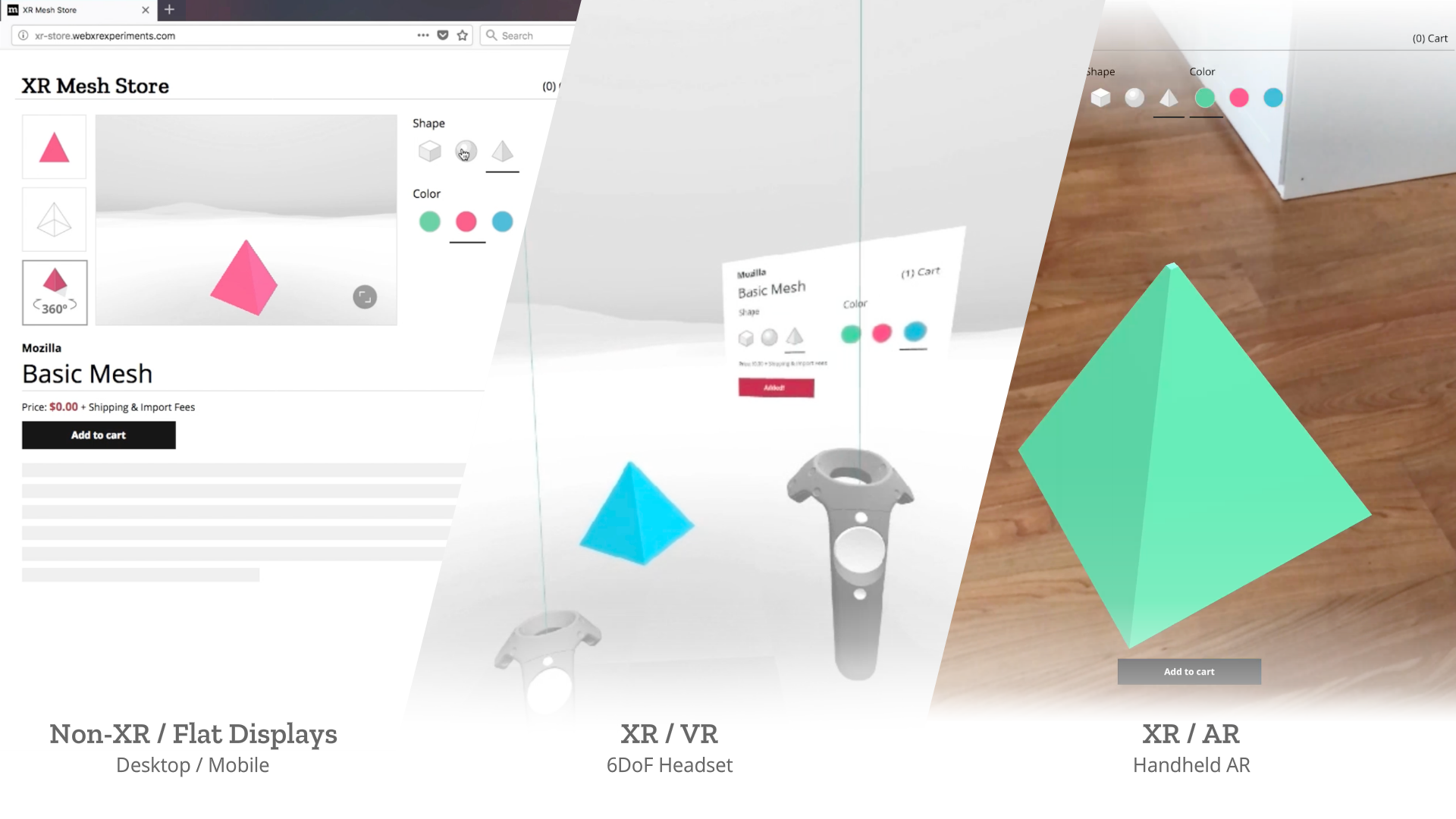
Imagine you wanted to have your store’s web page work in 2D, and also take advantage of the full range of AR and VR devices. WebXR will provide the foundation you need to create pages that work everywhere, and let you focus on compelling User Experiences on each of the devices.
In a recent blog post, we touched on one aspect of progressive WebXR, showcasing a version of A-Painter that was adapted to handheld AR and immersive VR. In this post, we will dive a bit deeper into the idea of progressive WebXR apps that are accessible across a much wider range of XR-supported devices.
The WebXR Device API expands on the WebVR API to include a broader range of mixed reality devices (i.e., AR/VR, immersive/handheld). By supporting all mixed reality devices in one API, the Immersive Web community hopes to make it easier for web apps to respond to the capabilities of a user’s chosen device, and present an appropriate UI for AR, VR, or traditional 2D displays.
At Mozilla, this move aligns with experiments we started last fall, when we created a draft WebXR API proposal, a WebXR polyfill based on it, and published our WebXR Viewer experimental web browser application to the iOS App Store. Publishing the app for iOS allowed us (and others) to experiment with WebXR on iOS, and is one of the target platforms for the XR Store demo that is the focus of this article. This demo shows how future sites can support the WebXR API across many different devices.
Before introducing the example store we've create, I’ll give an overview of the spectrum of devices that might need to be supported by a UX strategy to design this kind of WebXR-compatible site.
The spectrum of WebXR displays/realities
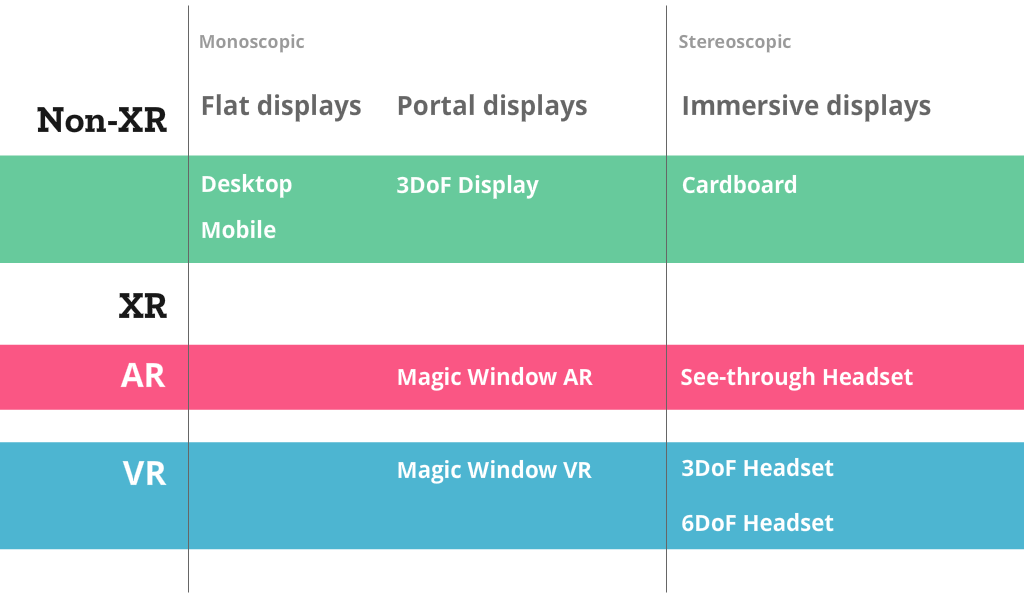
Broadly speaking, there are three categories of displays that need to be supported by a responsive WebXR application:
- current non-WebXR “flat displays” on desktop and handheld devices,
- “portal displays” where these same screens present the illusion of a portal into a 3D world by leveraging device motion and 3D sensing, and
- “immersive displays” such as head-worn displays that encompass the user’s senses in the 3D world.
Non-WebXR Displays
Current flat displays, such as desktop monitors, phones and tablets, may not have access to VR/AR capabilities via WebXR, although some will be able to simulate WebXR using a WebXR polyfill. Such desktop and mobile displays will remain the most common ways to consume web content for the forseeable future.
Mobile devices with 3DoF orientation sensors (that use accelerometers, gyroscopes, and magnetometers to give 3 Degrees of Freedom for the device pose) can simulate monoscopic 3D VR (and AR, if they use getUserMedia to access the video camera on the device), by leveraging the deviceorientation or Orientation Sensor APIs to access the device orientation.
Apps written for "Cardboard" display holders for these mobile devices (i.e., cases that use the phone's screen as their display, such as a Google Cardboard) use the same 3DoF sensors, but render stereoscopic VR on the phone display.
XR Displays
XR displays come in two sorts: AR and VR. The most common XR displays right now are Handheld or "Magic Window" AR, made possible by Apple’s ARKit for iOS (used by our WebXR Viewer) or Google’s ARCore for Android (used by the
To help you control the amount of data Facebook can gather about you, we have updated the Facebook Container extension to include Instagram and Facebook Messenger. This way, users of … Read more
The post Facebook Container extension now includes Instagram and Facebook Messenger appeared first on The Firefox Frontier.
We’re in the middle of our Firefox Quantum Extensions Challenge and we’ve been asking ourselves: What makes a great extension?
Great extensions add functionality and fun to Firefox, but there’s more to it than that. They’re easy to use, easy to understand, and easy to find. If you’re building one, here are some simple steps to help it shine.
Make It Dynamic
Firefox 57 added dynamic themes. What does that mean? They’re just like standard themes that change the look and feel of Firefox, but they can change over time. Create new themes for daytime, nighttime, private browsing, and all your favorite things.
Mozilla developer advocate Potch created a wonderful video explaining how dynamic themes work in Firefox:
Make It Fun
Browsing the web is fun, but it can be downright hilarious with an awesome extension. Firefox extensions support JavaScript, which means you can create and integrate full-featured games into the browser. Tab Invaders is a fun example. This remake of the arcade classic Space Invaders lets users blast open tabs into oblivion. It’s a cathartic way to clear your browsing history and start anew.

But you don’t have to build a full-fledged game to have fun. Tabby Cat adds an interactive cartoon cat to every new tab. The cats nap, meow, and even let you pet them. Oh, and the cats can wear hats.

Make It Functional
A fantastic extension helps users do everyday tasks faster and more easily. RememBear, from the makers of TunnelBear, remembers usernames and passwords (securely) and can generate new strong passwords. Tree Style Tab lets users order tabs in a collapsible tree structure instead of the traditional tab structure. The Grammarly extension integrates the entire Grammarly suite of writing and editing tools in any browser window. Excellent extensions deliver functionality. Think about ways to make browsing the web faster, easier, and more secure when you’re building your extension.

Make It Firefox
The Firefox UI is built on the Photon Design System. A good extension will fit seamlessly into the UI design language and seem to be a native part of the browser. Guidelines for typography, color, layout, and iconography are available to help you integrate your extension with the Firefox browser. Try to keep edgy or unique design elements apart from the main Firefox UI elements and stick to the Photon system when possible.
Make It Clear
When you upload an extension to addons.mozilla.org (the Firefox add-ons site), pay close attention to its listing information. A clear, easy-to-read description and well-designed screenshots are key. The Notebook Web Clipper extension is a good example of an easy-to-read page with detailed descriptions and clear screenshots. Users know exactly what the extension does and how to use it. Make it easy for users to get started with your extension.
Make It Fresh
Firefox 60, now available in Firefox Beta, includes a host
Our fourth and final SEO experiment for MDN, to optimize internal links within the open web documentation, is now finished. Optimizing internal links involves ensuring that each page (in particular, the ones we want to improve search engine results page (SERP) positions for, are easy to find.
This is done by ensuring that each page is linked to from as many topically relevant pages as possible. In addition, it should in turn link outward to other relevant pages. The more quality links we have among related pages, the better our position is likely to be. The object, from a user’s perspective, is to ensure that even if the first page they find doesn’t answer their question, it will link to a page that does (or at least might help them find the right one).
Creating links on MDN is technically pretty easy. There are several ways to do it, including:
- Selecting the text to turn into a link and using the toolbar’s “add link” button
- Using the “add link” hotkey (Ctrl-K or Cmd-K)
- Any one of a large number of macros that generate properly-formatted links automatically, such as the
domxrefmacro, which creates a link to a page within the MDN API reference; for example: {{domxref(“RTCPeerConnection.createOffer()”)}} creates a link to https://developer.mozilla.org/en-US/docs/Web/API/RTCPeerConnection/createOffer, which looks like this:RTCPeerConnection.createOffer(). Many of the macros offer customization options, but the default is usually acceptable and is almost always better than trying to hand-make the links.
Our style guide talks about where links should be used. We even have a guide to creating links on MDN that covers the most common ways to do so. Start with these guidelines.
The content updates
10 pages were selected for the internal link optimization experiment.
Changes made to the selected pages
In general, the changes made were only to add links to pages; sometimes content had to be added to accomplish this but ideally the changes were relatively small.
- Existing text that should have been a link but was not, such as mentions of terms that need definition, concepts for which pages exist that should have been linked to, were turned into links.
- The uses of API names, element names, attributes, CSS properties, SVG element names, and so forth were turned into links when either first used in a section or if a number of paragraphs had elapsed since they were last a link. While repeated links to the same page don’t count, this is good practice for usability purposes.
- Any phrase for which a more in-depth explanation is available was turned into a link.
- Links to related concepts or topics were added where appropriate; for example, on the article about
HTMLFormElement.elements, a note is provided with a link to the relatedDocument.formsproperty. - Links to related functions or HTML elements or whatever were added.
- The “See also” section was reviewed and updated to include appropriate related content.
Changes made to targeted pages
Targeted pages—pages to which links were added—in some cases got smaller changes made, such as the addition of a link back to the original page, and in some cases new links were added to other relevant content if the pages were particularly in need of help.
Pages to be updated
The pages selected to be updated for this experiment:
- https://developer.mozilla.org/en-US/docs/Web/CSS/object-position
- https://developer.mozilla.org/en-US/docs/Web/API/XMLHttpRequest/HTML_in_XMLHttpRequest
- https://developer.mozilla.org/en-US/docs/Web/API/Document_object_model/Locating_DOM_elements_using_selectors
- https://developer.mozilla.org/en-US/docs/Web/API/MediaDevices/enumerateDevices
- https://developer.mozilla.org/en-US/docs/Web/API/HTMLFormElement/elements