
This week we’re heads down focusing on adding features in the three broad areas of Browsers, Social and the Content Ecosystem.
Browsers
This week we focused on building Firefox Reality and we’re excited to announce additional features:
- Implemented private tabs
- Tab overflow popup list
- Added contextual menu for “more options” in the header
- Improvements for SVR based devices:
- Update SDK to v2.1.2 for tracking improvements
- Fallback to head tracking based input when there are not controllers available
- Implement scrolling using wheel and trackpad input buttons in ODG devices
- Working on the virtual keyboard across Android platform
- We are designing the transitions for WebVR immersive mode
Check out the video clip of additional features we added this week of the contextual menu and private tabs:
Firefox Reality private browsing from Imanol Fern'andez Gorostizaga on Vimeo.
Social
We're working on a web-based social experience for Mixed Reality.
In the last week, we have:
- Landed next 2D UX pass which cleans up a bunch of CSS and design inconsistencies, and prompts users for avatar and name customization before entry until they customize their name.
- Ongoing work for final push of in-VR UX: unified 3D cursor, “pause/play” mode for blocking UX, finalized HUD design and positioning, less error-prone teleporting component should all land this week.
- Worked through remaining issues with deployments, cleaned up bugs and restart issues with Habitat (as well as filed a number of bugs.)
- Set-up room member capping and room closing.
Join our public WebVR Slack #social channel to join in the discussion!
Content ecosystem
This week, Blair MacIntyre released a new version of the iOS WebXR Viewer app that includes support for experimenting with Computer Vision.
Check out the video below:

Stay tuned next week for some exciting news!
All entities move and nothing remains still.
At this time last year, I had just moved on from Release Engineering to start managing the Sheriffs and the Developer Workflow teams. Shortly after the release of Firefox Quantum, I also inherited the Taskcluster team. The next few months were *ridiculously* busy as I tried to juggle the management responsibilities of three largely disparate groups.
By mid-January, it became clear that I could not, in fact, do it all. The Taskcluster group had the biggest ongoing need for management support, so that’s where I chose to land. This sanity-preserving move also gave a colleague, Kim Moir, the chance to step into management of the Developer Workflow team.
Meet the Team
Let me start by introducing the Taskcluster team. We are:
- Hassan Ali
- Wander Lairson Costa
- John Ford
- Jonas Finnemann Jensen
- Dustin Mitchell
- Pete Moore
- Eli Perelman
- Brian Stack
We are an eclectic mix of curlers, snooker players, pinball enthusiasts, and much else besides. We also write and run continous integration (CI) software at scale.
What are we doing?

The part I understand is excellent, and so too is, I dare say, the part I do not understand…
One of the reasons why I love the Taskcluster team so much is that they have a real penchant for documentation. That includes their design and post-mortem processes. Previously, I had only managed others who were using Taskcluster…consumers of their services. The Taskcluster documentation made it really easy for me to plug-in quickly and help provide direction.
If you’re curious about what Taskcluster is at a foundational level, you should start with the tutorial.
The Taskcluster team currently has three, big efforts in progress.
1. Redeployability
Many Taskcluster team members initially joined the team with the dream of building a true, open source CI solution. Dustin has a great post explaining the impetus behind redeployability. Here’s the intro:
Taskcluster has always been open source: all of our code is on Github, and we get lots of contributions to the various repositories. Some of our libraries and other packages have seen some use outside of a Taskcluster context, too.
But today, Taskcluster is not a project that could practically be used outside of its single incarnation at Mozilla. For example, we hard-code the name taskcluster.net in a number of places, and we include our config in the source-code repositories. There’s no legal or contractual reason someone else could not run their own Taskcluster, but it would be difficult and almost certainly break next time we made a change.
The Mozilla incarnation is open to use by any Mozilla project, although our focus is obviously Firefox and Firefox-related products like
This is a bit late (how is it the middle of April already?!), but the dev-tools team has lots of exciting plans for 2018 and I want to talk about them!
Our goals for 2018
Here's a summary of our goals for the year.
Ship it!
We want to ship high quality, mature, 1.0 tools in 2018. Including,
- Rustfmt (1.0)
- Rust Language Server (RLS, 1.0)
- Rust extension for Visual Studio Code using the RLS (non-preview, 1.0)
- Clippy (1.0, though possibly not labeled that, including addressing distribution issues)
Support the epoch transition
2018 will bring a step change in Rust with the transition from 2015 to 2018 epochs. For this to be a smooth transition it will need excellent tool support. Exactly what tool support will be required will emerge during the year, but at the least we will need to provide a tool to convert crates to the new epoch.
We also need to ensure that all the currently existing tools continue to work through the transition. For example, that Rustfmt and IntelliJ can handle new syntax such as dyn Trait, and the RLS copes with changes to the compiler internals.
Cargo
The Cargo team have their own goals. Some things on the radar from a more general dev-tools perspective are integrating parts of Xargo and Rustup into Cargo to reduce the number of tools needed to manage most Rust projects.
Custom test frameworks
Testing in Rust is currently very easy and natural, but also very limited. We intend to broaden the scope of testing in Rust by permitting users to opt-in to custom testing frameworks. This year we expect the design to be complete (and an RFC accepted) and for a solid and usable implementation to exist (though stabilisation may not happen until 2019).The current benchmarking facilities will be reimplemented as a custom test framework. The framework should support testing for WASM and embedded software.
Doxidize
Doxidize is a successor to Rustdoc. It adds support for guide-like documentation as well as API docs. This year there should be an initial release and it should be practical to use for real projects.
Maintain and improve existing tools
Maintenance and consistent improvement is essential to avoid bit-rot. Existing mature tools should continue to be well-maintained and improved as necessary. This includes
- debugging support,
- Rustdoc,
- Rustup,
- Bindgen,
- editor integration.
Good tools info on the Rust website
The Rust website is planned to be revamped this year. The dev-tools team should be involved to ensure that there is clear and accurate information about key tools in the Rust ecosystem and that high quality tools are discoverable by new users.
Organising the team
The dev-tools team should be reorganised to continue to scale and to support the goals in this roadmap. I'll outline the concrete changes next.
Re-organising the dev-tools team
The dev-tools team has always been large and somewhat broad - there are a lot of different tools at different levels of maturity with different people working on them. There has always been a tension between having a global, strategic view vs having a detailed, focused view. The peers system was one way to tackle that. This year we're trying something new - the dev-tools team will become something of an umbrella team, coordinating work across multiple teams and working groups.
We're creating two new teams - Rustdoc, and IDEs and editors - and going to work more closely with the Cargo team. We're also spinning up a bunch of working groups. These are more focused, less formal teams, they are dedicated to a single tool or task, rather than to strategy and decision making. Primarily they are a way to let people working on a tool work more effectively. The dev-tools team will continue to coordinate work and keep track of the big picture.
We're always keen to work with more people on Rust tooling. If you'd like to get involved, come chat to us on Gitter in the following rooms:
 Precision Agriculture, or high tech farming, is being heralded as a panacea solution to the ever-growing demands of an increasing global population - but the...
https://air.mozilla.org/emerging-tech-speaker-series-talk-with-rian-wanstreet/
 This is a weekly call with some of the Reps to discuss all matters about/affecting Reps and invite Reps to share their work with everyone.
“I want you to think: if she can walk into that room and change her entire life and help create this whole energy and buzz, you can do it too.”
– Nonny de la Pe~na
This week, we’re highlighting VR’s groundbreaking potential to take audiences inside stories with a four part video series. There aren’t many examples of creators doing that more effectively and powerfully than Nonny de la Pe~na.
Nonny de la Pe~na is a former correspondent for Newsweek, the New York Times and other major outlets. For more than a decade now, de la Pe~na has been focused on merging her passion for documentary filmmaking with a deep-seeded expertise in VR. She essentially invented the field of “immersive journalism” through her company, Emblematic Group.
What makes de la Pe~na’s work particularly noteworthy (and a primary reason we’ve been driven to collaborate with her), is that her journalism often uses virtual reality to bring attention to under-served and overlooked groups.
To that end, our panel at this year’s Sundance Festival doubled as another installation in Nonny’s latest project, Mother Nature.
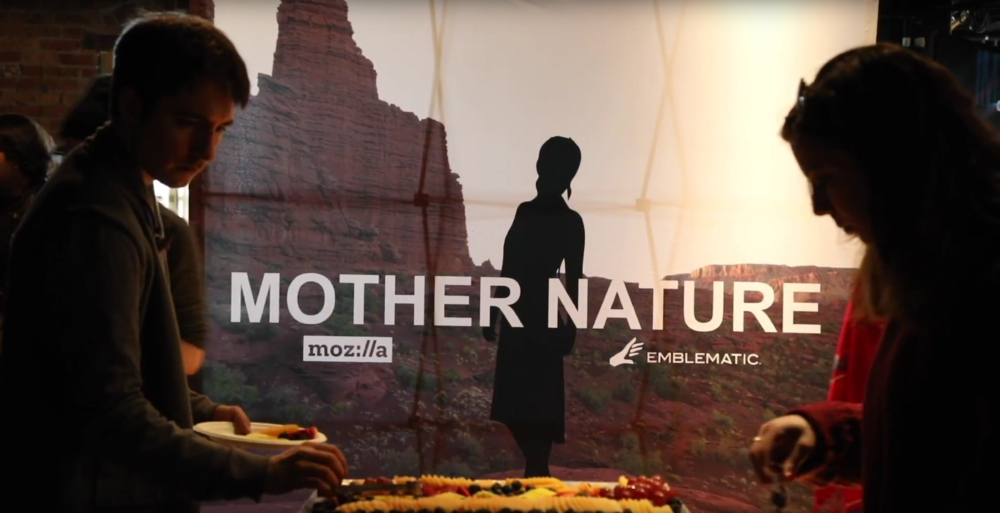
Mother Nature is an open and collaborative project that amplifies the voices of women and creators working in tech. It rebukes the concept that women are underrepresented in positions of power in tech and engineer roles because of anything inherent in their gender.

It’s a clear demonstration of how journalists and all storytellers can use VR to create experiences that can change minds and hearts, and help move our culture towards a more open and human direction.
For more on Nonny de la Pe~na and her immersive projects, visit Emblematic Group. I’d also encourage you to access our resources and open tools at https://mixedreality.mozilla.org/ and learn how you can use virtual reality and the web to tell your own stories.
Read more on VR the People
- An Open Call to Filmmakers: Make Something Amazing With Virtual Reality and the Open Web
- Virtual Reality at the Intersection of Art & Technology
The post Nonny de la Pe~na & the Power of Immersive Storytelling appeared first on The Mozilla Blog.
https://blog.mozilla.org/blog/2018/04/19/nonny-de-la-pena-the-power-of-immersive-storytelling/
cargo src is a new tool for exploring your Rust code. It is a cargo plugin which runs locally and lets you navigate your project in a web browser. It has syntax highlighting, jump to definition, type on hover, semantic search, find uses, find impls, and more.
Today I'm announcing version 0.1, our first beta; you should try it out! (But be warned, it is definitely beta quality - it's pretty rough around the edges).
To install: cargo install cargo-src, to run: cargo src --open in your project directory. You will need a nightly Rust toolchain. See below for more directions.
When cargo src starts up it will need to check and index your project. If it is a large project, that can take a while. You can see the status in the bottom left of the web page (this is currently not live, it'll update when you load a file). Build information from Cargo is displayed on the console where you ran cargo src. While indexing, you'll be able to see your code with syntax highlighting, but won't get any semantic information or be able to search.
Actionable identifiers are underlined. Click on a reference to jump to the definition. Click on a definition to search for all references to that definition. Right click on a link to see more options (such as 'find impls').
Hover over an identifier to see it's type, documentation, and fields (or similar info).
On the left-hand side there are tabs for searching, and for browsing files and symbols (which to be honest that last one is not working that well yet). Searching is for identifiers only and is case-sensitive. I hope to support text search and fuzzy search in the future.
A big thank you to Nicole Anderson and Zahra Traboulsi for their work - they've helped tremendously with the frontend, making it look and function much better than my attempts. Thanks to everyone who has contributed by testing or coding!
Cargo src is powered by the same tech as the Rust Language Server, taking it's data straight from the compiler. The backend is a Rust web server using Hyper. The frontend uses React and is written in Javascript with a little TypeScript. I think it's a fun project to work on because it's at the intersection of so many interesting technologies. It grew out of an old project - rustw - which was a web-based frontend for the Rust compiler.
Contributions are welcome! It's really useful to file issues if you encounter problems. If you want to get more involved, the code is on GitHub; come chat on Gitter.
In my previous seven part posting on the Things Gateway from Mozilla, I explored the various built in options for connecting with existing home automation technologies. While interesting, at that point, the Things Gateway hadn't really broken any new ground. The features could be found in other Home Automation projects, arguably in more mature environments.
With the release of version of 0.4, the Things Gateway introduces something entirely new that the other products in the field don't yet do. Mozilla is thinking about the Internet of Things in a different way: a way that plays directly to the company's strengths. What if all these home automation devices, switches, plugs, bulbs, spoke a protocol that already exists and is cross platform, cross language and fully open: the Web protocols. Imagine if each plug or bulb would respond to HTTP requests as if it were a Web app. You could just use a browser to control them: no need for proprietary software stacks and phone apps. This could be revolutionary.

Right now, the Mozilla team on this project is focused intensely on making the Web Things Framework easy to implement by hardware manufacturers. Targeting the Maker Movement, the team is pushing to make it easy to enable small Arduino and similar tiny computers to speak the Web of Things (WoT) protocol. They've created libraries and modules in various languages that implement the Things Framework: Javascript, Java, Python 3 have been written, with C++ and Rust on the horizon.
I'm going to focus on the Python implementation of the Things Framework. It is pip installable with this command on a Linux machine:
The webthing-python github repo provides some programming examples on how to use the module.
$ sudo pip3 install webthing
One of the first things that a Python programmer is going to notice about this module is that it closely tracks the structure of a reference implementation. That reference implementation is written in Javascript. As such, it imposes a rather Javascript style and structure onto the Python API. For some that can roll with the punches, this is not a problem, for others, like myself, I'd rather have a more Pythonic API to deal with. So I've wrapped the webthing module with my own pywot (python Web of Things) module.
pywot paves over some of the awkward syntax exposed in the Python webthing implementation and offers some services that further reduce the amount code it takes to create a Web thing.
 For example, I don't have one of those fancy home weather stations in my yard. However, I can make a virtual weather station that fetches data from Weather Underground with the complete set of current conditions for my community. Since I can access a RESTful API from Weather Underground in a Python program, I can wrap that API as a Web Thing. The Thing Gateway then sees it as a device on the network and integrates it into the UI as a sensor for multiple values.
Weather Underground offers a software developers license that will allows up to 500 API calls per day at no cost. All you have to do is sign up and they'll give you an API key. Embed that key in a URL and you can fetch data from just about any weather station on their network. The license agreement says that if you publicly post data from their network, you must provide
People searching for a Google Chrome ad blocking extension have to choose from dozens of similarly named extensions. Only few of these are legitimate, most are forks of open source ad blockers trying to attract users with misleading extension names and descriptions. What are these up to? Thanks to Andrey Meshkov we now know what many people already suspected: these extensions are malicious. He found obfuscated code hidden carefully within a manipulated jQuery library that accepted commands from a remote server.
As it happens, I checked out some fake ad blockers only in February. Quite remarkably, all of these turned up clean: the differences to their respective open source counterparts were all minor, mostly limited to renaming and adding Google Analytics tracking. One of these was the uBlock Plus extension which now showed up on Andrey’s list of malicious extensions and has been taken down by Google. So at some point in the past two months this extension was updated in order to add malicious code.
And that appears to be the point here: somebody creates these extensions and carefully measures user counts. Once the user count gets high enough the extension gets an “update” that attempts to monetize the user base by spying on them. At least stealing browsing history was the malicious functionality that Andrey could see, additional code could be pushed out by the server at will. That’s what I suspected all along but this is the first time there is actual proof.
Chrome Web Store has traditionally been very permissive as far as the uploaded content goes. Even taking down extensions infringing trademarks took forever, extensions with misleading names and descriptions on the other hand were always considered “fine.” You have to consider that updating extensions on Chrome Web Store is a fully automatic process, there is no human review like with Mozilla or Opera. So nobody stops you from turning an originally harmless extension bad.
On the bright side, I doubt that Andrey’s assumption of 20 million compromised Chrome users is correct. There are strong indicators that the user numbers of these fake ad blockers have been inflated by bots, simply because the user count is a contributing factor to the search ranking. I assume that this is also the main reason behind the Google Analytics tracking: whoever is behind these extensions, they know exactly that their Chrome Web Store user numbers are bogus.
For reference, the real ad blocking extensions are:
https://palant.de/2018/04/18/the-ticking-time-bomb-fake-ad-blockers-in-chrome-web-store
As the Firefox data engineering teams we provide core tools for using data to other teams. This spans from collection through Firefox Telemetry, storage & processing in our Data Platform to making data available in Data Tools.
To make new developments more visible we aim to publish a quarterly newsletter. As we skipped one, some important items from Q4 are also highlighted this time.
This year our teams are putting their main focus on:
- Making experimentation easy & powerful.
- Providing a low-latency view into product release health.
- Making it easy to work with events end-to-end.
- Addressing important user issues with our tools.

Usage improvements
Last year we started to investigate how our various tools are used by people working on Firefox in different roles. From that we started addressing some of the main issues users have.
Most centrally, the Telemetry portal is now the main entry point to our tools, documentation and other resources. When working with Firefox data you will find all the important tools linked from there.
We added the probe dictionary to make it easy to find what data we have about Firefox usage.
For STMO, our Redash instance, we deployed a major UI refresh from the upstream project.
There is new documentation on prototyping and optimizing STMO queries.
Our data documentation saw many other updates, from cookbooks on how to see your own pings and sending new pings to adding more datasets. We also added documentation on how our data pipeline works.
Enabling experimentation
For experimentation, we have focused on improving tooling. Test Tube will soon be our main experiment dashboard, replacing experiments viewer. It displays the results of multivariant experiments that are being conducted within Firefox.
We now have St. Moab as a toolkit for automatically generating experiment dashboards.
Working with event data
To make working with events easier, we improved multiple stages in the pipeline. Our documentation has an overview of the data flow.
On the Firefox side, events can now be recorded through the events API, from add-ons, and whitelisted Firefox content. From Firefox 61, all recorded events are automatically counted into scalars, to easily get summary statistics.
Event data is available for analysis in Redash in different datasets. We can now also connect more event data to Amplitude, a product analytics tool. A connection for some mobile events to Amplitude is live, for Firefox Desktop events it will be available soon.
Low-latency release health data
To enable low-latency views into release health data, we are working on improving Mission Control, which will soon replace arewestableyet.com.
 mconley livehacks on real Firefox bugs while thinking aloud.
The web should be open to everyone, a place for unbridled innovation, education, and creative expression. That’s why Firefox fights for Net Neutrality, promotes online privacy rights, and supports open-source … Read more
The post Working for Good: Metalwood Salvage of Portland appeared first on The Firefox Frontier.
https://blog.mozilla.org/firefox/working-for-good-metalwood-salvage/
 This is the SUMO weekly call
Please meet our newest Friend of Add-ons, Viswaprasanth Ks! Viswa began contributing to Mozilla in January 2013, when he met regional community members while participating in a Firefox OS hackathon in Bangalore, India. Since then, he has been a member of the Firefox Student Ambassador Board, a Sr. Firefox OS app reviewer, and a Mozilla Rep and Tech Speaker.
In early 2017, Viswa began developing extensions for Firefox using the WebExtensions API. From the start, Viswa wanted to invite his community to learn this framework and create extensions with him. At community events, he would speak about extension development and help participants build their first extensions. These presentations served as a starting point for creating the Activate campaign “Build Your Own Extension.” Viswa quickly became a leader in developing the campaign and testing iterations with a variety of different audiences. In late 2017, he collaborated with community members Santosh Viswanatham and Trishul Goel to re-launch the campaign with a new event flow and more learning resources for new developers.
Viswa continues to give talks about extension development and help new developers become confident working with WebExtensions APIs. He is currently creating a series of videos about the WebExtensions API to be released this summer. When he isn’t speaking about extensions, he mentors students in the Tamilnadu region in Rust and Quality Assurance.
These experiences have translated into skills Viswa uses in everyday life. “I learned about code review when I became a Sr. Firefox OS app reviewer,” he says. “This skill helps me a lot at my office. I am able to easily point out errors in the product I am working on. The second important thing I learned by contributing to Mozilla is how to build and work with a diverse team. The Mozilla community has a lot of amazing people all around the world, and there are unique things to learn from each and every one.”
In his free time, Viswa watches tech-related talks on YouTube, plays chess online, and explores new Mozilla-related projects like Lockbox.
He’s also quick to add, “I feel each and every one who cares about the internet should become Mozilla contributors so the journey will be awesome in future.”
If that describes you and you would like get more involved with the add-ons community, please take a look at our wiki for some opportunities to contribute to the project.
Thank you so much for all of your contributions, Viswa! We’re proud to name you Friend of Add-ons.
The post Friend of Add-ons: Viswaprasath Ks appeared first on Mozilla Add-ons Blog.
https://blog.mozilla.org/addons/2018/04/18/friend-of-add-ons-viswaprasath-ks/
“If someone can imagine a world…they can create an experience.”
– Reggie Watts
This is the second video in our four part series around creators, virtual reality, and the open web. As we laid out in the opening post of this series, virtual reality is more than a technology, and it is far more than mere eye-candy. VR is an immensely powerful tool that is honed and developed every day. In the hands of a creator, that tool has the potential to transport audiences into new worlds and provide new perspectives.
It’s one thing to read about the crisis in Sudan, but being transported inside that crisis is deeply affecting in a way we haven’t seen before.

The hard truth is that all the technological capabilities in the world won’t matter if creators don’t have the proper tools to shape that technology into experiences. To make a true impact, technology and art can’t live parallel lives. They must intersect. Bringing together those worlds was the thrust for our VR the People panel at the Sundance Festival.
“You’re gonna end up finding someone who’s a 16-year-old in the basement with an open-source VR headset and some crappy computer and they download free software so they can build [an experience].”
– Brooks Brown, Global Director of Virtual Reality, Starbreeze Studios
That quote above is exactly why Mozilla spent years working to build WebVR, and why we held our panel at Sundance. It’s why we are writing these posts. We’re hoping they reach someone out there – anyone, anywhere – who has a world in their head and a story to tell. We’re hoping they pick up the tools our engineers built and use them in ways that inspire and force those same engineers to build new tools that keep pace with the evolving creative force.
So go ahead, check out our resources and tools at https://mixedreality.mozilla.org/. We promise you won’t be creating alone. You bring the art, we’ll bring the technology, and together we can make something special.
Read more on VR the People
- An Open Call to Filmmakers: Make Something Amazing With Virtual Reality and the Open Web
The post Virtual Reality at the Intersection of Art & Technology appeared first on The Mozilla Blog.
https://blog.mozilla.org/blog/2018/04/18/virtual-reality-at-the-intersection-of-art-technology/
Just when you think you’ve got a handle on this web stuff, things change. The latest mixup? Apps vs Web Apps. An app should be an app no matter what, … Read more
The post No-Judgment Digital Definitions: App vs Web App appeared first on The Firefox Frontier.
https://blog.mozilla.org/firefox/no-judgment-digital-definitions-app-vs-web-app/
 Learn about working open at the Global Sprint and hear stories and tips from past participants.
https://air.mozilla.org/2018-global-sprint-orientation-webinar-3-april-17th-2018/
 Holochain Meetup 4/17/2018