
This week the team is continously working on new features, making improvements and fixing bugs.
Next week, the team will be in San Francisco for an all-Mozilla company meeting.
Browsers
We just added a new browser design and assets to Firefox Reality and we now have the ability to display a 360 image as the background in VR while doing 2D browsing!
- Added CubeMap support to the VR engine
- Added Skybox support to Firefox Reality
- Putting new UI and platform work for immersive mode
- The design team delivered the final designs for v1, including the browser window UI, the button tray, and the settings panel
Social
We can now import and display basic 2D web content in a shared room and continue to make improvements.
- Working on allowing users to pull in content from around the web. This is going to roll out and expand over time, but in the meantime here is some emergent gameplay footage https://imgur.com/DtEBOS6 for the Hubs by Mozilla product.
- Pushing some improvements to the controls: 2D mobile users can pinch to move around the space, mouse users can engage pointer-lock with right click, 6DOF users can pull ducks to them from far away using a thumbpad or joystick
- Improvements to networking code particularly on slow connections
Join our public WebVR Slack #social channel to participate in on the discussion!
Content ecosystem
We are improving support for the Oculus Go on the Unity WebVR project on the Unity WebVR exporter tool.
Found a critical bug? File it in our public GitHub repo or let us know on the public WebVR Slack #unity channel and as always, join us in our discussion!
Stay tuned for new features and improvements across our three areas!
What is Standup?
Standup is a system for capturing standup-style posts from individuals making it easier to see what's going on for teams and projects. It has an associated IRC bot standups for posting messages from IRC.
Project report
Over the last six months, we've done:
- monthly library updates
- revamped static assets management infrastructure
- service maintenance
- fixed the textarea to be resizeable (Thanks, Arai!)
The monthly library updates have helped with reducing technical debt. That takes a few hours each month to work through.
Paul redid how Standup does static assets. We no longer use django-pipeline, but instead use gulp. It works muuuuuuch better and makes it possible to upgrade to Djagno 2.0 soon. That was a ton of work over the course of a few days for both of us.
We've been keeping the Standup service running. That includes stage and production websites as well as stage and production IRC bots. That also includes helping users who are stuck--usually with accounts management. That's been a handful of hours.
Arai fixed the textareas so they're resizeable. That helps a ton! I'd love to get more help with UI/UX fixing.
Some GitHub stats:
GitHub
======

  mozilla/standup: 15 prs

    Committers:
             pyup-bot :     6  (  +588,   -541,   20 files)
               willkg :     5  (  +383,   -169,   27 files)
                 pmac :     2  ( +4179,   -223,   58 files)
               arai-a :     1  (    +2,     -1,    1 files)
                  g-k :     1  (    +3,     -3,    1 files)

                Total :        ( +5155,   -937,   89 files)

    Most changed files:
      requirements.txt (11)
      requirements-dev.txt (7)
      standup/settings.py (5)
      docker-compose.yml (4)
      standup/status/jinja2/base.html (3)
      standup/status/models.py (3)
      standup/status/tests/test_views.py (3)
      standup/status/urls.py (3)
      standup/status/views.py (3)
      standup/urls.py (3)

    Age stats:
          Youngest PR : 0.0d: 466: Add site-wide messaging
       Average PR age : 2.3d
        Median PR age : 0.0d
            Oldest PR : 10.0d: 459: Scheduled monthly dependency update for May


  All repositories:

    Total merged PRs: 15


Contributors
============

  arai-a
  g-k
  pmac
  pyup-bot
  willkg
That's it for the last six months!
Switching to swag-driven development
Do you use Standup?
Did you use Standup, but the glacial pace of fixing issues was too much so you switched to something else?
Do you want to use Standup?
We think there's still some value in having Standup around and there are still people using it. There's still some technical debt to fix that makes working on it harder than it should be. We've been working through that glacially.
As a project, we have the following problems:
- The bulk of the work is being done by Paul and Will.
- We don't have time to work on Standup.
- There isn't anyone else contributing.
Why aren't users contributing? Probably a lot of reasons. Maybe everyone has their own reason! Have I spent a lot of time to look into this? No, because I don't have a lot of time to work on Standup.
Instead, we're just going to make some changes and see whether that helps. So we're doing the following:
- Will promises to send out Standup project reports every 6 months before the All Hands and in doing this raise some awareness of what's going on and thank people who contributed.
- We're fixing the Standup site to be clearer on who's doing work and how things get fixed so it's more likely your ideas come to fruition rather than get stale.
- We're switching Standup to swag-driven development!
What's that you say? What's swag-driven development?
I mulled over the idea in my post on swag-driven development.
It's a couple of things, but mainly an explicit statement that people work on Standup in our spare time at the cost of not spending that time on other things. While we don't feel entitled to feeling appreciated, it would be nice to feel appreciated sometimes. Not feeling appreciated makes me wonder whether I should spend the time elsewhere. (And maybe that's the case--I have no idea.) Maybe other people would be more interested in spending their spare time on Standup if they knew there were swag incentives?
So what does this mean?
It means that we're encouraging swag donations!
- If your team has stickers at the All Hands and you use Standup, find Paul and Will and other Standup
 The IETF QUIC working group had its fifth interim meeting the other day, this time in Kista, Sweden hosted by Ericsson. For me as a Stockholm resident, this was ridiculously convenient. Not entirely coincidentally, this was also the first quic interim I attended in person.
We were 30 something persons gathered in a room without windows, with another dozen or so participants joining from remote. This being a meeting in a series, most people already know each other from before so the atmosphere was relaxed and friendly. Lots of the participants have also been involved in other protocol developments and standards before. Many familiar faces.
Schedule
As QUIC is supposed to be done "soon", the emphasis is now a lot to close issues, postpone some stuff to "QUICv2" and make sure to get decisions on outstanding question marks.
Kazuho did a quick run-through with some info from the interop days prior to the meeting.
After MT's initial explanation of where we're at for the upcoming draft-13, Ian took us a on a deep dive into the Stream 0 Design Team report. This is a pretty radical change of how the wire format of the quic protocol, and how the TLS is being handled.
The existing draft-12 approach...

Is suggested to instead become...

What's perhaps the most interesting take away here is that the new format doesn't use TLS records anymore - but simplifies a lot of other things. Not using TLS records but still doing TLS means that a QUIC implementation needs to get data from the TLS layer using APIs that existing TLS libraries don't typically provide. PicoTLS, Minq, BoringSSL. NSS already have or will soon provide the necessary APIs. Slightly behind, OpenSSL should offer it in a nightly build soon but the impression is that it is still a bit away from an actual OpenSSL release.
EKR continued the theme. He talked about the quic handshake flow and among other things explained how 0-RTT and early data works. Taken from that context, I consider this slide (shown below) fairly funny because it makes it look far from simple to me. But it shows communication in different layers, and how the acks go, etc.

HTTP
Mike then presented the state of HTTP over quic. The frames are no longer that similar to the HTTP/2 versions. Work is done to ensure that the HTTP layer doesn't need to refer or "grab" stream IDs from the transport layer.
There was a rather lengthy discussion around how to handle "placeholder streams" like the ones Firefox uses over HTTP/2 to create "anchors" on which to make dependencies but are never actually used over the wire. The nature of the quic transport makes those impractical and we talked about what alternatives there are that could still offer similar functionality.

The subject of priorities and dependencies and if the relative complexity of the h2 model should be replaced by something simpler came up (again) but was ultimately pushed aside.
QPACK
Alan presented the state of QPACK, the HTTP header
Text available in: English | Francais | Deutsche
In July, our Voice Assistant Team will be in France and Germany to explore trust and technology adoption. We’re particularly interested in how people use voice assistants and how people listen to content like Pocket and podcasts. We would like to learn more how you use technology and how a voice assistant or voice user interface (VUIs) could improve your Internet and open web experiences. We will be conducting a series of in-home interviews and participatory design sessions. No prior voice assistant experience needed!
We would love to meet folks in person in:
Paris: July 3 – 6, 2018
Munich: July 9 – 13, 2018
Dresden: July 16 – 20, 2018
If you are interested in participating in our in home interviews (2 hours) or participatory design sessions (1.5 hours), please let us know! We’d love to meet you in-person!
If you are interested in meeting us in Paris, please fill out this form.
If you are interested in meeting us in Germany, please fill out this form.
All information will be held under Mozilla’s Privacy Policy.
Paris, Munich & Dresde : aidez-nous `a donner une voix au Web !
En juillet, notre 'equipe Assistants vocaux sera en France et en Allemagne pour explorer la confiance et l’adoption de ces technologies. Nous sommes particuli`erement int'eress'es par la facon dont les gens utilisent les assistants vocaux et par comment ils 'ecoutent du contenu comme Pocket ou des podcasts. Nous aimerions en savoir plus sur la facon dont vous utilisez cette technologie et sur la facon dont un assistant vocal ou une interface utilisateur vocale (VUI) pourrait am'eliorer vos exp'eriences sur le Web. Nous m`enerons une s'erie d’entrevues `a domicile et de s'eances de conception participatives. Aucune utilisation d’assistant vocal n’est requise au pr'ealable !
Nous aimerions rencontrer des gens en personne `a :
Paris : du 3 au 6 juillet 2018,
Munich : du 9 au 13 juillet 2018,
Dresde : du 16 au 20 juillet 2018.
Si vous ^etes int'eress'e(e)s `a participer `a nos interviews `a domicile (2 heures) ou `a des sessions de conception participative (1,5 heure), faites le nous savoir ! Nous aimerions vous rencontrer !
Si vous souhaitez nous rencontrer `a Paris, veuillez remplir ce formulaire.
Si vous souhaitez nous rencontrer en Allemagne, veuillez remplir ce formulaire.
Toutes les informations seront conserv'ees dans la politique de confidentialit'e de Mozilla.
Paris, M"unchen, & Dresden: Bitte helfen Sie uns, dem Internet eine Stimme zu geben!
Im Juli wird unser Voice Assistant Team in Frankreich und Deutschland sein, um Technologie-Akzeptanz und -Vertrauen zu erkunden. Uns interessiert besonders, wie Menschen Sprachassistenten benutzen und wie Menschen Inhalte wie Pocket und Podcasts h"oren. Wir w"urden gerne mehr dar"uber erfahren, wie Sie Technologie benutzen und wie ein Sprachassistent oder eine Sprachbenutzeroberfl"ache (VUIs) Ihr Internet- und freies Weberlebnis verbessern k"onnte. Wir werden eine Reihe von In-Home-Interviews und partizipativen Design-Sessions durchf"uhren. Keine vorherige Erfahrung des Sprachassistenten erforderlich!
Wir w"urden uns freuen Sie pers"onlich zu treffen in:
Paris: 3. – 6. Juli 2018;
M"unchen: 9. – 13. Juli 2018;
Dresden: 16. – 20. Juli 2018.
Wenn Sie daran interessiert sind, an unseren In-Home-Interviews (2 Stunden) oder partizipativen Design-Sessions (1,5 Stunden) teilzunehmen, lassen Sie es uns bitte wissen! Wir w"urden uns freuen, Sie pers"onlich zu treffen!
Wenn Sie Interesse haben, uns in Paris zu treffen, f"ullen Sie bitte dieses Formular aus.
Wenn Sie Interesse haben, uns in Deutschland zu treffen, f"ullen Sie bitte dieses Formular aus.
Alle
I spend most of my time developing flipping back and forth between VS Code and Searchfox. VS Code is a great editor but it has nowhere near the speed needed to do searches over the entire tree, at least on my machine. Searchfox on the other hand is pretty fast. But there’s something missing. I usually want to search Searchfox for something I found in the code. Then I want to get the file I found in Searchfox open in my editor.
Luckily VS Code has a decent extension system that allows you to add new features so I spent some time yesterday evening building an extension to integration some of Searchfox’s functionality into VS Code. With the extension installed you can search Searchfox for something from the code editor or pop open an input box to write your own query. The results show up right in VS Code.

Click on a result in Searchfox and it will open the file in an editor in VS Code, right at the line you wanted to see.
It’s pretty early code so the usual disclaimers apply, expect some bugs and don’t be too surprised if it changes quite a bit in the near-term. You can check out the fairly simple code (rendering the Searchfox page is the hardest part of it) on Github.
If you want to give it a try, install the extension from the VS Code Marketplace or find it by searching for “Searchfox” in VS Code itself. Feel free to file issues for bugs or improvements that would be useful or of course submit pull requests of your own! I’d love to hear if you find it useful.
https://www.oxymoronical.com/blog/2018/06/Searchfox-in-VS-Code
One of the core projects we did over 2017 was a major overhaul of the Localization and Internationalization layers in Gecko, and all throughout the first half of 2018 we were introducing Fluent into Firefox.
All of that work was “behind the scenes” and laid the foundation to enable us to bring higher level improvements in the future.
Today, I’m happy to announce that the first of those high-level features has just landed in Firefox Nightly!
Pseudolocalization?
Pseudolocalization is a technology allowing for testing the localizability of software UI. It allows developers to check how the UI they are working on will look like when translated, without having to wait for translations to become available.
It shortens the Test-Driven Development cycle and lowers the burden of creating localizable UI.
Here’s a demo of how it works:
How to turn it on?
At the moment, we don’t have any UI for this feature. You need to create a new preference called intl.l10n.pseudo and set its value to accented for a left-to-right, ~30% longer strategy, or bidi for a right-to-left strategy. (more documentation).
If you test the bidi strategy you also will likely want to switch another preference – intl.uidirection – to 1. This is because right now the directionality of text and layout are not connected. We will improve that in the future.
We’ll be looking into ways to expose this functionality in the UI, and if you have any ideas or suggestions for what you’d like to see, let’s talk!
Nitty-gritty details
Although the feature may seem simple to add, and the actual patch that adds it was less than 100 lines long, it took many years of prototyping and years of development to build the foundation layers to allow for it.
Many of the design principles of Project Fluent combined with the vision shaped by the L10n Drivers Team at Mozilla allowed for dynamic runtime locale switching and declarative UI localization bindings.
Thanks to all of that work, we don’t have to require special builds or increase the bundle size for this feature to work. It comes practically for free and we can extend and fine tune pseudolocalization strategies on fly.
Kudos
If that feature looks cool, in the esoteric way localization and internationalization can, please, make sure to high-five the people who put a lot of work to get this done: Sta's Malolepszy, Axel Hecht, Francesco Lodolo, Jeff Beatty and Dave Townsend.
More features are coming! Stay tuned.
https://diary.braniecki.net/2018/06/07/pseudolocalization-in-firefox/
Just for the record, if you really need to know about the browser container of your WebExtension, do NOT rely on StackOverflow answers... Most of them are based, directly or not, on the User Agent string. So spoofable, so unreliable. Some will recommend to rely on a given API, implemented by Firefox and not Edge, or Chrome and not the others. In general valid for a limited time only... You can't even rely on chrome, browser or msBrowser since there are polyfills for that to make WebExtensions cross-browser.
So the best and cleanest way is probably to rely on chrome.extension.getURL("/") . It can start with "moz", "chrome" or "ms-browser". Unlikely to change in the near future. Simple to code, works in both content and background.
My pleasure  [показать]
Today we are excited to announce that Common Voice, Mozilla’s initiative to crowdsource a large dataset of human voices for use in speech technology, is going multilingual! Thanks to the tremendous efforts from Mozilla’s communities and our deeply engaged language partners you can now donate your voice in German, French and Welsh, and we are working to launch 40+ more as we speak. But this is just the beginning. We want Common Voice to be a tool for any community to make speech technology available in their own language.
Since we launched Common Voice last July, we have collected hundreds of thousands of voice samples in English through our website and iOS app. Last November, we published the first version of the Common Voice dataset. This data has been downloaded thousands of times, and we have seen the data being used in commercial voice products as well as open-source software like Kaldi and our very own speech recognition engine, project Deep Speech.
Up until now, Common Voice has only been available for voice contributions in English. But the goal of Common Voice has always been to support many languages so that we may fulfill our vision of making speech technology more open, accessible, and inclusive for everyone. That is why our main effort these last few months has been around growing and empowering individual language communities to launch Common Voice in their parts of the world, in their local languages and dialects.
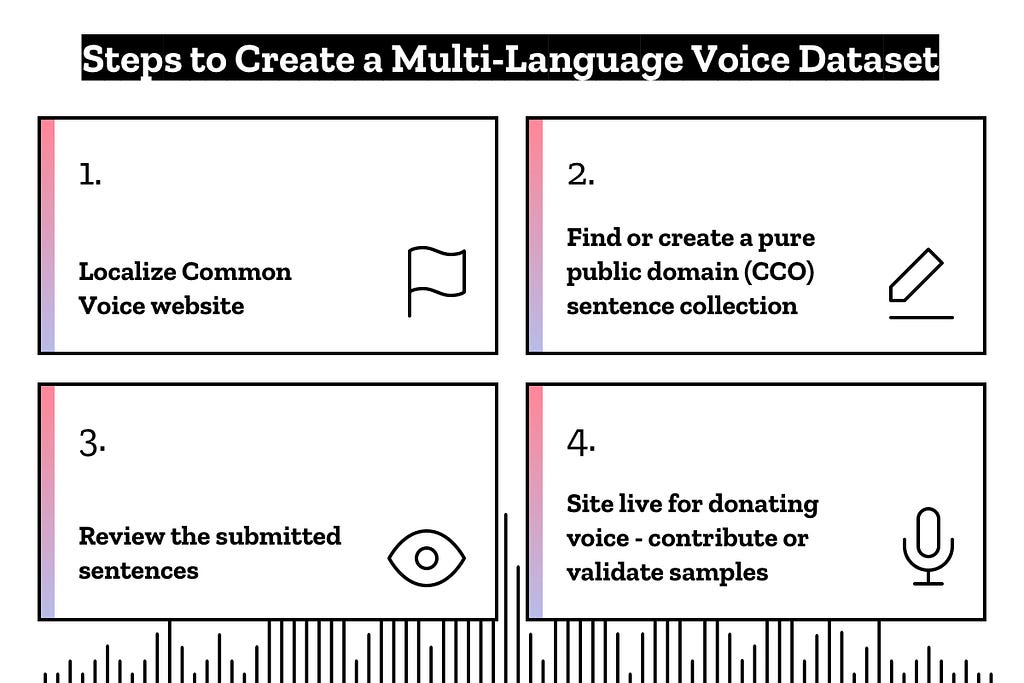
In addition to localizing the website, these communities are populating Common Voice with copyright-free sentences for people to read that have the required characteristics for a high quality dataset. They are also helping promote the site in their countries, building a community of contributors, with the goal of growing the total number of hours of data available in each language.
In addition to English, we are now collecting voice samples in French, German and Welsh. And there are already more than 40 other languages on the way — not only big languages like Spanish, Chinese or Russian, but also smaller ones like Frisian, Norwegian or Chuvash. For us, these smaller languages are important because they are often under-served by existing commercial speech recognition services. And so by making this data available, we can empower entrepreneurs and communities to address this gap on their own.
Going multilingual marks a big step for Common Voice and we hope that it’s also a big step for speech technology in general. Democratizing voice technology will not only lower the barrier for global innovation, but also the barrier for access to information. Especially so for people who traditionally have had less of this access — for example, vision impaired, people who never learned to read, children, the elderly and many others.
We are thrilled to see the growing support we are getting to build the world’s largest public, multi-language voice dataset. You can help us grow it right now by donating your voice. You can also use the iOS app. If you would like to help bring Common Voice and speech technology to your language, visit our language page. And if you are part of an organization and have an idea for participating in this project, please get in touch (dchinniah@mozilla.com).
Our Forum gives more details on how to help, as well as being a great place to ask questions and meet the communities.
Special Thanks
We would like to thank our Speech Advisory Group, people who have been expert advisors and contributors to the Common Voice project:
- Francis Tyers — Assistant Professor of Computational Linguistics at Higher School of Economics in Moscow
- Gilles Adda — Speech scientist
- Thomas Griffiths —
We’re very proud to be announcing the next phase of the Common Voice project. It’s now available for contributors in three new languages, German, French and Welsh, with 40+ other languages on their way! But this is just the beginning. We want Common Voice to be a tool for any community to make speech technology available in their own language.
Speech interfaces are the next frontier for the Internet. Project Common Voice is our initiative to build a global corpus of open voice data to be used to train machine-learning algorithms to power the voice interfaces of the future. We believe these interfaces shouldn’t be controlled by a few companies as gatekeepers to voice-enabled services, and we want users to be understood consistently, in their own languages and accents.
As anyone who has studied the economics of the Internet knows, services chase money. And so it’s quite natural that developers and publishers seek to develop for the audience that will best reward their efforts. What we see as a consequence is an Internet that is heavily skewed towards English, in a world where English is only spoken by 20% of the global population, and only 5% natively. This is increasingly going to be an accessibility issue, as Wired noted last year, “Voice Is the Next Big Platform, Unless You Have an Accent”.
Inevitably, English is becoming a global language, spoken more and more widely, and this is a trend that was underway before the emergence of the Internet. However, the skew of Internet content to English is certainly accelerating this. And while global communications may be becoming easier, there is also a cultural wealth that we should preserve. Native languages provide a deeper shared cultural context, down to the level of influencing our thought patterns. This is a part of our humanity we surely wish to retain and support with technology. In doing so, we’re upholding a proud Mozilla tradition of enabling local ownership by a global community: Firefox is currently offered in 90 languages (and counting), powered by volunteers near you.
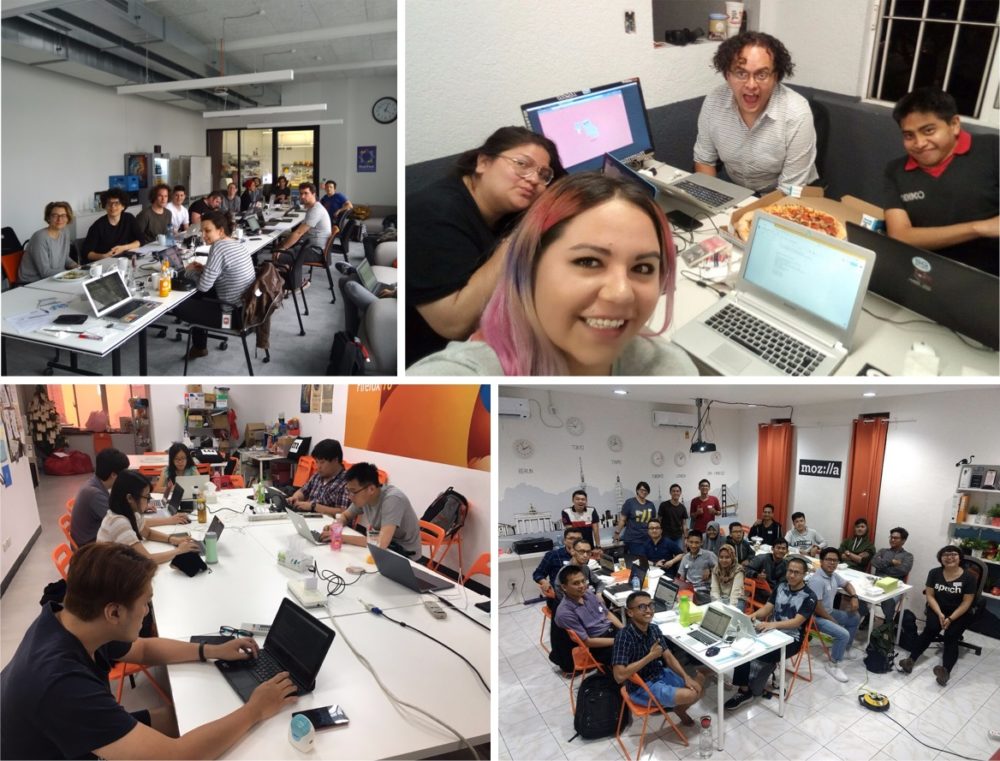
Common Voice contribution sprints in Berlin (credit: Michael Kohler), Mexico City (credit: Luis A. S'anchez), Jakarta (credit: Irayani Queencyputri) and Taipei (credit: Irvin Chen), from the top left to the bottom right
With Common Voice it’s the same volunteer passion that drives the project further and we’re grateful for all contributors who already said, “We want to help bringing speech recognition technology to my part of the world – what can we do?”. It is the underlying stories which also make this project so rewarding for me personally:
In Indonesia 20 community members came to our community space in Jakarta for a meet-up to write up sentences for the text corpus that will become the basis for voice recordings. They went into overdrive and submitted around 4,000 sentences within two days.
In Kenya a group of volunteers interested in Mozilla projects found out about Common Voice and started both localizing the website and submitting sentences in Swahili, Jibana and Kikiyu, all highly underrepresented languages, which we’re extremely happy to support. This is in addition to working with language experts in these communities like Laurent Besacier, the initiator of ALFFA, an interdisciplinary project bundling resources and expertise in speech analysis and speech technologies for African languages.
If we look at the country where I’m from, there has been one particular contributor to the Common Voice github project since the very early days. He originally contributed to the English effort, but he is German and wanted to see Common Voice come to Germany. He set himself on a strict schedule, wrote a few sentences every day for the next 6 months (while commuting to school or work), and collected 11,000 (!) sentences, ranging from poetry to day-to-day conversations.
Speaking of which: Another German contributor joined the Global Sprint in our Berlin office, utterly frustrated about a lengthy but fruitless discussion at the post office (Sounds
the following changes have been pushed to bugzilla.mozilla.org:
- [1430905] Remove legacy phabbugz code that is no longer needed
- [1466159] crash graph is wrong
- [1466122] Change “Reviews Requested of You” to show results are from Phabricator and not from BMO
- [1465889] form.dev-engagement-event field should be red instead of black
discuss these changes on mozilla.tools.bmo.
https://dlawrence.wordpress.com/2018/06/06/happy-bmo-push-day-44/
 The Bugzilla Project Developers meeting.
For a long time Mozilla’s JS team and others have been using https://arewefastyet.com to track the JS engine performance against various benchmarks.
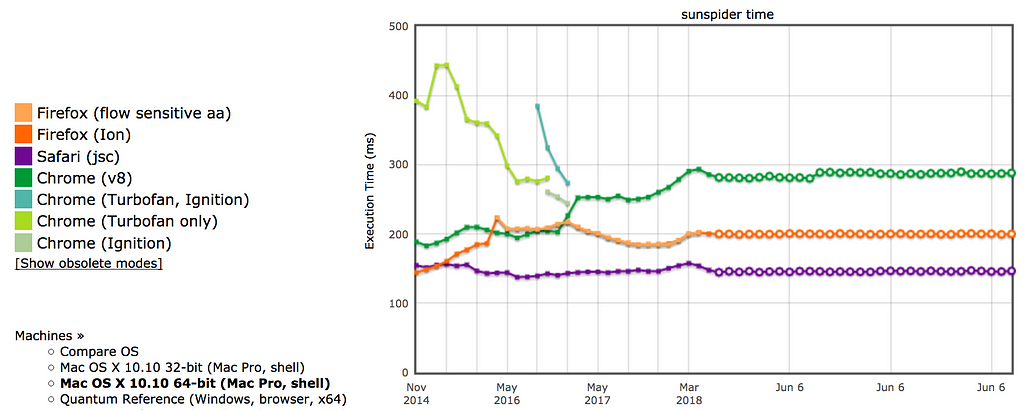
In the last little while, there’s been work moving those benchmarks to another continuous integration system and we have the metrics in Mozilla’s Perfherder. This rewrite will focus on using the new generated data.
If you’re curious on the details about the UI refresh please visit this document. Feel free to add feedback. Stay tuned for an update next month.
http://feedproxy.google.com/~r/armenzg_mozilla/~3/-RW21RnGokw/arewefastyet-ui-refresh-328129d21742
 mconley livehacks on real Firefox bugs while thinking aloud.
 This is the SUMO weekly call
The Engineering Workflow team at Mozilla is happy to announce that Phabricator and Lando are now ready for use with mozilla-central! This represents about a year of work integrating Phabricator with our systems and building out Lando.
There are more details in my post to the dev.platform list.
https://mrcote.info/blog/2018/06/06/phabricator-and-lando-launched/
Choices matter. That might sound flippant or obvious, but we’re not just talking about big, life-changing decisions. Little choices — daily choices — add up in a big way, online and off. This is … Read more
The post A Socially Responsible Way to Internet appeared first on The Firefox Frontier.
https://blog.mozilla.org/firefox/a-socially-responsible-way-to-internet/
A little while back, I wrote a piece outlining the case for the total abolition (or non-introduction) of software patents, as seen through the lens of “promoting innovation”. Few of the arguments are new, but the “Narrow Road to Patent Goodness” presentation of the information is quite novel as far as I know, and may form a good basis for anyone trying to explain all the possible problems with software (or other) patents.
You can find it on my website.
http://feedproxy.google.com/~r/HackingForChrist/~3/l_llzOl9qGo/
Just a quick announcement that the first “production-ready” version of Mission Control just went live yesterday, at this easy-to-remember URL:
https://missioncontrol.telemetry.mozilla.org
For those not yet familiar with the project, Mission Control aims to track release stability and quality across Firefox releases. It is similar in spirit to arewestableyet and other crash dashboards, with the following new and exciting properties:
- Uses the full set of crash counts gathered via telemetry, rather than the arbitrary sample that users decide to submit to crash-stats
- Results are available within minutes of ingestion by telemetry (although be warned initial results for a release always look bad)
- The denominator in our crash rate is usage hours, rather than the probably-incorrect calculation of active-daily-installs used by arewestableyet (not a knock on the people who wrote that tool, there was nothing better available at the time)
- We have a detailed breakdown of the results by platform (rather than letting Windows results dominate the overall rates due to its high volume of usage)
In general, my hope is that this tool will provide a more scientific and accurate idea of release stability and quality over time. There’s lots more to do, but I think this is a promising start. Much gratitude to kairo, calixte, chutten and others who helped build my understanding of this area.
The dashboard itself an easier thing to show than talk about, so I recorded a quick demonstration of some of the dashboard’s capabilities and published it on air mozilla:
https://wlach.github.io/blog/2018/06/mission-control-1-0?utm_source=Mozilla&utm_medium=RSS