This post is cross-posted from Matthew Gaudet’s blog
When implementing a language feature for JavaScript, an implementer must make decisions about how the language in the specification maps to the implementation. Sometimes this is fairly simple, where the specification and implementation can share much of the same terminology and algorithms. Other times, pressures in the implementation make it more challenging, requiring or pressuring the implementation strategy diverge to diverge from the language specification.
Private fields is an example of where the specification language and implementation reality diverge, at least in SpiderMonkey– the JavaScript engine which powers Firefox. To understand more, I’ll explain what private fields are, a couple of models for thinking about them, and explain why our implementation diverges from the specification language.
Private Fields
Private fields are a language feature being added to the JavaScript language through the TC39 proposal process, as part of the class fields proposal, which is at Stage 4 in the TC39 process. We will ship private fields and private methods in Firefox 90.
The private fields proposal adds a strict notion of ‘private state’ to the language. In the following example, #x may only be accessed by instances of class A:
class A {
  #x = 10;
}
This means that outside of the class, it is impossible to access that field. Unlike public fields for example, as the following example shows:
class A {
  #x = 10; // Private field
  y = 12; // Public Field
}
sf;
var a = new A();
a.y; // Accessing public field y: OK
a.#x; // Syntax error: reference to undeclared private field
Even various other tools that JavaScript gives you for interrogating objects are prevented from accessing private fields (i.e. Object.getOwnProperty{Symbols,Names} don’t list private fields; there’s no way to use Reflect.get to access them).
A Feature Three Ways
When talking about a feature in JavaScript, there are often three different aspects in play: The mental model, the specification, and the implementation.
The mental model provides the high level thinking that we expect programmers to use mostly. The specification in turn provides the detail of the semantics required by the feature. The implementation can look wildly different from the specification text, so long as the specification semantics are maintained.
These three aspects shouldn’t produce different results for people reasoning through things (though, sometimes a ‘mental model’ is shorthand, and doesn’t accurately capture semantics in edge case scenarios).
We can look at private fields using these three aspects:
Mental Model
The most basic mental model one can have for private fields is what it says on the tin: fields, but private. Now, JS fields become properties on objects, so the mental model is perhaps ‘properties that can’t be accessed from outside the class’.
However, when we encounter proxies, this mental model breaks down a bit; trying to specify the semantics for ‘hidden properties’ and proxies is challenging (what happens when a Proxy is trying to provide access control to a properties, if you aren’t supposed to be able see private fields with Proxies? Can subclasses access private fields? Do private fields participate in prototype inheritance?) . In order to preserve the desired privacy properties an alternative mental model became the way the committee thinks about private fields.
This alternative model is called the ‘WeakMap’ model. In this mental model you imagine that each class has a hidden
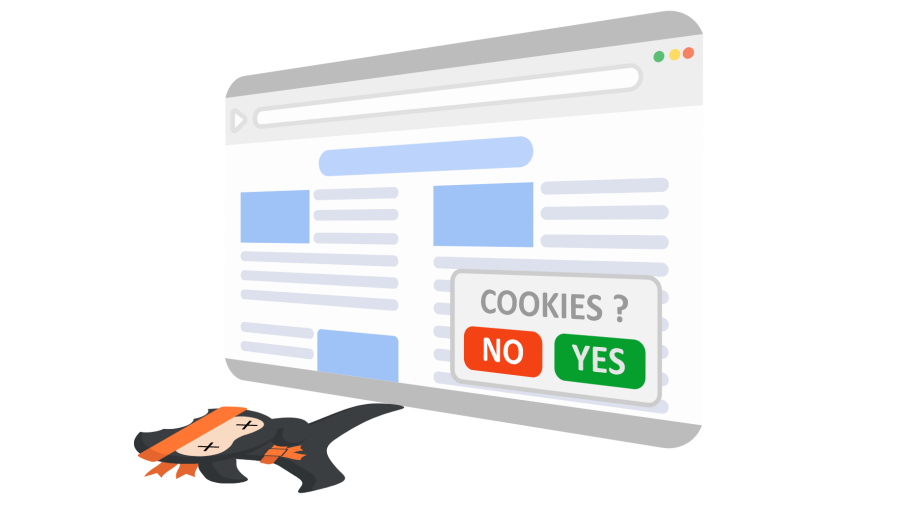
The cookie consent screens are really annoying. They attempt to trick you into accepting all cookies, dismissing them without agreeing is made intentionally difficult. A while back I wrote on Twitter than I’m almost at the point of writing a private browser extension to automate the job. And somebody recommended Ninja Cookie extension to me, which from the description seemed perfect for the job.
Now I am generally wary of extensions that necessarily need full access to every website. This is particularly true if these extensions have to interact with the websites in complicated ways. What are the chances that this is implemented securely? So I took a closer look at Ninja Cookie source code, and I wasn’t disappointed. I found several issues in the extension, one even allowing any website to execute JavaScript code in the context of any other website (Universal XSS).
As of Ninja Cookie 0.7.0, the Universal XSS vulnerability has been resolved. The other issues remain however, these are exploitable by anybody with access to the Ninja Cookie download server (ninja-cookie.gitlab.io). This seems to be the reason why Mozilla Add-ons currently only offers the rather dated Ninja Cookie 0.2.7 for download, newer versions have been disabled. Chrome Web Store still offers the problematic extension version however. I didn’t check whether extension versions offered for Edge, Safari and Opera browsers are affected.
Contents
How does the extension work?
When it comes to cookie consent screens, the complicating factor is: there are way too many. While there are some common approaches, any given website is likely to be “special” in some respect. For my private extension, the idea was having a user interface to create site-specific rules, so that at least on websites I use often things were covered. But Ninja Cookie has it completely automated of course.
So it will download several sets of rules from ninja-cookie.gitlab.io. For example, cmp.json currently contains the following rule:
"cmp/admiral": {
  "metadata": {
    "name": "Admiral",
    "website": "https://www.getadmiral.com/",
    "iab": "admiral.mgr.consensu.org"
  },
  "match": [{
    "type": "check",
    "selector": "[class^='ConsentManager__']"
  }],
  "required": [{
    "type": "cookie",
    "name": "euconsent",
    "missing": true
  }],
  "action": [{
    "type": "hide"
  }, {
    "type": "css",
    "selector": "html[style*='overflow']",
    "properties": {
      "overflow": "unset"
    }
  }, {
    "type": "css",
    "selector": "body[style*='overflow']",
    "properties": {
"overflow": Firefox will ship Private Fields and Methods in Firefox 90. This new language syntax allows programmers to have strict access control over their class internals. A private field can only be accessed by code inside the class declaration.
class PrivateDetails {
  #private_data = "I shouldn't be seen by others";

  #private_method { return "private data" }

  useData() {
    /.../.test(this.#private_data);

    var p = this.#private_method();
  }
}

var p = new PrivateDetails();
p.useData(); // OK
p.#private_data; // SyntaxError
This is the last remaining piece of the Stage 4 Proposal, Class field declarations for JavaScript, which has many more details about the design of private data.
https://spidermonkey.dev/blog/2021/05/03/private-fields-ship.html
On April 28th, Mozilla successfully launched its VPN Client in two new countries: Germany and France. While the VPN Client has been available since 2020 in several countries (U.S., U.K., Canada, New Zealand, Singapore, and Malaysia), the user interface was only available in English.
This blog post describes the process and steps needed to make this type of product localizable within the Mozilla ecosystem.

How It Begins
Back in October 2020, the small team working on this project approached me with a request: we plan to do a complete rewrite of the existing VPN Client with Qt, using one codebase for all platforms, and we want to make it localizable. How can we make it happen?
First of all, let me stress how important it is for a team to reach out as early as possible. That allows us to understand existing limitations, explain what we can realistically support, and set clear expectations. It’s never fun to find yourself backed in a corner, late in the process and with deadlines approaching.
Initial Localization Setup
This specific project was definitely an interesting challenge, since we didn’t have any prior experience with Qt, and we needed to make sure the project could be supported in Pontoon, our internal Translation Management System (TMS).
The initial research showed that Qt natively uses an XML format (TS File), but that would have required resources to write a parser and a serializer for Pontoon. Luckily, Qt also supports import and export from a more common standard, XLIFF.
The next step is normally to decide how to structure the content: do we want the TMS to write directly in the main repository, or do we want to use an external repository exclusively for l10n? In this case, we opted for the latter, also considering that the main repository was still private at the time.
Once settled on the format and repository structure, the next step is to do a full review of the existing content:
- Check every string for potential localizability issues.
- Add comments where the content is ambiguous or there are variables replaced at run-time.
- Check consistency issues in the en-US content, in case the content hasn’t been reviewed or created by our very capable Content Team.
It’s useful to note that this process heavily depends on the Localization Project Manager assigned to a project, because there are different skill sets in the team. For example, I have a very hands-on approach, often writing patches directly to fix small issues like missing comments (that normally helps reducing the time needed for fixes).
In my case, this is the ideal approach:
- After review, set up the project in Pontoon as a private project (only accessible to admins).
- Actually translate the project into Italian. That allows me to verify that everything is correctly set up in Pontoon and, more importantly, it allows me to identify issues that I might have missed in the initial review. It’s amazing how differently your brain works when you’re just looking at content, and when you’re actually trying to translate it.
- Test a localized build of the product. In this way I can verify that we are able to use the output of our TMS, that the build system works as expected, and that there are no errors (hard-coded content, strings reused in different contexts, etc.).
This whole process typically requires at least a couple of weeks, depending on how many other projects are active at the same time.
Scale and Automate
I’m a huge fan of automation when it comes to getting rid of repetitive tasks, and I’ve come to learn a lot about GitHub Actions working on this project. Luckily, that knowledge helped in several other projects later on.
The first thing I noticed is that I was often commenting on two issues on the source (en-US) strings: typographic issues (straight quotes, 3 dots instead of ellipsis), lack of comments when a string has variables. So I wrote a very basic linter that runs in automation every time a developer adds new strings in a pull request.
The
In the curl project we make great efforts to store a lot of meta data about each and every vulnerability that we have fixed over the years – and curl is over 23 years old. This data set includes CVE id, first vulnerable version, last vulnerable version, name, announce date, report to the project date, CWE, reward amount, code area and “C mistake kind”.
We also keep detailed data about releases, making it easy to look up for example release dates for specific versions.
Dashboard
All this, combined with my fascination (some would call it obsession) of graphs is what pushed me into creating the curl project dashboard, with an ever-growing number of daily updated graphs showing various data about the curl projects in visual ways. (All scripts for that are of course also freely available.)
What to show is interesting but of course it is sometimes even more important how to show particular data. I don’t want the graphs just to show off the project. I want the graphs to help us view the data and make it possible for us to draw conclusions based on what the data tells us.
Vulnerabilities
The worst bugs possible in a project are the ones that are found to be security vulnerabilities. Those are the kind we want to work really hard to never introduce – but we basically cannot reach that point. This special status makes us focus a lot on these particular flaws and we of course treat them special.
For a while we’ve had two particular vulnerability graphs in the dashboard. One showed the number of fixed issues over time and another one showed how long each reported vulnerability had existed in released source code until a fix for it shipped.
CVE age in code until report
The CVE age in code until report graph shows that in general, reported vulnerabilities were introduced into the code base many years before they are found and fixed. In fact, the all time average time suggests they are present for more than 2,700 – more than seven years. Looking at the reports from the last 12 months, the average is even almost 1000 days more!
It takes a very long time for vulnerabilities to get found and reported.

When were the vulnerabilities introduced
Just the other day it struck me that even though I had a lot of graphs already showing in the dashboard, there was none that actually showed me in any nice way at what dates we created the vulnerabilities we spent so much time and effort hunting down, documenting and talking about.
I decided to use the meta data we already have and add a second plot line to the already existing graph. Now we have the previous line (shown in green) that shows the number of fixed vulnerabilities bumped at the date when a fix was released.
Added is the new line (in red) that instead is bumped for every date we know a vulnerability was first shipped in a release. We know the version number from the vulnerability meta data, we know the release date of that version from the release meta data.
This all new graph helps us see that out of the current 100 reported vulnerabilities, half of them were introduced into the code before 2010.
Using this graph it also very clear to me that the increased CVE reporting that we can spot in the green line started to accelerate in the project in 2016 was not because the bugs were introduced then. The creation of vulnerabilities rather seem to be fairly evenly distributed over time – with occasional bumps but I think that’s more related to those being particular releases that introduced a larger amount of features and code.
As the average vulnerability takes 2700 days to get reported, it could indicate that flaws landed since 2014 are too young to have gotten reported yet. Or it could mean that we’ve improved over time so that new code is better than old and thus when we find flaws, they’re more likely to be in old code paths… I don’t think the red graph suggests any particular notable improvement over time though. Possibly it does if we take into account the massive code growth we’ve also had over this time.
The green “fixed” line at least has a much better trend
 [294x440]
In my previous post, I introduced the concept of a Personal Digital Habitat (PDH) which I defined as: a federated multi-device information environment within which a person routinely dwells. If you haven’t read that post, you should do so before continuing.
That previous post focused on the experience of using a PDH. It established a vision of a new way to use and interact with our personal collections of computing devices. Hopefully it is an attractive vision. But, how can we get from where we are today to a world where we all have our own comfortable digital habitat?
A PDH provides a new computing experience for its inhabitant.1 Historically, a new computing experience has resulted in the invention of new operating systems to support that experience—timesharing, GUI-based personal computing, touch-based mobile computing, cloud computing all required fundamental operating system reinvention. To fully support the PDH vision we will ultimately need to reinvent again and create operating systems that manage a federated multi-device PDH rather than a single computing device.
An OS is a complex layered collection of resource managers that control the use of the underlying hardware and services that provide common capabilities to application programs. Operating systems were originally developed to minimize waste of scarce expensive “computer time.” Generally, that is no longer a problem. Today it is more important to protect our digital assets and to minimize wasting scarce human attention.
Modern operating systems are seldom built up from scratch. More typically new operating systems evolve from existing ones2 through the addition (and occasional removal) of resource managers and application service layers in support of new usage models. A PDH OS will likely be built by adding new layers upon an existing operating system.
You might imagine a group of developers starting a project today to create a PDH OS. Such an effort would almost certainly fail. The problem is that we don’t yet understand the functionality and inhabitant experience of a PDH and hence we don’t really know which OS resource managers and service layers need to be implemented.
Before we will know enough to build a PDH OS we need to experience building PDH applications. Is this a chicken or egg problem? Not really. A habitat-like experience can be defined and implemented by an individual application that supports multiple devices—but the application will need to provide its own support for the managers and services that it needs. It is by building such applications that we will begin to understand the requirements for a PDH OS.
Some developers are already doing something like this today as they build applications that are designed to be local-first or peer-to-peer dWeb/Web 3 based or that support collaboration/multi-user sync. Much of the technology applicable to those initiatives is also useful for building self-contained PDH applications.
If you are an application developer who finds the PDH concept intriguing, here is my recommendation. Don’t wait! Start designing your apps in a habitat-first manner and thinking of your users as app inhabitants. For your next application don’t just build another single device application that will be ported or reimplemented on various phone, tablet, desktop, and web platforms. Instead, start from the assumption that your application’s inhabitant will be simultaneously running it on multiple devices and that they deserve a habitat-like experience as they rapidly switch their attention among devices. Design that application experience, explore what technologies are available that you can leverage to provide it, and then implement it for the various types of platforms. Make the habitat-first approach your competitive advantage.
If you have comments or question tweet them mentioning @awbjs. I first starting talking about personal digital habitats in a twitter thread on March 22, 2021. That and subsequent twitter threads in March/April 2021 include interesting discussions of technical approaches to PDHs.
Today, Mozilla joins Fastly, Intel, and Microsoft in announcing the incorporation and expansion of the Bytecode Alliance, a cross-industry partnership to advance a vision for fast, secure, and simplified software development based on WebAssembly.
Building software today means grappling with a set of vexing trade-offs. If you want to build something big, it’s not realistic to build each component from scratch. But relying on a complex supply chain of components from other parties allows a defect anywhere in that chain to compromise the security and stability of the entire program. Tools like containers can provide some degree of isolation, but they add substantial overhead and are impractical to use at per-supplier granularity. And all of these dynamics entrench the advantages of big companies with the resources to carefully manage and audit their supply chains.
Mozilla helped create WebAssembly to allow the Web to grow beyond JavaScript and run more kinds of software at faster speeds. But as it matured, it became clear that WebAssembly’s technical properties — particularly memory isolation — also had the potential to transform software development beyond the browser by resolving the tension described above. Several other organizations shared this view, and we came together to launch the Bytecode Alliance as an informal industry partnership in late 2019. As part of this launch, we articulated our shared vision and called for others to join us in bringing it to life.
That vision resonated with others, and we soon heard from many more organizations interested in joining the Alliance. However, it was clear that our informal structure would not scale adequately, and so we asked prospective members to be patient and, in parallel with ongoing technical efforts, worked to incorporate the Alliance as a formal 501(c)(6) organization. That process is now complete, and we’re thrilled to welcome Arm, DFINITY Foundation, Embark Studios, Google, Shopify, and University of California at San Diego as official members of the Bytecode Alliance. We aim to continue growing the Alliance in the coming months, and encourage other like-minded organizations to apply.
We have a real opportunity to change how software is built, and in doing so, enable small teams to build big things that are both secure and fast. Achieving the elusive trifecta — easy composition, defect isolation, and high performance — requires both the right technology and a coordinated effort across the ecosystem to deploy it in the right way. Mozilla believes that WebAssembly has the right technical ingredients to build a better, more secure Internet, and that the Bytecode Alliance has the vision and momentum to make it happen.
The post Growing the Bytecode Alliance appeared first on The Mozilla Blog.
https://blog.mozilla.org/blog/2021/04/28/growing-the-bytecode-alliance/
If you have updated Firefox recently, you may have noticed that Take a Screenshot is missing from the page actions menu. Don’t fret. The feature is still in Firefox; it has just been moved.

Here’s how to find it…


You now have a button to take screenshots.
Of course, you can always right-click within a webpage and Take Screenshot will be part of the menu.

https://ilias.ca/blog/2021/04/the-screenshot-option-in-firefox-has-moved-heres-how-to-find-it/
Last time we looked at some ways reviewers can keep the review process moving efficiently. This week, let’s put on our author hats and do the same thing.
https://ahal.ca/blog/2021/phabricator-etiquette-part-2-the-author/
Any time India comes up in the context of Firefox and Data I know it’s going to be an interesting day.
They’re our largest Beta population:

They’re our second-largest English user base (after the US):

But this is the interesting stuff about India that you just take for granted in Firefox Data. You come across these factoids for the first time and your mind is all blown and you hear the perhaps-apocryphal stories about Indian ISPs distributing Firefox Beta on CDs to their customers back in the Firefox 4 days… and then you move on. But every so often something new comes up and you’re reminded that no matter how much you think you’re prepared, there’s always something new you learn and go “Huh? What? Wait, what?!”
Especially when it’s India.
One of the facts I like to trot out to catch folks’ interest is how, when we first released the Canadian English localization of Firefox, India had more Canadians than Canada. Even today India is, after Canada and the US, the third largest user base of Canadian English Firefox:

Back in September 2018 Mozilla released the official Canadian English-localized Firefox. You can try it yourself by selecting it from the drop down menu in Firefox’s Preferences/Options in the “Language” section. You may have to click ‘Search for More Languages’ to be able to add it to the list first, but a few clicks later and you’ll be good to go, eh?
(( Or, if you don’t already have Firefox installed, you can select which language and dialect of Firefox you want from this download page. ))
Anyhoo, the Canadian English locale quickly gained a chunk of our install base:

…actually, it very quickly gained an overlarge chunk of our install base. Within a week we’d reached over three quarters of the entire Canadian user base?! Say we have one million Canadian users, that first peak in the chart was over 750k!
Now, we Canadian Mozillians suspected that there was some latent demand for the localized edition (they were just too polite to bring it up, y’know)… but not to this order of magnitude.
So back around that time a group of us including :flod, :mconnor, :catlee, :Aryx, :callek (and possibly others) fell down the rabbit hole trying to figure out where these Canadians were coming from. We ran down the obvious possibilities first: errors in data, errors in queries, errors in visualization… who knows, maybe I was counting some clients more than once a day? Maybe I was counting other Englishes (like South African and Great Britain) as well? Nothing panned out.
Then we guessed that maybe Canadians in Canada weren’t the only ones interested in the Canadian English localization. Originally I think we made a joke about how much Canadians love to travel, but then the query stopped running and showed us just how many Canadians there must be in India.
We were expecting a fair number of Canadians in the US. It is, after all, home to Firefox’s largest user base. But India? Why would India have so many Canadians? Or, if it’s not Canadians, why would Indians have such a preference for the English spoken in ten provinces and three territories? What is it about one of two official languages spoken from sea to sea to sea that could draw their attention?
Another thing that was puzzling was the raw speed of the uptake. If users were choosing the new localization themselves, we’d have seen a shallow curve with spikes as various news media made announcements or as we started promoting it ourselves. But this was far sharper an incline. This spoke to some
Individuals’ security and privacy on the internet are fundamental. Living up to that principle we are announcing the following changes to Mozilla’s Root Store Policy (MRSP) which will come into effect on May 1, 2021.
These updates to the Root Store Policy will not only improve our compliance monitoring, but also improve Certificate Authority (CA) practices and reduce the number of errors that CAs make when they issue new certificates. As a result, these updates contribute to a healthy security ecosystem on the internet and will enhance security and privacy to all internet users.
Living up to our mission and truly working in the open source community has led, after weeks of public exchange, to the following improvements to the MRSP. Please find a detailed comparison of the policy changes here – summing it up:
- Beginning on October 1, 2021, CAs must verify domain names and IP addresses within 398 days prior to certificate issuance. (MRSP § 2.1)
- Clarified that EV audits are required for root and intermediate certificates that are capable of issuing EV certificates, rather than being based on CA intentions. (MRSP § 3.1.2)
- Clearly specified that annual audit statements are required “cradle-to-grave” – from CA key pair generation until the root certificate is no longer trusted by Mozilla’s root store. (MRSP § 3.1.3)
- Added a requirement that audit team qualifications be provided when audit statements are provided. (MRSP § 3.2)
- Specified that Audit Reports must now include a list of incidents, and also indicate which CA locations were and were not audited (MRSP § 3.1.4 items 11 and 12).
- Clarified when a certificate is deemed to directly or transitively chain to a CA certificate included in Mozilla’s program, which affects when the CA must provide audit statements for the certificate. (MRSP § 5.3)
- Added a requirement that Section 4.9.12 of a CA’s CP/CPS MUST clearly specify the methods that may be used to demonstrate private key compromise. (MRSP § 6)
Many of these changes will result in updates and improvements in the processes of CAs and auditors and cause them to revise their practices. To ease transition, Mozilla has sent a CA Communication to alert CAs about these changes. We also sent CAs a survey asking them to indicate when they will be able to reach full compliance with this version of the MRSP.
In summary, updating the Root Store Policy improves the security ecosystem on the internet and the quality of every HTTPS connection, thus helping to keep your information private and secure.
The post Upgrading Mozilla’s Root Store Policy to Version 2.7.1 appeared first on Mozilla Security Blog.
During last week’s Apple event, the team announced a lot of new products and a new iPhone color, but the news that can have the biggest impact on all iPhone … Read more
The post Mozilla Explains: What is IDFA and why is this iOS update important? appeared first on The Firefox Frontier.
https://blog.mozilla.org/firefox/turn-off-idfa-for-apps-apple-ios-14-5/
My week is very scheduled, so I am not able to host any public drafting sessions this week – however, Ryan Levick will be hosting two sessions!
| When | Who |
|---|---|
| Wed at 07:00 ET | Ryan |
| Fri at 07:00 ET | Ryan |
If you’re available and those stories sound like something that interests you, please join him! Just ping me or Ryan on Discord or Zulip and we’ll send you the Zoom link. If you’ve already joined a previous session, the link is the same as before.
Extending the schedule by two weeks
We have previously set 2021-04-30 as the end-date, but I proposed in a recent PR to extend that end date to 2021-05-14. We’ve been learning how this whole vision doc thing works as we go, and I think it seems clear we’re going to want more time to finish off status quo stories and write shiny future before we feel we’ve really explored the design space.
The vision…what?
Never heard of the async vision doc? It’s a new thing we’re trying as part of the Async Foundations Working Group:
We are launching a collaborative effort to build a shared vision document for Async Rust. Our goal is to engage the entire community in a collective act of the imagination: how can we make the end-to-end experience of using Async I/O not only a pragmatic choice, but a joyful one?
Read the full blog post for more.
http://smallcultfollowing.com/babysteps/blog/2021/04/26/async-vision-doc-writing-sessions-vii/