Hello, present and future Mozillians!
We are continuing our series of mid-year posts regarding the state and future of Mozilla Support. If you missed the previous posts, part one and part two are still online. This time we are going to talk a bit more about (Support) Localization and the plans for the second half of the year.
Over the years, localizer activity on the Support site went up and down, influenced by Firefox popularity, new released on different platforms, and general localization needs across Mozilla. Peaking at over 200 people around three years ago, it is now oscillating at 40-50% of that number.
While Mozilla keep continuously shipping new Firefox releases and experimenting with new ideas, the global audience will keep increasing in numbers and languages – and we want to make sure that the site stays relevant and informative to as many users out there as possible.
Design update of the site
The Support site has long been overdue to get a facelift that would make it on par with the modern and clean look of mozilla.org. Recently, we have seen the first (preview & github issue) steps towards that.
At the moment, the preview is not fully localized, but once the updated English wording and new layout are finalized, we will be promoting
You could argue that this is only tangentially related to localization, but it may actually have a significant impact on the site’s usability for speakers of different languages. Therefore, reporting any issues found on the non-English versions of the site is very important for a successful visual refresh of support.mozilla.org. We will also keep tracking site usage and interactions by users around the globe to make sure the changes have not negatively impacted site traffic.
Knowledge Base clean-up
With over 700 individual pieces of content in the Knowledge Base at the moment of writing, it is one of the biggest repositories of useful product information around Mozilla – and probably the most useful one for users of Firefox (and not only) around the world.
Changes to Mozilla’s product strategy and line-up have naturally affected the Knowledge Base and its localization profile over time. Experiments or projects become products, products become obsolete, etc. – and the content we present to the users should be displayed accordingly and evolve with the changes.
This means you can expect (or have already seen) some content going away into the archive (we do our best never to delete anything) – and new products or projects popping up as well. One of the bigger near future additions to the Knowledge Base, for example, will be the Pocket support content, at the moment hosted here.
Locale clean-up
Similarly to products, languages come and go, by popularity. While we do aim to maintain as many languages available as possible, very often the amount of content to be localized across Mozilla is already a big challenge for smaller communities around the world. You can read more about the idea and reasons behind it here. As of the writing of this post:
Locales with a “Top 100” goal before the end of 2018
Bengali
Hindi
Gujarati
Bosnian
Slovak
Arabic
Tamil
Telugu
Locales that need wider community support to not be archived before the end of 2018
Albanian
Greek
Thai
Yoruba
Locales that will be archived before the end of 2018
Hebrew
Estonian
Croatian
Kazakh
Norwegian
Romanian
Vietnamese
Serbian
Sorbian (Lower/Upper)
Euskara
Gaelic
Lithuanian
Malay
Swahili
Localization request & community communication optimization
At the moment, because of the distributed nature of product development, marketing, and support, almost all of the requests for each of those separate areas come separately and are not reviewed or prioritized as a unified part of internationalization efforts at Mozilla.
This localization “request firehose” may work for separate teams or tools, but definitely does not make it easier for localization coordinators and localizers in distributed communities. Missing a single “source of truth” for localization needs for each bigger release or project introduces confusion, false expectations, and difficulties in organizing local communities around localization sprints.
Optimizing the way localization requests are filed (including new or updated Support content) through a unified process should, in turn, make it easier for localization coordinators to message
Back in 2015, I implemented a feature in Mercurial 3.6 that allows
servers to advertise URLs of pre-generated bundle files. When a
compatible client performs a hg clone against a repository leveraging
this feature, it downloads and applies the bundle from a URL then goes
back to the server and performs the equivalent of an hg pull to obtain
the changes to the repository made after the bundle was generated.
On hg.mozilla.org, we've been using this feature since 2015. We host bundles in Amazon S3 and make them available via the CloudFront CDN. We perform IP filtering on the server so clients connecting from AWS IPs are served S3 URLs corresponding to the closest region / S3 bucket where bundles are hosted. Most Firefox build and test automation is run out of EC2 and automatically clones high-volume repositories from an S3 bucket hosted in the same AWS region. (Doing an intra-region transfer is very fast and clones can run at >50 MB/s.) Everyone else clones from a CDN. See our official docs for more.
I last reported on this feature in October 2015. Since then, Bitbucket also deployed this feature in early 2017.
I was reminded of this clone bundles feature this week when kernel.org posted Best way to do linux clones for your CI and that post was making the rounds in my version control circles. tl;dr git.kernel.org apparently suffers high load due to high clone volume against the Linux Git repository and since Git doesn't have an equivalent feature to clone bundles built in to Git itself, they are asking people to perform equivalent functionality to mitigate server load.
(A clone bundles feature has been discussed on the Git mailing list before. I remember finding old discussions when I was doing research for Mercurial's feature in 2015. I'm sure the topic has come up since.)
Anyway, I thought I'd provide an update on just how valuable the clone bundles feature is to Mozilla. In doing so, I hope maintainers of other version control tools see the obvious benefits and consider adopting the feature sooner.
In a typical week, hg.mozilla.org is currently serving ~135 TB of data. The overwhelming majority of this data is related to the Mercurial wire protocol (i.e. not HTML / JSON served from the web interface). Of that ~135 TB, ~5 TB is served from the CDN, ~126 TB is served from S3, and ~4 TB is served from the Mercurial servers themselves. In other words, we're offloading ~97% of bytes served from the Mercurial servers to S3 and the CDN.
If we assume this offloaded ~131 TB is equally distributed throughout the week, this comes out to ~1,732 Mbps on average. In reality, we do most of our load from California's Sunday evenings to early Friday evenings. And load is typically concentrated in the 12 hours when the sun is over Europe and North America (where most of Mozilla's employees are based). So the typical throughput we are offloading is more than 2 Gbps. And at a lower level, automation tends to perform clones soon after a push is made. So load fluctuates significantly throughout the day, corresponding to when pushes are made.
By volume, most of the data being offloaded is for the mozilla-unified Firefox repository. Without clone bundles and without the special stream clone Mercurial feature (which we also leverage via clone bundles), the servers would be generating and sending ~1,588 MB of zstandard level 3 compressed data for each clone of that repository. Each clone would consume ~280s of CPU time on the server. And at ~195,000 clones per month, that would come out to ~309 TB/mo or ~72 TB/week. In CPU time, that would be ~54.6 million CPU-seconds, or ~21 CPU-months. I will leave it as an exercise to the reader to attach a dollar cost to how much it would take to operate this service without clone bundles. But I will say the total AWS bill for our S3 and CDN hosting for this service is under $50 per month. (It is worth noting that intra-region data transfer from S3 to other AWS services is free. And we are definitely taking advantage of that.)
Despite a significant increase in the size of the Firefox repository and clone volume of it since 2015, our servers are still performing less work (in terms
In the continuing death march of Spectre side-channel variants for stealing data, all of the known attacks thus far have relied upon code running locally on the computer (so don't run sketchy programs, which have much better ways of pwning your Power Mac than slow and only occasionally successful data leaks). As you'll recall, it is possible for Spectre to succeed on the G5 and 7450 G4e, but not on the G3 and 7400.
The next generation is making Spectre go remote, and while long hypothesized it was never demonstrated until the newest, uh, "advance" called NetSpectre (PDF). The current iteration comes in two forms.
The first and more conventional version is like Spectre in that it relies on CPU cache timing. A victim application would have to have something called a "leak gadget," similar to the one in Spectre where network-facing code processes some network packet with a condition that's usually true and sets a flag based on a data bit of interest in memory. The processor, after enough training by the attacker, then is induced to mispredict, which means the flag is now in the cache even though it never observably changed. This could be done as with the example in the paper, where an attacker sends packets with multiple normal bitstream lengths, training the predictor, and then suddenly sends one with an abnormal or out-of-bound one. The flag isn't actually set, but the misprediction caused it to be loaded into the CPU cache. Later on, the application executes a "transmit gadget" that uses that flag to do a network-observable operation. The flag is in the cache, so the transmit gadget runs just a little bit faster, and the attacker can infer that data bit.
This sounds very slow and error-prone, and it is. In fact, it would be even worse on our slower systems: besides the fact that it presupposes the machine is vulnerable to Spectre in the first place (G3 and 7400 systems don't seem to be), we would generate packets much slower than a modern system, meaning the attacker would have to wait even longer to differentiate a response and the difference between the flag being and not being in the cache is likely to be drowned out by the other code that needs to execute to generate a network response. Looking at the histogram for the ARM core they tested, which is more comparable to the PowerPC than an Intel CPU, there is substantial overlap between the '1' and '0'; if network latency intervenes, it could take literally millions of measurements to extract even a single bit. And that's assuming the attacker knows enough about the innards of your network-facing application (like TenFourFox, or what have you) to even know the memory location they're looking for. Even with that sizeable advantage, even when attacking a far faster computer over a local network, it took 30 minutes for the researchers to exfiltrate just a single byte of data. Under the most optimal conditions for such an attack, a Quad G5 would probably require several times longer; a 7450 would take longer still.
The researchers, however, recognized this and looked for other kinds of network-observable side channels that could be faster to work with than the CPU cache. The vast majority of modern CPUs these days have some sort of SIMD instruction set for working on big chunks of data at once. We have the 128-bit AltiVec (VMX) in Power Mac land on G4s and G5s, for example, and later Power ISA chips like the POWER9 have an extension called VSX; Intel for its part historically offered MMX and the SSE series of instructions all the way up to things like AVX2. AltiVec and VSX are pretty well-designed and reasonably power-efficient extensions but only work on 128 bits of data at once, whereas AVX2 was extended to 256 (AVX-512 even supports 512-bit registers). Intel's larger SIMD implementations require more power to run and the processor actually turns off the circuitry operating on the upper 128 bits of its AVX vector registers when they aren't needed. With that crucial bit of knowledge you can probably write the end of this paragraph already, but turning on the upper 128 bits is not instantaneous and can incur a noticeable penalty on execution if the upper bits aren't already activated. If you can get the processor to speculatively execute an AVX2 instruction operating on the upper bits based on the data bit of interest, you can then infer from how quickly that instruction executed what the data bit was, the execution time itself inferred from a later network-visible operation that also uses the AVX2 upper unit. The AVX2 upper unit cycles on and off with roughly a 1ms latency, an eternity in computing, but it requires very few network
If you are in the middle of a failed
Mercurial hg histedit, you can normally
do hg histedit --abort to cancel it, though sometimes you also have to
reach out for hg update -C. This is the equivalent of
git's git rebase --abort and it does what you'd
expect.
However, if you go ahead and finish the history rewriting and only notice
problems later, it's not as straighforward. With git, I'd look into the
reflog
(git reflog) for the previous value of the branch pointer and simply git
reset --hard to that value. Done.
Based on a Stack Overflow answer, I thought I could undo my botched histedit using:
hg unbundle ~/devel/mozilla-unified/.hg/strip-backup/47906774d58d-ae1953e1-backup.hg
but it didn't seem to work. Maybe it doesn't work when using bookmarks.
Here's what I ended up doing to fully revert my botched Mercurial histedit. If you know of a simpler way to do this, feel free to leave a comment.
Collecting the commits to restore
The first step was to collect all of the commits hashes I needed to restore. Luckily, I had sumitted my patch to Try before changing it and so I was able to look at the pushlog to get all of the commits at once.
If I didn't have that, I could also go to the last bookmark I pushed and click on parent commits until I hit the first one that's not mine. Then I could collect all of the commits using the browser's back button:
- https://hg.mozilla.org/users/fmarier_mozilla.com/mozilla-unified/rev/3c31c543e736
- https://hg.mozilla.org/users/fmarier_mozilla.com/mozilla-unified/rev/7ddfe5ae2fa6
- https://hg.mozilla.org/users/fmarier_mozilla.com/mozilla-unified/rev/c04b620136c7
- https://hg.mozilla.org/users/fmarier_mozilla.com/mozilla-unified/rev/2d1bf04fd155
- https://hg.mozilla.org/users/fmarier_mozilla.com/mozilla-unified/rev/e194843f5b7a
- https://hg.mozilla.org/users/fmarier_mozilla.com/mozilla-unified/rev/47906774d58d
- https://hg.mozilla.org/users/fmarier_mozilla.com/mozilla-unified/rev/f6a657bca64f
- https://hg.mozilla.org/users/fmarier_mozilla.com/mozilla-unified/rev/0d7a4e1c0079
- https://hg.mozilla.org/users/fmarier_mozilla.com/mozilla-unified/rev/976e25b49758
- https://hg.mozilla.org/users/fmarier_mozilla.com/mozilla-unified/rev/a1a382f2e773
- https://hg.mozilla.org/users/fmarier_mozilla.com/mozilla-unified/rev/b1565f3aacdb
- https://hg.mozilla.org/users/fmarier_mozilla.com/mozilla-unified/rev/3fdd157bb698
Back in March, we announced something new:
This year, we will deliver Rust 2018, marking the first major new edition of Rust since 1.0 (aka Rust 2015).
We will continue to publish releases every six weeks as usual. But we will designate a release in the latter third of the year (Rust 1.29 - 1.31) as Rust 2018. This new ‘edition’ of Rust will be the culmination of feature stabilization throughout the year, and will ship with polished documentation, tooling, and libraries that tie in to those features.
Now that some time has passed, we wanted to share more about what this actually means for Rust and Rust developers.
Language change over time
One of the key questions facing language developers is “how do you manage change over time”? How does that work for your users? We believe quite strongly that language stability is of utmost importance. A language is the foundation that you build your application on top of, and you cannot build reliable, long-living things on a foundation of sand. The very second post on our blog, way back in October of 2014, was “Stability as a Deliverable”. This laid out our plans for the six week release schedule that we still follow to this day. It also described how stability was important:
It’s important to be clear about what we mean by stable. We don’t mean that Rust will stop evolving. We will release new versions of Rust on a regular, frequent basis, and we hope that people will upgrade just as regularly. But for that to happen, those upgrades need to be painless.
We put in a lot of work to make upgrades painless; for example, we run a tool (called “crater”) before each Rust release that downloads every package on crates.io and attempts to build their code and run their tests. We have a strong culture of testing, and we use tooling to ensure that every single pull request is tested on every platform. While we still believe that the six-week process is a fantastic engineering strategy, it has some flaws.
Losing the big picture
Increasing the number of releases means that each release is smaller. That’s the point! From an engineering perspective, this is great. But from a user-facing perspective, it’s harder to keep track of what’s going on in Rust unless you pay close attention every six weeks. And for those of us who do pay such attention, it’s easy to lose sight of the big picture. Rust has come a long way in the last three years! Finally, for people who have tried Rust and stopped using it for whatever reason, it’s hard to know if the concerns have been addressed: they’d have to pay attention every six weeks, which is not something that is likely to happen.
Tiny but necessary changes
Especially in a language with static types, almost any release can contain something that breaks someone’s code. Rust’s RFC 1105 lays out what kinds of changes we can make when incrementing a major, minor, or patch version of the language. However, the concept of “2.0” is extremely overloaded in the minds of developers. 2.0 is major breaking change. Time to throw everything out and start again. As such, we are very wary of releasing a Rust 2.0. There are some small changes that would be nice to make without needing to bump to 2.0, however. For example, the addition of a new keyword is a breaking change. But sometimes, new features require a new keyword to work properly. In many ways, Rust is about taking tradeoffs and bending the curve. Can we have our cake and eat it too?
What is Rust 2018?
The release of Rust 1.31.0 on December 6th will be the first release of “Rust 2018.” This marks a culmination of the last three years of Rust’s development, and brings it together in one neat package. For example, there will be a 2018 edition of the book that incorporates features stabilized since the print edition was considered finalized.
You’ll be able to put edition = '2018' into your Cargo.toml, and cargo
new will add it by default for new projects. At first, this will unlock
some new features that are not possible without it, and eventually, it will
enable some new lints that nudge you towards new idioms. You can also choose
'2015', and if you don’t have an edition key at all, it will default to
this value. These projects will continue on as before. We’ll be shipping a
tool, that
The Telecom Regulatory Authority of India launched a new salvo this past week into the ongoing debate on the shape of the country’s first data protection law, with the release of their recommendations on data privacy in the telecom sector. While TRAI makes many recommendations that strengthen user rights, they also propose to extend the telecom regulatory framework to “all entities in the digital ecosystem”, a change that would result in significant harm for users and the internet ecosystem. TRAI argues that until India has a comprehensive data protection law, the licence conditions that apply to telecom companies must apply to “telecom service providers, devices, operating systems, browsers, applications etc”. We respectfully disagree with TRAIs claim that this framework is “fairly robust” in protecting user privacy. The license terms are not only an awkward fit in the context of non-telecom companies, but several conditions, like those relating to data localization, encryption, and law enforcement access, are themselves in need of urgent reform.
TRAI’s recommendations are just one of the many attempts by Indian regulators to fill the void left by the repeated delays in the release of the Justice Srikrishna Committee bill — the Committee established nearly a year ago by the Indian Ministry of Electronics and Information Technology to write the country’s first data protection law. Other regulators getting into the fight include the Reserve Bank of India (RBI), which made the controversial announcement requiring all financial data to be localized in India, and the Health Ministry, which has proposed its own health data privacy bill. Sectoral regulation can have many benefits under certain circumstances. But as regulators grow impatient with the delays in developing a comprehensive data protection framework, India risks splintering into problematic sectoral regulation that both expands these regulators’ mandates and provides insufficient protections for users.
So what does TRAI actually say?
Applying telecom license conditions to the entire “digital ecosystem”: Making a bad problem worse
TRAI Recommendation 3.1.b reads
“Till such time a general data protection law is notified by the Government, the existing Rules/ License conditions applicable to TSPs for protection of users’ privacy be made applicable to all the entities in the digital ecosystem”
- The license conditions referred to by TRAI include the “Unified License” (or UL) binding on all telecom service providers in India. Several of these terms are long overdue for reform, and in particular, we worry about the following:
- Access for security agencies: (UL Condition 39.12): This license condition requires that entities, “in the interests of security”, set up “suitable monitoring equipment” as per the requirements of security agencies – “as and when” they may require them. This broadly worded obligation requires re-examination, particularly whether it fulfils the proportionality standard laid down by the Supreme Court of India in Puttaswamy v Union of India case.
- Data localization (UL Condition 39.23.viii and 39.23.iii): These conditions prohibit the transfer of accounting or user information to servers outside India; and allow the government to mandate that traffic related to certain entities is localized “for security reasons”. As we’ve argued, a broad data localization mandate, particularly for the fast-growing Indian digital economy, would be bad for users, business, and security.
- Prohibition of bulk encryption (UL Condition 37.1): At Mozilla, we believe encryption is critical to the health of the Web. The current license terms bluntly restrict any “bulk encryption”. While TRAI does acknowledge that encryption is critical to a safe and secure web, and recommends strengthening encryption standards in Indian policy, a clear recommendation for the repeal of this regressive condition is in order.
Steps in the right direction: user rights, meaningful choice, breach notifications
- Somewhat at odds with their endorsement of the telecom license terms, TRAI also recommends several key data protection rights,
As part of the larger redesign of addons.mozilla.org (AMO), the user profile and collections pages just got an overhaul. They now match the new style of the rest of the site, but there are also some functional changes you might be interested in.
Collections
Collections let you save and share lists of add-on listings on AMO. Lots of people use them as a way to bookmark add-ons they want to get back to. They can even act as a sort of backup of what they have installed on their profile. Others create collections to share them online.
Here’s how they look after the update:
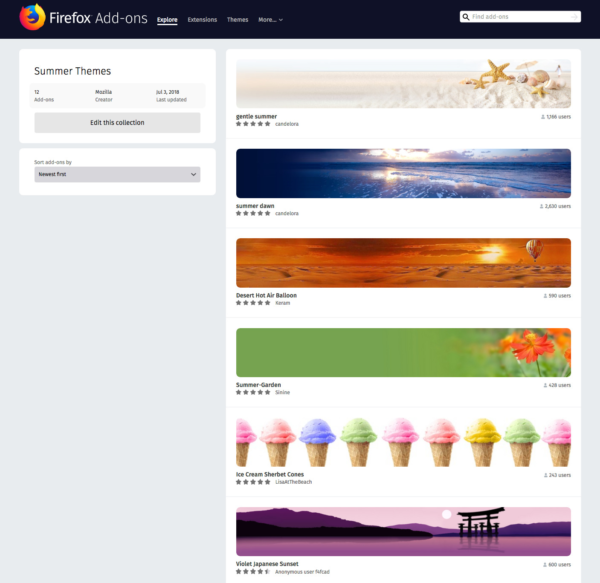
Collections were initially created as a social feature. This included features like voting, following, and multiple contributors for a single collection. However, these features weren’t used much by the majority of our users, and have become a maintenance burden. Because of this, we decided to remove these secondary features.
Another big change is that it won’t be possible to browse and search through collections on the site. If you want to share any of your collections, you can use their URL and post them anywhere on the web. We’re making this change because they have become a common vector for spam. This change shouldn’t disrupt how most people use them at present.
User Profiles
User profiles also got a style refresh:
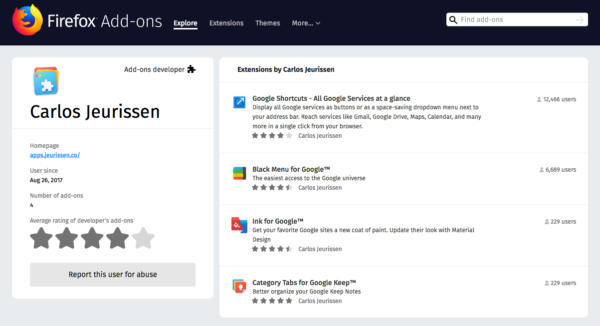
The main difference is that, on the new site, only developer profiles are public. If you’re not an add-on developer, you can still access your own profile page, but other people can’t. Like with collections, this is a mitigation against spam. The main use for profile pages is to find other add-ons created by a developer, so that’s why those profiles will remain public.
Collections and user profiles were the last big features to move to the new design. There are still a number of small features that need to be ported over, and they will be handled in the next month or two. We expect to shut down the old site next quarter, so if you switched to the old design early in the migration process, this is a good time to give the new design another try.
The post Collections and User Profiles have a new look appeared first on Mozilla Add-ons Blog.
https://blog.mozilla.org/addons/2018/07/26/collections-user-profiles-new-look/

About a month ago we got our Tesla Model 3. This is a rambling post about it.
Personally I don't mind spending money on some things, but I absolutely hate spending money on depreciating assets. Since I'm lucky enough to have money to save, I feel it should be in boring assets that make a solid return every year.
I've liked looking at fast and expensive cars, but when it comes to actually spending lots of money on them, I've always thought its a terrible idea. I've wanted a Porsche forever, but I've never wanted to spend the money on one. We've gone to buy cars and I've come away feeling grumpy and miserable that I've spent that much money on something that will depreciate.
And then along came Tesla. Sure Elon Musk and Tesla have a few problems at the moment, but here is a person who is actually trying to do something about the fact that our planet is burning up. This is a man on a mission to do good.
This is a company that released the Model S, a car so revolutionary that it broke Consumer Reports scoring. A car that has taken over the luxury model class. We test drove a Model S and it was amazing. Everything we drove after that felt like it was ancient technology. But there's no way in hell I'd spend that kind of money on a Model S.
Then along came the Model 3 and we put our refundable deposit down predicting we'd need a new car eventually. And waited and waited. Finally our spot came up and we had to buy the premium version which sucked. It meant more money and that made me grumpy. We thought about it, I got more grumpy but eventually we went for it.
There's a few reasons why. The time is right for electric cars. The infrastructure is in place. Most car manufacturers, spurred by Tesla, are producing electric cars. There's a tipping point and its happening over the next few years. In BC over 90% of electricity comes from hydro electricity. A car is rarely a green choice in terms of the plastic, metal and other materials used, the manufacturing process, the amount of road infrastructure dedicated to it and so on. But this is about as good as a car gets.
So how is it?

Amazeballs. I irrationally love this thing. I'm still making excuses to go places so I can drive the car.
The car is minimalist on the the inside and I like it. So many cars have a billion buttons and knobs for every function. Everything apart from lights, indicators and wipers are controlled through the tablet mounted in the middle. But most of those are automatic anyway, so hey why bother. Sitting in my Toyota now feels fussy and complicated.
It goes fast. Really fast. You put your foot down and it just goes and keep going. Silently and with power. It accelerates faster than that Porsche Boxster I wanted. And thats more than fast enough for me thank you. It's got a 500km range and we barely do that in a few weeks around town. Because of the huge battery in the bottom it goes round corners amazingly well. Everytime we get in it, its like driving a sports car. A quiet and amazing sports car.
For a car this price, I wanted a few more things like an automatically closing and opening trunk and front trunk. But then you've got other things like a great tablet as a dashboard that's fast and responsive and helpful. When you are on the phone its loud and clear. It's got full time LTE for traffic routing. I could go on and on. And no we didn't get autopilot, that is scary.
This feels like a car from the future that doesn't destroy the environment. Driving it is amazing and I still love it. Way more than I should.
Oh and my other favourite toy, my Cerv'elo S3, fits perfectly in the boot.
If you plan on buying one, here's my affiliate code.
I'm totally aware of how meta this is*, but nevertheless: Let's start a funny experiment of assembling a list of webmention capable websites and blogs (What is this anyway?). I know the following from my filter bubble: webrocker.de / @webrocker matthiasott.com / @m_ott boffosocko.com / @ChrisAldrich...
aria-hidden="true" will have their sub trees completely removed from the accessibility tree.
Background
The aria-hidden attribute can be set on an element to mark it and all of its descendants as hidden from accessibility, and therefore any assistive technology, while at the same time retaining visible status on the screen itself. In this form, it is different from CSS properties such as display:none; and visibility:hidden;, which truly hide content from both the seeing eye as well as the accessibility programming interfaces.
As noted in the ARIA 1.1 specification, extreme caution should be used when using this attribute. It may hide content from users of assistive technologies such as speech recognition, switch control, or magnifier users that they actually need to access. For more information on the different way of hiding things, I recommend this read by the Paciello Group.
The change
Both Chrome and Safari have traditionally always unconditionally cut the element marked with aria-hidden=”true” from the accessibility tree on all platforms. But as soon as a focusable element was within that tree, this means that there is no accessible object associated with that focusable element, so the screen reader in use would not speak anything. And despite many criticisms and discussions over the years, this has never been addressed other than the above mentioned warnings in the specification.
Up to and including Firefox 62, the Gecko engine, however, advertised for a different model where aria-hidden content was merely marked as hidden, but still included in the accessibility tree. Assistive technologies could then decide whether to expose, and interact with, such elements or not. For us, this solved the problems that focusable aria-hidden elements were still speaking when focus was set to them. They also remained accessible to magnifiers and other assistive technologies.
However, this approach did not gain any traction since it was implemented, and it caused more confusion with web developers than it solved problems. So, in the spirit of better interoperability among browsers, we heavy-heartedly decided that it was time to fully go with the specification as it stands today and finally cut the aria-hidden tree in Firefox 63 and later. This means that stuff marked with aria-hidden=”true” will now fully disappear from the accessibility tree, also reflected in our Accessibility Inspector, as it does in other browsers.
Unanswered questions
Despite of this, some questions remain, like the disconnect between user expectation, gained from what’s visible on the screen, and what is exposed via the accessibility tree. Especially users of magnifiers, speech recognition products, and switch control users could be adversely affected by the wrong use of aria-hidden if such elements that are hidden acutually comprise operable controls. The same is true for keyboard focus.
But for certain situations, such as marking a whole section as “not available” or “inert” as a modal popup is opened, for example, there is currently no solution available other than aria-hidden, to properly hide content that is, for a given situation, considered to be non-operable. As long as elements such as the dialog element aren’t fully supported on all browsers (Firefox included), or the specification for the inert attribute is not solid enough to be considered implementable, the beast that is aria-hidden is the only one we have to wrestle such situations.
We’re not happy, but at least now, we’re consistent.
https://www.marcozehe.de/2018/07/24/firefox-63-will-cut-subtrees-marked-with-aria-hidden/
Greetings Mozillians!
We are happy to let you know that Friday, August 3rd, we are organizing Firefox 62 Beta 14 Testday. We’ll be focusing our testing on Pocket, Customization and Bookmarks features. We will also have fixed bugs verification and unconfirmed bugs triage ongoing.
Check out the detailed instructions via this etherpad.
No previous testing experience is required, so feel free to join us on #qa IRC channel where our moderators will offer you guidance and answer your questions.
Join us and help us make Firefox better!
See you on Friday!
https://quality.mozilla.org/2018/07/firefox-62-beta-14-testday-august-3rd/
I have used a variety of profiling tools over the years, including several I wrote myself.
But there is one profiling tool I have used more than any other. It is capable of providing invaluable, domain-specific profiling data of a kind not obtainable by any general-purpose profiler.
It’s a simple text processor implemented in a few dozen lines of code. I use it in combination with logging print statements in the programs I am profiling. No joke.
Post-processing
The tool is called counts, and it tallies line frequencies within text files, like an improved version of the Unix command chain sort | uniq -c. For example, given the following input.
a 1
b 2
b 2
c 3
c 3
c 3
d 4
d 4
d 4
d 4
counts produces the following output.
10 counts:
(  1)        4 (40.0%, 40.0%): d 4
(  2)        3 (30.0%, 70.0%): c 3
(  3)        2 (20.0%, 90.0%): b 2
(  4)        1 (10.0%,100.0%): a 1
It gives a total line count, and shows all the unique lines, ordered by frequency, with individual and cumulative percentages.
Alternatively, when invoked with the -w flag, it assigns each line a weight, determined by the last integer that appears on the line (or 1 if there is no such integer). On the same input, counts -w produces the following output.
30 counts:
(  1)       16 (53.3%, 53.3%): d 4
(  2)        9 (30.0%, 83.3%): c 3
(  3)        4 (13.3%, 96.7%): b 2
(  4)        1 ( 3.3%,100.0%): a 1
The total and per-line counts are now weighted; the output incorporates both frequency and a measure of magnitude.
That’s it. That’s all counts does. I originally implemented it in 48 lines of Perl, then later rewrote it as 48 lines of Python, and then later again rewrote it as 71 lines of Rust.
In terms of benefit-to-effort ratio, it is by far the best code I have ever written.
counts in action
As an example, I added print statements to Firefox’s heap allocator so it prints a line for every allocation that shows its category, requested size, and actual size. A short run of Firefox with this instrumentation produced a 77 MB file containing 5.27 million lines. counts produced the following output for this file.
5270459 counts:
( 1) 576937 (10.9%, 10.9%): small 32 (32)
( 2) 546618 (10.4%, 21.3%): small 24 (32)
( 3) 492358 ( 9.3%, 30.7%): small 64 (64)
( 4) 321517 ( 6.1%, 36.8%): small 16 (16)
( 5) 288327 ( 5.5%, 42.2%): small 128 (128)
( 6) 251023 ( 4.8%, 47.0%): small 512 (512)
( 7) 191818 ( 3.6%, 50.6%): small 48 (48)
( 8) 164846 ( 3.1%, 53.8%): small 256 (256)
( 9) 162634 ( 3.1%, 56.8%): small 8 (8)
( 10) 146220 ( 2.8%, 59.6%): small 40 (48)
( 11) 111528 ( 2.1%, 61.7%): small 72 (80)
( 12) 94332 ( 1.8%, 63.5%): small 4 (8)
( 13) 91727 ( 1.7%, 65.3%): small 56 (64)
( 14) 78092 ( 1.5%, 66.7%): small 168 (176)
( 15) 64829 ( 1.2%, 68.0%): small 96 (96)
( 16) 60394 ( 1.1%, 69.1%): small 88 (96)
( 17) 58414 ( 1.1%, 70.2%): small 80 (80)
( 18) 53193 ( 1.0%, 71.2%): large 4096 (4096)
( 19) 51623 ( 1.0%, 72.2%): small 1024 (1024)
( 20) 45979 ( 0.9%, 73.1%): small 2048 (2048)
Unsurprisingly, small allocations dominate. But what happens if we weight each entry by its size? counts -w produced the following output.
2554515775 counts:
( 1) 501481472 (19.6%, 19.6%): large 32768 (32768)
( 2) 217878528 ( 8.5%, 28.2%): large 4096 (4096)
( 3) 156762112 ( 6.1%, 34.3%): large 65536 (65536)
( 4) 133554176 ( 5.2%, 39.5%): large 8192 (8192)
( 5) 128523776 ( 5.0%, 44.6%): small 512 (512)
( 6) 96550912 ( 3.8%, 48.3%): large 3072 (4096)
( 7) 94164992 ( 3.7%, 52.0%): small 2048 (2048)
( 8) 52861952 ( 2.1%, 54.1%): small 1024 (1024)
( 9) 44564480 ( 1.7%, 55.8%): large 262144 (262144)
( 10) 42200576 ( 1.7%, 57.5%): small 256 (256)
( 11) 41926656 ( 1.6%, 59.1%): large 16384 (16384)
( 12) 39976960 ( 1.6%, 60.7%): large 131072 (131072)
( 13) 38928384 ( 1.5%, 62.2%): huge 4864000 (4866048)
( 14) 37748736 ( 1.5%, 63.7%): huge 2097152 (2097152)
( 15) 36905856 ( 1.4%, 65.1%): small 128 (128)
( 16) 31510912 ( 1.2%, 66.4%): small 64 (64)
( 17) 24805376 ( 1.0%, 67.3%): huge 3097600 (3100672)
( 18) 23068672 ( 0.9%, 68.2%): huge 1048576 (1048576)
( 19) 22020096 ( 0.9%, 69.1%): large 524288 (524288)
( 20) 18980864 ( 0.7%, 69.9%): large 5432 (8192)
This shows that the cumulative count of allocated bytes (2.55GB) is dominated by a mixture of larger allocation sizes.
This example gives just a taste of what counts can do.
(An aside: in
It was important for me to make sure this demo is accessible even if it’s just a quick proof of concept for a talk. First of all, because the code for the demo will be public, so I have a bigger responsibility for making sure it’s accessible, because I wouldn’t want to spread any inaccessible code around, especially if there’s a chance people might be using it somewhere else.
Another reason I wanted this to be good is that I’ll probably want to reuse it for other components for my upcoming front-end components workshop.
https://www.marcozehe.de/2018/07/23/sara-soueidan-on-designing-a-switch-control/
In the last few months (whoops!), we merged 498 PRs in the Servo organization’s repositories. It should be easier to return to a regular publishing schedule now that we’re caught up!
Planning and Status
Our roadmap is available online, including the overall plans for 2018. It has been updated to account for Servo’s new role in Mozilla’s mixed reality team.
This week’s status updates are here.
Exciting Work in Progress
- asajeffrey is trying to get all supported platforms building Servo with an upgraded JavaScript engine.
- paulrouget is completely redesigning how the Android port works; we’ll have a usable browser application on Android once it merges.
- Manishearth and ferjm are implementing the DOM APIs required for WebAudio content to work.
- gterzian is making Window.open work.
- KiChjang is adding support for the MessagePort and MessageChannel DOM APIs.
Notable Additions
- bobthekingofegypt improved the layout of absolutely positioned replaced block elements.
- DonatJr implemented the
FileReaderSyncAPI for web workers. - gterzian added support for the
beforeunloadevent when navigating a web page. - talklittle removed the need to have the
adbbinary in the path when making android builds. - jdm added support for x86 android builds.
- jonleighton improved the font fallback behaviour.
- KiChjang implemented the missing indexed window getter API.
- simartin corrected a number of WebGL APIs.
- fabricedesre implemented several API for
MutationObserver. - gterzian moved all UI-related code for prompts and alerts to the embedding layer.
- kvark added support to webrender for debug output that chases a display item through the entire rendering pipeline.
- mrobinson corrected an infinite loop when calculating ellipse arc lengths.
- pyfisch added support for rendering the
border-image-outsetCSS property. - pyfisch corrected an edge case for clipping background colours.
- mbrubeck implemented pinch zoom support on Android.
- nox added support for a bunch of WebGL
getParametervalues. - arthurps made it possible to reduce the size of SmallVec values using unions.
- asajeffrey performed several magic tricks to make mozjs rely on the bindgen

This week we focused on fixing bugs and delivering a seamless experience across our three areas: browsers, social, and the content ecosystem.
Browsers
We spent this week improving performance and fixing bugs on Firefox Reality:
- Enabling VR controller implementations outside of Gecko
- Removing the spin waits in WebVR to improve performance and avoid draining battery life
- Latency improvements for head tracking in immersive mode
- Improve UI experience
- Clean up the build system for the graphics lib
- Asynchronous loading of content and creation off-render-thread of GL textures and vertex buffers to speed the application startup experience
Social
We added a bunch of new features on Hubs by Mozilla:
- PRs getting landed for upstream changes needed for gLTF exporting from three.js. Debugging and polish on UI and scene management
- Pen interactable added for drawing
- Bug fixing for 3d model import from Google Poly and added Sketchfab API support
- New packaging and deploy process for Hubs that removes client code from Reticulum server package. This is the first of several steps needed towards “one-click” self-hosting
Another coming soon for #MozillaHubs... @mozillareality @aframevr #threejs pic.twitter.com/ttUOUsyEou
— Kevin Lee (@infinite_lee) July 13, 2018
Interested in joining our public Friday stand ups? For more details, join our public WebVR Slack #social channel
Content ecosystem
Found a critical bug on the Unity WebVR exporter? File it in our public GitHub repo or let us know on the public WebVR Slack #unity channel and as always, join us in our discussion!
Interested in learning more about what we're up to?
Check out the Mixed Reality team update from Josh Marinacci here on Youtube.
Stick around next week for more new features and improvements!
This post was written by Prathamesh Chavan
TL;DR
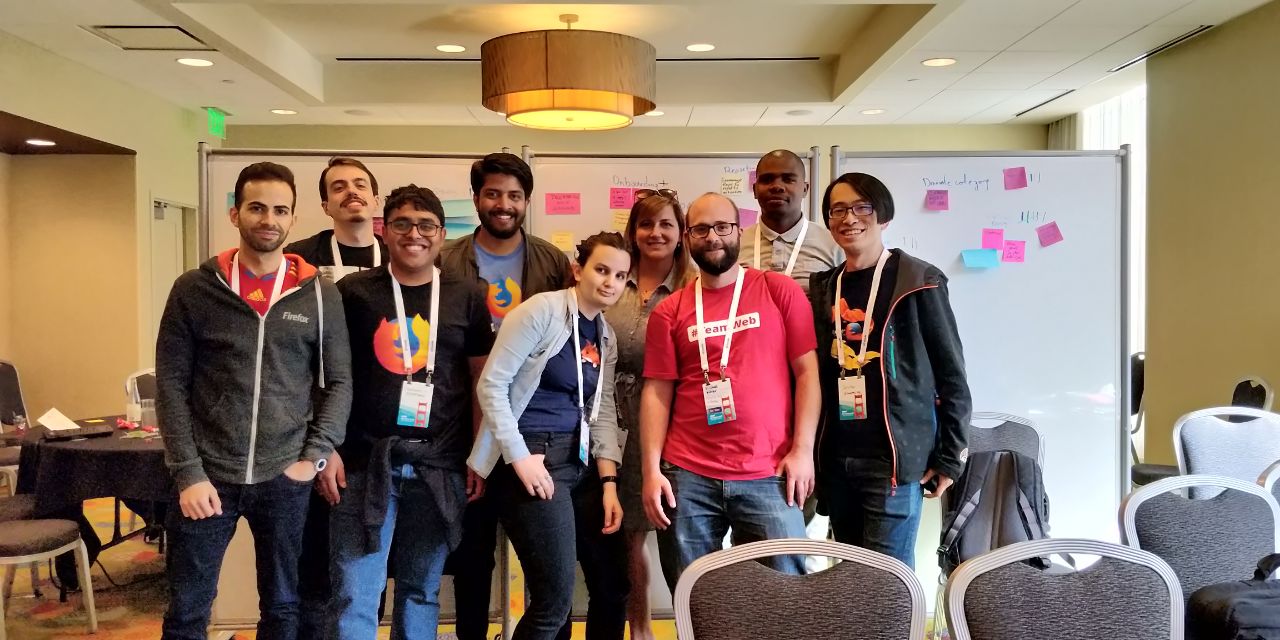
The All Hands is a special time of the year where Mozilla employees along with core volunteers gather for a week of many meetings and brainstorming. The All Hands Wiki page has more information about the general setting. During the All Hands, the Reps Council participated in the Open Innovation meetings as well as had meetings about improve 2018 planning.
The Mozilla All-Hands was organized between 11th June to 15th June 2018 in San Francisco. All Hands are a unique and special opportunity for all paid staff and our most impactful volunteers to come together, in person, to share experiences and interact with people they may not normally work with.
This year’s All Hands was a great learning experience for the Reps Council and Peers.
The Reps Council worked more on the projects which could directly or indirectly help the community and align the plan for the community for the next quarters.
One of the first things that we made was a little recap of what we have done in the first half:

The Reps Council members were invited to join the different meetings which were focused on Localization of Firefox, the Addon sprint campaigns to define the final plan and Diversity & Inclusion.
The status of Mission Driven Mozillians and the Mozilla Group experiment in India was also shared with the Reps Council. The Reps Council was very interested to understand how the program can fit in and align itself with the new opportunities.
The Reps Council also ran a check on the issues opened in https://github.com/mozilla/reps/issues and assigned tasks on the issues which were pending or open since a while.
The Reps Council and Peers discussed some of the important things which are as follows :
– Achievements in the past quarter
– Mozilla Reps Logo
– Mozilla Reps Newsletter team
– Prioritize tickets for the Reps Portal
– Collecting ideas about data gathering to enable data-driven decisions
– Issues on priorities
– Failure and Success of the Reps program
– Mission Driven Mozillians
– H2 plan
There was a meeting on the H2 plan to discuss and assign priorities. A blogpost about this plan would be shared soon.
The Open Innovation Team shared the numbers of the Sprints of this half of the year where there was an huge involvement of our Reps and communities.
The All Hands was quite productive for the Reps Council and the things which were discussed would start be getting reflected in the present quarter (July, August, September).
Useful Links:
Schedule: https://sanfranciscoallhandsjune2018.sched.com/
https://blog.mozilla.org/mozillareps/2018/07/20/reps-council-at-sf-all-hands-2018/
(I work for Mozilla. None of this is secret. None of this is official Mozilla policy. Not speaking for Mozilla here.)
The good news is that interesting
competition among web browsers is
back, not
just because of ongoing performance improvements
in Firefox, but also because of Apple Safari's
good work on protecting users from some kinds of
cross-site tracking by default. Now the challenge
for other browsers is to learn from the Safari work
and build on it, to even more accurately implement
the user's preferences on sharing their personal
information. According to research by Tini Sevak at
YouGov,
36% of users are more likely to engage with
adverts that are tailored to them
, while 55% are
creeped out
by personalized ads. The browser
has to get its data sharing settings right for the
individual user, while minimizing the manual settings
and decision fatigue that the user has to go through.
A short-term problem for sites, though, is that the current price for highly tracked ad impressions facilitated by cross-site tracking is way below the price of impressions delivered to users who choose to protect themselves. Tim Peterson, on Digiday, covers the natural experiment of GDPR consenters and non-consenters:
If an exchange or SSP declines to sign the agreement, it is limited to only selling non-personalized ads through DBM. Those generic ads generate less revenue for publishers than personalized ads that are targeted to specific audiences based on data collected about them. Some publishers that are heavily reliant on DBM have seen their revenues decline by 70-80 percent since GDPR took effect because they were limited to non-personalized ads, said another ad tech exec.
In the medium to long term, better browser privacy settings will give an advantage to high-reputation sites for two reasons:
ads on high-value content have signaling value
users are more likely to share information with a site they trust
But in the short term, what can browsers do to help address the market dislocation from the user data crunch?
One possibility is to take advantage of an important side effect of browser privacy improvements: better anti-fraud data.
Today, unprotected browsers and fraudbots are hard to tell apart. Both maintain a single "cookie jar" across trusted and untrusted sites. For fraudbots, cross-site trackability is not a bug as it is for a human user's browser—it's a feature. A fraudbot can only produce valuable ad impressions on a fraud site if it is somehow trackable from a legit site.
As browser users start to upgrade to nightly releases that include more protection, though, a trustworthy site's real users will start to look more and more different from fraudbots. Low-reputation and fraud sites claiming to offer the same audience will have a harder and harder time trying to sell impressions to agencies that can see it's not the same people. This does require better integration with anti-fraud tools, so it's something sites and anti-fraud vendors can do in parallel with the brower release process.
Can the anti-fraud advantages of browser privacy improvements completely swamp out the market effects of reducing cross-site trackability? Depends on how much adfraud there is. We don't know.
https://blog.zgp.org/browser-privacy-improvements-and-anti-fraud/