In July I took the train up to beautiful Edinburgh to attend the EuroPython 2018 conference. Despite using Python professionally for almost 8 years, this was my first experience of a Python conference. The schedule was packed, and it was challenging deciding what talks to attend, but I had a great time and enjoyed the strong community feeling of the event. We even went for a group run around Holyrood Park and Arthur’s Seat, which I hope is included in the schedule for future years.
Now that the videos of the talks have all been published, I wanted to share my personal highlights, and list the talks I saw during and since the conference. I still haven’t caught up on everything I wanted to see, so I’ve also included my watch list. First, here’s the full playlist of talks from the conference
Here are my top picks from the talks I either attended or have watched since:
- Stephane Wirtel - What’s new in Python 3.7
- Hynek Schlawack - How to Write Deployment friendly Applications
- Nicole Harris - PyPI: Past, Present and Future
- Raphael Pierzina - The Challenges of Maintaining a Popular Open Source Project
- Sarah Bird - The Web is Terrifying! Using the PyData stack to spy on the spies
- Doug Hellmann - reno - A New Way to Manage Release Notes
I also wanted to highlight the following lightning talks:
Here is a list of the other talks I either attended at the conference or have watched since:
- David Beazley - Die Threads
- Yury Selivanov - asyncio in Python 3.7 and 3.8
- Lukasz Kakol - Pythonic code vs performance
- Romain Dorgueil - Using Bonobo, Airflow and Grafana to visualize your business
- Almar Klein - Let’s embrace WebAssembly!
- Pascal van Kooten - When to use Machine Learning: Tips, Tricks and Warnings
- Bernat Gabor - Standardize Testing in Python
- James Saryerwinnie - Debugging Your Code with Data Visualization
- Mark Smith - More Than You Ever Wanted To Know About Python Functions
- Neil Gall - System testing with Pytest, Docker, and Flask
- Sven Hendrik Haase - Rust and Python - Oxidize Your Snake
- Becky Smith - Python 2 is dead! Drag your old code into the modern age
- Anastasiia Tymoshchuk - How to develop your project from an idea to architecture design
- Marco Buttu - White Mars living far away from any form of life
- Mika Bostr"om, Alexander Schmolck - Marge: A bot for better Git’ing
- Dougal Matthews - 10 years of EuroPython and the Python community
- Ines Montani - How to Ignore Most Startup Advice and Build a Decent Software Business
- Ian Ozsvald - Citizen Science with Python
- Alec MacQueen - Python and GraphQL
- Alexandre Figura - Integration Tests with Super Powers

Firefox Reality, Mozilla's VR web browser, is getting closer to release; so let's talk about how to make your experiences work well in this new browser.
Use a Framework with WebVR 1.1 Support
Building WebVR applications from scratch requires using WebGL, which is very low level. Most developers use some sort of a library, framework or game engine to do the heavy lifting for them. These are some commonly used libraries that support WebVR.
Three JS
As of June 2018 ThreeJS has new and improved WebVR support. It should just work. See these official examples of how to use it.
AFrame
AFrame is a framework built on top of ThreeJS that lets you build VR scenes using an HTML like syntax. It is the best way to get started with VR if you have never used it before.
Babylon
Babylon.js is an open source high performance 3D engine for the web. Since version 2.5 it has full WebVR support. This doc explains how to use the WebVRFreeCamera class.
Amazon Sumerian
Amazon’s online Sumerian tool lets you easily build VR and AR experiences, and obviously supports WebVR out of the box.
Play Canvas
Play Canvas is a web first game engine, and it supports WebVR out of the box.
Existing WebGL applications
If you have an existing WebGL application you can easily add WebVR support. This blog covers the details.
No matter what framework you use, make sure it supports the WebVR 1.1 API, not the newer WebXR API. WebXR will eventually be a full web standard but no browser currently ships with non-experimental support. Use WebVR for now, and in the future a polyfill will make sure existing applications continue to work once WebXR is ready.
Optimize Like it’s the Mobile Web, Because it is.
Developing for VR headsets is just like developing for mobile. Though some VR headsets run attached to a desktop with a beefy graphics card, most users have a mobile device like a smartphone or dedicated headset like the Oculus Go or Lenovo Mirage. Regardless of the actual device, rendering to a headset requires at least twice the rendering cost of a non-immersive experience because everything must be rendered twice, one for each eye.
To help your VR application be fast, keep the draw call count to a minimum. The draw call count matters far more than the total polygons in your scene, though polygons are important as well. Drawing 10 polygons 100 times is far slower than 100 polygons 10 times.
Lighting also tends to be expensive on mobile, so use fewer lights or cheaper materials. If a lambert or phong material will work just as well as a full PBR material (physically based rendering), go for the cheaper option.
Compress your 3D models as GLB files instead of GLTF. Decompression time is about the same but the download time will be much faster. There are a variety of command line tool to do this, or you can use this web based tool by SBtron. Just drag in your files and get back a GLB.
Always use powers of 2 texture sizes and try to keep textures under 1024 x 1024. Mobile GPUs don’t have nearly as much texture memory as desktops.Plus big textures just take a long time to download. You can often use 512 or 128 for things like bump maps and light maps.
For your 2D content, don’t assume any particular screen size or resolution. Use good responsive design practices that work well on a screen of any shape or size.
Lazy load your assets so that the initial experience is good. Most VR frameworks have a way of loading resources on demand. ThreeJS uses the DefaultLoadingManager. Your goal is to get the initial screen up and running as quickly as possible. Keep the initial download to under 1MB if at all possible. A fast loading experience is one that
FSFE fellows recently started discussing my blog posts about Who were the fellowship? and An FSFE Fellowship Representative's dilemma.
Fellows making posts in support of reform have reported their emails were rejected. Some fellows had CC'd me on their posts to the list and these posts never appeared publicly. These are some examples of responses received by a fellow trying to post on the list:
The list moderation team decided now to put your email address on moderation for one month. This is not censorship.
One fellow forwarded me a rejected message to look at. It isn't obscene, doesn't attack anybody and doesn't violate the code of conduct. The fellow writes:
+1 for somebody to answer the original questions with real answers
-1 for more character assassination
Censors moderators responded to that fellow:
This message is in constructive and unsuited for a public discussion list.
Why would moderators block something like that? In the same thread, they allowed some very personal attack messages in favour of existing management.
Moderation + Bias = Censorship
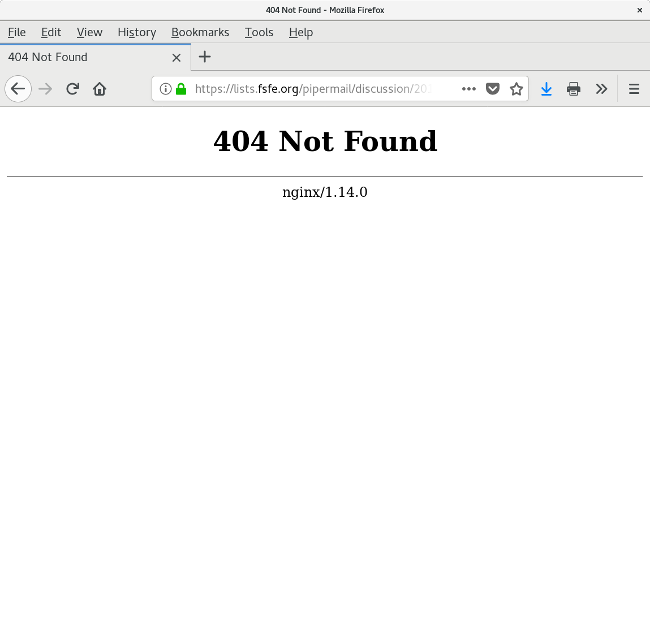
Even links to the public list archives are giving errors and people are joking that they will only work again after the censors PR team change all the previous emails to comply with the censorship communications policy exposed in my last blog.
Fellows have started noticing that the blog of their representative is not being syndicated on Planet FSFE any more.
Some people complained that my last blog didn't provide evidence to justify my concerns about censorship. I'd like to thank FSFE management for helping me respond to that concern so conclusively with these heavy-handed actions against the community over the last 48 hours.
The collapse of the fellowship described in my earlier blog has been caused by FSFE management decisions. The solutions need to come from the grass roots. A totalitarian crackdown on all communications is a great way to make sure that never happens.
FSFE claims to be a representative of the free software community in Europe. Does this behaviour reflect how other communities operate? How successful would other communities be if they suffocated ideas in this manner?
This is what people see right now trying to follow links to the main FSFE Discussion list archive:
https://danielpocock.com/what-is-the-difference-between-moderation-and-censorship
There’s a new Bugs Ahoy in town, and it’s called Codetribute.
The past
I started the Bugs Ahoy project in October 2011 partly because I was procrastinating from studying for midterms, but mostly because I saw new contributors being overwhelmed by Bugzilla’s… Bugzilla-ness. I wanted to reduce the number of decisions that new contributors had to make by:
- only showing bugs that match their skills
- only showing bugs that have someone ready to mentor
- presenting only the most useful information needed to make the required contribution
Bugs Ahoy was always something that was Good Enough, but I’ve never been able to focus on making it the best tool it could be. I’ve heard enough positive feedback over the past 7 years to convince me that it was better than nothing, at least!
The future
Bugs Ahoy’s time is over, and I would like to introduce the new Codetribute site. This is the result of Fienny Angelina’s hard work, with Dustin Mitchell, Hassan Ali, and Eli Perelman contributing as well. It is the spiritual successor to Bugs Ahoy, built to address limitations of the previous system by people who know what they’re doing. I was thrilled by the discussions I had with the team while Codetribute was being built, and I’m excited to watch as the project evolves to address future needs.
Bugs Ahoy will redirect automatically to the Codetribute homepage, but you should update any project or language-specific bookmarks or links so they remain useful. If your project isn’t listed and you would like it to be, please go ahead and add it! Similarly, if you have suggestions for ways that Codetribute could be more useful, please file an issue!
https://www.joshmatthews.net/blog/2018/09/bugs-ahoy-the-next-generation/
Firefox Focus is private browsing as an app: It automatically blocks ads and trackers, so you can surf the web in peace. When you’re done, a single tap completely erases your history, cookies, and other local data.
Protecting you from invasive tracking is part of Mozilla’s non-profit mission, and Focus’s built-in tracking protection helps keep you safe. It also makes websites load faster!

With Focus, you don’t have to worry about your browsing history coming back to haunt you in retargeted ads on other websites.
Bringing Gecko to Focus
In the next weeks, we’ll release a new version of Focus for Android, and for the first time, Focus will come bundled with Gecko, the browser engine that powers Firefox Quantum. This is a major architectural change, so while every copy of Focus will include Gecko—hence the larger download size—we plan on enabling it gradually to ensure a smooth transition. You can help us test Gecko in Focus today by installing the Focus Beta.

Note: At time of publishing, Focus Beta is conducting an A/B test between the old and new engines. Look for “Gecko/62.0” in your User-Agent String to determine if your copy is using Gecko or not.
Up until this point, Focus has been powered exclusively by Android’s built-in WebView. This made sense for initial development, since WebView was already on every Android device, but we quickly ran into limitations. Foremost, it isn’t designed for building browsers. Despite being based on Chromium, WebView only supports a subset of web standards, as Google expects app developers to use native Android APIs, and not the Web, for advanced functionality. Instead, we’d prefer if apps had access to the entirety of the open, standards-based web platform.
In Focus’s case, we can only build next-generation privacy features if we have deep access to the browser internals, and that means we need our own engine. We need Gecko. Fortunately, Firefox for Android already uses Gecko, just not in a way that’s easy to reuse in other applications. That’s where GeckoView comes in.
GeckoView: Making Gecko Reusable
GeckoView is Gecko packaged as a reusable Android library. We’ve worked to decouple the engine itself from its user interface, and made it easy to embed in other applications. Thanks to GeckoView’s clean architecture, our initial benchmarks of the new Focus show a median page load improvement of 20% compared to Firefox for Android, making GeckoView our fastest version of Gecko on Android yet.

We first put GeckoView into production last year, powering both Progressive Web Apps (PWAs) and Custom Tabs in Firefox for Android. These minimal, self-contained features were good initial projects, but with Focus we’re going much further. Focus will be our first time using GeckoView to completely power an existing, successful, and standalone product.
We’re also using GeckoView in entirely new products like
DNS is a critical part of the Internet, but unfortunately has bad security and privacy properties, as described in this excellent explainer by Lin Clark. In June, Mozilla started experimenting with DNS over HTTPS, a new protocol which uses encryption to protect DNS requests and responses. As we reported at the end of August, our experiments in the Nightly channel look very good: the slowest users show a huge improvement, anywhere up to hundreds of milliseconds, and most users see only a small performance slowdown of around 6 milliseconds, which is acceptable given the improved security.
This is a very promising result and the next step is to validate the technique over a broader set of users on our Beta channel. We will once again work with users who are already participating in Firefox experiments, and continue to provide in-browser notifications about the experiment and details about the DoH service provider so that everyone is fully informed and has a chance to decline participation in this particular experiment. A soft rollout to selected Beta users in the United States will begin the week of September 10th.
As before, this experiment will use Cloudflare’s DNS over HTTPS service. Cloudflare has been a great partner in developing this feature and has committed to very strong privacy guarantees for our users. Moving forward, we are working to build a larger ecosystem of trusted DoH providers that live up to this high standard of data handling, and we hope to be able to experiment with other providers soon.
References to DoH
- A cartoon intro to DNS over HTTPS by Lin Clark, Mozilla, May 31, 2018
- Improving DNS Privacy in Firefox by Patrick McManus, Mozilla, June 1, 2018
The post DNS over HTTPS (DoH) – Testing on Beta appeared first on Future Releases.
https://blog.mozilla.org/futurereleases/2018/09/13/dns-over-https-doh-testing-on-beta/
The Rust team is happy to announce a new version of Rust, 1.29.0. Rust is a systems programming language focused on safety, speed, and concurrency.
If you have a previous version of Rust installed via rustup, getting Rust 1.29.0 is as easy as:
$ rustup update stable
If you don’t have it already, you can get rustup from the
appropriate page on our website, and check out the detailed release notes for
1.29.0 on GitHub.
What’s in 1.29.0 stable
The 1.29 release is fairly small; Rust 1.30 and 1.31 are going to have a lot in them, and so much of the 1.29 cycle was spent preparing for those releases. The two most significant things in this release aren’t even language features: they’re new abilities that Cargo has grown, and they’re both about lints.
cargo fixcan automatically fix your code that has warningscargo clippyis a bunch of lints to catch common mistakes and improve your Rust code
cargo fix
With the release of Rust 1.29, Cargo has a new subcommand: cargo fix. If you’ve written
code in Rust before, you’ve probably seen a compiler warning before. For example, consider
this code:
fn do_something() {}

fn main() {
    for i in 0..100 {
        do_something();
    }
}
Here, we’re calling do_something a hundred times. But we never use the variable i.
And so Rust warns:
> cargo build
   Compiling myprogram v0.1.0 (file:///path/to/myprogram)
warning: unused variable: `i`
 --> src\main.rs:4:9
  |
4 |     for i in 1..100 {
  |         ^ help: consider using `_i` instead
  |
  = note: #[warn(unused_variables)] on by default

    Finished dev [unoptimized + debuginfo] target(s) in 0.50s
See how it suggests that we use _i as a name instead? We can automatically
apply that suggestion with cargo fix:
> cargo fix
    Checking myprogram v0.1.0 (file:///C:/Users/steve/tmp/fix)
      Fixing src\main.rs (1 fix)
    Finished dev [unoptimized + debuginfo] target(s) in 0.59s
If we look at src\main.rs again, we’ll see that the code has changed:
fn do_something() {}

fn main() {
    for _i in 0..100 {
        do_something();
    }
}
We’re now using _i, and the warning will no longer appear.
This initial release of cargo fix only fixes up a small number of warnings.
The compiler has an API for this, and it only suggests fixing lints that
we’re confident recommend correct code. Over time, as our suggestions
improve, we’ll be expanding this to automatically fix more warnings.
if you find a compiler suggestion and want to help make it fixable, please leave a comment on this issue.
cargo clippy
Speaking of warnings, you can now check out a preview of cargo clippy through Rustup.
Clippy is a large number of additional warnings that you can run against your Rust code.
For example:
let mut lock_guard = mutex.lock();

std::mem::drop(&lock_guard)

operation_that_requires_mutex_to_be_unlocked();
This code is syntactically correct, but may have a deadlock! You see, we
dropped a reference to lock_guard, not the guard itself. Dropping
a reference is a no-op, and so this is almost certainly a bug.
We can get the preview of Clippy from Rustup:
$ rustup component add clippy-preview
and then run it:
$ cargo clippy
error: calls to `std::mem::drop` with a reference Today marks a very sad day for the internet in Europe. Lawmakers in the European Parliament have just voted to turn their backs on key principles on which the internet was built; namely openness, decentralisation, and collaboration.
Parliamentarians have given a green light to new rules that will compel online services to implement blanket upload filters, a crude and ineffective measure that could well spell an end to the rich creative fabric of memes, mashups, and GIFs that make internet culture so great. The Parliament’s vote also endorses a ‘link tax’ that will undermine access to knowledge and the sharing of information in Europe.
We recognise the efforts of many MEPs who attempted to find workable solutions that would have rectified some of the grave shortcomings in this proposal. Sadly, the majority dismissed those constructive solutions, and the open internet that we’ve taken for granted the last 20 years is set to turn into something very different in Europe.
The fight is not over yet. Lawmakers still need to finalise the new rules, and we at Mozilla will do everything we can to achieve a modern reform that safeguards the health of the internet and promotes the rights of users. There’s simply too much at stake not to.
The post Mozilla reacts to EU Parliament vote on copyright reform appeared first on Open Policy & Advocacy.
https://blog.mozilla.org/netpolicy/2018/09/12/eucopyrightreform/
The European Commission has today proposed a troublesome new regulation regarding terrorist content online. As we have said, illegal content – of which terrorist content is a particularly striking example – undermines the overall health of the internet. We welcome effective and sustainable efforts to address illegal content online. But the Commission’s proposal is a poor step in that direction. It would undermine due process online; compel the use of ineffective content filters; strengthen the position of a few dominant platforms while hampering European competitors; and, ultimately, violate the EU’s commitment to protecting fundamental rights.
Under the Commission’s proposal, government-appointed authorities – not independent courts – would have the unilateral power to suppress speech on the internet. Longstanding norms around due process and the separation of powers would be swept aside, with little evidence to support such a drastic departure from established norms. These authorities would have vague, indeterminate authority to require additional proactive measures (including but not limited to content filters) from platforms where they deem them appropriate.
In keeping with a worrying global policy trend, this proposal falls victim to the flawed and dangerous assumption that technology is a panacea to complex problems. It would force private companies to play an even greater role in defining acceptable speech online. In practice it would force online services throughout the internet ecosystem to adapt the standards of speech moderation designed for the largest platforms, strengthening their role in the internet economy and putting European competitors at a disadvantage. At a time when lawmakers around the world are increasingly concerned with centralisation and competition in the digital marketplace, this would be a step backwards.
A regulation that poses broad threats to free expression outside of a rule-of-law framework is incompatible with the EU’s long-standing commitment to protecting fundamental rights. As a mission-driven technology company and not-for-profit foundation, both maker of the Firefox web browser and steward of a community of internet builders, we believe user rights and technical expertise must play an essential part in this legislative debate. We have previously presented the Commission with a framework to guide effective policy for illegal content in the European legal context. This proposal falls far short of what is needed for the health of the internet in Europe.
The post EU terrorism regulation threatens internet health in Europe appeared first on Open Policy & Advocacy.
https://blog.mozilla.org/netpolicy/2018/09/12/euterrorismreg/
You might have read that Mozilla recently switched Windows builds to clang-cl. More recently, those Windows builds have seen both PGO (Profile-Guided Optimization) and LTO (Link-Time Optimization) enabled.
As of next nightly (as of writing, obviously), all tier-1 platforms are now built with clang with LTO enabled. Yes, this means Linux, Mac and Android arm, aarch64 and x86. Linux builds also have PGO enabled.
Mac and Android builds were already using clang, so the only difference is LTO being enabled, which brought some performance improvements.
The most impressive difference, though, was on Linux, where we’re getting more than 5% performance improvements on most Talos tests (up to 18% (!) on some tests) compared to GCC 6.4 with PGO. I must say I wasn’t expecting switching from GCC to clang would make such a difference. And that is with clang 6. A quick test with upcoming clang 7 suggests we’d additionally get between 2 and 5% performance improvement from an upgrade, but our static analysis plugin doesn’t like it.
This doesn’t mean GCC is being unsupported. As a matter of fact, we still have automated jobs using GCC for some static analysis, and we also have jobs ensuring everything still builds with a baseline of GCC 6.x.
You might wonder if we tried LTO with GCC, or tried upgrading to GCC 8.x. As a matter of fact, I did. Enabling LTO turned up linker errors, and upgrading to GCC 7.x turned up breaking binary compatibility with older systems, and if I remember correctly had some problems with our test suite. GCC 8.1 was barely out when I was looking into this, and we all know to stay away from any new major GCC version until one or two minor updates. Considering the expected future advantages from using clang (cross-language inlining with Rust, consistency between platforms), it seemed a better deal to switch to clang than to try to address those issues.
Update: As there’s been some interest on reddit and HN, and I failed to mention it originally, it’s worth noting that comparing GCC+PGO vs. clang+LTO or GCC+PGO vs. clang+PGO was a win for clang overall in both cases, although GCC was winning on a few benchmarks. If I remember correctly, clang without PGO/LTO was also winning against GCC without PGO.
Anyways, what led me on this quest was a casual conversation at our last All Hands, where we were discussing possibly turning on LTO on Mac, and how that should roughly just be about turning a switch.
Famous last words.
At least, that’s a somehow reasonable assumption. But when you have a codebase the size of Firefox, you’re up for “interesting” discoveries.
This involved compiler bugs, linker bugs (with a special mention for a bug in ld64 that Apple has apparently fixed in Xcode 9 but hasn’t released the source of), build system problems, elfhack issues, crash report problems, clang plugin problems (would you have guessed that __attribute__((annotate("foo"))) can affect the generated machine code?), sccache issues, inline assembly bugs (getting inputs, outputs and clobbers correctly is hard), binutils bugs, and more.
I won’t bother you with all the details, but here we are, 3 months later with it all, finally, mostly done. Counting only the bugs assigned to me, there are 77 bugs on bugzilla (so, leaving out anything in other bug trackers, like LLVM’s). Some of them relied on work from other people (most notably, Nathan Froyd’s work to switch to clang and then non-NDK clang on Android). This spread over about 150 commits on mozilla-central, 20 of which were backouts. Not everything went according to plan, obviously, although some of those backouts were on purpose as a taskcluster trick.
Hopefully, this sticks, and Firefox 64 will ship built with clang with LTO on all tier-1 platforms as well as PGO on some. Downstreams are encouraged to do the same if they can. The build system will soon choose clang by default on all builds, but won’t enable PGO/LTO.
As a bonus, as of a few days ago, Linux builds are also finally using Position Independent Executables, which improves Address Space Layout Randomization for the few things that are in the executables instead of some library (most notably, mozglue and the allocator). This was actually necessary for LTO, because clang doesn’t build position independent code in executables that are not PIE (but GCC does), and
At Mozilla, we’ve been working to ensure our repositories hosted on GitHub are protected from malicious modification. As the recent Gentoo incident demonstrated, such attacks are possible.
Mozilla’s original usage of GitHub was an alternative way to provide access to our source code. Similar to Gentoo, the “source of truth” repositories were maintained on our own infrastructure. While we still do utilize our own infrastructure for much of the Firefox browser code, Mozilla has many projects which exist only on GitHub. While some of those project are just experiments, others are used in production (e.g. Firefox Accounts). We need to protect such “sensitive repositories” against malicious modification, while also keeping the barrier to contribution as low as practical.
This describes the mitigations we have put in place to prevent shipping (or deploying) from a compromised repository. We are sharing both our findings and some tooling to support auditing. These add the protections with minimal disruption to common GitHub workflows.
The risk we are addressing here is the compromise of a GitHub user’s account, via mechanisms unique to GitHub. As the Gentoo and other incidents show, when a user account is compromised, any resource the user has permissions to can be affected.
Overview
GitHub is a wonderful ecosystem with many extensions, or “apps”, to make certain workflows easier. Apps obtain permission from a user to perform actions on their behalf. An app can ask for permissions including modifying or adding additional user credentials. GitHub makes these permission requests transparent, and requires the user to approve via the web interface, but not all users may be conversant with the implications of granting those permissions to an app. They also may not make the connection that approving such permissions for their personal repositories could grant the same for access to any repository across GitHub where they can make changes.
Excessive permissions can expose repositories with sensitive information to risks, without the repository admins being aware of those risks. The best a repository admin can do is detect a fraudulent modification after it has been pushed back to GitHub. Neither GitHub nor git can be configured to prevent or highlight this sort of malicious modification; external monitoring is required.
Implementation
The following are taken from our approach to addressing this concern, with Mozilla specifics removed. As much as possible, we borrow from the web’s best practices, used features of the GitHub platform, and tried to avoid adding friction to the daily developer workflows.
Organization recommendations:
- 2FA must be required for all members and collaborators.
- All users, or at least those with elevated permissions:
- Should have contact methods (email, IM) given to the org owners or repo admins. (GitHub allows Users to hide their contact info for privacy.)
- Should understand it is their responsibility to inform the org owners or repo admins if they ever suspect their account has been compromised. (E.g. laptop stolen)
Repository recommendations:
- Sensitive repositories should only be hosted in an organization that follows the recommendations above.
- Production branches should be identified and configured:
- To not allow force pushes.
- Only give commit privileges to a small set of users.
- Enforce those restrictions on admins & owners as well.
- Require all commits to be GPG signed, using keys known in advance.
Workflow recommendations:
- Deployments, releases, and other audit-worthy events, should be marked with a signed tag from a GPG key known in advance.
- Deployment and release criteria should include an audit of all signed commits and tags to ensure they are signed with the expected keys.
There are some costs to implementing these protections – especially those around the signing of commits. We have developed some internal tooling to help with auditing the configurations, and plan to add tools for auditing commits. Those tools are available in the mozilla-services/GitHub-Audit repository.

Here’s an example of using the audit
A couple months ago I ported the Pathfinder demo app to WebVR. It was an interesting experience, and I feel like I learned a bunch of things about porting WebGL applications to WebVR that would be generally useful to folks, especially folks coming to WebVR from non-web programming backgrounds.
Pathfinder is a GPU-based font rasterizer in Rust, and it comes with a demo app that runs the Rust code on the server side but does all the GPU work in WebGL in a TypeScript website.
We had a 3D demo showing a representation of the Mozilla Monument as a way to demo text rasterization in 3D. What I was hoping to do was to convert this to a WebVR application that would let you view the monument by moving your head instead of using arrow keys.
I started working on this problem with a decent understanding of OpenGL and WebGL, but almost zero background in VR or WebVR. I’d written an Android Cardboard app three years previously and that was about it.
I’m hoping this article may be useful for others from similar backgrounds.

The converted triangle demo running in WebVR
What is WebVR?
WebVR is a set of APIs for writing VR applications on the web. It lets us request jumping into VR mode, at which point we can render things directly to the eyes of a VR display, rather than rendering to a flat surface browser within the display. When the user is on a device like the Cardboard or Daydream where a regular phone substitutes for the VR display, this is the point where the user puts their phone within the headset.
WebVR APIs help with transitioning to/from VR mode, obtaining pose information, rendering in VR, and dealing with device input. Some of these things are being improved in the work in progress on the new WebXR Device API specification.
Do I need any devices to work with WebVR?
Ideally, a good VR device will make it easier to test your work in progress, but depending on how much resolution you need, a Daydream or Cardboard (where you use your phone in a headset casing) is enough. You can even test stuff without the headset casing, though stuff will look weird and distorted.
For local testing Chrome has a WebVR API emulation extension that’s pretty useful. You can use the devtools panel in it to tweak the pose, and you get a non-distorted display of what the eyes see.
Firefox supports WebVR, and Chrome Canary supports it if you enable some flags. There’s also a polyfill which should work for more browsers.
How does it work under the hood?
I think not understanding this part was the source of a lot of confusion and bugs for me when I was getting started. The core of the API is basically “render something to a canvas and then magic happens”, and I had trouble figuring how that magic worked.
Essentially, there’s a bunch of work we’re supposed to do, and then there’s extra work the browser (or polyfill) does.
Once we enter VR mode, there’s a callback triggered whenever the device requests a frame. Within this callback we have access to pose information.
Using this pose information, we can figure out what each eye should see, and provide this to the WebVR API in some form.
What the WebVR API expects is that we render each eye’s view to a canvas, split horizontally (this canvas will have been passed to the API when we initialize it).
That’s it from our side, the browser (or polyfill) does the rest. It uses our rendered canvas as a texture, and for each eye, it distorts the rendered half to appropriately work with the lenses used in your device. For example, the distortion for Daydream and Cardboard follows
One of the most interesting (and sometimes scary!) parts of my job at Mozilla is dealing with security bugs. We don’t always ship perfect code – nobody does – but I’m privileged to work with a great team of engineers and security folks who know how to deal effectively with security issues when they arise. I’m also privileged to be able to work in the open, and I want to start taking more advantage of that to share some of my experiences.
One of the best ways to learn how to write more secure code is to get experience watching code fail in practice. With that in mind, I’m planning to write about some of the security-bug stories that I’ve been involved in during my time at Mozilla. Let’s start with a recent one: Bug 1447452, in which some mishandling of unicode characters by the Firefox Accounts API server could have allowed an attacker to make arbitrary requests to its backend data store.
https://www.rfk.id.au/blog/entry/security-bugs-ssrf-via-request-splitting/
At Mozilla, our Open Innovation team is driven by the guiding principle of being Open by Design. We are intentionally designing how we work with external collaborators and contributors — both at the individual and organizational level — for the greatest impact and shared value. This includes foundational strategic questions from business objectives to licensing through to overall project governance. But importantly, it also applies to how we design experiences for our communities. Including how we think about creating interactions, from onboarding to contribution.
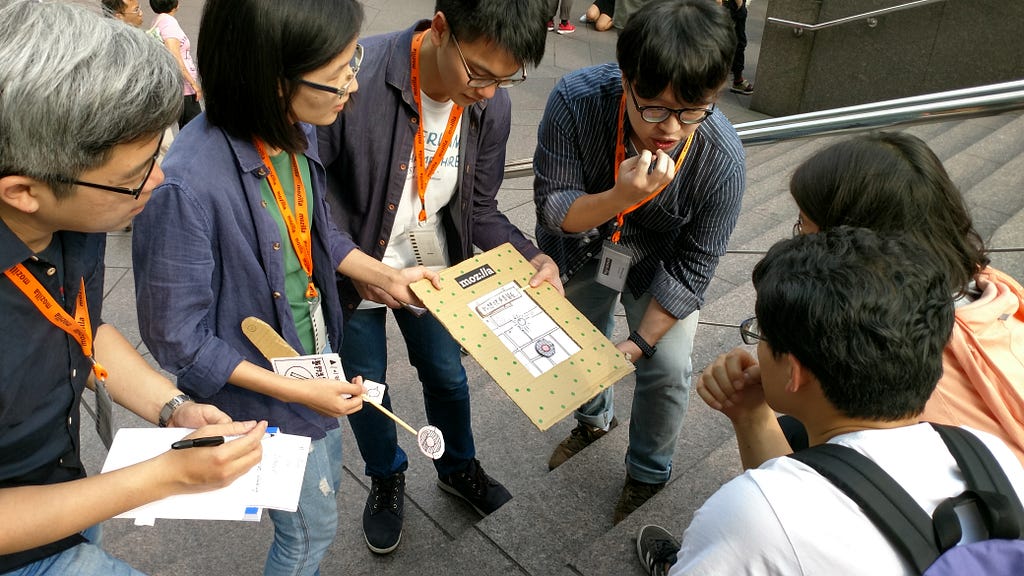
In a series of articles we will share deeper insight as to why, and how, we’re applying experience design practices throughout our open innovation projects. It is our goal in sharing these learnings that further Open Source projects and experiments may benefit from their application and a holistic Service Design approach. As a relevant example, throughout the series, we’ll point often to the Common Voice project where we’ve enabled these practices from its inception.
Starting with a Question
What is now Common Voice, an multi-language voice collection experience, started merely as an identified need. Since early 2016 Mozilla’s Machine Learning Group has been working on an Open Source speech recognition engine and model, project “Deep Speech”. Any high quality speech-to-text engines require thousands of hours of voice data to train them, but publicly available voice data is very limited and the cost of commercial datasets is exorbitant. This prompted the question, how might we collect large quantities of voice data for Open Source machine learning?
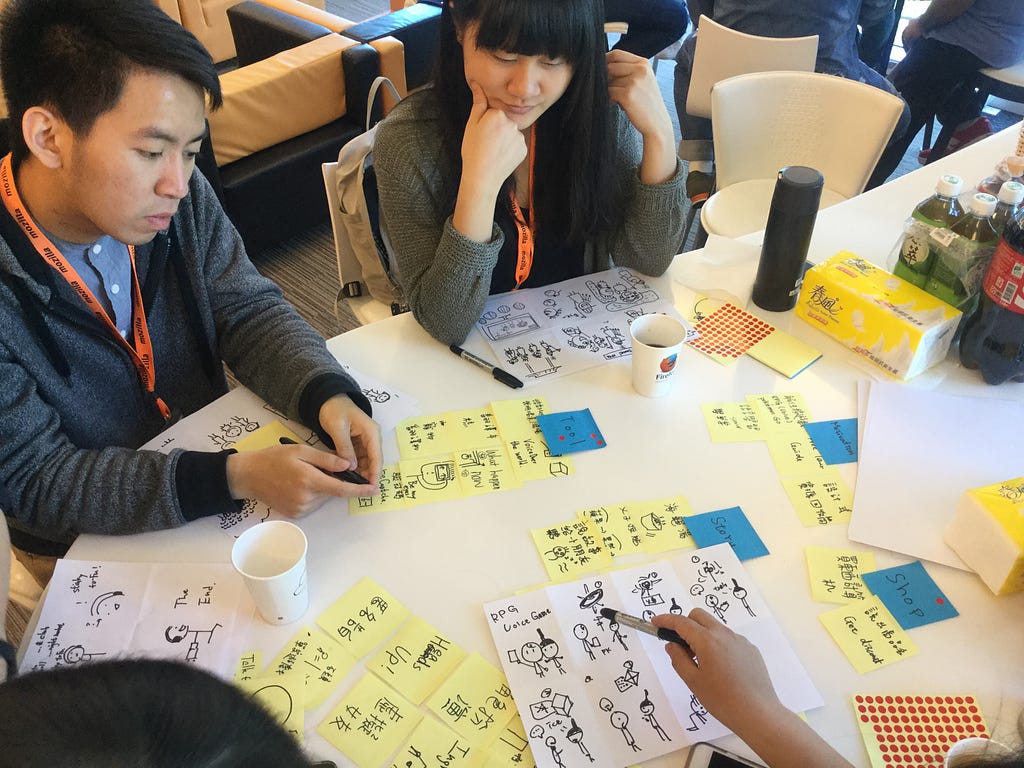
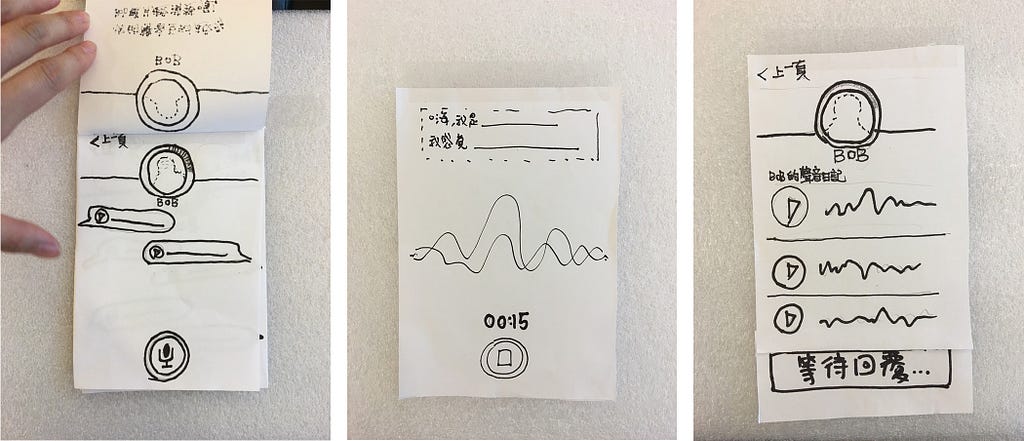
We hypothesized that creating an Open Source voice dataset could lead to more diverse and accurate machine learning capabilities. But how to do this? The best way to ideate and capture multiple potential solutions is to leverage some additional minds and organize a design sprint. In the case of Common Voice our team gathered in Taipei to lead a group of Mozilla community members through various design thinking exercises. Multiple ideas emerged around crowdsourcing voice data and ultimately resulted in testable paper prototypes.
Engaging with Actual Humans
At this point we could have gone immediately to a build phase, and may have in the past. However we chose to pursue further human interaction, by engaging people via in person feedback. The purpose of this human-centered research being to both understand what ideas resonated with people and to narrow in on what design concepts we should move forward with. Our test audience consisted of the people we hoped to ultimately engage with our data collection efforts — everyday internet citizens. We tested concepts by taking to the streets of Taipei and utilizing guerilla research methods. These concepts were quite varied and included everything from a voice-only dating app to a simple sentence read back mechanism.

We went into this research phase fully expecting the more robust app concepts to win out. Our strongly held belief was that people wanted to be entertained or needed an ulterior motive in order to facilitate this level of voice data collection. What resulted was surprisingly intriguing (and heartening): it was the experience of voice donation itself that resonated most with people. Instead of using a shiny
The FSFE Fellowship representative role may appear trivial, but it is surprisingly complicated. What's best for FSFE, what is best for the fellows and what is best for free software are not always the same thing.
As outlined in my blog Who are/were the FSFE Fellowship?, fellows have generously donated over EUR 1,000,000 to FSFE and one member of the community recently bequeathed EUR 150,000. Fellows want to know that this money is spent well, even beyond their death.
FSFE promised them an elected representative, which may have given them great reassurance about the checks and balances in the organization. In practice, I feel that FSFE hasn't been sincere about this role and it is therefore my duty to make fellows aware of what representation means in practice right now.
This blog has been held back for some time in the hope that things at FSFE would improve. Alas, that is not the case and with the annual general meeting in Berlin only four weeks away, now is the time for the community to take an interest. As fellowship representative, I would like to invite members of the wider free software community to attend as guests of the fellowship and try to help FSFE regain legitimacy.
Born with a conflict of interest
According to the FSFE e.V. constitution, as it was before elections were abolished, the Fellows elected according to §6 become members of FSFE e.V.
Yet all the other fellows who voted, the people being represented, are not considered members of FSFE e.V. Sometimes it is possible to view all fellows together as a unit, a separate organization, The Fellowship. Sometimes not all fellows want the same thing and a representative has to view them each as individuals.

Any representative of this organization, The Fellowship and the individual fellows, has a strong ethical obligation to do what is best for The Fellowship and each fellow.
Yet as the constitution recognizes the representative as a member of FSFE e.V., some people have also argued that he/she should do what is best for FSFE e.V.
What happens when what is best for The Fellowship is not in alignment with what is best for FSFE e.V.?
It is also possible to imagine situations where doing what is best for FSFE e.V. and doing what is best for free software in general is not the same thing. In such a case the representative and other members may want to resign.
Censorship of the Fellowship representatives by FSFE management
On several occasions management argued that communications to fellows need to be censored adapted to help make money. For example, when discussing an email to be sent to all fellows in February about the risk of abolishing elections, the president warned:
"people might even stop to support us financially"
if they found out about the constitutional changes. He subsequently subjected the email to censorship modification by other people.
This was not a new theme: in a similar discussion in August 2017 about communications from the representatives, another senior member of the executive team had commented:
"It would be beneficial if our PR team could support in this, who have the experience from shaping communication in ways which support retention of our donors."
A few weeks later, on 20 March, FSFE's management distributed a new censorship communications policy, requiring future emails to prioritize FSFE's interests and mandating that all emails go through the censors PR team. As already explained, a representative has an ethical obligation to prioritize the interests of the people represented, The Fellowship, not FSFE's interests. The censorship communications policy appears deliberately incompatible with that obligation.
As the elected representative of a 1500-strong fellowship, it seems obscene that communications to the people represented are subject to censorship by the very staff the representative scrutinizes. The situation is even more ludicrous when the
libcurl has done internet transfers specified as URLs for a long time, but the URLs you'd tell libcurl to use would always just get parsed and used internally.
Applications that pass in URLs to libcurl would of course still very often need to parse URLs, create URLs or otherwise handle them, but libcurl has not been helping with that.
At the same time, the under-specification of URLs has led to a situation where there's really no stable document anywhere describing how URLs are supposed to work and basically every implementer is left to handle the WHATWG URL spec, RFC 3986 and the world in between all by themselves. Understanding how their URL parsing libraries, libcurl, other tools and their favorite browsers differ is complicated.
By offering applications access to libcurl's own URL parser, we hope to tighten a problematic vulnerable area for applications where the URL parser library would believe one thing and libcurl another. This could and has sometimes lead to security problems. (See for example Exploiting URL Parser in Trending Programming Languages! by Orange Tsai)
Additionally, since libcurl deals with URLs and virtually every application using libcurl already does some amount of URL fiddling, it makes sense to offer it in the "same package". In the curl user survey 2018, more than 40% of the users said they'd use an URL API in libcurl if it had one.
Handle based
Create a handle, operate on the handle and then cleanup the handle when you're done with it. A pattern that is familiar to existing users of libcurl.
So first you just make the handle.
/* create a handle */
CURLU *h = curl_url();
Parse a URL
Give the handle a full URL.
/* "set" a URL in the handle */
curl_url_set(h, CURLUPART_URL,
    "https://example.com/path?q=name", 0);
If the parser finds a problem with the given URL it returns an error code detailing the error. The flags argument (the zero in the function call above) allows the user to tweak some parsing behaviors. It is a bitmask and all the bits are explained in the curl_url_set() man page.
A parsed URL gets split into its components, parts, and each such part can be individually retrieved or updated.
Get a URL part
Get a separate part from the URL by asking for it. This example gets the host name:
/* extract host from the URL */
char *host;
curl_url_get(h, CURLUPART_HOST, &host, 0);

/* use it, then free it */
curl_free(host);
As the example here shows, extracted parts must be specifically freed with curl_free() once the application is done with them.
The curl_url_get() can extract all the parts from the handle, by specifying the correct id in the second argument. scheme, user, password, port number and more. One of the "parts" it can extract is a bit special: CURLUPART_URL. It returns the full URL back (normalized and using proper syntax).
curl_url_get() also has a flags option to allow the application to specify certain behavior.
Set a URL part
/* set a URL part */
curl_url_set(h, CURLUPART_PATH,
  "/index.html", 0);
curl_url_set() lets the user set or update all and any of the individual parts of the URL.
curl_url_set() can also update the full URL, which also accepts a relative URL in case an existing one was already set. It will then apply the relative URL onto the former one and "transition" to the new absolute URL. Like this;
/* first an absolute URL */
curl_url_set(h, CURLUPART_URL,
  "https://example.org:88/path/html", 0);

/* .. then we set a relative URL "on top" */
curl_url_set(h, CURLUPART_URL,
   "../new/place", 0);
Duplicate a handle
It might be convenient to setup a handle once and then make copies of that...
CURLU *n = curl_url_dup(h);
Cleanup the handle
When you're done working with this URL handle, free it and all its related resources.
curl_url_cleanup(h);
Ship?
This API is marked as experimental for now and ships for the first time in libcurl 7.62.0 (October 31, 2018). I will happily read your feedback and