The Internet is a huge playground, but also has a few dark corners. In order to ensure that users still feel secure and protected while browsing, we’ve implemented features that offer privacy and control in all of our products, including Firefox Focus.
Today’s release truly reflects this philosophy: Android users can now individually decide which publishers they want to share data with and are warned when they access risky content. We also have an update for iOS users with Search Suggestions.
Enhanced privacy settings in Firefox Focus
We initially created Firefox Focus to provide smartphone users with a tracking-free browsing experience that allows them to feel safe when navigating the web, and do it faster, too. However, cookies and trackers can create snail-paced experiences, and are also used to follow users across the Internet – often times without their knowledge. At Firefox, we are committed to giving users control and letting them decide what information is collected about them, which is why we recently introduced our Enhanced Tracking Protection approach and added corresponding improvements to Firefox for desktop. Today we are pleased to announce that Firefox Focus is following this lead.
Now you have more choices. You can choose to block all cookies on a website, no cookies at all – the default so far –, third party cookies or only 3rd party tracking cookies as defined by Disconnect’s Tracking Protection list. If you go with the latter option, which is new to Firefox Focus and also the new default, cross-site tracking will be prevented. This enables you to allow cookies if they contribute to the user experience for a website while still preventing trackers from being able to track you across multiple sites, offering you the same products over and over again and recording your online behavior.
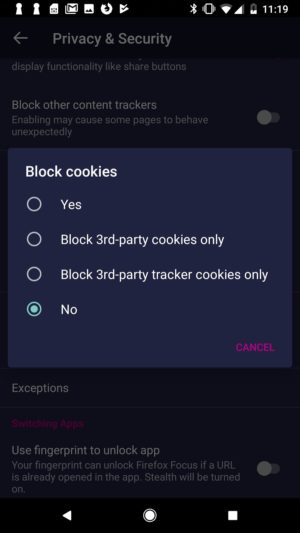 Firefox Focus now allows users to choose individually which cookies to accept.
When you block cookies, you might find that some pages may no longer work properly. But no worries, we’re here to offer a solution: With just 2 clicks you can now add websites to the new Firefox Focus “allowlist”, which unblocks cookies and trackers for the current page visit. As soon as you navigate to another website, the setting resets so you don’t have to worry about a forgotten setting that could weaken your privacy.
 The new Firefox Focus allowlist unblocks cookies and trackers for the current page visit.
An update on GeckoView
In October we were happy to announce that Firefox Focus was going to be powered by Mozilla’s own mobile engine GeckoView. It allows us to implement many amazing new features. We are currently working on a good deal of under-the-hood improvements to enhance the performance of GeckoView. Occasionally some minor bugs may still occur and we’re looking forward to gathering your feedback, learning from your experiences with GeckoView and improving the engine accordingly.
In order to provide our users with another GeckoView sneak peek and something to test, we’re proud to also provide a new feature today: Thanks to in-browser security warnings, your mobile web browsing will now be a lot less risky. Firefox Focus will check URLs against Google’s constantly updated lists of unsafe web resources, which includes phishing and other fraudulent sites, and will provide an alert if you reach an unsafe site. You may then either follow to safety, or ignore to continue navigating to the requested site. After all, we value users’ right to choose how to browse, and want to make sure they’re able to make informed choices.
 Firefox Focus now warns against phishing and other fraudulent sites.
Firefox Focus for iOS now supports search
Let’s imagine a not-too-distant future:
Imagine you are somewhere that is familiar to you such as your home, or your favorite park.
Imagine that everything around you is connected and it has a link.
Imagine you have the internet in your ears and you can speak directly to it.
Imagine that instead of 2D screens around you, the air is alive with knowledge and wonder.
Imagine that you are playing your favorite game with your friend while they are virtually sitting next to you.
Now, imagine what that looks like covered in ads. Malware is everywhere, and you have no control over what you see or hear.
Technology will continue to shape our lives and our future, but what that future looks like is up to us. We are excited about the internet growing and evolving, but new possibilities bring new challenges. We don’t need to give up control of our personal lives in exchange for great products that rely on personal data for ads. Here at Mozilla, we are working hard to make sure that new technologies evolve in a way that champion privacy and choice.
We do this by engaging with engineers, teachers, researchers, developers, creators, artists, and thinkers around the globe to ensure that every voice is heard. We are constantly building new prototypes and experimental products for platforms that have the potential to build a different kind of web experience.
Today, Mozilla is launching a new Mozilla Labs. This is our online space where anyone can find our latest creations, innovations, and cutting-edge technologies.
What will you find at Mozilla Labs?
Install Firefox Reality and browse the immersive web completely in virtual reality.
Those are just a few of the future technologies we worked on in 2018, and we are just getting started. As we ramp up for 2019, we will continue to innovate across platforms such as Virtual Reality, Augmented Reality, Internet of Things, Speech/Voice, Artificial Intelligence, Open Web Technologies, and so much more.
You can check out our cutting-edge projects on Mozilla Labs, or you can roll up your sleeves and contribute to one of our many open source projects. Together we can collectively build the future we want to see.
The post Create, test, innovate, repeat. appeared first on The Mozilla Blog.
https://blog.mozilla.org/blog/2018/12/20/create-test-innovate-repeat/
The Rust team is happy to announce a new version of Rust, 1.31.1. Rust is a systems programming language focused on safety, speed, and concurrency.
If you have a previous version of Rust installed via rustup, getting Rust 1.31.1 is as easy as:
$ rustup update stable
If you don't have it already, you can get rustup from the
appropriate page on our website, and check out the detailed release notes for
1.31.1 on GitHub.
What's in 1.31.1 stable
This patch release fixes a build failure on powerpc-unknown-netbsd by
way of an update to the libc
crate used by the compiler.
Additionally, the Rust Language Server was updated to fix two critical bugs. First, hovering over the type with documentation above single-line attributes led to 100% CPU usage:
/// Some documentation
#[derive(Debug)] // Multiple, single-line
#[allow(missing_docs)] // attributes
pub struct MyStruct { /* ... */ }
Go to definition was fixed for std types:
Before, using the RLS on HashMap, for example, tried to open this file
~/.rustup/toolchains/stable-x86_64-unknown-linux-gnu/lib/rustlib/src/rust/libstd/collections/hash/map.rs
and now RLS goes to the correct location (for Rust 1.31, note the extra src):
~/.rustup/toolchains/stable-x86_64-unknown-linux-gnu/lib/rustlib/src/rust/src/libstd/collections/hash/map.rs
At a talk I did a while ago, someone from the back of the audience raised this question. I found it to be such a great question that I decided to spend a few minutes and explain how this happens and why.
In this blog post I’ll stick to discussing the curl command line tool. “curl” is often also used as a shortcut for the library but let’s focus on the tool here.
When you use a particular curl version installed in a system near you, chances are that it differs slightly from the curl your neighbor runs or even the one that you use in the machines at work.
Why is this?
Versions
We release a new curl version every eight weeks. On average we ship over thirty releases in a five-year period.
A lot of people use curl versions that are a few years old, some even many years old. There are easily more than 30 different curl version in active use at any given moment.
Not every curl release introduce changes and new features, but it is very common and all releases are at least always corrected a lot of bugs from previous versions. New features and fixed bugs make curl different between releases.
Linux/OS distributions tend to also patch their curl versions at times, and then they all of course have different criteria and work flows, so the exact same curl version built and shipped from two different vendors can still differ!
Platforms
curl builds on almost every platform you can imagine. When you build curl for your platform, it is designed to use features, native APIs and functions available and they will indeed differ between systems.
curl also relies on a number of different third party libraries. The set of libraries a particular curl build is set to use varies by platform, but even more so due to the decisions of the persons or group that built this particular curl executable. The exact set, and the exact versions of each of those third party libraries, will change curl’s feature set, from subtle and small changes up to large really noticeable differences.
TLS libraries
As a special third party library, I want to especially highlight the importance of the TLS library that curl is built to use. It will change not only what SSL and TLS versions curl supports, but also how to handle CA certificates, it provides crypto support for authentication schemes such as NTLM and more. Not to mention that of course TLS libraries also develop over time so if curl is built to use an older release, it probably has less support for later features and protocol versions.
Feature shaving
When building curl, you can switch features on and off to a very large extent, making it possible to quite literally build it in several million different combinations. The organizations, people and companies that build curl to ship with their operating systems or their package distribution systems decide what feature set they want or don’t want for their users. One builder’s decision and thought process certainly does not have to match the ones of the others’. With the same curl version, the same TLS library on the same operating system two curl builds might thus still end up different!
Build your own!
If you aren’t satisfied with the version or feature-set of your own locally installed curl – build your own!
https://daniel.haxx.se/blog/2018/12/19/why-is-curl-different-everywhere/
This past weekend was a balmy 5 degrees Celsius which was lucky for me as I had to once again climb onto the roof of my house to deal with my Christmas lights. The middle two strings had failed bulbs somewhere along their length and I had a decent expectation that it was the Blue ones. Again.
Two years ago was our first autumn at our new house. The house needed Christmas lights so we bought four strings of them. Over the course of their December tour they suffered devastating bulb failures rendering alternating strings inoperable. (The bulbs are wired in a single parallel strand making a single bulb failure take down the whole string. However, connectivity is maintained so power flows through the circuit.)

Last year I tested the four strings and found them all faulty. We bought two replacement strings and I scavenged all the working bulbs from one of the strings to make three working strings out of the old four. All five (four in use, one in reserve) survived the season in working order.

This year in performing my sanity check before climbing the ladder I had to replace lamps in all three of the original strings to get them back to operating condition. Again.
And then I had an idea. A nerdy idea.
I had myself a wonderful nerdy idea!
“I know just what to do!” I laughed like an old miser.
I’ll gather some data and then visualize’er!
The strings are penta-colour: Red, Orange, Yellow, Green, and Blue. Each string has about an equal number of each colour of bulb and an extra Red and Yellow replacement bulb. Each bulb is made up of an internal LED lamp and an external plastic globe.
The LED lamps are the things that fail either from corrosion on the contacts or from something internal to the diode.
So I started with 6N+12 lamps and 6N+12 globes in total: N of each colour with an extra 1 Red and 1 Yellow per string. Whenever a lamp died I kept its globe. So the losses over time should manifest themselves as a surplus of globes and a defecit of lamps.
If the losses were equal amongst the colours we’d see a equal surplus of Green, Orange, and Blue globes and a slightly lower surplus of Red and Yellow globes (because of the extras). This is not what I saw when I lined them all up, though:

Instead we find ourselves with no oranges (I fitted all the extra oranges into empty blue spots when consolidating), an equal number of lamps and globes of yellow (yellow being one of the colours adjacent to most broken bulbs and, thus, less likely to be chosen for replacement), a mild surplus of red (one red lamp had evidently failed at one point), a larger surplus of green globes (four failed green lamps isn’t great but isn’t bad)…
And 14 excess blue globes.
Now, my sampling frequency isn’t all that high. And my knowledge of confidence intervals is a little rusty. But that’s what I think I can safely call a statistical outlier. I’m pretty sure we can conclude that, on my original set of strings of Christmas lights, Blue LEDs are more likely to fail than any other colour. But why?
I know from my LED history that high-luminance blue LEDs took the longest to be invented (patents filed in 1993 over 30 years after the first red LED). I learned from my friend who works at a display company that blue LEDs are more expensive. If I take those together I can suppose that perhaps the manufacturers of my light strings cheaped out on their lot of blue LEDs one year and stuck me, the consumer, with substandard lamps.
Instead of bringing joy, it brought frustration. But also predictive power because, you know what? On those two broken strings I had to climb up to retrieve this past, unseasonably-warm Saturday two of the four failed bulbs were indeed, as I said at the top, the Blue ones. Again.
:chutten
Hello and welcome to another issue of This Week in Rust! Rust is a systems language pursuing the trifecta: safety, concurrency, and speed. This is a weekly summary of its progress and community. Want something mentioned? Tweet us at @ThisWeekInRust or send us a pull request. Want to get involved? We love contributions.
This Week in Rust is openly developed on GitHub. If you find any errors in this week's issue, please submit a PR.
Updates from Rust Community
News & Blog Posts
- Tools in the 2018 edition.
- Making Rust float parsing fast and correct.
- Bootstrapping Rust.
- Async in Rust, circa 2018.
- Rust Analyzer in 2018 and 2019.
- Rust and WebAssembly in 2019.
- Storing unboxed trait objects in Rust.
- Currying in Rust — Part 2 (A glimpse of generics).
- Building a JS Interpreter in Rust part 1.
- Edge programming with Rust and WebAssembly.
#Rust2019
Find all #Rust2019 posts at Read Rust.
Crate of the Week
This week's crate is yaserde, a specialized XML (de)serialization crate compatible with serde. Thanks to Marc Antoine Arnaud for the suggestion!
Submit your suggestions and votes for next week!
Call for Participation
Always wanted to contribute to open-source projects but didn't know where to start? Every week we highlight some tasks from the Rust community for you to pick and get started!
Some of these tasks may also have mentors available, visit the task page for more information.
- A call for Rust 2019 Roadmap blog posts.
- Rust Latam CFP is now open, deadline is December 31st.
- Tarpaulin: OSX support tracking issue. Tarpaulin is a code coverage tool for Rust projects.
- The imag project calls for contributors (2).
If you are a Rust project owner and are looking for contributors, please submit tasks here.
Updates from Rust Core
247 pull requests were merged in the last week
- x86: add the
adxtarget feature to whitelist - bump minimum required LLVM version to 6.0
- unconditionally emit the target-cpu LLVM attribute
- account for
impl Traitwhen suggesting lifetime
My so far last BugBountyNotes challenge is called Can you get the flag from this browser extension?. Unlike the previous one, this isn’t about exploiting logical errors but the more straightforward Remote Code Execution. The goal is running your code in the context of the extension’s background page in order to extract the flag variable stored there.
If you haven’t looked at this challenge yet, feel free to stop reading at this point and go try it out. Mind you, this one is hard and only two people managed to solve it so far. Note also that I won’t look at any answers submitted at this point any more. Of course, you can also participate in any of the ongoing challenges as well.
Still here? Ok, I’m going to explain this challenge then.
The obvious vulnerability
This browser extension is a minimalist password manager: it doesn’t bother storing passwords, only login names. And the vulnerability is of a very common type: when generating HTML code, this extension forgets to escape HTML entities in the logins:
for (let login of logins)
html += `${login} `;Since the website can fill out and submit a form programmatically, it can make this extension remember whichever login it wants. Making the extension store something like login will result in JavaScript code executing whenever the user opens the website in future. Trouble is: the code executes in the context of the same website that injected this code in the first place, so nothing is gained by that.
Getting into the content script
What you’d really want is having your script run within the content script of the extension. There is an interesting fact: if you call eval() in a content script, code will be evaluated in the context of the content script rather than website context. This happens even if the extension’s content security policy forbids eval: content security policy only applies to extension pages, not to its content scripts. Why the browser vendors don’t tighten security here is beyond me.
And now comes something very non-obvious. The HTML code is being inserted using the following:
$container = $(html);
$login.parent().prepend($container);
One would think that jQuery uses innerHTML or its moral equivalent here but that’s not actually true. innerHTML won’t execute JavaScript code within
https://palant.de/2018/12/17/bbn-challenge-resolution-getting-the-flag-from-a-browser-extension
One of the great things about Firefox is the ability to customize with extensions.A MIG-15 can climb and turn faster than an F-86. A MIG-15 is more heavily armed. But in actual dogfights the F-86 won 9 out of 10 times. Part of that is training, but part is that the Soviets used data to build for the average pilot, while the USA did a bigger study of pilots' measurements and recognized that adjustable seats and controls were necessary. Even in a group of pilots of average overall size, nobody was in the average range on all their measurements. Here is what I'm running right now.
Awesome RSS. Get the RSS button back. Works great with RSS Preview.
blind-reviews. This is an experiment to help break your own habits of bias when reviewing code contributions. It hides the contributor name and email when you first see the code, and you can reveal it later.
Cookie AutoDelete. Similar to the old "Self-Destructing Cookies". Cleans up cookies after leaving a site. Useful but requires me to whitelist the sites where I want to stay logged in. More time-consuming than other privacy tools. This is a good safety measure that helps protect me while I'm trying out new the new privacy settings in Firefox Nightly as my main data protection tool.
Copy as Markdown. Not quite as full-featured as the old "Copy as HTML Link" but still a time-saver for blogging. Copy both the page title and URL, formatted as Markdown, for pasting into a blog.
Facebook Container because, well, Facebook.
Facebook Political Ad Collector, even though I don't visit Facebook very often. This one reports sneaky Facebook ads to ProPublica.
Global Consent Manager, which provides an improved consent experience for European sites. More info coming soon.
HTTPS Everywhere. This is pretty basic. Use the encrypted version of a site where available.
Link Cleaner. Get rid of crappy tracking parameters in URLs, and speed up some navigation by skipping data collection redirects.
NJS. Minimal JavaScript disable/enable button that remembers the setting by site and defaults to "on". Most sites that use JavaScript for real applications are fine, but this is for handling sites that cut and pasted a "Promote your newsletter to people who haven't even read your blog yet" script from some "growth hacking" article.
Personal Blocklist is surprisingly handy for removing domains that are heavy on SEO but weak on actual information from search results. (the Ministry of Central Planning at Google is building the perfectly-measured MIG cockpit, while extension developers make stuff adjustable.)
RSS Preview. The other missing piece of the RSS experience. The upside to the unpopularity of RSS is that so many sites just leave the full-text RSS feeds, that came with their CMS, turned on.
Bonus links
'Artifact' Isn't a Game on Steam, It's Steam in a Game - Waypoint
Does It Matter Where You Go to College?
LCA 2018 is happening in January in Christchurch (which is a great conference and has a few Rust talks this year). I'm not able to attend, but I am in town, so I hope to meet some of my internet friends (get in touch!).
I thought I'd write down a few things to do in Christchurch for those who are new to the city. Don't get your hopes up for lots of tourist fun though (unless you have time to see some of the surrounding country), it is not the most interesting city, even less so since half of it was flattened in an earthquake. For more ideas, I like the Neat Places website.
Good places to drink coffee
- C4
- Coffee Embassy
- the brunch places below
Good places to drink alcohol
- The Volsted (near-ish the university)
- 44 Welles Street
Good places to eat brunch
- Hello Sunday
- Unknown Chapter
- Supreme Supreme (if they re-open in time - they're currently closed for refurbishment)
- Addington Coffee Co
- Caffeine Laboratory
- Black Betty
- Southside Social
Good places to eat dinner
- Rangoon Ruby (Burmese)
- Mumbaiwala (fancy Indian street food)
- Birkenavala (cheap and delicious Indian)
- Little High Eatery (hipster food court, lots of options)
- Mexico (interesting but expensive Mexican food and lots of drinks)
- Cassels (great pizza and great beer)
Best ice cream
- Rollickin’ Gelato
Best place to swim
- Jellie Park - 50m outdoor pool and 2x25m indoor pools. Also a decent gym which you can use without a membership.
Best place to run
- Hagley Park
Best beach
- Sumner - it has a good bit of sand plus some surfing and is a nice little beach village
Good places to go nearby
- Castle Hill (On the way to Arthur's Pass, kind of magical, nature-sculpted boulders to work amongst)
- Arthur's Pass national park (Mountains and forests, one of NZ's lesser visited NPs, but one of my favourite)
- Akaroa (cute tourist town (and you can swim with dolphins), drive there the long way via Governor's Bay and enjoy food and views and chocolate at She cafe, as well as a nice drive. If you like cheese, stop at Barrys Bay)
Good things to see and do in town
- Look at the ruins of the Cathedral and wonder the new city centre.
- Riccarton House farmers market (Saturday Morning; lots of nice things to eat and drink)
- Walk in the Port Hills
- The Buskers Festival (Throughout January, lots of shows)
- Go to the beach (see above)
Any questions, ping me on twitter - @nick_r_cameron.
Periodically I refresh my machines by dusting them off and plugging them in and running them for a while to keep the disks spinnin' and the caps chargin'. Today was the day to refurbish my Sun Ultra-3, the only laptop Sun ever "made" (they actually rebadged the SPARCle and later the crotchburner 1.2GHz Tadpole Viper, which is the one I have). Since its last refresh the IDPROM had died, as they do when they run out of battery, resetting the MAC address to zeroes and erasing the license for the 802.11b which I never used anyway. But, after fixing the clock to prevent GNOME from puking on the abnormal date, it booted and I figured I'd update Firefox since it still had 38.4 on it. Ginn Chen, first at Sun and later at Oracle, regularly issued builds of Firefox which ran very nicely on SPARC Solaris 10. Near as I can determine, Oracle has never offered a build of any Firefox post-Rust even to the paying customers they're bleeding dry, but I figured I should be able to find the last ESR of 52 and install that. (Amusingly this relic can run a Firefox in some respects more current than TenFourFox, which is an evolved and patched Firefox 45.)
To my consternation, however, there was no contributed build for 52.9, the last 52ESR. I had to walk all the way back to 52.0.2 to find the last Solaris 10 package, which was accompanied by this sad message:
This directory contains Solaris builds of Firefox 52.0.2 ESR, which are contributed by Oracle Solaris Desktop Beijing Team. If you have any problem with these builds, please send email to ginnchen at gmail dot comThis is the last contrib build before I leave Oracle.
My job is eliminated.
Thanks everyone for supporting me.
ginnchen@...
I don't know if anyone ever said to Ginn how much all that work was appreciated. Well, I'm saying it now. I hope for much greener pastures away from scum like Larry, who ruined Sun, Solaris and SPARC just by being his scummy self, and lays off good folks just so he can buy another island. Here is Ginn's last build:

To this day, in Solaris 11, Firefox 52.9 is the last Firefox available, probably using Ginn's work.
http://tenfourfox.blogspot.com/2018/12/a-thank-you-to-ginn-chen-whom-larry.html
Hi! The newsletter skipped a week because of Mozilla’s bi-annual allhands which took place in Orlando last week. We’ll probably skip a few others in December as a lot of the gfx folks are taking some time off. Before I get to the usual change list, I’ll continue answering the questions nic4r asked in the 31st newsletter’s comment section:
Is the interning work Glenn is doing related to picture caching?
Yes indeed. In order for picture caching to work across displaylists we must be able to detect what did not change after a new displaylist arrives. The interning mechanism introduced by Glenn in #3075 gives us this ability in addition to other goodies such as de-duplication of interned resources and less CPU-GPU data transfer.
What is blob tiling and what does it offer above normal blob rendering?
Tiling blobs means splitting blobs into square tiles. For very large blobs this means we can lazily rasterize tiles as they come into the viewport without throwing away the rest instead of either rasterizing excessively large blob images in one go or having to clip the blob against the viewport and re-rasterize everything during scrolling as the bounds of the blob change. It also lets us rasterize tiles in parallel.
Is there a bug to watch some of the document splitting work going on? My understanding is that document splitting will make the chrome more resilient against slow scene builds in the content frame? Is this right? How does this compare to push_iframe in the DL.
You can look at bug 1441308 although it doesn’t contain a lot of updates. In a nutshell, the bulk of the Gecko side work is done and there are WebRender side adjustments and some debugging to do. Currently WebRender can nest displaylists from different sources (content, UI, etc) by nesting iframes into a single document. Any change to the document more or less causes it to be re-rendered entirely (modulo caching optimizations).
Separating the UI and web content into separate documents mostly means we will update them independently and updating one won’t cause the other to be re-built and re-rendered. It will also let us render the the two in separate OS compositor windows.
One of the most complicated aspect of this is probably due to the way the browser is structured to nest the web content within the UI (there is both a background behind the web content and elements on top of it that belong to the UI). A lot of the work that went into this was to be able to split without introducing a lot of overdraw (needlessly allocating texture space for the background behind the web content and drawing it).
OMTA for color, gradients, etc? How much more of CSS can be feasibly calculated off thread and fed to WR using its Property Binding infra?
Anything is possible given enough time and motivation but with WebRender’s current architecture, any of the data that is fed directly to the shaders is a good candidate for animated property bindings. Colors are particularly appealing because it is the most commonly animated CSS property that we don’t already run as an off-main-thread animation (I don’t have the data handy though). We’ll likely tackle these nice perf optimizations after WebRender is shipped and stable.
Notable WebRender and Gecko changes
- Bobby overhauled WebRender shader cache.
- Bobby switched non-WebRender’s AWSY test to VMs with GPUs.
- Kats made some Android improvements.
- Kats made some progress on the Windows CI work.
- Kvark removed some memcpys leading to a 5% improvement on dl_mutate.
- Kvark improved the render target allocation scheme, improving GPU times and VRAM consumption on a lot of sites.
- Matt added new telemetry.
- Andrew fixed a few regressions from animated image recycling.
- Andrew Kvark and Nical chased a crash caused by two race conditions and landed two fixes.
- Emilio fixed transform flattening.
- Emilio enabled warning-as-errors for rust code in CI.
- Glenn fixed the way we track frame ids.
- Glenn
This curl release was developed and put together over a period of six weeks (two weeks less than usual). This was done to accommodate to my personal traveling plans – and to avoid doing a release too close to Christmas in case we would ship any security fixes, but ironically, we have no security advisories this time!
Numbers
the 178th release
3 changes
42 days (total: 7,572)
79 bug fixes (total: 4,837)
122 commits (total: 23,799)
0 new public libcurl functions (total: 80)
1 new curl_easy_setopt() options (total: 262)
0 new curl command line option (total: 219)
51 contributors, 21 new (total: 1,829)
31 authors, 14 new (total: 646)
0 security fixes (total: 84)
Changes
With the new CURLOPT_CURLU option, an application can now pass in an already parsed URL to libcurl instead of a string.
When using libcurl’s URL API, introduced in 7.62.0, the result is held in a “handle” and that handle is what now can be passed straight into libcurl when setting up a transfer.
In the command line tool, the –write-out option got the ability to optionally redirect its output to stderr. Previously it was always a given file or stdout but many people found that a bit limiting.
Interesting bug-fixes
Weirdly enough we found and fixed a few cookie related bugs this time. I say “weirdly” because you’d think this is functionality that’s been around for a long time and should’ve been battle tested and hardened quite a lot already. As usual, I’m only covering some bugs here. The full list is in the changelog!
Cookie saving – One cookie bug that we fixed was related to libcurl not saving a cookie jar when no cookies are kept in memory (any more). This turned out to be a changed behavior due to us doing more aggressive expiry of old cookies since a while back, and one user had a use case where they would load cookies from a cookie jar and then expect that the cookies would update and write to the jar again, overwriting the old one – although when no cookies were left internally it didn’t touch the file and the application thus reread the old cookies again on the next invoke. Since this was subtly changed behavior, libcurl will now save an empty jar in this situation to make sure such apps will note the blank jar.
Cookie expiry – For the received cookies that get ‘Max-Age=0’ set, curl would treat the zero value the same way as any number and therefore have the cookie continue to exist during the whole second it arrived (time() + 0 basically). The cookie RFC is actually rather clear that receiving a zero for this parameter is a special case and means that it should rather expire it immediately and now curl does.
Timeout handling – when calling curl_easy_perform() to do a transfer, and you ask libcurl to timeout that transfer after say 5.1 seconds, the transfer hasn’t completed in that time and the connection is in fact totally idle at that time, a recent regression would make libcurl not figure this out until a full 6 seconds had elapsed.
NSS – we fixed several minor issues in the NSS back-end this time. Perhaps the most important issue was if the installed NSS library has been built with TLS 1.3 disabled while curl was built knowing about TLS 1.3, as then things like the ‘–tlsv1.2’ option would still cause errors. Now curl will fall back correctly. Fixes were also made to make sure curl again works with NSS versions back to 3.14.
OpenSSL – with TLS 1.3 session resumption was changed for TLS, but now curl will support it with OpenSSL.
snprintf – curl has always had its own implementation of the *printf() family of functions for portability reasons. First, traditionally snprintf() was not universally available but then also different implementations have different support for things like 64 bit integers or size_t fields and they would disagree on return values. Since curl’s snprintf() implementation doesn’t use the
Firefox 64 is available today! Our new browser has a wealth of exciting developer additions both in terms of interface features and web platform features, and we can’t wait to tell you about them. You can find out all the news in the sections below — please check them out, have a play around, and let us know your feedback in the comment section below.
New Firefox interface features
Multiple tab selection
We’re excited to introduce multiple tab selection, which makes it easier to manage windows with many open tabs. Simply hold Control (Windows, Linux) or Command (macOS) and click on tabs to select them.
Once selected, click and drag to move the tabs as a group — either within a given window, or out into a new window.
Devtools improvements
Our Developer Tools also gained a notable new feature: when hovering over text, the Accessibility Inspector now displays text contrast ratios in the pop-up infobar.

The infobar also indicates whether or not the text meets WCAG 2.0 Level AA or AAA accessibility guidelines for minimum contrast.
Another great addition is related to Responsive Design Mode — device selection is now saved between sessions.
New CSS features in 64
Standardizing proprietary styling features
As part of our platform work, we’re trying to standardize some of the non-standard CSS features that have often caused developers cross-browser headaches. Landing in 64 we’ve got the following:
- CSS Scrollbars: The CSS Scrollbars Level 1 spec standardizes features for setting scrollbar width and color, which were originally only available in Internet Explorer. See CSS Scrollbars on MDN Web Docs and Scrollbars on CSS Tricks for more information.
-webkit-appearance: To make the effects of theappearanceproperty more consistent across browsers, Firefox has unshipped all of its own proprietary values from web content, and added support for all the-webkit-prefixed versions that are in common use. See https://developer.mozilla.org/en-US/docs/Web/CSS/appearance on MDN Web Docs for more information.- Going forward in Firefox, if a selector chain or group includes a
-webkit-prefixed pseudo-element, that pseudo-element no longer invalidates the whole group.
New media queries
Firefox 64 sees the addition of new media queries from the Level 4 and Level 5 specifications for detecting pointers/touchscreens, whether the user can hover over something, and whether the user prefers reduced-motion.
Multi-position color stop gradients
CSS gradients now support multi-position color stops (e.g. see their use on linear gradients). So now yellow 25%, yellow 50% can now be written yellow 25% 50%, for example.
JavaScript improvements
There were a lot of internal improvements this time around. In terms of developer facing improvements:
- The TC39 Well-formed JSON.stringify proposal has been implemented, to prevent JSON.stringify
It’s the season for spending time with family and friends over a nice meal and exchanging gifts. Whether it’s a monogrammed bag or a nicely curated 2019 calendar of family photos, it’s the practical gifts that get the most use.
For Firefox, we’re always looking for ways to simplify and personalize your online experience. For today’s version of Firefox for desktop, we have a couple new features that do just that. They include:
Contextual Feature Recommender (CFR)
Aimed at people who are looking to get more out of their online experience or ways to level up. CFR is a system that proactively recommends Firefox features and add-ons based on how you use the web. For example, if you open multiple tabs and repeatedly use these tabs, we may offer a feature called “Pinned Tabs” and explain how it works. Firefox curates the suggested features and notifies you. With today’s release, we will start to rollout with three recommended extensions which include: Facebook Container, Enhancer for YouTube and To Google Translate. This feature is available for US users in regular browsing mode only. They will not appear in Private Browsing mode. Also, Mozilla does NOT receive a copy of your browser history. The entire process happens locally in your copy of Firefox.
Multiple Tab Organization
When you go online, it’s not uncommon to have several tabs open on a variety of topics whether it’s dinner recipes or gift ideas for your family, it can add up to a lot of tabs. How does anyone ever organize all those tabs? In today’s release, you can now shift or ctrl-click multiple tabs from the tab bar, and organize them the way you want. You can mute, move, bookmark or pin them quickly and easily.
Here’s a link to our release notes for a complete list of what’s included in today’s release.
Check out and download the latest version of Firefox Quantum available here. For the latest version of Firefox for iOS, visit the App Store.
The post Latest Firefox Release Available Today appeared first on The Mozilla Blog.
https://blog.mozilla.org/blog/2018/12/11/latest-firefox-release-available-today/
Rust shines when we find ways to have our cake and eat it too: memory safety without runtime garbage collection, abstraction without overhead, threading without data races. We must find new ways to continue this tradition for Rust 2019 and beyond.
On a day-to-day basis, I am dedicated to small, incremental progress. If a pull request is an improvement over the status quo, merge it now! Don’t wait for the pull request to be perfectly pristine or the feature to be 100% complete. Each day we drag reality inch by inch towards the ideal.
However, when planning on the scale of years, our vision must not be weighed down by discussion of incremental improvements: we must rise and collectively define the lofty ideals we aim for. It requires avoiding local maxima. Nick Cameron’s Rust in 2022 post, where he starts with what we might want in a Rust 2022 edition and then works backwards from there, is a great example.
With that out of the way, I will make a couple suggestions for the Rust 2019 roadmap. I will leave my thoughts for the Rust and WebAssembly domain working group’s 2019 roadmap for a future post.
Speed Up Compilation
Tired: make
rustcfaster.Wired: integrate distributed compilation and artifact caching into
cargoand crates.io.
Of course we should continue identifying and implementing performance wins in
rustc itself. We should even invest in larger scale rearchitecting like adding
finer-grained parallelism in with rayon (I won’t go into too many specifics
here because I’m largely ignorant of them!)
But we should also be thinking bigger.
The fastest compilation is the one that you didn’t have to do. If we integrate
something like sccache into cargo and crates.io, then individuals
can download pre-built artifacts for common dependencies from a shared cache and
save big on local CPU time. In comparison, a 5% speedup to trait resolution is
peanuts. This is an opportunity that is not available to most language
ecosystems! Most languages don’t have a compiler toolchain, build system, and
package manager that are widely used together and well integrated.
First-Class, Domain-Specific Workflows
Tired: make
wasm-packreally good.Wired: make
wasm-packunnecessary by building generic task hooks intocargoitself.
Different domains have different workflows that extend past cargo build. With
WebAssembly, we must also generate JavaScript bindings, run tools like
wasm-opt, create a package.json to integrate with NPM and JavaScript
tooling, etc… For embedded development, you need to at minimum flash your
built program into your microcontroller’s persistent memory.
To perform these tasks today, we typically write whole new tools that wrap
cargo (like wasm-pack), invoke external tools manually (like using openocd
by hand), or write a cargo-mytask package to add the cargo mytask
subcommand. These solutions suffer from either repetition and a lack of
automation, or they wrap cargo but fail to expose all the wonderful features
that cargo supports (for example, you can’t use the --feature flag yet with
wasm-pack). We should not write these tools that wrap cargo, we should write
generic build tasks, which are invoked automatically by cargo itself.
cargo should not just grow a post_build.rs hook, its build tasks and
dependencies between tasks and artifacts should become fully extensible. I
should be able to depend on wasm build tasks in my Cargo.toml, and then after
that cargo build should just Do The Right Thing. I shouldn’t have to compile
these wasm build tasks for every project I use them with. cargo and crates.io
should handle transparently distributing the wasm task binaries to me.
Growing Working Groups
Tired: the Rust project should start a working group for
$PROJECT_OR_DOMAIN.Wired: the Rust project should have a working group template, and system of mentorship for new (and old!) working group leads.
The more we collaborate and work together, the better we can tackle problems that are larger than any one of us. The primary way we’ve been organizing technical efforts in the Rust project has been working groups. But starting a new working group is hard, and leading a working group is hard.
We should have a template for new working groups that comes with
Rust shines when we find ways to have our cake and eat it too: memory safety without runtime garbage collection, abstraction without overhead, threading without data races. We must find new ways to continue this tradition for Rust 2019 and beyond.
On a day-to-day basis, I am dedicated to small, incremental progress. If a pull request is an improvement over the status quo, merge it now! Don’t wait for the pull request to be perfectly pristine or the feature to be 100% complete. Each day we drag reality inch by inch towards the ideal.
However, when planning on the scale of years, our vision must not be weighed down by discussion of incremental improvements: we must rise and collectively define the lofty ideals we aim for. It requires avoiding local maxima. Nick Cameron’s Rust in 2022 post, where he starts with what we might want in a Rust 2022 edition and then works backwards from there, is a great example.
With that out of the way, I will make a couple suggestions for the Rust 2019 roadmap. I will leave my thoughts for the Rust and WebAssembly domain working group’s 2019 roadmap for a future post.
Speed Up Compilation
Tired: make
rustcfaster.Wired: integrate distributed compilation and artifact caching into
cargoand crates.io.
Of course we should continue identifying and implementing performance wins in
rustc itself. We should even invest in larger scale rearchitecting like adding
finer-grained parallelism in with rayon (I won’t go into too many specifics
here because I’m largely ignorant of them!)
But we should also be thinking bigger.
The fastest compilation is the one that you didn’t have to do. If we integrate
something like sccache into cargo and crates.io, then individuals
can download pre-built artifacts for common dependencies from a shared cache and
save big on local CPU time. In comparison, a 5% speedup to trait resolution is
peanuts. This is an opportunity that is not available to most language
ecosystems! Most languages don’t have a compiler toolchain, build system, and
package manager that are widely used together and well integrated.
First-Class, Domain-Specific Workflows
Tired: make
wasm-packreally good.Wired: make
wasm-packunnecessary by building generic task hooks intocargoitself.
Different domains have different workflows that extend past cargo build. With
WebAssembly, we must also generate JavaScript bindings, run tools like
wasm-opt, create a package.json to integrate with NPM and JavaScript
tooling, etc… For embedded development, you need to at minimum flash your
built program into your microcontroller’s persistent memory.
To perform these tasks today, we typically write whole new tools that wrap
cargo (like wasm-pack), invoke external tools manually (like using openocd
by hand), or write a cargo-mytask package to add the cargo mytask
subcommand. These solutions suffer from either repetition and a lack of
automation, or they wrap cargo but fail to expose all the wonderful features
that cargo supports (for example, you can’t use the --feature flag yet with
wasm-pack). We should not write these tools that wrap cargo, we should write
generic build tasks, which are invoked automatically by cargo itself.
cargo should not just grow a post_build.rs hook, its build tasks and
dependencies between tasks and artifacts should become fully extensible. I
should be able to depend on wasm build tasks in my Cargo.toml, and then after
that cargo build should just Do The Right Thing. I shouldn’t have to compile
these wasm build tasks for every project I use them with. cargo and crates.io
should handle transparently distributing the wasm task binaries to me.
Growing Working Groups
Tired: the Rust project should start a working group for
$PROJECT_OR_DOMAIN.Wired: the Rust project should have a working group template, and system of mentorship for new (and old!) working group leads.
The more we collaborate and work together, the better we can tackle problems that are larger than any one of us. The primary way we’ve been organizing technical efforts in the Rust project has been working groups. But starting a new working group is hard, and leading a working group is hard.
We should have a template for new working groups that comes with
A response to the call for 2019 roadmap blog posts.
In case you missed it, we released our second edition of Rust this year! An edition is an opportunity to make backwards incompatible changes, but more than that it's an opportunity to bring attention to how programming in Rust has changed. With the 2018 edition out of the door, now is the time to think about the next edition: how do we want programming in Rust in 2022 to be different to programming in Rust today? Once we've worked that out, lets work backwards to what should be done in 2019.
Without thinking about the details, lets think about the timescale and cadence it gives us. It was three years from Rust 1.0 to Rust 2018 and I expect it will be three years until the next edition. Although I think the edition process went quite well, I think that if we'd planned in advance then it could have gone better. In particular, it felt like there were a lot of late changes which could have happened earlier so that we could get more experience with them. In order to avoid that I propose that we aim to avoid breaking changes and large new features landing after the end of 2020. That gives 2021 for finishing, polishing, and marketing with a release late that year. Working backwards, 2020 should be an 'impl year' - focussing on designing and implementing the things we know we want in place for the 2021 edition. 2019 should be a year to invest while we don't have any release pressure.
To me, investing means paying down technical debt, looking at our processes, infrastructure, tooling, governance, and overheads to see where we can be more efficient in the long run, and working on 'quality of life' improvements for users, the kind that don't make headlines but will make using Rust a better experience. It's also the time to investigate some high-risk, high-reward ideas that will need years of iteration to be user-ready; 2019 should be an exciting year!
The 2021 edition
I think Rust 2021 should be about Rust's maturity. But what does that mean? To me it means that for a programmer in 2022, Rust is a safe choice with many benefits, not a high-risk/high-reward choice. Choosing Rust for a project should be a competitive advantage (which I think it is today), but it should not require investment in libraries, training, or research.
Some areas that I think are important for the 2021 edition:
- sustainability: Rust has benefited from being a new and exciting language. As we get more mature, we'll become less exciting. We need to ensure that the Rust project has sufficient resources for the long term, and that we have a community and governance structure that can support Rust through the (hopefully) long, boring years of its existence. We'll need to think of new ways to attract and retain users (as well as just being awesome).
- diversity: Rust's community as a good reputation as a welcoming community. However, we are far from being a diverse one. We need to do more.
- mature tools: Cargo must be more flexible, IDE support must be better, debugging, profiling, and testing need to be easy to use, powerful, and flexible. We need to provide the breadth and depth of tool support which users expect from established languages.
- async programming: high-performance network programming is an amazing fit for Rust. Work on Linkerd and Fuchsia has already proved this out. Having a good story around async programming will make things even better. I believe Rust could be the best choice in this domain by a wide margin. However, building out the whole async programming story is a huge task, touching on language features, libraries, documentation, programming techniques, and crates. The current work already feels huge and I believe that this is only the beginning of iteration.
- std, again: Rust's standard library is great, a point in favour of Rust. Since Rust 1.0 there have been steady improvements, but the focus has been on the wider ecosystem. I think for the next edition we will need to consider a second wave of work. There are some fundamental things that are worth re-visiting (e.g., Parking Lot mutexes), and a fair few things where our approach has been to let things develop as crates 'for now', and where we either need to move them into std, or re-think user workflow around discoverability, etc. (e.g., Crossbeam, Serde).
- error handling: we really need to improve the ergonomics of error handling. Although the mechanism is (IMO) really great, it is pretty high-friction compared to exceptions. We should look at ways to improve this (
Ok-wrapping,throwsin function signatures, etc.). I think this is an edition issue since it will probably require a breaking
The big bug bounty platforms are structured like icebergs: the public bug bounty programs that you can see are only a tiny portion of everything that is going on there. As you earn your reputation on these platforms, they will be inviting you to private bug bounty programs. The catch: you generally aren’t allowed to discuss issues reported via private bug bounty programs. In fact, you are not even allowed to discuss the very existence of that bug bounty program.
I’ve been playing along for a while on Bugcrowd and Hackerone and submitted a number of vulnerability reports to private bug bounty programs. As a result, I became convinced that these private bug bounty programs are good for the bottom line of the bug bounty platforms, but otherwise their impact is harmful. I’ll try to explain here.
What is a bug bounty?
When you collect a bug bounty, that’s not because you work for a vendor. There is no written contract that states your rights and obligations. In its original form, you simply stumble upon a security vulnerability in a product and you decide to do the right thing: you inform the vendor. In turn, the vendor gives you the bug bounty as a token of their appreciation. It could be a monetary value but also some swag or an entry in the Hall of Fame.
Why pay you when the vendor has no obligation to do so? Primarily to keep you doing the right thing. Some vulnerabilities could be turned into money on the black market. Some could be used to steal data or extort the vendor. Everybody prefers people to earn their compensation in a legal way. Hence bug bounties.
What the bug bounty isn’t
There are so many bug bounty programs around today that many people made them their main source of income. While there are various reasons for that, one thing should not be forgotten: there is no law guaranteeing that you will be paid fairly. No contract means that your reward is completely dependent on the vendor. And it is hard to know in advance, sometimes the vendor will claim that they cannot reproduce, or downplay severity, or mark your report as a duplicate of a barely related report. In at least some cases there appears to be intent behind this behavior, the vendor trying to fit the bug bounty program into a certain budget regardless of the volume of the reports. So any security researcher trying to make a living from bug bounties has to calculate pessimistically, e.g. expecting that only one out of five reports will get a decent reward.
On the vendor’s side, there is a clear desire for the bug bounty program to replace penetration tests. Bugcrowd noticed this trend and is tooting their bug bounty programs as the “next gen pen test.” The trouble is, bug bounty hunters are only paid for bugs where they can demonstrate impact. They have no incentives to report minor issues, not only will the effort of demonstrating the issue be too high for the expected reward, it also reduces their rating on the bug bounty platform. They have no incentives to point out structural weaknesses, because these reports will be closed as “informational” without demonstrated impact. They often have no incentives to go for the more obscure parts of the product, these require more time to get familiar with but won’t necessarily result in critical bugs being discovered. In short, a “penetration test” performed by bug bounty hunters will be everything but thorough.
How are private bug bounties different for researchers?
If you feel that you are treated unfairly by the vendor, you have essentially two options. You can just accept it and vote with your feet: move on to another bug bounty program and learn how to recognize programs that are better avoided. The vendor won’t care as there will be plenty of others coming their way. Or you can make a fuzz about it. You could try to argue and probably escalate to the bug bounty platform vendor, but IMHO this rarely changes anything. Or you could publicly shame the vendor for their behavior and warn others.
The latter is made impossible by the conditions to participate in private bug bounty programs. Both Bugcrowd and Hackerone disallow you from talking about your experience with the program. Bug bounty hunters are always dependent on the good will of the vendor, but with private bug bounties it is considerably worse.
But it’s not only that. Usually, security researchers want recognition for their findings. Hackerone even has a process for disclosing vulnerability reports once the issue has been fixed. Public Bugcrowd programs also usually provision for coordinated disclosure. This gives the reporters the deserved recognition and allows everybody else to learn. But guess what: with private bug bounty programs, disclosure is always forbidden.
Why will people participate in private bug bounties at all? Main reason seems to be the reduced competition, finding unique issues is easier. In