Дневник rss_planet_mozilla
Лента друзей - Дневник - Полная версия
rss_planet_mozilla (rss_planet_mozilla)
Kim Moir: Beyond the Code 2016 recap
30-09-2016 16:10
к комментариям - к полной версии
- понравилось!
The conference started off with Anna Lambert of Shopify welcoming everyone to the conference.


The first speaker was Atlee Clark, Director of App and Developer relations at Shopify who discussed the wheel of diversity.

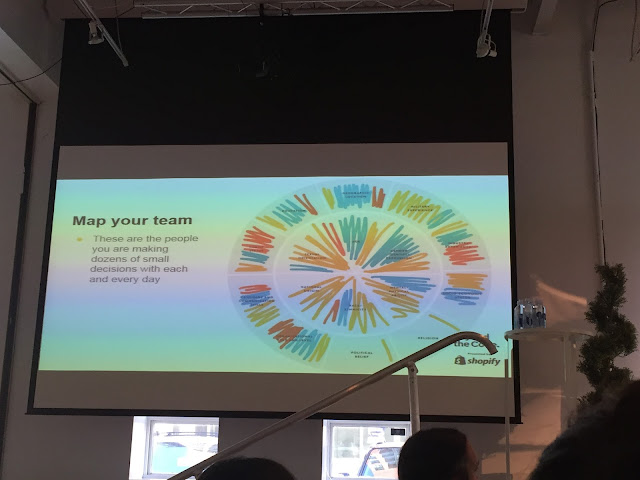
The wheel of diversity is a way of mapping the characteristics that you're born with (age, gender, gender expression, race or ethnicity, national origin, mental/physical ability), along with those that you acquire through life (appearance, education, political belief, religion, income, language and communication skills, work experience, family, organizational role). When you look at your team, you can map how diverse it is by colour. (Of course, some of these characteristics are personal and might not be shared with others). You can see how diverse the team is by mapping different characteristics with different colours. If you map your team and it's mostly the same colour, then you probably will not bring different perspectives together when you work because you all have similar backgrounds and life experiences. This is especially important when developing products.
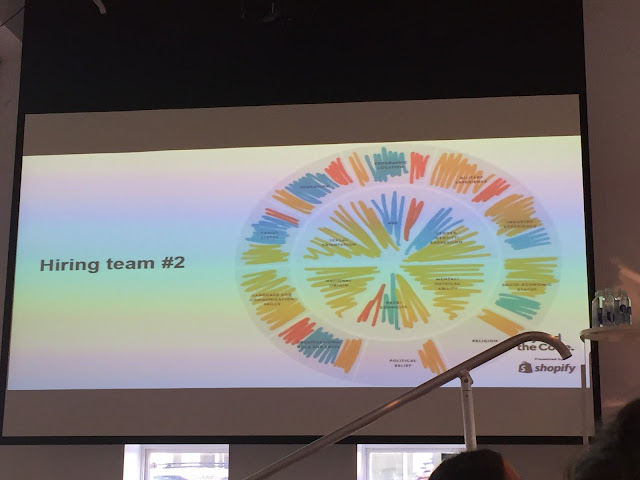
This wheel also applies to hiring too. You want to have different perspectives when you're interviewing someone. Atlee mentioned when she was hiring for a new role, she mapped out the characteristics of the people who would be conducting the hiring interviews and found there was a lot of yellow.

So she switched up the team that would be conducting the interviews to include people with more diverse perspectives.
 She finished by stating that this is just a tool, keep it simple, and practice makes it better.
The next talk was by Erica Joy, who is a build and release engineer at Slack, as well as a diversity advocate. I have to admit, when I saw she was going to speak at Beyond the Code, I immediately pulled out my credit card and purchased a conference ticket. She is one of my tech heroes. Not only did she build the build and release pipeline at Slack from the ground up, she is an amazing writer and advocate for change in the tech industry. I highly recommend reading everything she has written on Medium, her chapter in Lean Out and all her discussions on twitter. So fantastic.
Her talk at the conference was "Building a Diverse Corporate Culture: Diversity and Inclusion in Tech". She talked about how literally thousands of companies say they value inclusion and diversity. However, few talk about what they are willing to give up to order to achieve it. Are you willing to give up your window seat with a great view? Something else so that others can be paid fairly? She mentioned that change is never free. People need both mentorship and sponsorship in in order to progress in their career.

I really liked her discussion around hiring and referrals. She stated that when you're hire people you already know you're probably excluding equally or better qualified that you don't know. By default, women of colour are underpaid.
Some companies have referral system to give larger referral bonuses to people who are underrepresented in tech, she gave the example of Intel which has this in place. This is a way to incentivize your referral system so you don't just hire all your white friends.
In addition, don't ask people to work for free, to speak at conferences or do diversity and inclusion work. Her words were "We can't pay rent with exposure".
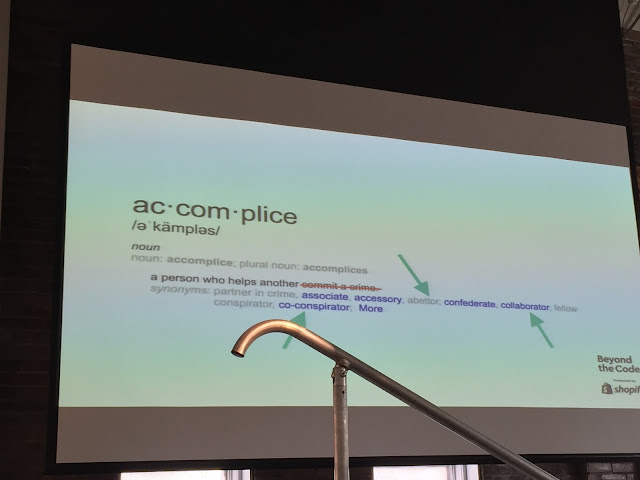
Spend time talking to diversity and inclusion experts. There are people that have spent their entire lives conducting research in this area and you can learn from their expertise. Meritocracy is a myth, we are just lucky to be in the right place in the right time. She mentioned that her colleague Duretti Hirpa at Slack points out the need for accomplices, not allies. People that will actually speak up for others. So people feeling pain or facing a difficult work environment don't have to do all the work of fighting for change.
In most companies, there aren't escalation paths for human issues either. If a person is making sexist or racist remarks, shouldn't that be a firing offense?
If people were really working hard on diversity and inclusion, we would see more women and people of colour on boards and in leadership positions. But we don't.
She closed with a quote from Beyonce:
вверх^
к полной версии
понравилось!
в evernote
I've had the opportunity to attend the Beyond the Code conference for the past two years. This year, the venue moved to a location in Toronto, the last two events had been held in Ottawa. The conference is organized by Shopify who again managed to have a really great speaker line up this year on a variety of interesting topics. It was a two track conference so I'll summarize some of the talks I attended. 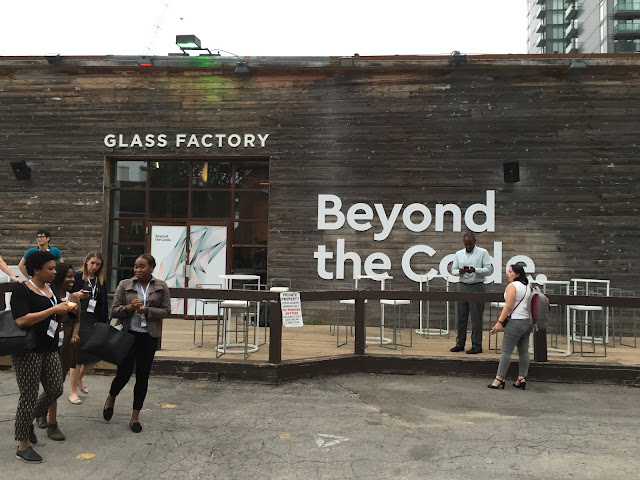

The conference started off with Anna Lambert of Shopify welcoming everyone to the conference.

The first speaker was Atlee Clark, Director of App and Developer relations at Shopify who discussed the wheel of diversity.

The wheel of diversity is a way of mapping the characteristics that you're born with (age, gender, gender expression, race or ethnicity, national origin, mental/physical ability), along with those that you acquire through life (appearance, education, political belief, religion, income, language and communication skills, work experience, family, organizational role). When you look at your team, you can map how diverse it is by colour. (Of course, some of these characteristics are personal and might not be shared with others). You can see how diverse the team is by mapping different characteristics with different colours. If you map your team and it's mostly the same colour, then you probably will not bring different perspectives together when you work because you all have similar backgrounds and life experiences. This is especially important when developing products.

This wheel also applies to hiring too. You want to have different perspectives when you're interviewing someone. Atlee mentioned when she was hiring for a new role, she mapped out the characteristics of the people who would be conducting the hiring interviews and found there was a lot of yellow.

So she switched up the team that would be conducting the interviews to include people with more diverse perspectives.

The next talk was by Erica Joy, who is a build and release engineer at Slack, as well as a diversity advocate. I have to admit, when I saw she was going to speak at Beyond the Code, I immediately pulled out my credit card and purchased a conference ticket. She is one of my tech heroes. Not only did she build the build and release pipeline at Slack from the ground up, she is an amazing writer and advocate for change in the tech industry. I highly recommend reading everything she has written on Medium, her chapter in Lean Out and all her discussions on twitter. So fantastic.
Her talk at the conference was "Building a Diverse Corporate Culture: Diversity and Inclusion in Tech". She talked about how literally thousands of companies say they value inclusion and diversity. However, few talk about what they are willing to give up to order to achieve it. Are you willing to give up your window seat with a great view? Something else so that others can be paid fairly? She mentioned that change is never free. People need both mentorship and sponsorship in in order to progress in their career.
I really liked her discussion around hiring and referrals. She stated that when you're hire people you already know you're probably excluding equally or better qualified that you don't know. By default, women of colour are underpaid.
 |
| Pay gap for white woman, African American women and Hispanic women compared to a white man in the United States. |
Some companies have referral system to give larger referral bonuses to people who are underrepresented in tech, she gave the example of Intel which has this in place. This is a way to incentivize your referral system so you don't just hire all your white friends.
 |
| The average white American has 91 white friends and one black friend so it's not very likely that they will refer non-white people. Not sure what the numbers are like in Canada but I'd guess that they are quite similar. |
In addition, don't ask people to work for free, to speak at conferences or do diversity and inclusion work. Her words were "We can't pay rent with exposure".
Spend time talking to diversity and inclusion experts. There are people that have spent their entire lives conducting research in this area and you can learn from their expertise. Meritocracy is a myth, we are just lucky to be in the right place in the right time. She mentioned that her colleague Duretti Hirpa at Slack points out the need for accomplices, not allies. People that will actually speak up for others. So people feeling pain or facing a difficult work environment don't have to do all the work of fighting for change.

In most companies, there aren't escalation paths for human issues either. If a person is making sexist or racist remarks, shouldn't that be a firing offense?
If people were really working hard on diversity and inclusion, we would see more women and people of colour on boards and in leadership positions. But we don't.
She closed with a quote from Beyonce:
"If everything was perfect, you would never learn and you would never grow"
http://relengofthenerds.blogspot.com/2016/09/beyond-code-2016-recap.html
Вы сейчас не можете прокомментировать это сообщение.
Дневник Kim Moir: Beyond the Code 2016 recap | rss_planet_mozilla - Planet Mozilla |
Лента друзей rss_planet_mozilla
/ Полная версия
Добавить в друзья
Страницы:
раньше»