
Your work has been saved and submitted
Exercise
Respond to the following based on your reading.
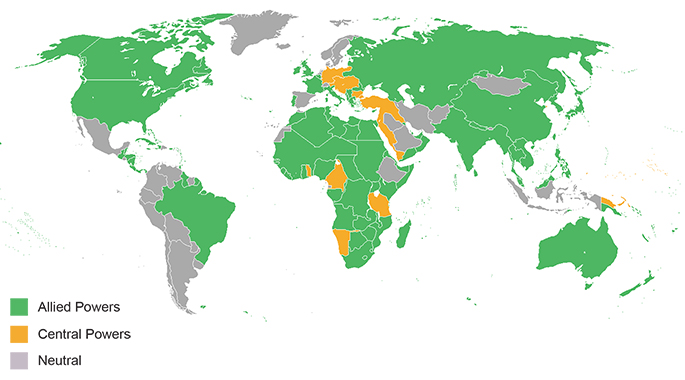
World War I was considered to truly be a world war because of the amount of people and nations that got involved in the war. The main combatants were Britain, France, and Russia on the Allied side and Germany, Austria-Hungary, and the Ottoman Empire on the Central Powers side. Not only were the nations involved but all of the resources of the European colonial empires were brought to bear. Smaller nations in Europe got involved on either side due to a complex system of alliances that existed in Europe before the war. As the war wore on, even more nations were dragged in. The reasons varied. Some, like the United States, got involved by trading with one side. Others, like Italy and Japan, opportunistically jumped in to make territorial gains. By the end of the war, most of the world was involved-making it truly a world war.
Given that the world was at war, how were the Central Powers defeated?
Thee Entry of the United States happened in (1917)
The U.S. joined the war on the side of the Allies in 1917. It not only joined but brought machinery and power into the war.
The British naval blockade greatly restricted Germany's access to resources. There were many economical factors at play. Collapse of Central Powers Allies happened because
Austria-Hungary was defeated by internal issues, The Ottoman Empire and Bulgaria were defeated by the end of the war. Germany lost its allies and it was tough. The failure of the Schlieffen Plan,
|
|
|
FeedbackOne of reasons the Central Powers were defeated was the entrance of the US forces into the war brought vast new resources to the allied forces. This also meant that the Allied forces were able to produce more war materials than the Central Powers, which proved to be decisive. |
|
Exercise
Respond to the following based on your reading.
The Espionage and Sedition Acts of 1917 called for the suppression of speech that criticized the war effort during World War I. Americas were imprisoned when accused and convicted of speaking out against the war.
- What arguments could be made to support such a law?
- What arguments could be made against such a law?
1 I am not a fan of the curtailing the free speech option. However, people always have motives. I think, that an argument of this approach could be that speaking against the war demoralizes the fighting spirit and undermines the politicians who had made the decision to go into the war,
2 The argument here that it is not good to censor the speech. People had right to protest against the war because it was their opinion and a peaceful protest.
|
|
|
FeedbackPossible Answers:
|
|