Activities with stories
After telling the students a fun and stimulating story, you’ll have a great platform to base activities around.
While your students might not have been interested in performing a writing activity before, now you’ll be able to give them a writing activity with some relation to the story that they’ve read. Whether you simply have the character on the paper, or whether you utilize some of the characters/vocab in the actual activity itself – and your students will be much more enthusiastic about it.
-
 /www.worldtesolacademy.com/wp-content/uploads/gruffalo-worksheet-1-200x283.jpg" target="_blank">https://www.worldtesolacademy.com/wp-content/uploads/gruffalo-worksheet-1-200x283.jpg 200w, https://www.worldtesolacademy.com/wp-content/uploads/gruffalo-worksheet-1-212x300.jpg 212w, https://www.worldtesolacademy.com/wp-content/uploads/gruffalo-worksheet-1.jpg 353w" style="box-sizing: border-box; border: 2px solid rgb(207, 207, 207); vertical-align: top; max-width: 100%; height: auto;" width="353" />
-
 /www.worldtesolacademy.com/wp-content/uploads/gruffalo-worksheet-3-200x283.jpg" target="_blank">https://www.worldtesolacademy.com/wp-content/uploads/gruffalo-worksheet-3-200x283.jpg 200w, https://www.worldtesolacademy.com/wp-content/uploads/gruffalo-worksheet-3-212x300.jpg 212w, https://www.worldtesolacademy.com/wp-content/uploads/gruffalo-worksheet-3.jpg 353w" style="box-sizing: border-box; border: 2px solid rgb(207, 207, 207); vertical-align: top; max-width: 100%; height: auto;" width="353" />
-
 /www.worldtesolacademy.com/wp-content/uploads/gruffalo-worksheet-2-200x283.jpg" target="_blank">https://www.worldtesolacademy.com/wp-content/uploads/gruffalo-worksheet-2-200x283.jpg 200w, https://www.worldtesolacademy.com/wp-content/uploads/gruffalo-worksheet-2-212x300.jpg 212w, https://www.worldtesolacademy.com/wp-content/uploads/gruffalo-worksheet-2.jpg 353w" style="box-sizing: border-box; border: 2px solid rgb(207, 207, 207); vertical-align: top; max-width: 100%; height: auto;" width="353" />
(Example Gruffalo worksheets from Live Worksheets)
In this lesson, we’re going to look at general areas for activities and how you might now form them around the stories you tell. These examples may not apply to all levels of learner, but should be usable by all good storybooks:
1. Discussions about likes and dislikes
The Very Hungry Caterpillar mentions various kinds of fruit. This could lead to a discussion on fruit and likes and dislikes.
The learners could then choose their three favorite fruits (whether in the story or not), put them in order of the most favorite being number 1, and could then draw and label each fruit.
Where language allows, you could then ask them to say why.
The Gruffalo lends itself well to a discussion about animals. You could follow the same procedure as above with animals.
2. Mini-surveys
To reinforce the point that good storybooks almost always offer similar useful opportunities for activities, you could do the following activity for both The Gruffalo and The Very Hungry Caterpillar.
Survey activity: Start by getting the learners into groups. Give each group a task to find out the three most favourite fruits or animals which they and their classmates like.
You could give them a list of all the learners’ names, and have the students survey all of their classmates, asking and then noting what each’s top three fruits or animals are.
At the end, each group would produce a similar list, but in their own way.It doesn’t matter if any of the results are different.
There’ll be a bit of a disorder while doing the activity, but if you make sure to walk around and reinforce the use of pre-taught questions “What is your favorite fruit?” then you’ll be able to give them 20 minutes of fun amidst more intensive/repetitive drilling type activities.
3. Drawing
A simple but essential follow-up activity would be to get the young learners to draw a picture of the main character and label different attributes. An example here could be with drawing and labeling the look on the faces of the fox, snake, and mouse when they do see the Gruffalo.
Alternatively, your students could draw and label the look on the face of the Very Hungry Caterpillar when he is hungry, when he has a stomach ache, and then when he eats a tasty, green leaf.
4. New words and chunks
Another significant activity can be seen with adding new lexis to their learning bank. You could get your students to choose four or five new words that they like and want to learn.
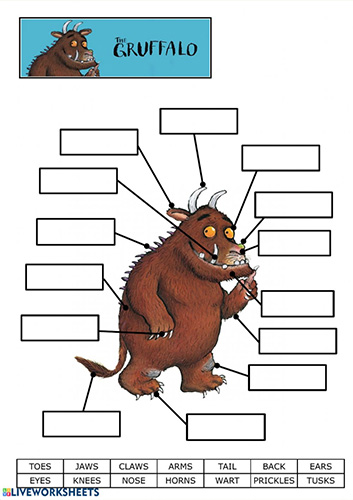
You can anticipate this by printing out some sheets that have, say, a picture of the Gruffalo with several words printed and arrows pointing to specific characteristics of the Gruffalo.
For example:
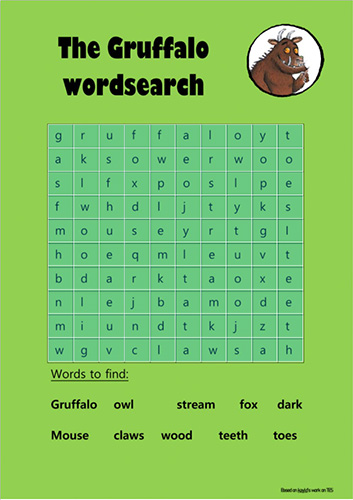
- The mouse in the story repeats several times that the Gruffalo has: Terrible tusks, and terrible claws, and terrible teeth in his terrible jaws. So, to start with, you have tusks, claws, teeth, and jaws.
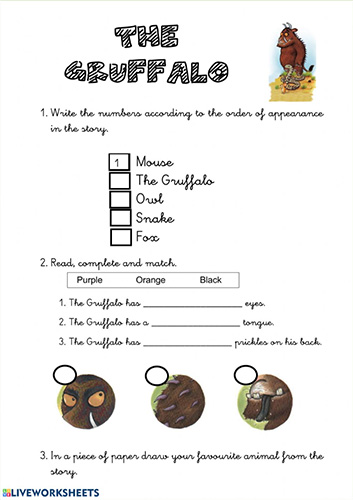
- The narrator tells us that: He has knobbly knees, and turned-out toes, and a poisonous wart at the end of his nose. His eyes are orange, his tongue is black; he has purple prickles all over his back.
So, there are plenty of other words you can put on the sheet that the young learners can choose.
Ensure you practice the sound of the words with them. Then, they can take the sheet home to show their parents/caregivers, with their specific words underlined, and they can get help to practice them. Even where the parent is a non-English speaker, the encouragement will be valuable.
Note: Non-English speaking parents/caregivers can access websites that help with the English pronunciation of words. Most of the words in the excerpts above can be heard by accessing sites such as: www.howjsay.com.
This will help them to help their children.
Next time they are in class, you can pair the learners up with friends and get them to say to each other the words they have learned. You’d then go around the class monitoring the pairs. This is a great activity for teachers that wish to promote self-directed learning.
5. Making a recording
A superb task that requires a bit of preparation can be to make a recording of the story that your students can take home with them.
You would have to factor in the cost of giving all of them a copy, e.g. a copy on CD, though some private language schools/kindergartens might have budgets to help cover the costs of such teaching materials. Alternatively, you might be able to have the school email a copy of the file to their parents/caregivers.
Having such a recording opens up a host of opportunities. You could set them simple tasks for homework, one or two at a time, ensuring beforehand that they know what to do.
Example tasks/questions could include:
- How many times does the mouse in The Gruffalo say: He has terrible tusks, and terrible claws, and terrible teeth in his terrible jaws?
- Try and learn this: He has terrible tusks, and terrible claws, and terrible teeth in his terrible jaws.
- Which animal slid away?
- Which animal sped away?
- Which food does the Gruffalo like to roast?
- Which food does the Gruffalo like to scramble?
- In the story, there are sometimes two words together that start with the same letter; for example, the words terrible teeth begin with the same letter t. Can you find any other examples?
Next time in class, you can check and praise their efforts by playing your recording. This is an excellent way to enhance their listening to detail skills, though it should be kept in mind that this might only be possible at certain schools.
6. Acting, retelling, and recording
Young learners can be helped to improve their discourse skills by acting and retelling stories.
Acting out stories: This would involve students learning the dialogue of a story (as much as they can remember) and then trying to act out the story. Children love this as it gives them a chance to become the different characters in the story. With the incentivization of being able to act out the stories, students will thoroughly read and re-read through the materials to make sure they get to have some involvement. You can simplify the dialogue if necessary and give them picture prompts to remind them of the bit they are acting out (with or without words as needs be).
Retelling a (tiny bit) of the story: Again, you can give them picture cards to focus on, and have the written words on if they’re able to read them. The activity usually works best if you give each student in the class a portion of the story to tell individually, this allows the story to progress without students needing to remember too much. As students get more advanced, and as their cognitive skills develop, you could extend the amount of retelling that each student must do.
After all the practice is done, the final event would be a recording of every one of the learners doing their bit in order. They will be delighted to listen to the story, listening avidly, of course, to their contribution. They’ll most likely also want to take a copy home to their parents/caregivers.
7. Writing
Writing activities based on a story offer up, as the cliché says, endless possibilities.
Writing activities from The Gruffalo could include:
- The children could pretend they are any of the animals, such as the mouse, and could write to a mouse friend telling them how frightened they were when they saw the Gruffalo.
- They could describe the Gruffalo using the repeated phrase: He has terrible tusks, and terrible claws, and terrible teeth in his terrible jaws or any other words or phrases from the text. This makes the activity a bit easier, while at the same time further embedding these phrases in their memory banks.
- They could take on the persona of the mouse, writing to a friend to tell her how he fooled the Gruffalo.
- They could take on the persona of the Gruffalo, writing to a friend to tell her how afraid he is of the mouse.
- They could write a dialogue about the mouse returning home and telling his partner about the narrow escape he has just had and how he fooled the Gruffalo.
- They could write a short piece on why they like or dislike the snake or the fox.
There are so many activities you could develop to help students practice writing abilities. It can be quite difficult to get young learners to get involved with writing activities without having some personal investment in the activity – but when you base activities around stories you’ll have a great anchor point that should keep the interest of your students.
8. Reading
Finally, depending on their level, the storybook can be used for reading practice. With beginner readers, the focus will be on areas such as:
- Letter/sound recognition
- Concepts of print (letters, words, spaces, simple punctuation, front and back of books, etc.)
- Phonological awareness: recognizing a word in a sentence, recognizing a rhyme, recognizing a syllable, etc.
Those who are more advanced in reading can listen to and follow your reading, then perhaps join you and read as you read, culminating in the ability to read aloud on their own. The more you use familiar stories that they have listened to many times, the better their reading skills will become over time.