



When starting a new color, most techniques leave you with loose stitches either side of the color change. These not only look ugly but also expand as you work them on the next row, which can be unnerving especially if the tail looks like it might escape completely from the stitch below. You could stop knitting after a few stitches and tie a knot with the yarn tails, but that stops the flow of knitting, and the knots sometimes work their way through to the front.
If you join many new colors in one area, as you might with intarsia, it can be difficult to make them neater even when you sew in the ends. I have previously found myself shuffling yarn back towards the join through many stitches to get them to a consistent size.
To avoid all these issues, the join I use is a "twist-and-weave", first shown to me in a workshop taught by Jane Crowfoot. The new and old colors are twisted together and the join is made more robust by weaving the tail of the new color into the next stitch.
 [показать]
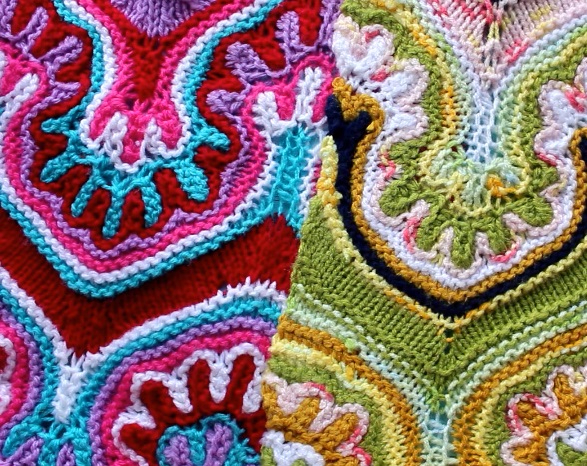
For both pieces of knitting: the join has been tightened up once and no ends have been sewn in at the back.
It's not just for new colors
I use this join almost every time I change to a new yarn. For fair-isle/stranded knitting it sets you up to continue weaving ends in neatly across the first few stitches of the row. For stripes and intarsia, it keeps the integrity of the fabric as you're working, meaning you're not dealing with the loose stitches. Depending on whether the back of my work will be visible, I often use this method even if I need to join in a new skein of yarn of the same color. It takes a lot less effort than a wet splice or aRussian or braided join (as great as these methods are!)
It takes a little practice to get the hang of it, but I think it's worth it. I've not seen it elsewhere since the workshop where I first learnt it (though I'm sure it's out there somewhere!) and I think it deserves to be more widely known!