THE WAR IS ALREADY ON ITS WAY. US MARINE CORPS AGAINST RUSSIA
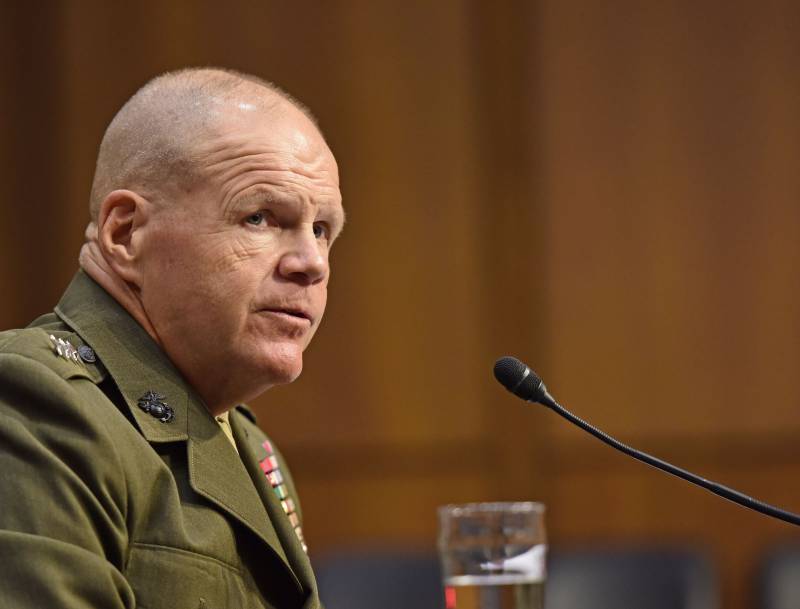
If in the autumn the prospect of a military conflict with the Russians in Eastern Europe prompted the command of the US Marine Corps to strengthen the combat capabilities of the units, then in the winter the high command of the Corps began talking about the "already oncoming" war.
Commander of the US Marine Corps, General Robert Neller: "The war is already on" The
activity of the US Marine Corps has increased since the summer of 2015 against the backdrop of the notorious "Russian threat".
According to The Times, in June 2015, hundreds of US Marines were assigned the task of redeploying to the British and other warships of the NATO countries (Spain, the Netherlands, Italy and France) in the Mediterranean. The Marines were required to become part of NATO's rapid reaction force.
The main reasons for the redeployment of the US military to Europe in NATO, no one hid. It was about "the ability to quickly respond to Russian threats in Eastern Europe."The headline of the material in The Times did not leave any doubts about the intentions of the NATO forces: "American Marines are relocating to British ships to counter the threat emanating from Putin."
Two years later, in the summer of 2017, the command of the Marines was already actively preparing for war with the "green men" of Putin.
The battle skills "with the Russians" were honed by the Marines directly in the Eastern European cities. For this purpose, the military base Camp-Lajen, specially decorated by the Americans, was used. To give "Russianness" actors were hired, costumes were sewn and even the "fragrance" of manure was artificially created. This was written by The Daily Beast.
Marines were trained not to step on mines, not to give phone numbers to prostitutes, to make their way through the heat on dirty rural roads - all this under the artificial smell of gunpowder and manure. From somewhere came the "Russian speech": unhappy civilians asked the Marines for help.
Enemies of the Marines in the script were Russian-speaking "rebels" and Putin's "green men". The organizers of the Marines training called such a scenario "the third world war". No kidding.
In war, as in war. "I am deeply convinced that here we are saving lives. There is no situation that we could not model. I'm impressed by the fact that the Marines we train every day, "says Greg Jackson, a veteran Marine. In his opinion, if the US Marine Corps deployed in Ukraine, it means: the third world war "in full swing".
This Jackson is difficult to call a panic or conspiracy. The fact is that the command of the Marines constantly repeats the coming war with the Russians. At the highest level.Wars are waiting from day to day. Either in January, or in February. Whether after Putin's re-election.
In the late autumn of 2017, intensive training of US Marine Corps servicemen began for military operations with Russia. Seriously.
American Marines are preparing for a conflict in Eastern Europe: The US Marine Corps is considering the prospect of an armed clash with Russia. "Concern" about the "fighting" was voiced at the level of the MEF (Marine Expeditionary Force, US Marine Expeditionary Force). This was written by the newspaper "Military Times".
Until now, the Corps believed that it would hardly be necessary to deploy the full complement of the Marine Expeditionary Force. This structure is very powerful, with over 25,000 marines serving in it. MEF functions were not previously a priority. However, in November 2017, Lieutenant-General Robert Hedelund, commander of the Marine Corps in North Carolina, said that the headquarters returns the MEF "some opportunities".
Speaking at the annual conference on national defense, the general said that MEF units "must be prepared" to support efforts to counter "the war in Europe."
The Military Times recalls that in recent years the US Marine Corps has already expanded its presence in Europe (in Romania and Norway).
The "European mission" of American marines is changing "against the backdrop of Russian aggression," the newspaper reported. The corps continues to prepare for a "whole series of missions". General Robert Hedelund hints: if "anywhere in the world" a shot is heard, "the Marines want to be there."
At the end of December 2017, a culmination statement was received from the High Command of the Marine Corps.
The commander of the US Marine Corps, General Robert Neller, said that the Marines should be ready for a big battle. Yes there are ready: the battle is already on!
"I hope I'm wrong, but the war is already on," asserts Robert Neller, whose statements are cited by the Washington Post.
To the assembled marines, he explained what kind of war this is: "You are participating here in the struggle, the information struggle, the political struggle, with one of your own presence."
The presence of marines in Norway is associated with support for NATO operations and the European Command of the United States, as well as to assist the Marine Corps in preparing for the cold and mountain conditions.
Mr. Neller and other members of the command say that the Marines should be ready to change their mission even in peacetime. In particular, Neller predicted that the Pacific and Russia would be at the center of any future conflict that would happen outside the Middle East.
Neller is a member of the Joint Chiefs of Staff, the highest of the Pentagon's leading structures responsible for contingency planning.
Initially, the newspaper notes, it was impossible to understand how serious the general is in his prediction of the coming war, as far as his statements testify to the "ongoing" real war.
Lt. Col. Eric Dent, a spokesman for the general, told the Washington Post correspondent that Neller's comments were aimed at "inspiring" Marines. According to his clarification, the general allegedly told the Marines that none of the four countries he referred to in his prophecies (Russia, China, Iran and North Korea), does not want to "go to war."
"The idea of war is a way of motivating warriors to train and increase readiness," Dent said. "I can not imagine any professional military commander offering his soldiers, sailors, pilots, marines and coast guards not to think that the conflict is only supposed to ..."
Neller and others for good reason repeat: "If you want peace, prepare for war. And this is exactly what we want to do and do. "
On the other hand, President Trump recently "fanfare" unveiled a new national security strategy. It explicitly admits that Russia and China are competitors of the United States in the struggle for global influence. Both states pose a potential threat to the United States. "China and Russia are challenging American power, influence and interests, trying to undermine American security and prosperity," the document states. It is also stated that the Russians and the Chinese are "determined" to increase their armed forces and control information in the world, thereby "suppressing their societies and expanding their influence."
As for the unsettling statements of General Neller, the TASS correspondent tried to clarify them, appealing to the Pentagon press service. However, the duty officers of the service "found it difficult to answer" the correspondent's questions about Neller's point of view and whether she reflects the position of the Secretary of Defense James Mattis (among other things, the retired General of the Marine Corps).
Should I fear the Marine Corps?
"The US Marine Corps is a serious enough threat," military expert, captain of the first rank Konstantin Sivkov, told RIA Novosti. - In case of aggression, the US Marines will be primarily involved in the northern direction, its goal will be to seize the bases of submarines in the Murmansk region. In the south, landing can occur in the Crimea, in the Far East, it is likely to be Kamchatka, where strategic submarines are also based. "
Sivkov recalled that the Russian armed forces are working out the tactics of anti-landing operations. In general, the classic naval landing, according to experts, is a vulnerable target. The composition of US Navy amphibious forces required for the landing of just one division can consist of more than fifty ships, which eliminates the factor of surprise and gives the enemy time to prepare for the defense of the coast.
It should also be pointed out that one of the main threats to enemy assault are coastal missile and artillery complexes. Among these, Russia has a complex "Bal", capable of hitting targets at a distance of up to 260 km. Another "surprise" for steep American guys could be the "Bereg" artillery complex: it destroys surface targets at a distance of up to 22 km. A warm meeting with the Russians, therefore, will take place exclusively at a distance and certainly will not be an "easy walk" for those who are currently intensively training, preparing for war.
American generals ought to have less tongue-tampering: every word about the "ongoing war" is immediately recalled not only among the servicemen to whom these speeches are addressed, but also among journalists who take such "information" around the world.
Observed and commented on by Oleg Chuvakin
- especially for topwar.ru