Это цитата сообщения Malika-osinka Оригинальное сообщение
Tutorial for Boho Sling Bag, Part Two
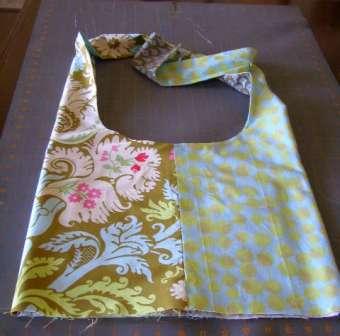
1. Almost a Boho Sling Bag
So now the bag looks almost like a bag… just a few more seams…
The base or bottom of the purse is the next section. (Full size pattern can be downloaded here)
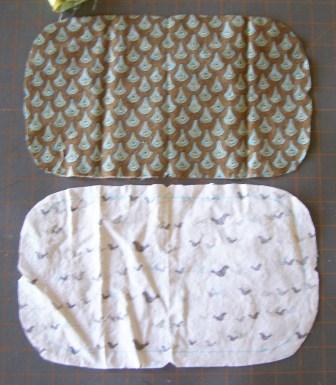
2. Two bases
Cut out two fabric bases, one of the lining and the other of the outer fabric as shown in Photo2. (It is fine if they are both the same fabrics!)
To give the purse some structure – so it doesn’t just lie flat – the lining portion of the purse base will have a three layers.
Cut another base from an old (but clean) washcloth, an old towel, a small piece of batting or felt and another one from another piece of scrap fabric. This fabric will not show, so it does not have to coordinate at all. It does help if it is a light color – as a stitching line will be drawn on it.

3. Fabric Sandwich - line drawn around trimmed pattern is visible on upper on lower edge of upper fabric.
Place the lining fabric on a table with the right side down. Place the filler on top of it and then the scrap fabric to make a “sandwich” as shown in Photo 3. I have used a scrap of white fabric and a piece of some left over batting for my sandwich.
Take the paper Base Pattern (NOT the fabrics!!) and cut off the seam allowances to create a template. Place the template on the top of the sandwich – on the scrap fabric and draw around it with a pencil or pen (the line will never show).
Pin the layers together. To secure the “sandwich”, sew the layers together halfway between the line and the edge of the fabric.
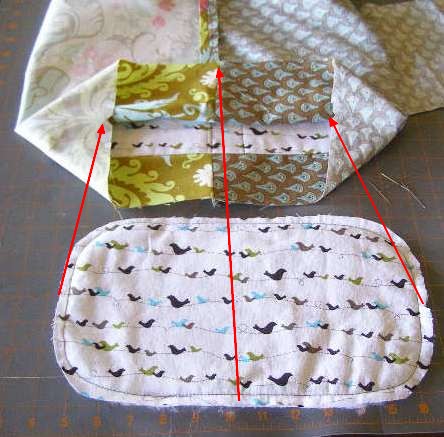
4. Align marks on base to marks and seams on bag.
The lining base “sandwich” will be sewn to the bag lining – right sides together.
Photo 4 illustrates how to align the lining base “sandwich” to the purse lining. Important: The center of the wide sides of the base align with the side seams. Align and pin.
The centers of the narrow end of the base align with the centers of the purse pieces. Align and pin. It may help to refer to the pattern pieces which have marks indicating what lines up with what.

5. Base pinned and ready to be sewn..or not
Then pin all the way around. From the base side, Photo 5 looks ready to be sewn.

6. Curves will require clipping (and later some trimming)
However, from the top side, the fabric does not align with edges of the base. This can be seen in Photo 6.
That is because curves must be clipped (and later trimmed). Clipping is a series of small (from the edge to no more than 1/4″ deep) cuts made perpendicular to where the seam will be sewn. These help fit curved pieces together.

7. Clipped curves align much better
After clipping, the fabric edges align much better as shown in Photo 7.

8. Sew along the line drawn on the scrap fabric
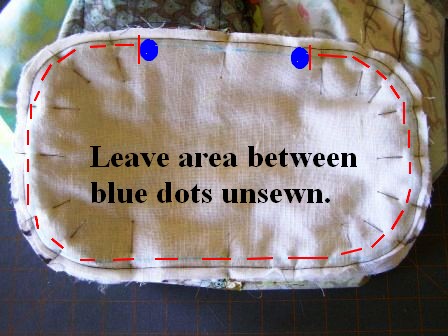
9. Leave one straight section unsewn.
Repin and sew lining base to lining along the line drawn on the scrap fabric – leaving about 4″ along one straight section unsewn. See Photos 8 and 9. If you do not leave the short section unsewn as shown in Photo 9, you will not be able to turn your purse right-side-out later.

10. Sew second reinforcing seam
As this seam will support all the weight of the purse (and everything in it!), it is best to reinforce the seam. Sew a second seam just outside the first seam as shown in Photo 10 – but be sure to leave the same opening unsewn.

11. Trim the seam
Then trim the sewn sections of the seam. Trimming is to cut away about 1/4″ from the seam that you just sewed as shown in Photo 11. Curved seams will fit together – clipping and trimming help!
Now that you have mastered sewing a curved base to the purse pieces, use the same steps (except no sandwich), to sew the outer base to the outer bag fabric. Go ahead and use the base template to draw the stitching line on the wrong side of the purse base fabric – but use a pencil – a Sharpie or gel or ink pen may bleed through and be visible. This time, there is no need to leave an opening – so sew the seam all the way around!
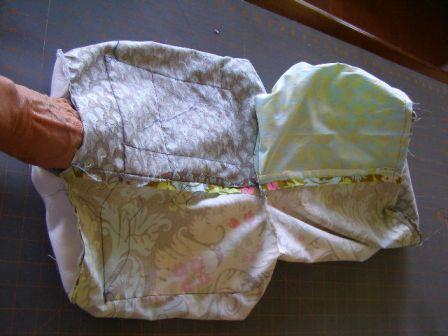
12. Reach hand through opening in lining base seam and pull bag right side out.
When both bases are attached. The project will not resemble a purse. It will look more like a deflated balloon.
Reach hand through unsewn opening in the lining base seam. Grasp the outer bag base and turn the bag right side out as shown in Photo 12.
To secure the lining to the bottom of the bag, the lining base seam edge is sewn to the edges of the bag base seam.

13. Reach through opening and grasp both base seams on the far side of the bag.
Place the bag on its base on a table. Reach through the opening in the base and grasp the two base seams (the outer and the lining) on the opposite side.

14. Pull two base seams through base opening and align two sides seams.
Pull the two seams through the opening as shown in Photo 14. Only 3″ – 4″ of the seam need be pulled through the opening. The 3″ – 4″ section should include the purse side seams. Align the two side seams and pin.

15. Stitching the "tack"
Sew back and forth in the seam allowance for about 1″. This is just to keep the lining attached to the outer bag. It is a short seam called a “tack”. It will not show.

16. Aligning base seams on opening side for tacking.
Repeat for the base seams on the opening side.
Handstitch the opening closed… That is the only handstitching in the entire project!
Now on to finishing the handles.

17. One of the Great Mysteries of Sewing
Lay handles flat – making sure not to twist them. It is one of the Great Mysteries of Sewing that two handles cut from the same pattern, sewn using the same seam allowance – will not be the same size!
But, in this case, that is good!
As visible in Photo 17, the blue green circle handle is wider than the large print handle.

18. Fold ends of wider handle to the inside and press.
Fold the ends of the wider handle to the inside, approximately 1/2″ and press with the iron.

19. Topstich the handle seam.
Insert the narrower handle into the opening of the wider handle approximately 1″. Make sure the handles are not twisted and are straight. Pin.
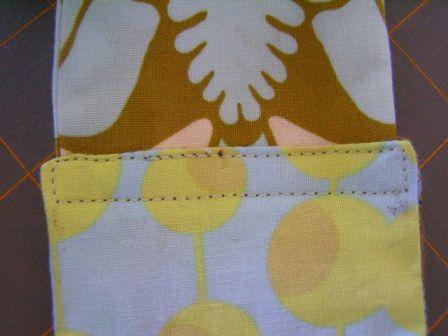
20. Topstitched Handle Seam
Topstitch close to the edge of the wider handle and then continue topsitching as shown in Photo 20. The “rectangle” shape of the stitching gives a nice finished look – and reinforces the seam – because bags can get heavy!
Speaking of a finished look…. Your Bag is now Finished!
So, now you can make another one for a friend!

You did it!
Or even better – show your friend how to make one!