Спать пошла в 5 утра ловила блох
делала Любимую берёзка и тд
Каждый день выбрасывают 10 вещей матемдра реп во пропустила
Блохи ещё больше появилось
надо Пылесосить
Написала антонине
8/52026 час ночи час тридцать почти И я с уровавым подбоем. Только под глазом. От жизни Вроде все нормально но у э растут зубы Блохи нас заедает Хоть мы и боремся. Я отхожу от противных антидепрессантов меня тошнит и огромное раздражениеюи лишний вес не уходит от гормональный прививки дкэепо поверь Я голодала была целую неделю
чай и все
Никаких сполвижек
уровень Раздражения зашкалив мне и
Это цитата сообщения Любаша_Бодя Оригинальное сообщение
КОФЕ ГЛЯСЕ:

8/22025--было иного работы
с сфия университет вебсайт и чесити
и работа подняла мне настроение
одна прогулка
сегодня пронулка тоже отдых не было работы
спустили фоггер от блох
и волнение за сына
но его зубы беспокоят
хорошая погода
передумала я переехжать
31 июля ещё вчера фри райт реп ва скачки настроениея днями рунаюсь ос м у меня отход от сапталина тощнота тревожность и раздражение и когда срываюсь достигои предела нокак одна говорила что у нее горионы и поэтому она ругается с мужем чвв говорит--это вы себе хорошо объясняеие
work on Biology History I --paper
no tutorings
fear because of damn fle foggers--usua;;y people levae and we stayed on aother part of the house
Fedinacollegesterak
Phrasal verbs are meaning groups made up of a single verb and a particle (usually an adverb). A phrasal verb is a combination which takes on a new meaning independent of the original meaning of the verb: We ran out of the house. (The meaning of the verb does not change and out of refers to the house.) We ran into Mark on Saturday. (The meaning has changed. ➝ run + into means ‘meet’) Phrasal verbs are frequently used in English. They tend to be used in less formal contexts than single verbs: We need to sort out the problem. (less formal) We need to resolve the problem. (more formal) Phrasal verbs do not always have a single verb equivalent (resolve = sort out) , but whenever they do, we choose the single verb over the phrasal verbs in formal English, and the phrasal verb over the single verb in neutral and informal contexts. Transitive and intransitive phrasal verbs Phrasal verbs can be transitive (used with an object) or intransitive (used without an object): It’s cold, put your jacket on. (your jacket = object, put on is a transitive phrasal verb) The policeman let him off with a fi ne. (him = object, let off is a transitive phrasal verb) The realisation of the disaster slowly began to sink in. (no object, sink in is an intransitive phrasal verb) I’m sure the price of some vegetables will go down. (no object, go down is an intransitive phrasal verb) Some phrasal verbs can be both transitive and intransitive: Cheer up! I’m sure everything will be all right in the end. (intransitive) My best friend always knows how to cheer me up when I am upset. (transitive) Sometimes the same verb can be used transitively and intransitively, but with a difference in meaning: It took years to pay off the loan. (= give the money back, transitive) In the end, eating carefully and avoiding fatty foods paid off. (= produce good results, intransitive). We do not place an adverb or a passive object between the verb and the particle: She backed up their ideas forcefully. (NOT She backed forcefully up their ideas.) The plan for the food festival was put forward by the promoters. (NOT The plan for the food festival was put by the promoters forward.) Some examples of transitive separable verbs are: let down, lay off, back up, bring up, pay off, blow up, call off, turn on, turn off. In inseparable phrasal verbs, the verb and the particle are never separated: the object always comes after the particle: As delicious as pancakes are, you can’t live on pancakes alone. (the object pancakes comes after the particle) As delicious as pancakes are, you can’t live on them alone. (the object them comes after the particle) Some examples of transitive inseparable verbs are: look for, look into, break into, call for, fall for, get over, go through. Three-word phrasal verbs Three-word phrasal verbs are made up of a verb + adverb particle + preposition, and are also known as phrasal prepositional verbs. They are transitive (used with an object) and inseparable. The object always follows the fi nal preposition: He put up with the pain for as long as he could but fi nally asked for a painkiller. (the object the pain comes after the f i nal preposition with) A modifying adverb can only be placed between the adverbial particle and the preposition: He put up bravely with the pain for as long as he could, but f i nally asked for a painkiller. OR He put up with the pain bravely for as long as he could, but f i nally asked for a painkiller. Common examples of three-word phrasal verbs are: back out of, catch up on, catch up with, drop in on, face up to, get down to, look down on, make away with, stand up for
The Endocrine and Reproductive Systems
The Endocrine System
Recall that the nervous system involves the brain controlling and coordinating the body by sending electrical signals along neurons to various parts of the body. Similarly, the endocrine system controls body function as well. The endocrine system releases chemical messengers, called hormones, directly into the bloodstream.
leather in spanish cuero
Phrasal verbs are meaning groups made up of a single verb and a particle (usually an adverb). A phrasal verb is a combination which takes on a new meaning independent of the original meaning of the verb: We ran out of the house. (The meaning of the verb does not change and out of refers to the house.) We ran into Mark on Saturday. (The meaning has changed. ➝ run + into means ‘meet’) Phrasal verbs are frequently used in English. They tend to be used in less formal contexts than single verbs: We need to sort out the problem. (less formal) We need to resolve the problem. (more formal) Phrasal verbs do not always have a single verb equivalent (resolve = sort out) , but whenever they do, we choose the single verb over the phrasal verbs in formal English, and the phrasal verb over the single verb in neutral and informal contexts. Transitive and intransitive phrasal verbs Phrasal verbs can be transitive (used with an object) or intransitive (used without an object): It’s cold, put your jacket on. (your jacket = object, put on is a transitive phrasal verb) The policeman let him off with a fi ne. (him = object, let off is a transitive phrasal verb) The realisation of the disaster slowly began to sink in. (no object, sink in is an intransitive phrasal verb) I’m sure the price of some vegetables will go down. (no object, go down is an intransitive phrasal verb) Some phrasal verbs can be both transitive and intransitive: Cheer up! I’m sure everything will be all right in the end. (intransitive) My best friend always knows how to cheer me up when I am upset. (transitive) Sometimes the same verb can be used transitively and intransitively, but with a difference in meaning: It took years to pay off the loan. (= give the money back, transitive) In the end, eating carefully and avoiding fatty foods paid off. (= produce good results, intransitive). We do not place an adverb or a passive object between the verb and the particle: She backed up their ideas forcefully. (NOT She backed forcefully up their ideas.) The plan for the food festival was put forward by the promoters. (NOT The plan for the food festival was put by the promoters forward.) Some examples of transitive separable verbs are: let down, lay off, back up, bring up, pay off, blow up, call off, turn on, turn off. In inseparable phrasal verbs, the verb and the particle are never separated: the object always comes after the particle: As delicious as pancakes are, you can’t live on pancakes alone. (the object pancakes comes after the particle) As delicious as pancakes are, you can’t live on them alone. (the object them comes after the particle) Some examples of transitive inseparable verbs are: look for, look into, break into, call for, fall for, get over, go through. Three-word phrasal verbs Three-word phrasal verbs are made up of a verb + adverb particle + preposition, and are also known as phrasal prepositional verbs. They are transitive (used with an object) and inseparable. The object always follows the fi nal preposition: He put up with the pain for as long as he could but fi nally asked for a painkiller. (the object the pain comes after the f i nal preposition with) A modifying adverb can only be placed between the adverbial particle and the preposition: He put up bravely with the pain for as long as he could, but f i nally asked for a painkiller. OR He put up with the pain bravely for as long as he could, but f i nally asked for a painkiller. Common examples of three-word phrasal verbs are: back out of, catch up on, catch up with, drop in on, face up to, get down to, look down on, make away with, stand up for
вчеа Испанский репетитор mariposa бабочка
nueve
inviero
primavers
otono
Sieptember
Dime
Octubre Noviembre
Diciembre
Enero
Abril Maryo Marso Junio Julio Agosto
Nublado
me calor favorito es rojo
uno dos tres catro cinco seis siete ocho nueve
diez
читаоа книгу про муравьёв
1 репетиторство преподала
читала про Мачу пикчу
майя инки
should нне самое строгон жлоожествование нао бы нужно
Кристин учила меня
уже заюыла
слушалитекст про еду
марсель пруст цитатат
сегодня 7-25 на рерве в дргой комнате распылили fogger
" takes more naps щно он начал это раньще
ещё горлоболело видно яего накормла холодной едой
The Diversity of Life
The classification system helps us make sense of and order living things. The largest classification level is a kingdom. However, the kingdom category has been highly unstable. We used to think there were five recognized kingdoms—Bacteria, Plants, Fungi, Protists, and Animals. Then, scientists discovered that archaea were very different from Bacteria, so they pulled them out of Bacteria and placed them in their own sixth kingdom. Then, it was recognized that Archaea and Bacteria are on a similar level as Eukaryotes, so that made for a logical division of all life into three domains: Archaea, Bacteria, and Eukaryota. But now—how many kingdoms? One of the latest ideas for grouping of kingdoms is:
- Archaea
- Eubacteria
- Protista
- Fungi
- Plantae
- Animalia
 The tree of life can be depicted in many ways. This image describes it in a circle shape with Bacteria, Archaea, and Eukarya.
However, there are two fundamental problems with this system. To visualize these problems, consider the tree of life figure again. Ask yourself: If Fungi are a kingdom (or Animals, or Plants . . . ), then how is it that the vast diversity of bacteria aren't subdivided into multiple kingdoms? Shouldn't at least the Proteobacteria be in their own kingdom? Maybe, but remember, the classification of higher taxa is only meant for human convenience, and it can be inconvenient to memorize 15 to 20 kingdoms. Microbiologists don't lump all bacteria into a single kingdom, but for this level of study, it isn't against the rules. As long as a group is monophyletic, you can give it a name.
There lies the second problem with the six-kingdom system, and that one is fatal. All named groups must be monophyletic. Looking at the tree of life figure, which one is not monophyletic? Protists. If we insist that animals and fungi are in their own kingdoms, then there's a minimum of seven eukaryotic kingdoms. Unfortunately, there's nothing about the group "Protista" that explains what they are. There are defining characteristics that separate the other kingdoms, and the next sections will provide more detail on what these kingdoms encompass. You'll have a section on protists with the understanding that they're no longer considered a kingdom.
Among the many characteristics that are commonly used to distinguish one kingdom from another
The Diversity of Life The classification system helps us make sense of and order living things. The largest classification level is a kingdom. However, the kingdom category has been highly unstable. We used to think there were five recognized kingdoms—Bacteria, Plants, Fungi, Protists, and Animals. Then, scientists discovered that archaea were very different from Bacteria, so they pulled them out of Bacteria and placed them in their own sixth kingdom. Then, it was recognized that Archaea and Bacteria are on a similar level as Eukaryotes, so that made for a logical division of all life into three domains: Archaea, Bacteria, and Eukaryota. But now—how many kingdoms? One of the latest ideas for grouping of kingdoms is: Archaea Eubacteria Protista Fungi Plantae Animalia An image of the tree of life is complicated and complex.The tree of life can be depicted in many ways. This image describes it in a circle shape with Bacteria, Archaea, and Eukarya. However, there are two fundamental problems with this system. To visualize these problems, consider the tree of life figure again. Ask yourself: If Fungi are a kingdom (or Animals, or Plants . . . ), then how is it that the vast diversity of bacteria aren't subdivided into multiple kingdoms? Shouldn't at least the Proteobacteria be in their own kingdom? Maybe, but remember, the classification of higher taxa is only meant for human convenience, and it can be inconvenient to memorize 15 to 20 kingdoms. Microbiologists don't lump all bacteria into a single kingdom, but for this level of study, it isn't against the rules. As long as a group is monophyletic, you can give it a name. There lies the second problem with the six-kingdom system, and that one is fatal. All named groups must be monophyletic. Looking at the tree of life figure, which one is not monophyletic? Protists. If we insist that animals and fungi are in their own kingdoms, then there's a minimum of seven eukaryotic kingdoms. Unfortunately, there's nothing about the group "Protista" that explains what they are. There are defining characteristics that separate the other kingdoms, and the next sections will provide more detail on what these kingdoms encompass. You'll have a section on protists with the understanding that they're no longer considered a kingdom. Among the many characteristics that are commonly used to distinguish one kingdom from another are type of cell, food source, and type of reproduction. There are prokaryotic and eukaryotic cells and plant and animal cells. Prokaryotic cells don't have a nucleus, and eukaryotic cells do. Plant cells have a cell wall, and animal cells don't. Some organisms produce their own food and are known as producers, while others have to rely on other organisms for food and are known as consumers. For reproduction, organisms rely on either sexual or asexual reproduction. Sexual reproduction leads to increased diversity among organisms, while asexual reproduction relies on other mechanisms of gene transfer to provide the necessary diversity for survival. Archaea As a domain, Archaea has only been known about since 1977. The scientist team that discovered this kingdom was led by Carl Woese (1928–2012). Developments in DNA sequencing allowed for the identification of Archaea as a separate domain. This allowed for recognition that within prokaryotic organisms, there were actually two completely separate types of organisms. Archaea are phylogenetically distinct from bacteria. Like bacteria, however, they're all single-celled organisms. Archaea can live in extremely inhospitable habitats, such as hot springs, deep in oceans, or in extremely salty environments. They can live where no other organism could, such as in petroleum. This doesn't mean that archaea have to live in extreme environments. They also can live in normal environments where many other organisms are. When they live in the digestive tracts of organisms, they can produce methane, which may be associated with gastrointestinal disorders. Archaea can take on many different types of shapes. They're all microscopic. Under the microscope, bacteria cells and archaea cells look different and are made of different things. Their DNA can distinguish them. There's a common misconception that all microscopic organisms are harmful to us. However, many species of archaea and bacteria are beneficial to humans and other organisms. Archaea don't produce their own food, but they can survive on food sources such as hydrogen or ammonia, which no other organism can do. There's a lot more that has yet to be discovered about archaea. Eubacteria Eubacteria, or "true bacteria," is the other domain of prokaryotic life. Eubacteria exist everywhere but are microscopic. These bacteria are more commonly known as simply bacteria. However, before 1977, archaea were thought to be bacteria, so to distinguish the two types of prokaryotes, the name kingdom name of Eubacteria was proposed. We often think of
Question 1 (1 point)
Exercise
Respond to the following based on your reading.
A draft was instituted in the North and South during the Civil War to meet the demand for soldiers. In the North, a person was able to avoid being drafted if they paid a $300 fee. Many poor Northerners and new immigrants to the United States found themselves fighting while rich Americans were able to buy their way out of danger.
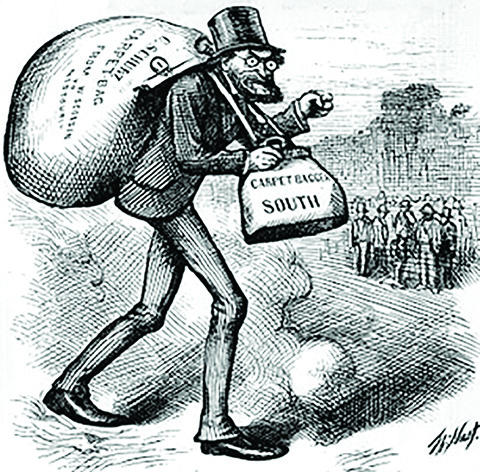 This Reconstruction-era cartoon depicts the hated “carpetbagger,” a figure who represented Northern opportunists taking advantage of political openings in the new South. (Image byThomas Nast [PD-US], via Wikimedia Commons)
Use the image to answer the following questions.
- What does this illustration say about the type of person who got drafted into the Civil War?
- Would you consider this illustration to be supportive of the draft? Why or why not?
Question 1 (1 point) Listen Exercise Exercise Respond to the following based on your reading. A draft was instituted in the North and South during the Civil War to meet the demand for soldiers. In the North, a person was able to avoid being drafted if they paid a $300 fee. Many poor Northerners and new immigrants to the United States found themselves fighting while rich Americans were able to buy their way out of danger. An image of an 1872 HarperThis Reconstruction-era cartoon depicts the hated “carpetbagger,” a figure who represented Northern opportunists taking advantage of political openings in the new South. (Image byThomas Nast [PD-US], via Wikimedia Commons) Use the image to answer the following questions. What does this illustration say about the type of person who got drafted into the Civil War? Would you consider this illustration to be supportive of the draft? Why or why not? Question 1 options:
В летнем лагере всё текло как обычно. Скучно, вязко, как в тёплой луже, в которой ты стоишь, а ноги тонут, и ты будто уже не можешь ни вперёд, ни назад. Китти была одной из вожатых. Она давно перестала чувствовать разницу между ролью и собой. Вожатая — это функция. Это маска. Это улыбка, приклеенная с утра до отбоя.
Тошнота снова подкатила — внезапно, как будто организм вспоминал, что ему больше некуда сливать тревогу. Китти закинула таблетку на язык, запила водой из пластиковой бутылки и села на кровать. Сердце билось неравномерно. Она снова подумала: "Что я здесь делаю?"
«Жизнь — это когда ты хочешь туда, куда идёшь», — всплыла в памяти цитата Литвака. Но куда она шла? И главное — зачем?
Однако лагерь не спал. Не спали дети — это понятно. Но этой ночью не спали и вожатые. Под её окном кто-то играл с фонариком — свет прыгал по кустам, как нервный заяц. Китти прижалась к жалюзи и попыталась рассмотреть силуэт. Было темно, но она уверена — это был не ребёнок.
Свет скользнул вверх, по окну. Китти отпрянула. Она не чувствовала страха — скорее, паралич, как во сне, когда ты хочешь закричать, но язык врос в небо. Вдалеке завыл пес. Или это был смех?
Она натянула худи поверх пижамы и вышла в коридор. Из соседней комнаты показалась Лена — та самая, из педагогического. Та, что не боится темноты и всегда говорит правду, даже когда не просят.
— Ты видела? — прошептала она, кивнув на окно.
Китти молча кивнула.
— Пойдём посмотрим, — предложила Лена, и в её голосе был азарт. Китти бы предпочла лечь обратно, накрывшись одеялом с головой, но что-то внутри — что-то глубинное, неосознанное — толкнуло её вперёд. Может быть, это был голод. Не физический. Экзистенциальный. Она больше не могла быть просто вожатой. Она хотела быть кем-то. Хотела понять, что здесь происходит.
Они вышли на улицу. Трава была холодной и влажной. Фонарик больше не мигал, но в воздухе чувствовалась чужеродность. Лагерь казался иным — будто чуть сдвинутым в реальности.
Они дошли до старой сцены у леса. Именно здесь две недели назад один из мальчиков — Никита — сказал, что видел ночью «странного дядю в форме». Тогда все списали это на кошмар. Но теперь...
Китти почувствовала, как сжалось горло. На сцене, на старом деревянном полу, лежала вещь. Что-то тканевое, тёмное.
— Это что?.. — Лена наклонилась. Подняла.
Это была нашивка. Военная. Из советской формы. С пятном, похожим на кровь.
Китти сделала шаг назад. Голова закружилась. Литвак говорил, что страх — это сигнал к действию. Но она не знала, что делать. Таблетка не помогала. Наоборот, всё стало острее, реальнее.
Она смотрела в темноту между соснами. И впервые за долгое время чувствовала не просто тошноту — а ясность. Это было начало чего-то. Может быть — конца.
Хочешь, я продолжу? Эта история явно
В летнем лагере всё текло как обычно. Китти была одно из вожатых. Чувство тошноты и беспоиощности часто овладевало ею.
Но что она могла поделать? Нужно было продолжать тащить эту лямку.
Она приняла антидепрессант и пошла спатОднако лагерь не спал. Вожатые не спали. Под окном кто-то играл с фонариком
Всё идёт не так как планировалось
лето жаркое
по бтологии поставили ноль
упрекаю себя что вколола в себя депо провера и вырос огромный живль
собаки принесли блохи и ни на что нет времени. Боязнь за сына постоянно. Как оградить его от жестогок мира. Надо стоб он был взрослым
Пока что репетиторство во фриланске не накормит меня
Полюс предельного внимания Т. Рибо обозначил как гипер трофию внимания (от греч. шер- и трофп — сверхпитание, пре увеличение) 2 . Он отнес к этому классу явлений прежде всего так называемую idee fixe (франц. — навязчивая идея) — болезненное сосредоточение всех помыслов и чувств человека в каком-либо одном направлении, на одной и той же мысли. Idee fixe наблюда ются при навязчивых страхах (фобиях) и болезненных влечениях (маниях), в состоянии общей подавленности (ипохондрии) и, напротив, экстаза. Нередки они и у стариков, которые в конце жизни теряют контроль над собственным разумом и начинают страшиться самых невероятных вещей. Один боится, что у него украдут все сбережения, другой — что ему будет нечего есть, не смотря на то, что дети и внуки окружают его заботой, а третий — что соседи претендуют на его жилплощадь и дожидаются удобно го момента, чтобы ее присвоить. Во всех этих случаях навязчивая идея доминирует в сознании до такой степени, что можно говорить о ее «абсолютной монар хии». У стороннего наблюдателя может возникнуть впечатление, что в окружающем мире больной обращает внимание только на то, что подтверждает его опасения. Даже события, которые, на первый взгляд, не связаны с этими опасениями, будут истолко ваны соответствующим образом, подчинятся «центростремитель ной силе», тяготея к тому, что постоянно находится в фокусе внимания больного — к самой idee fixe. Внимание уделяется не значительнейшим подробностям, но только если они согласуют ся с idee fixe или могут служить ее подтверждением. предельного внимания, а с дру невнимания, и первым делом — разнообразные типы ошибок, которые человек допускает по причине недостатка внимания. Психология вообще часто оказывается «наукой об ошиб ках»: именно ошибки и сбои в работе психики указывают на скры тые стороны предмета исследований, которые, пока психика «ра ботает нормально», просто не дают о себе знать. Противоположный полюс — атрофия вним
Уже 16 2 ночи 15 день сурка Одно репетиторство Весь ешь возилась с сыном Блохи закусали Но м старается Дал собакам таблетки Усердно и усидчивостиине Немного поделала истории для джэмжс Чвв говорит цели пока у неё нет. Но она книжку доделала а у меня дотянуть

Your work has been saved and submitted
Exercise
Respond to the following based on your reading.
In September of 1862, President Lincoln issued the Emancipation Proclamation. This executive order freed slaves in states that were in rebellion against the United States. Consider what you have read in your online resources and answer the following questions:
- What reasons could Lincoln have for making such a move during the Civil War?
- Why didn’t Lincoln free slaves in all of the United States?
1Slavery was an outdated institution and unethical notion and Lincoln, perhaps, had moral reasons. Another reason might be that slaves supported economy, and their freedom would weaken Southern economy and war efforts
2 He thought that he needed them in certain territories;